July 23, 2026
The Copper Supply Crisis Forcing a Rethink of How Mines Operate
The global copper industry is navigating a slow-motion supply emergency. Unlike sudden price shocks or geopolitical disruptions, this crisis is structural in nature, built from decades of underinvestment, declining ore grades, and the sheer geological difficulty of bringing new deposits into production. The copper supply crunch is compounding at precisely the moment demand is accelerating at a pace that most supply-side forecasts have consistently underestimated.
Electrification sits at the core of this pressure. Every electric vehicle requires roughly two to four times more copper than a conventional internal combustion engine vehicle. Utility-scale renewable energy installations, grid expansion programmes, and industrial automation systems all carry substantial copper requirements. The result is a demand trajectory that is compressing the timelines within which the mining industry must respond.
Some forecasts point to a structural supply shortfall approaching 10 million tons if new production capacity fails to materialise quickly enough. For context, global copper mine production currently sits at approximately 22 million tons per year, meaning a deficit at that scale would represent a crisis with no precedent in modern commodity markets. Incremental operational improvements are no longer sufficient responses to a gap of this magnitude.
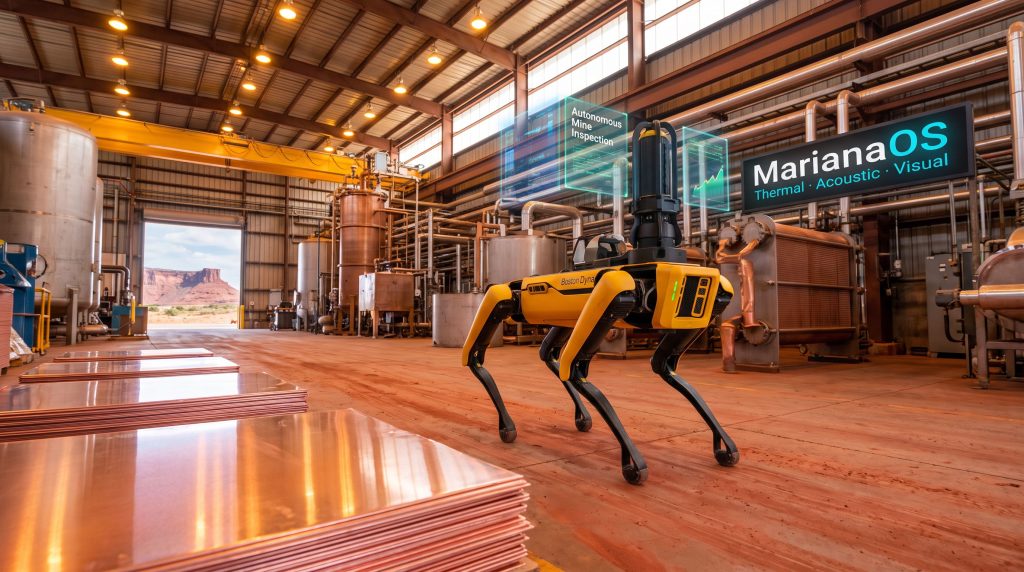
What the industry requires are fundamentally different approaches to how mines operate, inspect, and produce. That is precisely the context within which the deployment of Boston Dynamics Spot at Copper One mine, Mariana Minerals' facility near Moab, Utah, becomes strategically significant. This is not simply a technology trial. It is a declared attempt to demonstrate that end-to-end autonomous mining is operationally viable at commercial scale.
When big ASX news breaks, our subscribers know first
What Makes Boston Dynamics' Spot Suited to Industrial Mining Environments
Spot is a quadruped mobile robot, meaning it moves on four legs rather than wheels or tracks. This distinction matters enormously in an industrial mining context. Wheeled and tracked robots struggle with uneven terrain, debris, stairs, and the general unpredictability of an active processing plant floor. Spot's legged locomotion system is specifically engineered to navigate complex, unstructured environments that would defeat conventional robotic platforms.
Beyond its mobility, Spot functions as a multi-modal sensor platform. Its payload configuration for industrial deployments typically includes:
- Thermal imaging for detecting equipment overheating and heat anomalies before they escalate into failures
- Acoustic monitoring for identifying unusual mechanical sounds indicative of bearing wear, pump stress, or structural fatigue
- High-resolution visual data collection for documentation, anomaly detection, and remote operator review
Furthermore, the following table illustrates how Spot's capabilities compare against conventional fixed-sensor monitoring infrastructure in an industrial mining context:
| Capability | Traditional Fixed Sensors | Boston Dynamics Spot |
|---|---|---|
| Terrain adaptability | Limited to fixed locations | Full site mobility across rugged terrain |
| Data collection type | Single-point, static | Multi-modal: thermal, acoustic, visual |
| Inspection frequency | Scheduled or manual | Continuous autonomous patrol |
| Hazard detection | Reactive | Predictive (overheating, leaks, anomalies) |
| Workforce exposure | Requires human presence | Removes operators from hazardous zones |
The critical conceptual difference here is the shift from periodic to continuous intelligence. A fixed sensor monitors one point in space. Spot monitors the entire facility on a moving basis, generating a living data picture of plant health rather than a series of static snapshots.
Copper One: A Facility Designed Around Autonomous Operation
Mariana Minerals' Copper One facility, situated near Moab in southeastern Utah, is not a conventional mining operation retrofitted with automation technology. The company's stated operational philosophy is described as an autonomy-first mine and refinery strategy, meaning autonomous systems are treated as the foundational architecture of the operation rather than supplementary tools layered onto existing workflows.
The facility is focused on high-purity cathode copper production, a refined product form that carries premium value in the supply chain. Cathode copper is the standard specification for most industrial and manufacturing applications, and producing it to a high-purity specification demands rigorous process monitoring and quality control throughout the refining workflow.
This makes Copper One an unusually appropriate environment for demonstrating advanced autonomous inspection. The precision requirements of high-purity cathode production mean that data quality, consistency, and timeliness all have direct downstream consequences for product output. A robot capable of streaming continuous, multi-modal environmental and equipment data into the production management system is not merely a safety tool here — it is a production quality input.
Mariana Minerals has positioned Copper One as a global demonstration site for what end-to-end mining autonomy looks like at a commercial facility. The company draws a direct parallel with autonomous vehicles navigating urban environments, autonomous rocket recovery systems, and the emerging deployment of humanoid robots in logistics and manufacturing. The argument is that mining has simply been slower than adjacent industries to move through this technological transition.
How Spot Is Integrated Into Copper One's Operations
From Manual Walkthroughs to Autonomous Patrol Routes
The previous inspection model at Copper One was conventional: human operators conducted routine physical walkthroughs of the plant, checking equipment, monitoring conditions, and identifying anomalies by sight and sound. This approach carries several significant operational costs that are rarely quantified explicitly.
Manual inspection cycles consume substantial operator time that could be directed toward higher-value analytical work. They expose workers to physical risk in areas where machinery, chemicals, or environmental conditions create genuine hazard. And critically, they are periodic by nature. A human operator can only inspect one location at one time, meaning that developing equipment faults occurring between inspection rounds may go undetected until they have escalated.
Spot replaces this workflow through programmed autonomous patrol routes covering the full plant footprint. The robot follows defined inspection paths, collects sensor data continuously, and feeds that data into the operational intelligence platform in real time. Mining automation of this kind represents a genuine step-change in how inspection-intensive facilities can be managed.
MarianaOS: Turning Sensor Data Into Operational Intelligence
A critical and underappreciated element of the Copper One deployment is that Spot is not operating as a standalone inspection device. It is integrated into MarianaOS, Mariana Minerals' proprietary operational software platform, functioning as a mobile data node within a connected system.
This distinction separates the Copper One deployment from many other industrial uses of Spot, where the robot operates in a more isolated patrol role without deep software integration into the broader operational stack. At Copper One, the thermal, acoustic, and visual data streams generated by Spot feed directly into predictive maintenance workflows and production monitoring systems within MarianaOS.
The practical result is that the facility's operators receive continuous, synthesised intelligence about plant health rather than raw sensor readings. Consequently, anomaly detection, trend analysis, and maintenance scheduling can all be informed by data that is richer, more frequent, and more comprehensive than any manual inspection programme could generate. This approach to data-driven mining is central to the facility's operational model.
Key Operational Applications at Copper One
The specific applications driving the Spot deployment cover several operational domains:
- Hazard zone elimination — Spot conducts inspections in areas previously requiring human presence despite genuine physical risk, removing operators from those zones entirely and eliminating the need for certain traditional personal protective equipment in those contexts
- Equipment health monitoring — Thermal imaging detects overheating machinery and mechanical stress indicators before they generate downtime events or safety incidents
- Leak detection — Gas and fluid anomalies are identified and flagged before they escalate into production disruptions or environmental incidents
- Cathode production support — Continuous data collection informs the quality and consistency of the high-purity copper refining process
- Environmental data streaming — Site-wide environmental metrics are collected continuously, supporting both operational management and compliance documentation
Workforce Safety: The Structural Argument for Autonomous Inspection
One of the most important dimensions of the Spot deployment is its workforce safety rationale, and it is worth understanding this argument precisely rather than broadly.
The deployment of Spot at Copper One is not a workforce reduction initiative. It is a hazard elimination strategy that reassigns human capability to higher-order analytical and supervisory roles while autonomous systems absorb routine risk exposure.
Mining remains one of the most physically hazardous industrial sectors globally. A significant proportion of incident risk in processing facilities comes not from catastrophic events, but from the routine, cumulative exposure of workers to conditions that carry low-probability, high-consequence injury risks. Manual inspection of active processing equipment, chemical handling areas, or confined spaces represents exactly this category of risk.
By routing these duties through an autonomous system, Copper One fundamentally alters the risk profile experienced by its workforce. Skilled workers who previously spent hours conducting physical walkthroughs are redirected toward data interpretation, system oversight, and decision-making roles that add more value and carry less physical risk.
Spot in Context: Industrial Deployments Across Multiple Sectors
Boston Dynamics' Spot has accumulated a significant track record across industrial sectors prior to the Copper One deployment. Its uses have included inspection roles in oil and gas processing facilities, construction site monitoring, utilities infrastructure assessment, and offshore energy platforms. In many of these applications, Spot functions as a supplementary inspection tool operating alongside existing human inspection programmes.
What distinguishes the Copper One deployment is the depth of software integration through MarianaOS and the broader operational philosophy within which Spot is embedded. Rather than augmenting a conventional operation, Spot is functioning as a core component of an autonomous-first system architecture where each technology layer is designed to work in coordination with the others.
This positions Copper One as something closer to a proof-of-concept for a new class of mining operation than a technology trial within a traditional one. The question the deployment is implicitly attempting to answer is not whether robots can inspect mines, but whether a fully integrated autonomous operating model can match or exceed the operational performance of conventionally managed facilities.
The next major ASX story will hit our subscribers first
The Broader Implications for Mining Technology Adoption
The deployment of Boston Dynamics Spot at Copper One mine carries implications that extend well beyond a single facility in southeastern Utah. The mining technology sector is watching closely because the integration model being demonstrated here — a mobile sensor platform deeply connected to a proprietary operational intelligence stack — represents a pathway that other operators could follow.
Several dynamics are converging to accelerate interest in this model:
- Rising development costs for new copper projects are increasing pressure on existing operations to extract more efficiency from current assets
- Tightening safety regulations in major mining jurisdictions are raising the compliance cost of manual inspection programmes
- Insurance and liability frameworks are increasingly factoring autonomous system adoption into risk assessments
- Labour market constraints in remote mining locations are making technology substitution for routine tasks economically attractive
In addition, understanding the copper demand drivers shaping these pressures helps contextualise why operators are willing to invest in unproven autonomous architectures. Furthermore, it is worth considering what scalability looks like for the MarianaOS and Spot integration model. If the Copper One deployment validates the operational and safety claims being made, the logical next question is whether this software-hardware stack can be adapted for different deposit types, processing methods, and geographic environments.
The answer to that question will determine whether Copper One becomes a blueprint for the future of copper mining or remains a unique demonstration case. According to Mariana Minerals' official announcement, the company is explicit about its ambitions to demonstrate that autonomous operations can set a new industry standard.
Disclaimer: This article contains forward-looking projections and speculative analysis regarding copper supply deficits, autonomous mining technology adoption, and market dynamics. These projections are based on publicly available forecasts and industry commentary and should not be interpreted as investment advice. Actual outcomes may differ materially from those projected.
Frequently Asked Questions: Boston Dynamics Spot at Copper One
What is Boston Dynamics Spot being used for at Copper One?
Spot is deployed as a mobile sensor platform conducting autonomous inspections across Mariana Minerals' Copper One facility near Moab, Utah. It collects thermal, acoustic, and visual data to support predictive maintenance, hazard detection, and operational monitoring, integrated directly into the MarianaOS software platform.
What is MarianaOS and how does it connect to Spot?
MarianaOS is Mariana Minerals' proprietary operational software stack. Spot feeds real-time multi-modal sensor data into this system, functioning as a connected data node rather than an independent patrol robot.
Does Spot replace human workers at Copper One?
The deployment is framed as a hazard elimination and workforce reallocation strategy. Spot absorbs routine inspection duties and removes operators from dangerous areas, allowing personnel to focus on higher-value analytical and supervisory functions.
Why is copper mining being targeted for autonomous inspection technology?
Copper demand is accelerating due to electrification and energy transition requirements, while new supply development faces significant geological, technical, and timeline constraints. Autonomous systems offer a pathway to improve operational efficiency and safety without proportional increases in workforce exposure or cost.
What types of hazards can Spot detect at a mine site?
At Copper One, Spot's sensor suite is configured to identify overheating equipment, gas and fluid leaks, and environmental anomalies, enabling predictive maintenance responses before incidents escalate into production or safety events.
Is Copper One the first mine to deploy Boston Dynamics Spot?
While Spot has been deployed across various industrial sectors, the Boston Dynamics Spot at Copper One mine deployment is notable for its integration depth within a fully autonomous, software-driven mining operation, positioning it as a demonstration case for end-to-end mine autonomy rather than a standalone inspection application.
Want to Know Which ASX Copper Explorers Could Benefit From the Autonomous Mining Revolution?
Discovery Alert's proprietary Discovery IQ model scans ASX announcements in real time, delivering instant alerts on significant mineral discoveries — including copper — so subscribers can identify actionable opportunities the moment they emerge. Explore historic mineral discoveries and their returns or start your 14-day free trial today to position yourself ahead of the market.