
July 23, 2026
When Two Giants Converge: The Strategic Stakes Behind BHP Lower Chile Copper Output Narrowing Lead Over Codelco
Copper markets rarely care about corporate pride. But when the world's two largest producers operate within a whisker of each other on the annual output leaderboard, the gap between them stops being a vanity metric and starts functioning as a live indicator of supply-side health. The current convergence between BHP and Codelco is precisely that kind of signal, and understanding its mechanics requires looking well beyond the headline tonnage figures.
The interplay of ore body maturity, water scarcity, underground development timelines, and sovereign fiscal pressure is reshaping the competitive dynamic between these two Chilean-anchored copper giants. BHP lower Chile copper output narrowing the lead over Codelco is not simply an operational footnote. It reflects structural forces that will influence global copper availability, concentrate market tightness, and investor positioning for the better part of the next decade. Furthermore, the copper supply crunch context makes understanding this rivalry all the more urgent.
When big ASX news breaks, our subscribers know first
The Thin Margin That Moves Markets
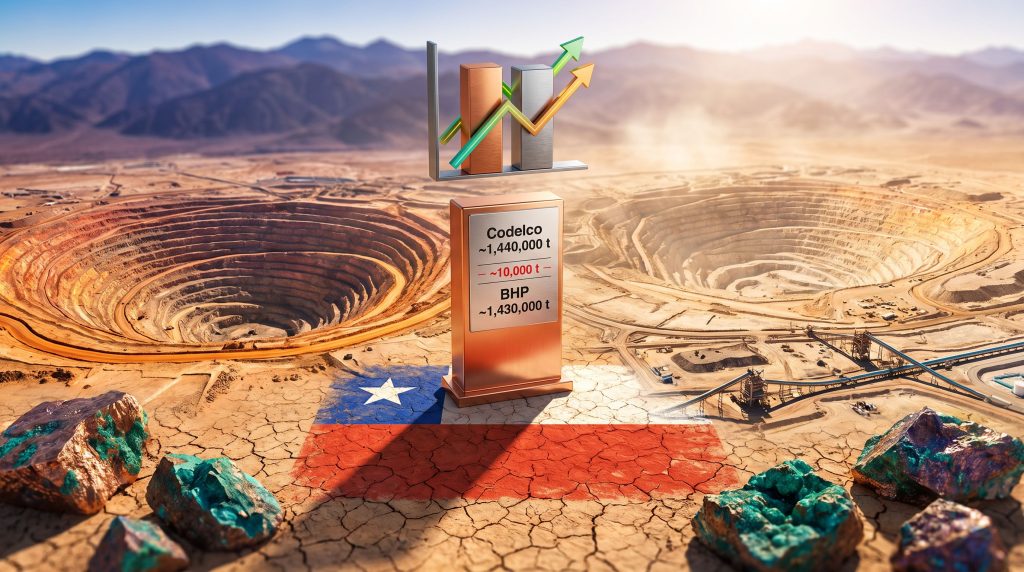
Full-year 2024 attributable production data placed Codelco at approximately 1.44 million tonnes and BHP at approximately 1.43 million tonnes, a separation of roughly 10,000 tonnes across a combined output base approaching 2.87 million tonnes annually. To put that margin in perspective, a single major processing disruption at Escondida, lasting only a few weeks, can swing monthly output by amounts that exceed the entire annual gap between the two producers.
This statistical proximity matters for reasons that extend beyond rankings. The title of world's largest copper producer carries tangible commercial weight. It affects:
- Sovereign credit narratives and Chile's positioning within global capital markets
- Investor confidence in the respective companies' operational track records
- Smelter and refinery offtake negotiations, where production scale influences contract leverage
- Streaming and royalty agreement valuations tied to Chilean copper assets
Monthly production data from mid-2026 illustrates just how fluid this competition has become. Codelco's output reached approximately 110,900 tonnes in March 2026, while Escondida alone produced around 101,600 tonnes, giving the state-owned enterprise a lead of roughly 9,300 tonnes for that month. By May 2026, the dynamic had inverted, with Escondida reporting approximately 108,800 tonnes against Codelco's 106,300 tonnes, a swing in BHP's favour of around 2,500 tonnes.
| Period | Codelco Output (tonnes) | BHP Escondida Output (tonnes) | Monthly Gap |
|---|---|---|---|
| March 2026 | 110,900 | 101,600 | Codelco +9,300 |
| May 2026 | 106,300 | 108,800 | BHP +2,500 |
| Full Year 2024 (attributable) | ~1,440,000 | ~1,430,000 | Codelco ~+10,000 |
These month-to-month reversals underscore why single data points are unreliable for ranking conclusions. Rolling 12-month averages remain the appropriate lens for assessing competitive positioning, and on that basis, the second half of 2026 has emerged as a decisive observation window.
Understanding BHP's Escondida Dependency
Escondida sits at the centre of BHP's entire copper production profile. As the world's single largest copper mine by output, its performance effectively determines where BHP lands in the global rankings. The ownership structure is worth understanding clearly: BHP holds a 57.5% attributable interest, Rio Tinto holds 30%, JECO Corporation holds 10%, and JECO 2 Ltd holds the remaining 2.5%. This means BHP's reported attributable copper production is materially lower than Escondida's gross output, a distinction that matters when comparing against Codelco's fully consolidated sovereign figures.
Beyond Escondida, BHP's Chilean copper exposure includes the Pampa Norte operations, specifically the Spence and Cerro Colorado assets, which contribute secondary volumes but also carry their own operational constraints. Cerro Colorado, in particular, has faced end-of-mine-life challenges that reduce its contribution to BHP's forward production profile. According to BHP's own quarterly reporting, copper output slipped 5% in Q4 with further declines flagged in Chile.
The Geology Driving Escondida's Output Challenges
Escondida is a classic large-scale porphyry copper deposit situated in the Atacama Desert in northern Chile. Porphyry systems of this scale are characterised by broad, disseminated mineralisation that supports enormous throughput volumes but is highly sensitive to ore grade variability as mining progresses deeper into the orebody. A less-understood dynamic at Escondida involves the relationship between ore hardness and throughput capacity. As the operation mines through harder, lower-grade transitional zones, mill throughput rates can decline even when processing capacity remains nominally unchanged. This phenomenon, sometimes called ore competency creep, means that capital investment in processing infrastructure does not always translate linearly into output recovery.
The processing transition from oxide to sulphide ores at Escondida, which has been unfolding across multiple years, also carries production implications that are easy to underestimate. Oxide ores are processed through solvent extraction and electrowinning (SX-EW) to produce copper cathode directly. Sulphide ores require flotation to produce concentrate, which then requires smelting and refining. The capital and operational requirements of these two pathways differ substantially, and managing the transition while sustaining output levels represents a genuine technical challenge.
Water availability compounds these geological pressures. The Atacama is one of the driest environments on Earth, and Escondida depends on desalination infrastructure to supply process water. BHP has committed significant capital to expanding its desalinated water supply systems at the mine, but the logistics of pumping desalinated seawater to high-altitude operations adds both cost and operational complexity that directly affects production economics.
Codelco's Structural Decline and the Recovery Programme
Codelco's current production levels represent a significant retreat from historical peaks. In years past, the company produced well above 1.7 million tonnes annually, a figure that once seemed like a floor rather than a ceiling. The Codelco production decline to current levels near 1.44 million tonnes reflects the accumulated effect of ageing infrastructure across several flagship operations simultaneously.
The three assets most central to Codelco's production profile each face distinct structural pressures:
- Chuquicamata: One of the world's most historically significant open-pit copper mines, now undergoing a complex conversion to underground block cave mining. The Chuquicamata Underground project involves developing new shaft infrastructure, ore handling systems, and ventilation networks at considerable depth, a process that has experienced cost increases and schedule extensions
- El Teniente: The world's largest underground copper mine by ore reserve, currently being expanded through the New Mine Level project, which involves developing new production levels below existing workings to access fresh ore zones. This multi-decade initiative is essential to sustaining El Teniente's output into the 2030s and beyond
- Radomiro Tomic: A lower-grade, high-volume open-pit operation that contributes meaningfully to Codelco's total output but faces increasing ore grade dilution over time
Codelco's capital investment requirements to arrest output decline and fund these structural projects are estimated in the range of tens of billions of dollars across the current decade. The challenge is compounding: the company simultaneously carries fiscal obligations as a state enterprise transferring dividends to the Chilean government, faces rising debt levels, and must fund transformational underground development while sustaining current operations. Chile's mining royalty framework adds further pressure on the capital available for reinvestment.
Codelco's debt load has grown materially over recent years as it funds structural projects, raising questions among analysts about the sustainability of its capital programme without compromising operational flexibility. The tension between sovereign dividend obligations and reinvestment requirements represents one of the most underappreciated risk factors in the global copper supply outlook.
However, it is worth noting that Codelco reclaims top producer status periodically, demonstrating resilience even amid these structural headwinds.
BHP's Counter-Strategy: Geographic Diversification as a Competitive Moat
While Codelco is structurally anchored to Chilean assets, BHP has been actively building a more geographically diversified copper production base. The 2023 acquisition of OZ Minerals added Carrapateena and Prominent Hill in South Australia to BHP's portfolio, joining the existing Olympic Dam operation to form what BHP has branded Copper South Australia. In addition, the Rio Tinto copper expansion strategy illustrates how major miners are broadly rethinking geographic concentration risk.
This South Australian copper hub strategy is more than a production diversification exercise. It reflects a deliberate attempt to reduce BHP's concentration risk in Chile and build processing and smelting infrastructure that can support multiple ore sources simultaneously. Olympic Dam's unique polymetallic nature, producing copper alongside uranium, gold, and silver, gives it a cost structure and revenue diversification profile that pure copper operations cannot replicate.
BHP also holds a long-dated but potentially transformative asset in Resolution Copper in Arizona, one of the largest undeveloped copper deposits in North America. Resolution faces a complex permitting pathway and will not contribute production within the current decade, but its scale positions it as a potential future cornerstone of BHP's copper growth pipeline.
Three Scenarios for the Rankings Race Through 2028
Scenario 1: BHP reclaims the top ranking by 2027
This outcome requires Escondida throughput to recover as desalination capacity expansions are completed, OZ Minerals assets in South Australia to ramp toward full capacity, and Codelco's underground project timelines to continue experiencing execution delays. Under this pathway, BHP's more geographically diversified production base provides incremental tonnage that Codelco cannot match through Chilean operations alone.
Scenario 2: Codelco consolidates its lead through 2028
Codelco retains its ranking if the Chuquicamata Underground ramp-up accelerates ahead of current schedules, El Teniente's New Mine Level delivers early production tonnes, and Escondida continues to face grade headwinds and water supply constraints. Codelco's ability to execute in this scenario depends heavily on project management capability and debt market access.
Scenario 3: A sustained statistical dead heat
The most analytically credible base case has both producers oscillating within a 30,000 to 50,000 tonne annual band, with rankings shifting year to year depending on operational variability. This scenario implies that neither producer has a durable structural advantage over the near term, and that the ranking will effectively be decided by which operation avoids the most significant disruption in any given calendar year.
Supply Concentration and the Systemic Risk No One Is Pricing Correctly
Chile accounts for approximately 25 to 27% of global copper mine production. The fact that the world's two largest copper producers both operate primarily within this single national jurisdiction creates a supply concentration risk that the copper market may be systematically underpricing.
Both BHP and Codelco face similar macro-level constraints:
- Shared water scarcity in the Atacama Desert region
- Exposure to Chilean labour relations and industrial action risk
- Chilean regulatory and royalty framework evolution
- Shared vulnerability to Andean seismic and geological events
When both producers experience simultaneous operational headwinds, as they periodically do, the combined effect on global copper concentrate availability is amplified. Treatment and refining charges (TC/RCs), the fees that smelters charge to process copper concentrate, serve as a proxy for concentrate supply tightness. When TC/RCs fall, it typically signals that concentrate supply is tightening relative to smelter demand, and Chilean output shortfalls are historically among the most reliable triggers for this dynamic. Consequently, the copper price growth drivers tied to supply disruptions become increasingly pronounced.
In a copper market where annual demand growth is being driven by electric vehicle manufacturing, grid infrastructure buildout, and data centre construction at scale, a combined output shortfall of even 50,000 to 100,000 tonnes from Chile's top two producers can materially tighten the global concentrate market and send TC/RCs sharply downward.
Furthermore, Chile's copper mine output decreased 5.8% in Q1, adding further evidence that national-level production pressures are reinforcing the competitive uncertainty between both giants.
The next major ASX story will hit our subscribers first
Key Variables to Watch Across H2 2026 and Into 2027
For investors and market participants tracking the BHP versus Codelco production rivalry, the following indicators carry the most forward-looking signal value:
- BHP quarterly production releases covering Escondida throughput, ore grade performance, and attributable copper output through the December 2026 half
- Codelco monthly output disclosures and progress reporting on the Chuquicamata Underground and El Teniente New Mine Level ramp-up schedules
- Cochilco data releases (Chile's Copper Commission) providing national-level production aggregates that contextualise both companies' performance within the broader Chilean supply picture
- LME copper price trajectory and TC/RC movements, which together signal whether the market is pricing in supply tightness from Chilean operational variability
- BHP FY2026 full-year guidance delivery, particularly any revision to copper production guidance ranges that would signal operational underperformance at Escondida
The structural variables with a three-to-five year shaping influence include Chilean water policy evolution, Codelco's debt trajectory, the pace of BHP's South Australian copper hub development, and whether Resolution Copper's permitting pathway gains any meaningful clarity in the US regulatory environment.
The Bigger Picture: Why This Race Has Global Supply Chain Consequences
Disclaimer: The scenario analyses, production forecasts, and market projections contained in this article are based on publicly available data and analytical frameworks. They do not constitute financial advice. Actual production outcomes, commodity prices, and competitive rankings may differ materially from the scenarios described.
The BHP versus Codelco production contest is ultimately not a story about corporate competition. It is a story about the structural health of the world's most critical copper supply corridor at a moment when electrification demand is accelerating and new mine development is struggling to keep pace with consumption growth.
BHP lower Chile copper output narrowing the lead over Codelco reflects genuine operational pressures at Escondida that are unlikely to resolve quickly. Whether BHP reclaims the top ranking or Codelco consolidates its position, the more important analytical question is whether either producer can grow absolute output meaningfully over the next five years. On current project pipelines and execution trajectories, the answer for both is cautiously optimistic at best.
In a structurally undersupplied copper market, production reliability and growth optionality will ultimately command a greater strategic premium than any single year's ranking title. The investors who understand that distinction are the ones best positioned to navigate what is shaping up to be one of the most consequential competitive dynamics in global resources.
For further analysis on Latin American mining industry dynamics and copper market developments, BNamericas provides ongoing reporting and intelligence coverage across the region's resource sectors.
Want To Position Yourself Ahead of the Next Major Copper Discovery?
Discovery Alert's proprietary Discovery IQ model scans ASX announcements in real time, instantly transforming complex mineral data into actionable investment insights across copper and 30+ other commodities — explore historic discoveries and their returns to understand the opportunity, then start your 14-day free trial at Discovery Alert to secure your market-leading edge before the broader market reacts.