
July 23, 2026
When Sovereign Law Meets Copper Scarcity: The Structural Puzzle Behind Cobre Panama's Future
Few situations in global mining illustrate the collision between constitutional sovereignty and commodity market imperatives as starkly as the Cobre Panama re-opening debate. While copper demand accelerates on the back of electrification, grid expansion, and energy transition infrastructure, one of the planet's most significant copper operations sits idle in Central America. Understanding why this is so difficult to resolve requires stepping back from the headlines and examining the structural mechanics at play.
When big ASX news breaks, our subscribers know first
The Weight Cobre Panama Carries in the Global Copper Ecosystem
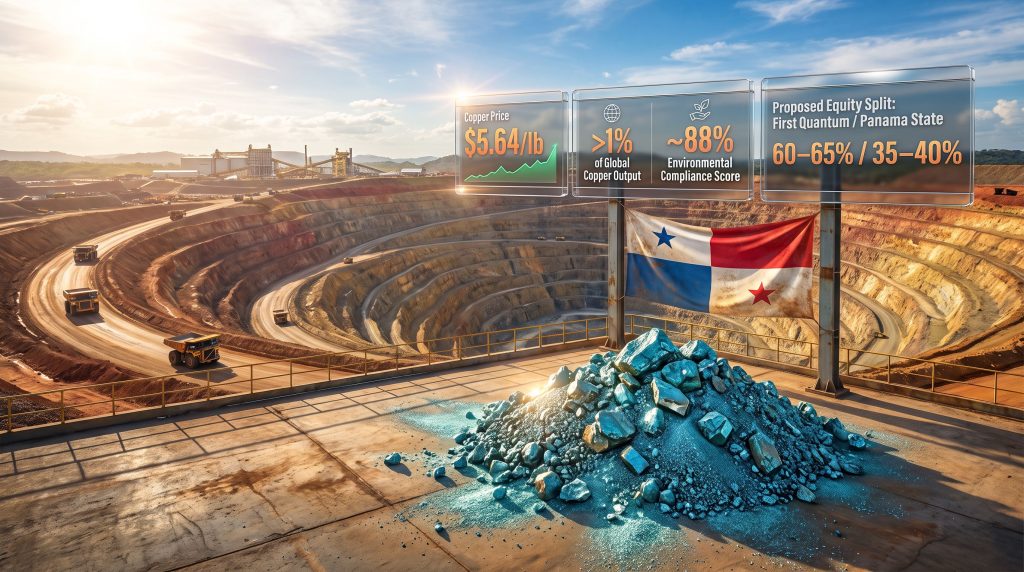
When Cobre Panama was operating at full capacity, it was not merely a significant regional asset. It ranked among the world's genuinely large-scale copper operations, contributing more than 1% of total global copper output at a time when the global copper market has very little tolerance for supply-side shocks. That figure may appear modest in percentage terms, but in a market defined by narrow supply surpluses and structurally growing demand, a single asset delivering more than one percentage point of global production is a market-moving variable.
The economic footprint of the mine's suspension was immediate and severe. According to IMF data, the 2023 closure removed an estimated 4.5% of Panama's GDP in a single regulatory action, an extraordinary concentration of economic dependency on a single industrial facility. Panama's national unemployment rate has since risen to approximately 10%, creating persistent political pressure on the administration of President Jose Mulino.
For First Quantum Minerals, the calculus was equally stark. Cobre Panama had accounted for roughly 40% of the company's total revenues, and its removal forced a multi-year financial restructuring. Furthermore, First Quantum has since suspended a USD 20 billion international arbitration claim against Panama, a concession that signals a genuine preference for negotiated resolution over protracted legal warfare. The Cobre Panama arbitration impacts of this suspended claim carry significant financial and diplomatic weight for both parties.
Copper prices are currently trading near $5.64 per pound, historically elevated levels that substantially amplify the economic consequences of every week Cobre Panama remains offline.
Why the 2023 Shutdown Cannot Simply Be Reversed
The instinct to treat Cobre Panama's situation as a straightforward licensing dispute misses the depth of the legal architecture involved. Panama's Supreme Court ruled in 2023 that First Quantum's 20-year mining contract was unconstitutional, a ruling that did not merely suspend operations but voided the entire legal basis on which the mine had been functioning. Simultaneously, the Panamanian legislature passed a law banning all new mining concessions, creating a secondary legislative barrier that compounds the constitutional constraint.
This dual-layer legal environment means a restart cannot simply involve reissuing the original contract or granting a new concession in the conventional sense. Any viable pathway must either navigate around the 2023 ban or create a sufficiently novel legal structure that does not trigger the ban's application.
The environmental audit commissioned by the Panamanian government has provided one piece of the puzzle. The audit returned an overall compliance score of approximately 88%, finding the operation generally compliant across environmental, legal, and operational dimensions. Importantly, this result gives the government an evidence base to argue that conditional reopening is defensible on environmental grounds, though it does not resolve the constitutional question.
| Audit Dimension | Assessment Outcome |
|---|---|
| Environmental Compliance | Generally compliant |
| Legal and Operational Standards | Generally compliant |
| Overall Composite Score | ~88% |
In the interim, Panama has permitted First Quantum to process and export stockpiled copper concentrate accumulated before the closure, and the mine's internal power plant has been restarted to maintain site infrastructure. Both the Panamanian government and First Quantum have publicly clarified that these measures do not constitute a formal reopening.
Three Governance Models Under Active Evaluation
The central challenge shaping Cobre Panama re-opening negotiations is not whether to reopen, but how to structure an arrangement that satisfies constitutional constraints, preserves Panamanian sovereignty, and provides First Quantum with sufficient operational control to justify further capital deployment. Three distinct models are being evaluated.
Public-Private Partnership via a New State-Owned Mining Entity
The most discussed option involves Panama creating a new state-owned mining company specifically to hold the underlying mineral concession. This structure is legally significant because the 2023 mining ban contains ambiguity regarding concessions granted to government-owned entities, potentially creating a legislative workaround that does not require amending the ban itself.
Under the proposed equity framework:
- First Quantum would hold a 60% to 65% stake in the venture, reflecting the capital investment the company made in constructing and operating the facility
- A Panamanian state entity would hold the remaining 35% to 40%
- The underlying mineral concession would remain sovereign Panamanian property, satisfying the government's declared requirement for complete sovereignty over the asset
- First Quantum would retain operational control, contributing the technical expertise and capital continuity the mine requires
This model carries medium legal complexity. Its viability rests on the untested assumption that Panamanian courts would interpret the 2023 ban as inapplicable to state-entity concessions, an interpretation that has not yet been validated judicially.
Lease Arrangement with Royalty and Tax Revenue
A second pathway involves the Panamanian government retaining full ownership of the mine as an asset while leasing operational control to First Quantum. Revenue would flow to the state through royalty payments and corporate tax on operational income, rather than through equity participation.
This model offers a simpler legal architecture. Because no new concession is technically created, the lease structure may sidestep the 2023 ban's constraints more cleanly than the partnership model. Panama retains 100% asset ownership, and operational and capital risk sits with First Quantum. Politically, the lease structure can be framed as an assertion of complete Panamanian sovereignty over the resource, potentially improving its social licence prospects.
Renegotiated Restart Under Revised Fiscal and Legal Terms
The third option involves comprehensive renegotiation of the entire legal and fiscal framework governing the mine's operation. This pathway is considered the most politically complex, as it would likely require new legislation or constitutional workarounds to address both the Supreme Court ruling and the 2023 concession ban. It offers the greatest flexibility in structuring revenue and governance outcomes but carries the highest implementation risk.
Comparative Framework: Governance Models at a Glance
| Model | State Ownership | First Quantum Role | Revenue Mechanism | Legal Complexity |
|---|---|---|---|---|
| Public-Private Partnership | 35-40% equity | Operator (60-65%) | Dividends and taxes | Medium |
| Lease Arrangement | 100% asset ownership | Lessee/Operator | Royalties and taxes | Lower |
| Renegotiated Restart | Negotiated | Negotiated | Revised fiscal regime | High |
Resource Nationalism in Context: Where Panama Sits in a Global Trend
Panama's deliberations over state participation in Cobre Panama are not occurring in isolation. Across resource-rich nations, governments have been steadily recalibrating the terms of engagement with foreign mining operators, demanding higher economic returns, greater oversight, and meaningful equity stakes without resorting to outright nationalisation. The broader metals mining geopolitics at play here are reshaping how host governments approach foreign capital across multiple continents.
Chile's state copper company Codelco has long served as a benchmark for sovereign participation in the copper sector. More recently, Zambia has moved toward increased state equity in copper operations, and other Sub-Saharan African producers have renegotiated fiscal frameworks in favour of host-government participation. The public-private partnership structure being evaluated for Cobre Panama fits within this broader pattern.
What makes Panama's case structurally distinct is the constitutional constraint. Unlike Chile or Zambia, where increased state participation is primarily a fiscal and political question, Panama faces a situation where the legal framework itself prohibits the most straightforward paths forward. The creation of a state-owned entity specifically designed to hold a concession that might otherwise be banned represents an innovative legal mechanism. If it is validated by Panamanian courts, it could establish a replicable template for other jurisdictions navigating similar constitutional barriers to mining investment.
This potential precedent is one of the most underappreciated dimensions of the Cobre Panama re-opening debate. The governance innovation being tested here could influence how resource-rich governments structure mining relationships for decades.
What a Restart Would Mean for Copper Markets
The copper market's current condition amplifies the significance of every development in the Cobre Panama re-opening process. The ongoing copper supply crunch is driven by declining ore grades at existing operations, long lead times for new project development, and permitting complexity in many jurisdictions. Demand, by contrast, is structurally elevated by electrification requirements in transport, power generation, and grid infrastructure.
In this environment, restoring more than 1% of global copper production from a single, already-built operation would represent a meaningful supply-side event. At current copper prices near $5.64 per pound, the annual revenue implications for both First Quantum and the Panamanian state are substantial. Indeed, the global copper supply gap makes the resolution of this stalemate a matter of pressing global concern, not merely a bilateral dispute.
For First Quantum specifically, analysts at RBC have characterised regaining operational control of Cobre Panama as transformational for the company's financial position. Given that the mine previously represented both the company's largest single asset and its primary revenue driver, this assessment is well-grounded. The company's suspended arbitration claim, valued at USD 20 billion, also creates a significant contingent financial overhang that a negotiated resolution would eliminate.
One dimension of the Cobre Panama situation that receives less attention is the ramp-up timeline. Even after a formal governance decision is made, restarting a major copper operation that has been idle for multiple years involves meaningful technical complexity. Equipment maintenance status, tailings management infrastructure, workforce reconstitution, and supply chain reactivation all require careful sequencing. Industry experience with comparable restart scenarios suggests that a 12 to 24-month lead time from formal decision to full production is a realistic baseline expectation.
The next major ASX story will hit our subscribers first
The Obstacles That Remain
Despite the economic logic of reopening and the environmental audit's supportive findings, several genuine obstacles stand between the current stalemate and a functioning mine.
Social licence risk remains the most immediate constraint. The public opposition that drove the 2023 closure was not simply a political moment — it reflected deep-seated concerns about environmental governance, revenue distribution, and the perceived power imbalance between foreign mining capital and host communities. Those concerns have not been systematically addressed, and the Mulino administration has acknowledged that fear of renewed social unrest is a genuine constraining factor. However, growing community support for a conditional reopening, contingent on greater transparency and community benefits, suggests the social licence landscape may be shifting.
Legal durability presents a second challenge. Whichever governance model is selected, the resulting legal structure must be robust enough to withstand constitutional challenge. Given that the mine was previously shut down following a Supreme Court ruling, the risk that a new arrangement could face similar judicial scrutiny is not hypothetical. The state-entity concession workaround is legally creative but legally untested.
Decision timeline pressure adds a third layer of complexity. Panama's Commerce and Industry Minister has indicated a decision is expected before the end of 2026. That is a tight horizon given the legal architecture that must be designed, debated, and implemented before any restart process can begin. Consequently, mining private equity and institutional investors are watching the timeline closely, as prolonged uncertainty carries its own capital costs.
Three Scenarios for Cobre Panama's Future
Scenario A: Public-Private Partnership (Base Case)
Panama establishes a state-owned mining entity; First Quantum retains 60-65% operational control. The legal ambiguity in the 2023 ban is successfully navigated via the state-entity concession framework. A formal decision is reached before year-end 2026, with mine restart achievable within 12-24 months thereafter. Global copper supply receives material relief, and First Quantum's financial recovery accelerates meaningfully.
Scenario B: Lease Arrangement (Alternative Path)
Panama leases operational control to First Quantum under a royalty and tax revenue structure. The simpler legal architecture reduces implementation risk and potentially shortens the timeline. The state retains full asset ownership, allowing the government to frame the outcome as complete sovereignty retention. This scenario may prove more politically viable domestically.
Scenario C: Prolonged Stalemate (Downside Risk)
Social unrest or constitutional challenges delay any formal decision beyond 2026. First Quantum reinstates its suspended arbitration claim, re-escalating the bilateral dispute. Copper markets continue without Cobre Panama's supply contribution, and Panama's economic recovery remains constrained by elevated unemployment and suppressed GDP.
Key Data Summary
| Metric | Figure |
|---|---|
| GDP impact of mine closure | ~4.5% of Panama's GDP |
| Global copper production share | More than 1% of global output |
| First Quantum revenue exposure | ~40% of total revenues |
| Environmental audit compliance score | ~88% |
| Proposed First Quantum equity stake | 60-65% |
| Proposed Panama state equity stake | 35-40% |
| First Quantum arbitration claim (suspended) | USD 20 billion |
| Panama unemployment rate | ~10% |
| Copper price (current) | ~$5.64/lb |
| Decision timeline | By end of 2026 |
A Decision With Consequences Far Beyond Panama
The Cobre Panama re-opening question has evolved well beyond a bilateral negotiation between a mining company and a host government. It has become a live test case for how constitutional democracy, resource nationalism, copper market fundamentals, and social licence requirements can be reconciled within a single governance framework.
The governance model Panama selects will be studied by resource-rich governments worldwide. If the state-entity concession workaround is legally validated and operationally successful, it creates a replicable template for jurisdictions facing similar constitutional constraints. If it fails, it reinforces the lesson that constitutional rulings against mining projects are extraordinarily difficult to reverse through legal innovation alone.
For copper markets, the stakes are equally clear. A structurally deficit market with constrained supply pipelines and accelerating demand cannot afford indefinite uncertainty around major assets. The year-end 2026 decision timeline is not merely a Panamanian administrative deadline — it is a moment that will reverberate across global copper supply chains, investor portfolios, and the evolving playbook of resource nationalism.
This article is intended for informational purposes only and does not constitute financial or investment advice. Forward-looking statements, scenario projections, and market assessments involve inherent uncertainty. Readers should conduct independent research before making any investment decisions.
Want to Stay Ahead of Major Copper Discoveries Before the Broader Market Reacts?
As the Cobre Panama situation demonstrates, supply disruptions and structural shifts in copper markets can move fast — and so can the opportunities they create. Discovery Alert's proprietary Discovery IQ model scans ASX announcements in real time, instantly identifying significant mineral discoveries across copper and 30+ other commodities, so subscribers can act on actionable insights before the broader market catches up — begin your 14-day free trial today and explore historic discovery returns that show just how transformative early positioning can be.