
August 26, 2026
The Hidden Cost of Selling Raw Gold: Why Processing Sovereignty Is Reshaping Mining Economics
Every tonne of unprocessed gold concentrate that crosses a national border represents a transfer of value, not just of material. For mining companies operating in resource-rich jurisdictions, the decision to export concentrate rather than process it domestically has long been treated as a pragmatic response to capital constraints or regulatory friction. However, as the economics of vertical integration become harder to ignore, major producers are increasingly rethinking that calculus, and AngloGold Ashanti Brazilian gold concentrate processing domestically offers one of the clearest illustrations of this strategic shift now unfolding across the global gold sector.
When big ASX news breaks, our subscribers know first
What Refractory Gold Ore Actually Demands, and Why It Changes Everything
To understand why the Queiroz industrial complex matters, it helps to understand what makes gold concentrate from operations like AngloGold's Brazilian mines so technically demanding to process in the first place.
The Cuiabá and Lamego mines, which supply concentrate to the Queiroz complex, produce what the industry classifies as refractory ore. Unlike free-milling gold deposits, where cyanide leaching can directly dissolve gold particles, refractory ore contains gold that is physically locked inside sulphide mineral matrices, most commonly arsenopyrite or pyrite. Standard leaching processes cannot access this gold without a pre-treatment step that breaks apart the sulphide structure.
Two primary technologies accomplish this:
- Pressure oxidation (POX): Subjects the concentrate to high-temperature, high-pressure conditions in the presence of oxygen, oxidising the sulphide minerals and freeing the encapsulated gold for subsequent leaching.
- Roasting: Uses high-temperature combustion to oxidise sulphides, producing sulphur dioxide gas as a by-product that must be captured, typically converted into sulphuric acid, to prevent environmental harm.
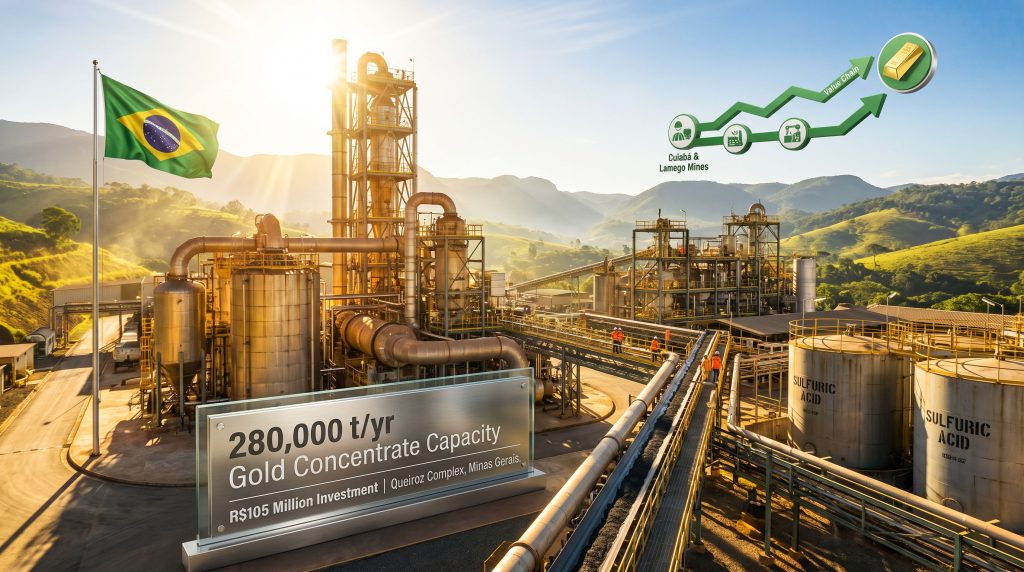
This is precisely why the Queiroz complex produces sulphuric acid as a commercially significant co-product. The 240,000 metric tonnes per year of sulphuric acid output capacity is not incidental. It is an engineered consequence of treating refractory sulphide concentrate at industrial scale, and it transforms what would otherwise be a costly waste stream into a secondary revenue source that meaningfully alters the project's financial profile.
The ability to monetise sulphuric acid output is a structural advantage that third-party concentrate purchasers retain when miners sell unprocessed material into export markets. Vertical integration brings that advantage back in-house.
The Queiroz Complex: Operational Geography and Processing Scale
Located in Nova Lima, Minas Gerais, the Queiroz industrial complex sits at the centre of Brazil's most historically significant gold-producing region. Minas Gerais, whose name translates literally as General Mines, has been a focal point of Brazilian mineral extraction since the eighteenth century and continues to host some of the country's most productive hard-rock gold operations.
The complex serves as the downstream processing hub for concentrate flowing from both the Cuiabá mine, one of the deepest gold operations in the Americas, and the Lamego mine. With its second processing plant reactivated in August 2026, the facility has returned to its full operational capacity of approximately 280,000 metric tonnes of gold concentrate per year, a benchmark that allows AngloGold Ashanti to process all of its Brazilian gold concentrate domestically through the Queiroz facility.
The timeline of the complex's suspension and restoration provides important context:
| Event | Year | Significance |
|---|---|---|
| Both Queiroz plants suspended | 2022 | Environmental compliance adjustments required for liquid waste treatment |
| First Queiroz plant restarted | 2024 | Partial domestic processing capacity restored |
| Second Queiroz plant reactivated | August 2026 | Full 280,000 t/yr capacity restored |
| Total investment committed | 2024 to 2026 | R$105 million (Brazilian reais) |
Why the 2022 Shutdown Was More Than a Compliance Footnote
The simultaneous suspension of both Queiroz plants in 2022 is often described simply as a response to regulatory requirements, but the underlying technical challenge deserves closer examination. Liquid waste management in sulphide gold concentrate processing is a structurally complex problem that extends well beyond routine permit compliance.
During sulphide oxidation, processing circuits generate acidic effluents containing dissolved heavy metals, arsenic compounds, and other potentially harmful constituents. The regulatory frameworks governing these discharges in Minas Gerais have become increasingly stringent, particularly following a series of high-profile tailings and effluent-related incidents across Brazil's mining sector in the years preceding the shutdown.
The compliance adjustments required at Queiroz were primarily related to liquid waste treatment infrastructure, suggesting that the facility required upgrades to its effluent handling systems before operations could resume. Furthermore, this is a recurring challenge in sulphide processing globally, as illustrated by the following examples:
- Australia addresses this through strict environmental licensing under state-level frameworks, with detailed acid and metalliferous drainage management plans required as conditions of approval.
- South Africa operates under the National Water Act, which places particular emphasis on acid mine drainage prevention and treatment, a legacy of the country's deep gold mining history.
- Ghana has faced considerable scrutiny over artisanal and small-scale mining effluents, with large-scale operators subject to Environmental Protection Agency permitting that increasingly mirrors international best practice standards.
Brazil's environmental licensing regime, particularly within Minas Gerais following the Brumadinho and Mariana dam disasters, has become one of the more demanding in Latin America for processing operations. The four-year gap between suspension and full restoration of the Queiroz complex reflects both the technical complexity of the required upgrades and the thoroughness of the regulatory process involved. Those interested in current gold exploration trends will recognise that environmental compliance is increasingly shaping operational timelines industry-wide.
The R$105 Million Investment Case: What the Numbers Signal
AngloGold Ashanti's commitment of R$105 million across the 2024 to 2026 period to restore Queiroz to full capacity carries an important signal for investors and industry observers alike. Specifically, it demonstrates that the company has sufficient confidence in its Brazilian mine life and production trajectory to justify capital expenditure at this scale on processing infrastructure alone.
Processing investments are fundamentally long-duration bets. Unlike exploration or development drilling, which can be deferred or scaled back relatively quickly, processing infrastructure requires sustained throughput over years to justify its capital cost. A company does not commit R$105 million to reactivating a processing complex without a clear view of the ore reserves and mine life that will feed it.
The financial logic of this investment becomes clearer when the alternative is considered. During the period when only one plant was operational, AngloGold was selling a portion of its Brazilian gold concentrate to third-party buyers in the open market. This arrangement, as reported by Mining.com, introduces several structural disadvantages:
- Treatment charge and refining charge exposure: Third-party concentrate purchasers recover their margin through deductions applied to the contained metal value, typically expressed as treatment charges (TCs) and refining charges (RCs). These deductions can represent a meaningful proportion of gross metal value.
- Pricing risk on concentrate sales: Concentrate sold into spot or short-term markets is subject to benchmark pricing negotiations, which can deteriorate during periods of smelter overcapacity or market dislocation.
- Loss of sulphuric acid co-product revenue: When concentrate is sold before processing, the seller forfeits the commercial value of all processing by-products, including sulphuric acid.
- Strategic information leakage: Third-party processing relationships can create unwanted visibility into a company's production volumes and concentrate characteristics.
By internalising all processing within the Queiroz complex, AngloGold eliminates each of these exposures simultaneously.
Vertical Integration as Deliberate Strategy, Not Opportunistic Expansion
What distinguishes the Queiroz reactivation from a simple capacity restoration exercise is the explicitly strategic framing applied to the decision. AngloGold Ashanti's Latin America leadership has characterised the reactivation as being driven primarily by the logic of vertical integration rather than by production growth ambitions. This framing matters because it positions the investment as a structural value-capture decision rather than a response to spot market conditions.
Vertical integration in gold mining refers to the consolidation of multiple stages of the value chain, from ore extraction through to refined metal production, within a single corporate structure. When fully achieved, it allows the operator to capture margin at every processing stage rather than sharing it with external service providers or concentrate purchasers.
In refractory gold operations specifically, the spread between the value of unprocessed concentrate and the value of the refined gold it contains can be substantial. Every step of processing that is internalised narrows the gap between production cost and full metal realisation.
This approach aligns with a broader trend visible across the global gold sector. Understanding the relationship between gold price and mining equities helps illustrate why producers with legacy third-party smelting arrangements are increasingly examining whether those arrangements remain optimal as processing technology improves and concentrate markets tighten.
The next major ASX story will hit our subscribers first
What Withdrawing Concentrate From Third-Party Markets Actually Means
When a producer of the scale of AngloGold Ashanti withdraws a significant volume of gold concentrate from third-party markets, the effects ripple through regional concentrate supply chains in ways that are not always immediately apparent.
Brazil's gold concentrate market is relatively concentrated, with a limited number of large-scale producers and an even smaller number of domestic processing facilities capable of handling refractory material. The reabsorption of Queiroz's full throughput capacity into AngloGold's integrated production chain effectively removes up to 280,000 tonnes per year of concentrate supply from the market, reducing the volume available to competing processors and potentially affecting regional treatment charge benchmarks.
For smaller Brazilian gold producers who lack access to their own processing infrastructure, this dynamic is worth monitoring. A reduction in available third-party processing capacity in the Minas Gerais region could translate into higher treatment charges or longer lead times for concentrate offtake agreements, particularly if domestic processing demand continues to grow. Investors evaluating gold mining stocks in this region should consider these supply chain dynamics carefully.
Frequently Asked Questions: AngloGold Ashanti Brazilian Gold Concentrate Processing
What is the Queiroz industrial complex?
The Queiroz industrial complex is AngloGold Ashanti's gold concentrate processing facility located in Nova Lima, Minas Gerais, Brazil. It processes refractory sulphide gold concentrate from the company's Cuiabá and Lamego mines and also produces sulphuric acid as a commercial by-product.
Why were the Queiroz processing plants shut down in 2022?
Both plants were suspended primarily to allow for upgrades and adjustments to liquid waste treatment systems, ensuring compliance with Brazil's environmental regulatory requirements for sulphide concentrate processing operations.
How much did AngloGold invest to restore full capacity?
The company committed approximately R$105 million (Brazilian reais) across the 2024 to 2026 period to fund the reactivation of both processing plants at the Queiroz complex.
What is the full processing capacity of the Queiroz complex?
With both plants operational, the Queiroz complex can process approximately 280,000 metric tonnes of gold concentrate per year.
Does AngloGold Ashanti still export or sell gold concentrate to third parties from Brazil?
Following the reactivation of the second plant in August 2026, AngloGold Ashanti Brazilian gold concentrate processing domestically is now fully operational, eliminating third-party concentrate sales from its Brazilian operations entirely.
What role does sulphuric acid play in the Queiroz operations?
Sulphuric acid is generated as a by-product of the sulphide oxidation process used to treat refractory gold concentrate. The Queiroz complex has an output capacity of approximately 240,000 metric tonnes of sulphuric acid per year, which represents a commercially significant secondary revenue stream.
Which mines supply concentrate to the Queiroz complex?
The complex receives gold concentrate from AngloGold Ashanti's Cuiabá and Lamego mines, both located in Minas Gerais, Brazil. For those interested in interpreting gold drill results from these operations, understanding the refractory nature of the ore is essential context.
Key Metrics: Queiroz Complex Restoration at a Glance
| Metric | Detail |
|---|---|
| Complex location | Nova Lima, Minas Gerais, Brazil |
| Full gold concentrate processing capacity | ~280,000 metric tonnes per year |
| Sulphuric acid output capacity | ~240,000 metric tonnes per year |
| Total reactivation investment | R$105 million (Brazilian reais) |
| First plant restart | 2024 |
| Second plant restart | August 2026 |
| Suspension reason | Liquid waste treatment compliance adjustments (from 2022) |
| Primary strategic rationale | Vertical integration; elimination of third-party concentrate sales |
| Concentrate source mines | Cuiabá and Lamego |
Processing Sovereignty as the New Competitive Benchmark
The restoration of AngloGold Ashanti Brazilian gold concentrate processing at the Queiroz complex is instructive not just as a company-specific operational update, but as a case study in how major gold producers are repositioning themselves in response to the economics of value chain control. The deliberate choice to frame this investment around vertical integration rather than raw capacity expansion signals a maturing strategic philosophy.
In this context, one in which retaining the full value of extracted metal within the company's own infrastructure is treated as a non-negotiable objective rather than an aspirational goal, the broader gold market outlook only strengthens the rationale for such integration. Furthermore, according to AngloGold Ashanti's corporate profile, the company's Americas operations represent a central pillar of its long-term growth strategy, making the Queiroz investment consistent with broader portfolio objectives.
For other gold producers operating in jurisdictions with the technical complexity of Brazil's refractory ore deposits, the Queiroz model offers a concrete framework for evaluating similar decisions. The combination of restored processing capacity, sulphuric acid co-product revenue, and the elimination of third-party concentrate market exposure creates a value proposition that extends well beyond the R$105 million capital outlay required to achieve it.
Disclaimer: This article is intended for informational purposes only and does not constitute financial advice or a recommendation to buy or sell any securities. Readers should conduct their own due diligence and consult a qualified financial adviser before making investment decisions. Forward-looking statements and projections involve inherent uncertainty and may not reflect actual outcomes.
Want to Identify the Next Major ASX Gold Discovery Before the Market Does?
Discovery Alert's proprietary Discovery IQ model delivers real-time alerts the moment significant mineral discoveries are announced on the ASX, transforming complex geological data into clear, actionable investment insights for both short-term traders and long-term investors — explore historic discovery returns on Discovery Alert's discoveries page to understand the scale of opportunity, then begin your 14-day free trial to position yourself ahead of the market.