July 31, 2026
When Price Becomes the Engine: Understanding Gold Mining Profitability in a Bull Market
The conventional assumption in resource extraction is straightforward: produce more, earn more. Yet the gold mining industry periodically dismantles this logic with striking clarity. When bullion prices surge aggressively, the relationship between volume and value becomes almost irrelevant. A miner extracting fewer ounces at dramatically higher prices can outperform itself by a wide margin, and this is precisely the dynamic playing out across the senior gold producer landscape in mid-2026.
Understanding why AngloGold quarterly profit up 58% as higher bullion prices offset lower output matters extends well beyond a single quarterly earnings release. It reveals how operating leverage, price realization strategy, and portfolio discipline combine to generate outsized financial returns even when operational headwinds constrain physical output.
When big ASX news breaks, our subscribers know first
Breaking Down the Financial Surge: What the Q2 2026 Numbers Actually Mean
Headline Earnings, EBITDA, and Free Cash Flow at a Glance
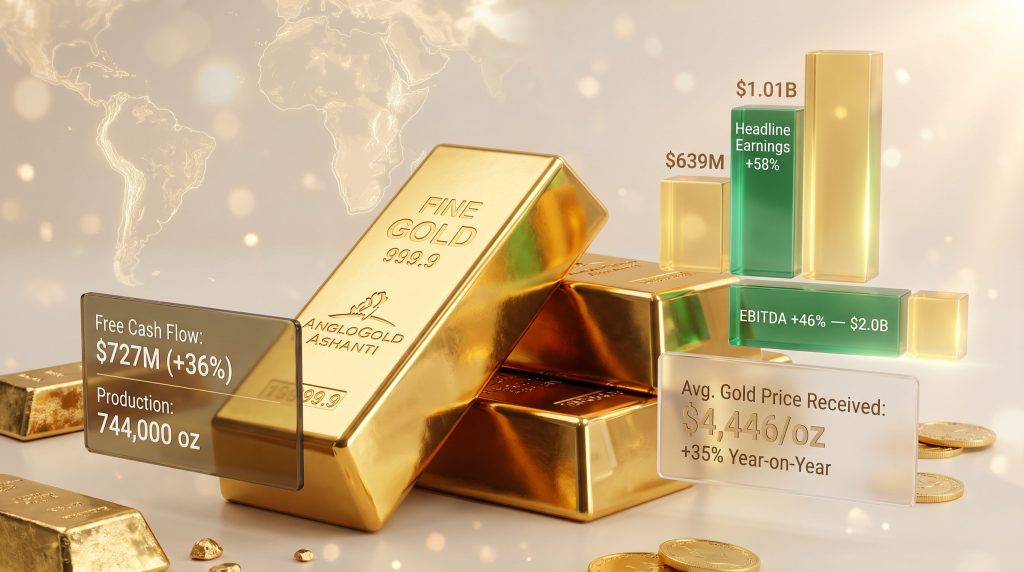
AngloGold Ashanti's second-quarter 2026 results present one of the clearest illustrations of price-driven earnings amplification seen in recent gold mining history. Headline earnings reached $1.01 billion, compared to $639 million in the same period of 2025, representing a 58% year-on-year increase. Critically, this came while total gold output actually declined. You can review the full financial results directly via AngloGold Ashanti's investor relations page.
| Metric | Q2 2025 | Q2 2026 | Year-on-Year Change |
|---|---|---|---|
| Headline Earnings | $639 million | $1.01 billion | +58% |
| EBITDA | ~$1.37 billion | ~$2.0 billion | +46% |
| Free Cash Flow | ~$535 million | $727 million | +36% |
| Average Gold Price Received | ~$3,293/oz | $4,446/oz | +35% |
| Gold Production | 804,000 oz | 744,000 oz | -7% |
The average realized gold price of $4,446 per ounce is the single most important variable in this earnings story. A 35% improvement in price realization translated into a 58% leap in headline earnings, which itself reflects the power of operating leverage in capital-intensive mining businesses. Furthermore, these gold price records have created a uniquely favourable backdrop for producers with unhedged exposure to spot markets.
The Operating Leverage Principle: Why Price Moves Amplify Earnings Disproportionately
Operating leverage is a concept that many casual investors overlook when analysing mining stocks. In underground gold mining, a substantial portion of costs are fixed or semi-fixed: shaft maintenance, ventilation systems, labor contracts, processing plant operations, and regulatory compliance expenditures do not scale proportionally with the gold price. When bullion prices rise sharply, these fixed costs remain relatively stable, meaning each additional dollar of revenue above a miner's all-in sustaining cost (AISC) flows almost directly to the bottom line.
This explains why a 35% gold price increase can generate a 58% earnings uplift even when production volumes fall by 7%. The mathematical relationship is non-linear, and it is this non-linearity that makes senior gold producers compelling investment instruments during sustained bullion bull markets. In addition, understanding gold price and mining equities helps contextualise why share prices of producers often move more dramatically than the underlying metal itself.
A useful rule of thumb for analysts: every $100 per ounce increase in the gold price, held against a stable AISC base, generates margin expansion that compounds across millions of ounces of annual production, often creating earnings sensitivity that surprises even experienced equity researchers.
Production Declines: Three Distinct Causes, One Combined Impact
Why Output Fell to 744,000 Ounces in Q2 2026
Total quarterly gold production of 744,000 ounces represented a 7% decline from 804,000 ounces in Q2 2025. At the half-year level, cumulative production of 1.47 million ounces sat 3.7% below the prior corresponding period. Three distinct factors drove this reduction:
-
Serra Grande divestment (Brazil): The December 2025 sale of this South American asset permanently removed its production contribution from AngloGold's portfolio. This was a deliberate strategic decision, not an operational failure.
-
Obuasi mine disruption (Ghana): A contractor fatality in April 2026 triggered a 32% production decline at Obuasi, one of the world's highest-grade underground gold operations, as equipment challenges and operational stoppages followed.
-
Planned mine sequencing: Scheduled maintenance and ore body sequencing at various operations contributed modestly to the aggregate shortfall.
Obuasi: High-Grade Asset, High-Stakes Risk
The Obuasi mine in Ghana carries geological significance that distinguishes it from most African gold operations. It hosts exceptionally high-grade ore reserves that have been mined intermittently for over a century, with grade profiles substantially above the global underground gold average. High-grade underground mines generate significant cash flow per tonne processed, but they also concentrate operational risk.
A disruption at a high-grade asset costs far more in foregone revenue than an equivalent stoppage at a lower-grade open-pit operation. Ghana's mining regulatory framework mandates operational reviews and potential shutdowns following fatalities, which introduces timeline uncertainty that management cannot fully control. The rehabilitation pathway for Obuasi's production recovery in the second half of 2026 is therefore a critical variable that investors should monitor closely.
What the Serra Grande Sale Reveals About Portfolio Strategy
The divestment of Serra Grande is worth examining beyond its surface-level production impact. Non-core asset sales in gold mining typically serve dual purposes: they raise capital for reinvestment or shareholder returns, and they concentrate operational focus on higher-margin, lower-complexity assets. While production volumes decrease post-divestment, margin quality across the retained portfolio often improves.
This dynamic is frequently misread by investors who focus solely on production metrics. A company producing fewer ounces at higher margins from a leaner, better-managed portfolio can be structurally more valuable than one maintaining production volumes through retention of sub-optimal assets. Consequently, monitoring gold M&A activity provides useful context for how asset disposals and acquisitions are reshaping the broader sector.
Full-Year 2026 Guidance: An Ambitious but Not Unprecedented Recovery Target
The Mathematics of H2 2026 Production Requirements
AngloGold has maintained its full-year 2026 production guidance range of 2.8 million to 3.17 million ounces. With H1 2026 output confirmed at 1.47 million ounces, the implied second-half requirement is substantial:
- Lower guidance boundary (2.8M oz): Requires H2 output of approximately 1.33 million ounces
- Upper guidance boundary (3.17M oz): Requires H2 output of approximately 1.70 million ounces
- Achieving the upper end would represent an H2 production increase of roughly 15-16% above H1 levels
Back-weighted production years are common in underground gold mining. Mine sequencing, seasonal patterns, and maintenance scheduling often concentrate higher-grade ore extraction in later quarters. The key execution assumptions underpinning AngloGold's H2 recovery thesis include:
- Obuasi returning to normalised operational output
- Stable throughput across African and Australian operations
- No additional unplanned asset disposals or force majeure events
Disclaimer: Production guidance figures are forward-looking statements subject to operational, regulatory, and market uncertainties. Past production recovery trajectories are not guarantees of future performance.
Capital Returns: A $2 Billion Buyback in Context
Dividends, Buybacks, and the Shareholder Return Calculus
AngloGold's capital return activity in H1 2026 reflects the financial confidence that elevated free cash flow generation creates. The company declared a quarterly dividend of 72 cents per share, equivalent to approximately $364 million, bringing total H1 2026 dividend payments to $949 million. Shareholders subsequently approved a $2 billion share buyback program on July 23, 2026.
Contextualising the buyback against current cash generation capacity provides useful perspective:
- Q2 2026 free cash flow: $727 million
- $2 billion buyback as a multiple of Q2 FCF: approximately 2.75 quarters
- This suggests the buyback is financially conservative relative to AngloGold's current cash generation rate at prevailing gold prices
Share buyback programmes in high-FCF environments serve a dual function. They reduce the outstanding share count, which mechanically increases earnings per share over time even if absolute earnings remain constant. They also signal management's conviction that the stock is undervalued relative to intrinsic cash-generating capacity — a particularly meaningful signal when made by producers with unhedged exposure to a gold price above $4,000 per ounce.
Dividend Sustainability in a High-Gold-Price Environment
The critical dependency for dividend sustainability is gold price stability. Most senior gold producers calibrate dividend policies against conservative gold price assumptions, typically well below spot market levels, to ensure payouts are not impaired during price corrections. If gold prices were to retrace significantly below $3,500 per ounce, free cash flow generation would compress, potentially putting pressure on current distribution levels. Investors should treat current dividend yields as reflective of an elevated gold price environment rather than a structurally permanent baseline.
The Gold Price at $4,446/oz: Macro Forces and Miner Implications
What Is Driving Gold's Sustained Appreciation
The average realized gold price of $4,446 per ounce in Q2 2026 reflects a confluence of structural forces that have been building across multiple years:
-
Central bank accumulation: Sovereign reserve managers, particularly across emerging market economies, have been systematically increasing gold allocations as part of broader reserve diversification strategies. Central bank gold demand has been cited by multiple analysts as one of the most significant structural drivers of this bull market, with some projecting that China's gold stockpile could surpass U.S. holdings within five years.
-
Real yield dynamics: The U.S. Federal Reserve's policy trajectory through 2025-2026 has influenced real interest rates in ways that reduced the opportunity cost of holding non-yielding gold.
-
Geopolitical risk premiums: Persistent geopolitical uncertainty across multiple theatres has reinforced gold safe-haven demand, embedding structural demand that extends beyond traditional investment cycles.
-
De-dollarisation momentum: Sovereign entities pursuing reduced U.S. dollar exposure in reserve portfolios have found gold to be the most liquid and politically neutral alternative.
Unhedged Exposure as a Strategic Choice
AngloGold's unhedged positioning means the company captures the full upside of spot price appreciation rather than locking in forward sale prices. This is a deliberate strategic stance that creates significant earnings sensitivity to gold price movements. In bull market conditions, unhedged producers dramatically outperform hedged peers on earnings metrics. The inverse is also true during price corrections, which means investors in unhedged producers are accepting higher earnings volatility in exchange for full participation in upside cycles.
The next major ASX story will hit our subscribers first
Risk Landscape: What Could Disrupt the H2 2026 Recovery
Operational, Macro, and Geopolitical Risk Factors
The positive H2 2026 recovery narrative carries meaningful execution risk across several dimensions:
-
Obuasi timeline uncertainty: The pace of operational restoration at Obuasi remains the single largest production variable within management's control.
-
Gold price sensitivity: Earnings are highly leveraged to gold price levels. A correction toward $3,500 per ounce would materially compress margins and free cash flow.
-
Geopolitical operating environments: AngloGold operates across Ghana, Tanzania, Guinea, and other jurisdictions where regulatory and political risk can materialise with limited advance warning.
-
Cost inflation: Labour, energy, and consumables costs in local operating currencies can erode AISC margins even when gold prices remain elevated.
-
Safety incidents: Further fatality-related operational stoppages carry both human cost and financial consequences that are difficult to model in advance.
Underground gold mining in West Africa involves geological complexity that compounds operational risk. Variable ore body geometry, ground stability challenges, and the logistical demands of deep, high-grade underground operations create an environment where maintaining consistent throughput requires sustained technical execution at every level of the mine.
Peer Context: AngloGold in the Senior Gold Producer Landscape
How the 2025-2026 Bull Market Is Reshaping Major Miner Priorities
Across the senior gold producer peer group — including Newmont, Barrick Gold, and Agnico Eagle — the prevailing theme of 2025-2026 has been margin discipline rather than volume expansion. Capital allocation priorities have shifted measurably toward shareholder returns, driven by the recognition that at gold prices above $4,000 per ounce, existing asset bases generate surplus cash flow that exceeds reinvestment requirements.
This environment is also reshaping M&A dynamics. Elevated gold prices increase the asset values of mid-tier producers, potentially accelerating consolidation as majors seek to acquire production ounces through acquisition rather than greenfield development. For AngloGold, its demonstrated financial strength and free cash flow generation position it as a potential acquirer in any consolidation cycle. According to reporting on AngloGold's Q2 results, the company's performance has drawn renewed attention from institutional investors monitoring the senior producer space.
FAQ: AngloGold Ashanti Q2 2026 Results Explained
Why did AngloGold's profit rise even though gold production fell?
A 35% increase in the average gold price received, reaching $4,446 per ounce, more than offset the 7% decline in production volume. Fixed cost structures in underground mining mean that price increases translate into disproportionately large earnings improvements — a concept known as operating leverage.
What caused AngloGold's production to decline in Q2 2026?
Three factors contributed: the December 2025 sale of the Serra Grande mine in Brazil, a 32% production drop at Obuasi in Ghana following a contractor fatality in April 2026 and associated operational challenges, and planned mine sequencing across the broader portfolio.
What is AngloGold's full-year 2026 production guidance?
The company has maintained annual production guidance of between 2.8 million and 3.17 million ounces, contingent on a materially stronger second-half operational performance.
What shareholder returns did AngloGold announce for Q2 2026?
A quarterly dividend of 72 cents per share ($364 million) was declared, bringing total H1 2026 dividends to $949 million. A $2 billion share buyback was approved by shareholders on July 23, 2026.
How does the current gold price environment affect AngloGold's financial outlook?
Sustained gold prices above $4,000 per ounce significantly expand operating margins for producers with competitive AISC profiles. AngloGold's unhedged position allows full participation in spot price upside, making earnings highly responsive to continued bullion strength.
Key Takeaways for Investors and Market Observers
-
Operating leverage is the dominant earnings mechanism in the current gold bull market, with a 35% price increase generating a 58% earnings uplift despite falling production volumes
-
Portfolio rationalisation through the Serra Grande divestment illustrates how asset sales can improve long-term margin quality even while reducing near-term production metrics
-
Obuasi represents both AngloGold's greatest operational risk and its most significant H2 recovery opportunity, given the mine's high-grade geological profile
-
Capital returns are accelerating as free cash flow generation at current gold prices creates surplus capital well beyond reinvestment requirements
-
Unhedged positioning amplifies both upside participation and downside earnings sensitivity, making gold price trajectory the single most important external variable for the investment thesis
-
H2 2026 production execution is the critical variable determining whether full-year guidance is achieved, with the upper boundary requiring a meaningful step-up from H1 performance levels
This article is for informational purposes only and does not constitute financial advice or a solicitation to buy or sell any financial instrument. Forecasts, guidance figures, and production targets referenced are forward-looking statements subject to material risks and uncertainties.
Want to Capitalise on the Next Major Gold Discovery Before the Market Moves?
While AngloGold's results demonstrate the extraordinary wealth-creation potential of gold at scale, the most dramatic returns in the sector have historically emerged from early-stage ASX mineral discoveries — and Discovery Alert's proprietary Discovery IQ model delivers real-time alerts the moment significant discoveries are announced, turning complex geological data into actionable investment insights. Explore historic discovery returns on Discovery Alert's dedicated discoveries page and begin a 14-day free trial to position yourself ahead of the broader market.