
July 31, 2026
When Processing Technology Unlocks What Geology Long Promised
For most of mining history, the discovery of a deposit has been only half the equation. The other half, often the harder half, is finding a processing pathway that makes extraction economically rational. Across the Walker Lane trend in Nevada, gold systems have attracted capital for well over a century. Yet one of the region's most substantial gold-copper porphyry deposits sat largely dormant through multiple exploration cycles, not because of inadequate grades or insufficient scale, but because the metallurgical tools needed to unlock it simply did not exist in commercially viable form until recently.
That gap between geological discovery and economic viability is now closing at the P2 Gold Gabbs project, and the closure is happening faster than the company's own preliminary economic assessment anticipated.
When big ASX news breaks, our subscribers know first
Why Gabbs Defeated Earlier Operators
A Dual-Metal Problem Without a Dual-Metal Solution
The Gabbs district in Nye County, Nevada, has a documented mining history stretching back to the late 1800s. Modern exploration campaigns returned during the 1980s and 1990s, but neither era produced a development-ready project. The core obstacle was consistent across all attempts: gold and copper occur together in the same ore, and no single processing approach could economically recover both metals from the same stream simultaneously.
This is not an uncommon challenge in porphyry systems, but it is one that historically forced operators to choose which metal to chase, and at Gabbs, neither metal alone justified the capital required. The two known mineralised zones, Sullivan and Lucky Strike, were drilled by prior owners to different depths and at different times. Because each operator was focused on a single commodity, neither tested either zone through its full vertical extent. The result was a deposit whose true scale was systematically underestimated across decades of work.
SART Processing as the Technical Pivot Point
The technology that changed the economic equation is Sulphidization, Acidification, Recycling and Thickening processing, widely known as SART. The process allows operators to selectively precipitate copper from cyanide-bearing heap leach solutions, recovering it as a copper sulphide product while simultaneously recycling the freed cyanide back into the leach circuit. This dual recovery function is precisely what the Gabbs ore requires.
SART processing is not experimental at this stage of industry adoption. It has established operational precedent at Newmont's Yanacocha mine in Peru, one of the largest gold operations in the Americas, and is currently under construction at Kinross's Redbird 2 project at Bald Mountain. Its application at Gabbs places the project within a proven technological framework rather than requiring any novel metallurgical approach.
Without SART, Sullivan and Lucky Strike remained two zones that historically could not be made to work economically. With it, the same ore that defeated prior operators becomes the foundation for a combined gold-copper production profile that neither metal could have supported independently. Furthermore, broader copper market trends in 2025 have reinforced the strategic value of dual-metal recovery projects precisely like Gabbs.
The Walker Lane Geological Setting
Gabbs sits within the Walker Lane trend, a northwest-trending structural corridor extending roughly 1,000 kilometres through Nevada and eastern California. The trend hosts numerous significant gold and silver operations, but Gabbs is geologically distinct from the tertiary epithermal deposits that characterise many of the region's better-known historic mines. The Gabbs mineralisation occurs in Jurassic-age rocks from an ancient island arc system, subsequently intruded by a monzonite porphyry. This geological setting draws a more apt comparison to the Ann Mason copper system near Yerington than to the epithermal gold districts immediately surrounding Gabbs, a distinction that partly explains why earlier operators with epithermal-focused technical teams may have underappreciated the deposit's porphyry-style potential.
The P2 Gold Gabbs Project Feasibility Study: What Has Changed and Why
From PEA Baseline to an Upgraded Mine Plan
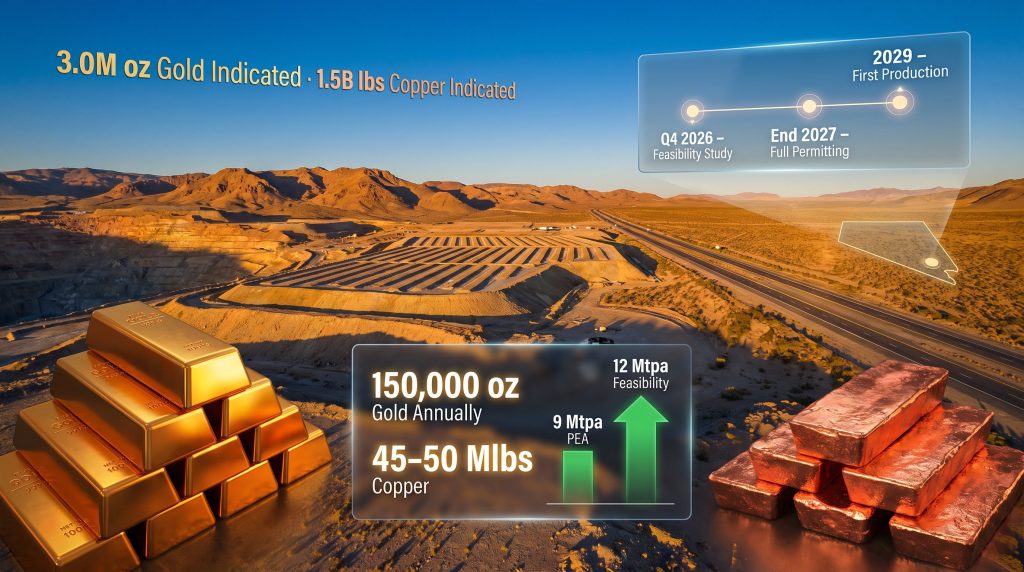
The October 7, 2025 preliminary economic assessment established a processing rate of 9 million tonnes per year with mill commissioning deferred to year six of mine life. By the company's May 2026 update, both parameters had been revised upward and forward, respectively. The P2 Gold Gabbs project feasibility study, targeted for completion by year-end 2026, is now engineering toward a 12 million tonne per year processing rate with the mill brought forward to year three.
These are not incremental adjustments. They represent a structural re-sizing of the production model. In addition, those evaluating copper investment strategies in 2025 will find the revised production targets at Gabbs particularly relevant to their assessments.
Production Target Comparison: PEA vs. Feasibility Study Target
| Metric | October 2025 PEA | Feasibility Study Target (2026) |
|---|---|---|
| Processing Rate | 9 Mtpa | 12 Mtpa |
| Mill Start-Up | Year 6 | Year 3 |
| Avg. Annual Gold Production | 109,000 oz | 150,000 oz |
| Avg. Annual Copper Production | 33 Mlbs | 45-50 Mlbs |
| Mine Life (PEA) | 14.2 years | TBC at FS completion |
| Heap Leach Rate (Years 1-2) | Not specified | 14 Mtpa |
| Mill Rate (Year 3+) | Not specified | 7 Mtpa |
| Heap Leach Rate (Year 3+) | Not specified | 5-7 Mtpa |
The targeted throughput increase of approximately 37% is being achieved without adding new ore tonnes to the resource base. That distinction matters considerably for how investors should interpret the upgrade: the improvement is coming from engineering optimisation of what is already known, not from speculative resource additions.
Why Accelerating the Mill to Year Three Is Significant
Mill-based processing recovers metals at higher rates and from finer particle sizes than heap leach methods can achieve. Deferring mill commissioning to year six, as the original PEA modelled, means the project would spend its first five years leaving recoverable value in the leach pad. Moving that transition forward to year three compresses the timeline to higher-recovery processing and materially improves the cumulative metal output profile across the mine's early, highest-value years.
Combined with the throughput expansion, the revised plan is targeting average annual gold production of 150,000 ounces and copper output of 45 to 50 million pounds, representing increases of approximately 38% and up to 52% respectively over PEA figures. According to P2 Gold's official project update, these revisions reflect meaningful engineering progress rather than speculative assumptions.
How the Staged Production Model Is Structured
Years One and Two: Heap Leach at Scale
The plan sequences a heap leach-only phase during the first two years of operation, processing at 14 million tonnes per year. This approach front-loads lower capital-intensity production to generate early cash flow before the more capital-intensive milling infrastructure is commissioned. For a development-stage project managing construction financing risk, this sequencing is logical: the heap leach phase reduces the capital hurdle at first production while establishing operational cash generation that can contribute to mill construction funding.
Year Three Onward: Dual-Stream Processing
From year three, the operation transitions to a combined circuit running the mill at 7 million tonnes per year alongside continued heap leach processing at 5 to 7 million tonnes per year. This concurrent dual-stream model is central to achieving the targeted 12 Mtpa aggregate throughput figure. It also reflects a processing philosophy increasingly common at large-scale porphyry operations: use coarser, oxide-dominant material for heap leaching while directing sulphide and transition ores through mill circuits where recovery economics justify the additional operating cost.
What the Drilling Results Are Telling the Market
Engineering Holes That Returned Unexpected Mineralisation
In early July 2026, results from a drill programme designed specifically to support mine engineering work, rather than to identify new ore, returned gold-copper mineralisation at the outer edge of the planned pit boundary. These were holes placed to confirm slope stability assumptions and engineering parameters, not to test geological targets. Their return of mineralisation is a meaningful signal: the Lucky Strike zone appears to extend beyond the pit shell currently modelled in the PEA, in every direction tested.
This matters because those results are being incorporated into the updated mineral resource estimate that will underpin the year-end feasibility study. Ground that was allocated only to geotechnical purposes is consequently contributing to the resource model.
High-Grade Intersections Within the Lucky Strike Zone
Exploration drilling at Lucky Strike has also produced notable grade intersections. For instance, within a broader mineralised interval in the zone's quartz monzonite host rock, a sub-section grading approximately 2 g/t gold and 0.35% copper over 65 feet was identified. Careful drill results interpretation at this stage is essential, as the data underpins the updated resource model feeding into the feasibility study. Within that interval, a narrower 5-foot section returned 183 g/t gold and 4% copper, an exceptionally high-grade intersection that, while narrow, confirms the presence of locally intense mineralisation within the broader system.
Notable Drill Highlights at Lucky Strike:
- Broad mineralised interval containing a sub-section of approximately 2 g/t Au and 0.35% Cu over 65 feet
- Within that, a 5-foot interval grading 183 g/t Au and 4% Cu
- Jurassic island arc host geology intruded by monzonite porphyry, geologically distinct from nearby tertiary epithermal systems
- Infill grades running higher than historical drilling implied, with potential upside to modelled resource grades
It is worth emphasising that recent infill grades at Lucky Strike have been exceeding what the historical drilling base implied. If that pattern holds through the updated resource estimate, the feasibility study will be working from a stronger grade foundation than the PEA assumed, independent of any throughput or timeline improvements.
Infrastructure Advantages Already in Place
One of the less-discussed aspects of the Gabbs project is how much of the capital and permitting burden associated with greenfield development has already been eliminated by existing infrastructure.
Infrastructure Status at Gabbs
| Infrastructure Asset | Current Status |
|---|---|
| Highway Access | Paved road direct to site |
| Power Supply | On-site substation and transmission line |
| Water Rights | Secured (subject to Nevada regulatory approval for 12 Mtpa rate) |
| Historical Drill Roads | Extensive network in place |
| Permitting Stage | Dual concurrent permits (Sullivan and Lucky Strike) |
The combination of paved highway access, an on-site power substation with transmission line, and secured water rights eliminates three of the most capital-intensive and time-consuming components of mine construction preparation. The dense network of historical drill roads further reduces new ground disturbance, which carries its own permitting implications in Nevada.
The Dual-Permit Structure and the Gold Ledge Constraint
The project is currently managing two permits concurrently, one covering the Sullivan zone and one covering Lucky Strike. Under current Nevada regulatory requirements, the two permitted areas must remain at least one mile apart. This spatial constraint temporarily limits systematic exploration of the Gold Ledge zone, which sits in the corridor between Sullivan and Lucky Strike.
The Gold Ledge zone is identified as a longer-term exploration target, but its full evaluation awaits resolution of the permit separation requirement. This is a regulatory complexity to monitor, though it does not affect the current feasibility study scope. The broader landscape of mining permits in the United States is also evolving, which may have downstream implications for how dual-permit structures like Gabbs's are managed going forward.
The next major ASX story will hit our subscribers first
Resource Scale and the Path to 5 Million Gold-Equivalent Ounces
The updated mineral resource estimate underpinning the P2 Gold Gabbs project feasibility study reflects 3.0 million ounces of gold (indicated) and 1.5 billion pounds of copper (indicated). These figures represent the resource base from which the 12 Mtpa production model is being engineered.
The company has identified a longer-term exploration target exceeding 5 million gold-equivalent ounces, supported by ongoing drilling that continues to expand known mineralisation at the Lucky Strike zone. That target reflects the combined potential of Sullivan, Lucky Strike, and Gold Ledge, and should be understood as an exploration aspiration rather than a current resource category.
The two primary zones serve complementary roles in the mine plan. Sullivan provides geological continuity and predictable ore characteristics. Lucky Strike, however, is the more dynamic zone, where recent drilling is consistently extending known boundaries and where infill grades are outperforming historical assumptions.
Development Timeline: Key Milestones to First Production
Project Development Schedule
| Milestone | Target Date |
|---|---|
| Feasibility Study Completion | Q4 2026 |
| Updated Mineral Resource Estimate | 2026 |
| Full Permitting | End of 2027 |
| First Production (Heap Leach) | 2029 |
| Mill Commissioning | Year 3 of Mine Life |
The timeline from feasibility completion to first production spans approximately three years, which is consistent with Nevada's permitting framework for projects of this scale. Baseline environmental studies, metallurgical test work, and engineering programmes are described as largely advanced, which should support the Q4 2026 feasibility target without significant schedule risk from those workstreams. The more consequential gating item will be the dual-permit process, where the year-end 2027 target requires both the Sullivan and Lucky Strike permits to advance in parallel.
Key Risks and Variables Investors Should Evaluate
Investors assessing the P2 Gold Gabbs project feasibility study should consider several variables that remain unresolved ahead of the full study publication. A thorough definitive feasibility study process will ultimately confirm or revise many of the targets outlined below.
-
Feasibility divergence from targeted parameters: The 150,000 oz/year gold and 12 Mtpa throughput figures are management targets, not confirmed feasibility outcomes. The full study may revise these figures in either direction based on detailed engineering.
-
Capital expenditure uncertainty: No definitive capital cost figure for the expanded 12 Mtpa plan has been published. The move from 9 Mtpa to 12 Mtpa and the mill acceleration will both affect total construction capital, and that number will be a critical market focus when the feasibility is released.
-
Dual-permit complexity: Running two concurrent permit applications increases regulatory management complexity and introduces the possibility that one permit advances while the other encounters delays.
-
Commodity price sensitivity: Gabbs generates revenue from both gold and copper. The economic profile will be sensitive to the relative price of each at the time of feasibility publication and, more importantly, at the time of any financing decision. A significant shift in the gold-to-copper price ratio could alter the project's economic ranking relative to single-commodity peers.
-
Water rights approval at 12 Mtpa: While water rights are secured, Nevada regulatory approval for the increased 12 Mtpa processing rate remains subject to formal confirmation.
This article contains forward-looking statements and targets provided by P2 Gold (TSX-V: PGLD) as of their May 2026 project update and related disclosures. Production targets, resource estimates, and project timelines are management targets and are subject to change pending completion of the feasibility study. This article does not constitute financial advice. Readers should conduct their own due diligence before making any investment decisions.
Frequently Asked Questions: P2 Gold Gabbs Project Feasibility Study
What is the P2 Gold Gabbs project?
Gabbs is a gold-copper porphyry deposit located in Nevada's Walker Lane trend, approximately 150 miles from Reno. P2 Gold (TSX-V: PGLD) is advancing the project toward a full feasibility study targeted for completion in Q4 2026.
Why was the Gabbs deposit not developed by previous operators?
Earlier exploration programmes in the 1980s and 1990s could not economically process both gold and copper from the same ore simultaneously. The adoption of SART processing technology resolves this dual-metal recovery challenge and is central to the project's current economic viability.
What production levels is the Gabbs feasibility study targeting?
The feasibility study is targeting average annual output of approximately 150,000 ounces of gold and 45 to 50 million pounds of copper, representing increases of approximately 38% and 36-52% respectively compared to the 2025 PEA figures.
What is the planned processing rate under the feasibility study?
The revised plan targets 12 million tonnes per year, up from 9 Mtpa in the October 2025 PEA. In years one and two, the heap leach is planned to process 14 Mtpa, transitioning to a combined heap leach and mill circuit from year three onward.
When is first production targeted at Gabbs?
P2 Gold is targeting first production in 2029, following feasibility study completion in Q4 2026 and full permitting by end of 2027.
What infrastructure is already in place at Gabbs?
The project benefits from paved highway access, an on-site power substation and transmission line, secured water rights, and an established network of historical drill roads, all of which reduce both capital requirements and permitting complexity.
What is the current mineral resource estimate at Gabbs?
The updated estimate reflects 3.0 million ounces of gold (indicated) and 1.5 billion pounds of copper (indicated), with a longer-term exploration target of more than 5 million gold-equivalent ounces.
Readers seeking additional context on the P2 Gold Gabbs project and its feasibility engineering progress can explore related coverage at Crux Investor, which features ongoing analysis of the project's development milestones and throughput decisions.
Ready to Identify the Next Major Gold-Copper Discovery Before the Broader Market?
Discovery Alert's proprietary Discovery IQ model delivers real-time alerts on significant ASX mineral discoveries, instantly translating complex geological and metallurgical data into actionable investment insights for both short-term traders and long-term investors. Explore Discovery Alert's dedicated discoveries page to understand how historic mineral discoveries have generated substantial market returns, and begin a 14-day free trial to position yourself ahead of the next major find.