July 31, 2026
When Mid-Tier Gold Miners Become Senior Producers: The Strategic Logic Behind Scale
The gold mining industry has long operated on a simple but powerful premise: scale changes everything. Larger producers attract institutional capital at lower cost, access deeper debt markets, command premium valuation multiples, and weather commodity price cycles with far greater resilience than smaller peers. Yet crossing the threshold from mid-tier to senior producer status is not merely a matter of growing output. It requires the right combination of asset quality, jurisdictional diversity, reserve depth, and financial firepower, and those conditions rarely align organically. Mergers are how the industry manufactures its next generation of majors.
That structural reality sits at the heart of the equinox and orla merger finalises story, a transaction that closed on July 31, 2026, and fundamentally redraws the competitive map of North American gold production. Furthermore, understanding this deal requires appreciating broader gold M&A activity trends that have been reshaping the sector throughout 2025 and into 2026.
When big ASX news breaks, our subscribers know first
Merger at a Glance: Key Metrics That Define the New Equinox Gold
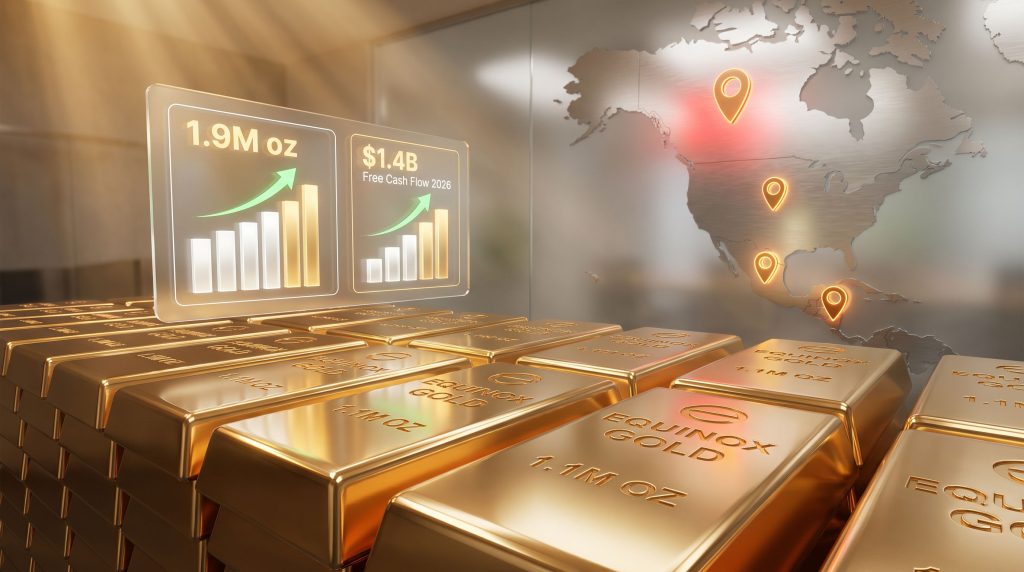
The numbers that emerged from the completed transaction are significant by any measure. The combined entity immediately enters the market producing approximately 1.1 million ounces of gold per year, placing it firmly within the senior producer tier. Beyond current output, the development pathway targeting more than 1.9 million ounces annually represents one of the most credible organic growth profiles among North American gold companies.
Perhaps the most compelling near-term metric is the projected combined free cash flow of approximately $1.4 billion in 2026, a figure that, if realised, would place the new Equinox Gold in direct competition with established senior producers for institutional portfolio allocation.
| Metric | Detail |
|---|---|
| Annual Gold Production (Current) | ~1.1 million oz |
| Development Pathway Target | >1.9 million oz/year |
| Projected 2026 Combined Free Cash Flow | ~$1.4 billion |
| Equinox Shareholder Ownership Post-Close | ~67% |
| Former Orla Shareholder Ownership Post-Close | ~33% |
| Transaction Close Date | July 31, 2026 |
| Orla Shareholder Approval Date | July 22, 2026 |
| Operating Name | Equinox Gold |
How the Transaction Came Together: A Timeline of Key Milestones
The path from announcement to completion followed a structured sequence that required satisfying multiple layers of regulatory and shareholder approval across several jurisdictions. According to mining industry reports, the deal created Canada's second-largest gold miner upon close.
- Merger announced with strategic rationale and deal structure presented to capital markets
- Regulatory and court approvals secured progressively through Q2 and Q3 2026
- Orla shareholder vote passed at a special meeting convened on July 22, 2026
- Transaction closes on July 31, 2026, with the combined company immediately operating under the Equinox Gold name
- Orla Mining shares commence the delisting process from both the Toronto Stock Exchange (TSX) and the New York Stock Exchange (NYSE)
- Q2 2026 results scheduled for August 5, 2026, when consolidated production guidance and proforma merger financials will be disclosed for the first time
The shareholder vote outcome on July 22 reflected broader market confidence in the deal's strategic logic. For Orla shareholders, the exchange represented access to a larger, more liquid vehicle with a broader asset base and greater capital market presence than Orla could have achieved independently.
Geographic Diversification: Why Canada Anchors the New Production Base
One of the most strategically significant aspects of the combined company is its geographic composition. The new Equinox Gold is now the second-largest gold producer in Canada, with the country serving as the primary production engine for the merged entity.
More than 60% of the combined company's production is expected to flow from three long-life mines located in Canada, providing a stable, low-geopolitical-risk production base that underpins the entity's re-rating potential in equity markets.
Canada's position as a leading nation in global gold production is not incidental. The country combines mature mining legislation, well-developed infrastructure, a skilled labour pool, and investor-friendly capital markets through the TSX, making it one of the most desirable operating environments for large-scale gold production globally. The Valentine plant in Newfoundland and Labrador, prominently associated with the combined entity's Canadian footprint, represents a long-life, high-quality processing hub that reinforces the portfolio's production durability.
Beyond Canada, the company maintains complementary operations across:
- The United States, offering additional political stability and well-established permitting frameworks
- Nicaragua, providing lower-cost operating exposure within a Latin American context
- Mexico, a jurisdiction with deep mining heritage and established processing infrastructure
This four-country spread materially reduces single-jurisdiction concentration risk, a factor that institutional investors increasingly weight heavily when evaluating gold producer equity.
Understanding the Senior Producer Hierarchy: Where the New Equinox Gold Fits
The transition from intermediate to senior producer carries specific implications for how equity markets price a company's shares. The mining industry broadly categorises gold producers by output tier, and each tier attracts a different profile of institutional investor. In addition, the relationship between the gold price and mining equities means that senior producer status amplifies the leverage a company has to rising spot prices.
| Producer Tier | Annual Output Range | Key Characteristic |
|---|---|---|
| Major (Tier 1) | >3 million oz/year | Global multi-asset diversification |
| Senior (Tier 2) | 1 to 3 million oz/year | Multi-jurisdiction, reserve-backed |
| Intermediate | 300,000 to 1 million oz/year | Growth-stage or single-region focus |
| Junior | <300,000 oz/year | Exploration or early development |
At 1.1 million ounces per year, the new Equinox Gold comfortably occupies the senior tier. This matters for several compounding reasons:
- Senior producers typically qualify for inclusion in major gold-focused ETFs and equity indices, broadening the passive investor base and improving share liquidity
- Larger free cash flow pools support dividend initiation or buyback programs, which attract income-oriented institutional mandates
- Reserve life index and mineral endowment, two heavily weighted variables in analyst re-rating models, scale proportionally with combined asset portfolios
- Debt financing terms generally improve at senior producer scale, lowering the cost of capital for future development spending
In senior gold producer peer analysis, free cash flow yield and reserve life index are two of the most heavily weighted variables in equity re-rating events. A combined free cash flow projection of $1.4 billion for 2026 positions the new Equinox Gold to compete directly with established North American senior producers for institutional capital allocation.
How Does This Compare to the World's Biggest Operations?
For context, it is worth noting that the combined entity's output, while firmly in the senior tier, remains well below the largest global gold mines, which individually produce several million ounces per year. However, the development pathway to 1.9 million ounces narrows that gap meaningfully over time.
Leadership Transition: A Structured Handover Designed for Continuity
Few aspects of a post-merger integration carry as much market sensitivity as leadership succession. The new Equinox Gold has adopted a sequenced transition structure that prioritises operational continuity while introducing fresh strategic direction at the board level.
Chuck Jeannes has been appointed as incoming Chairperson effective at transaction close. Jeannes brings significant senior mining experience to the role and has articulated a clear vision for the combined company's positioning as a North American senior producer anchored by long-life Canadian assets.
Ross Beaty, the outgoing Chairperson and one of the most prominent figures in the Canadian mining industry, has transitioned to the role of Emeritus Chairperson. He remains available to the company in a special adviser capacity, preserving institutional knowledge during the integration phase without creating governance ambiguity.
Darren Hall, the outgoing CEO of Equinox, will retire from the board at the end of October 2026. Hall's own assessment of the transaction framed it as delivering capabilities that neither company could have accessed independently, including improved market liquidity, reduced standalone operational risk, peer-leading production growth supported by a substantial mineral reserve base, and the financial strength needed to drive meaningful long-term re-rating.
Jason Simpson will assume the CEO role following Hall's departure, giving the organisation a clearly defined transition runway rather than an abrupt handover.
Reconstituted Board Composition
| Board Member | Role |
|---|---|
| Chuck Jeannes | Chairperson |
| Ross Beaty | Emeritus Chairperson / Special Adviser |
| Jason Simpson | Incoming CEO |
| Lenard Boggio | Lead Director |
| Tamara Brown | Director |
| Omaya Elguindi | Director |
| Douglas Foster | Director |
| Blayne Johnson | Director |
| Rob Krcmarov | Director |
| David Stephens | Director |
| Mike Vint | Director |
The reconstituted board blends experience drawn from both legacy companies, which is a deliberate integration mechanism that reduces the cultural friction common in post-merger periods and ensures that Orla's institutional knowledge is retained within the governance structure.
The next major ASX story will hit our subscribers first
What the Growth Pathway to 1.9 Million Ounces Actually Requires
The development target of more than 1.9 million ounces per year is not simply an aspirational headline. It reflects a pipeline of identified growth projects that, when advanced through the capital allocation process, would collectively lift output by approximately 800,000 ounces above current combined production levels.
Understanding what drives that pipeline requires appreciating a fundamental concept in senior gold producer analysis: the reserve life index (RLI). RLI measures how many years of production are supported by proven and probable mineral reserves at current extraction rates. A high RLI signals that a company is not simply producing today's ounces but has the geological inventory to sustain and grow output over a multi-decade horizon.
The mineral reserve endowment of the combined entity is specifically cited as underpinning the production growth pathway, suggesting that the development projects feeding the 1.9 million ounce target are already supported by converted reserve inventory rather than speculative exploration upside. This distinction matters considerably to institutional investors evaluating gold mining stock types and the risk profiles that accompany each category. Reserve-backed growth carries far lower technical and financial risk than exploration-dependent growth, and it supports the credibility of multi-year production forecasts in equity analyst models.
What Former Orla Mining Shareholders Now Hold
For investors who held Orla Mining shares prior to the merger close, the transaction has converted their position into an approximately 33% ownership stake in the combined Equinox Gold, with existing Equinox shareholders retaining approximately 67%. Orla's shares will delist from both the TSX and NYSE following completion, meaning former Orla holders now participate directly in the larger, more liquid Equinox Gold equity on those exchanges.
The value realisation thesis for former Orla shareholders rests on several pillars: the re-rating potential of the combined entity as it qualifies for senior producer index inclusion, the free cash flow generation capacity that the merged balance sheet unlocks, and the diversification benefit of holding exposure across four producing jurisdictions rather than the narrower footprint Orla maintained as a standalone company.
Key Catalysts to Watch: What Comes After July 31
The merger close is not the conclusion of the value creation story. Several near-term catalysts will define how quickly the market re-rates the combined entity. Consequently, investors should follow the official merger announcement details closely as integration milestones are disclosed.
The August 5, 2026 Q2 results presentation will be the first major disclosure of the combined entity's consolidated production guidance and proforma merger financials, a critical inflection point for institutional investors assessing the merger's immediate value creation.
Beyond the Q2 disclosure, investors should monitor:
- Integration milestone updates, including cost synergy realisation timelines and operational consolidation progress
- Development project sequencing decisions that will define which assets are advanced first toward the 1.9 million ounce target
- Capital allocation announcements, including whether the combined free cash flow profile supports dividend initiation, debt reduction, or accelerated project development
- Jason Simpson's strategic priorities once he formally assumes the CEO role following Hall's October departure
- Gold price environment, which at current elevated levels materially amplifies free cash flow generation relative to historical cost structures
Frequently Asked Questions: Equinox and Orla Merger Finalises
When did the Equinox and Orla merger officially close?
The merger was completed on July 31, 2026, following Orla shareholder approval on July 22, 2026, and the satisfaction of all required regulatory and court conditions.
What is the combined company's annual gold production?
The merged entity currently produces approximately 1.1 million ounces of gold per year, with a development pathway targeting more than 1.9 million ounces annually.
Who leads the new combined Equinox Gold?
Chuck Jeannes has been appointed Chairperson. Jason Simpson will assume the CEO role following Darren Hall's retirement from the board at the end of October 2026.
What happens to Orla Mining's stock listing?
Orla Mining's shares will be delisted from both the Toronto Stock Exchange and the New York Stock Exchange following the transaction close.
What ownership stake do former Orla shareholders hold?
Former Orla Mining shareholders hold approximately 33% of the combined company, with Equinox Gold's existing shareholders retaining approximately 67%.
Where does the combined company operate?
The new Equinox Gold operates across four jurisdictions: Canada, the United States, Nicaragua, and Mexico.
What is the combined free cash flow projection for 2026?
The combined entity is projected to generate approximately $1.4 billion in free cash flow during 2026, a figure that reinforces the company's credentials as it finalises the equinox and orla merger finalises transition into the senior producer tier.
This article contains forward-looking statements including production targets, free cash flow projections, and development timelines. These figures are based on company disclosures and projections as at the date of publication and are subject to change. Readers should conduct independent due diligence before making any investment decisions. This article does not constitute financial advice.
Want to Catch the Next Major Gold Discovery Before the Market Does?
Discovery Alert's proprietary Discovery IQ model scans ASX announcements in real time, instantly identifying significant mineral discoveries and translating complex data into actionable opportunities — explore historic discovery returns to understand the scale of what early positioning can achieve, then begin your 14-day free trial at Discovery Alert to secure your market-leading edge.