July 31, 2026
When the Dollar Speaks, Gold Listens
Few relationships in financial markets are as consistently misread by retail investors as the interplay between the U.S. dollar and gold. The common assumption is that gold moves on fear alone, spiking during crises and fading when calm returns. The reality is considerably more mechanical. Because gold is priced in U.S. dollars on international markets, any shift in the dollar's relative strength directly alters the effective purchasing cost for buyers operating in other currencies.
When the dollar strengthens, gold becomes more expensive for overseas buyers even if the underlying demand hasn't changed, and prices tend to soften. Understanding gold and bond dynamics helps explain this mechanism, which sits at the heart of the gold market's behaviour on Friday, July 31, 2026, a session that illustrates perfectly how short-term currency dynamics can obscure longer-term structural trends.
When big ASX news breaks, our subscribers know first
Gold Slips but Remains on Track to End Four-Month Losing Streak
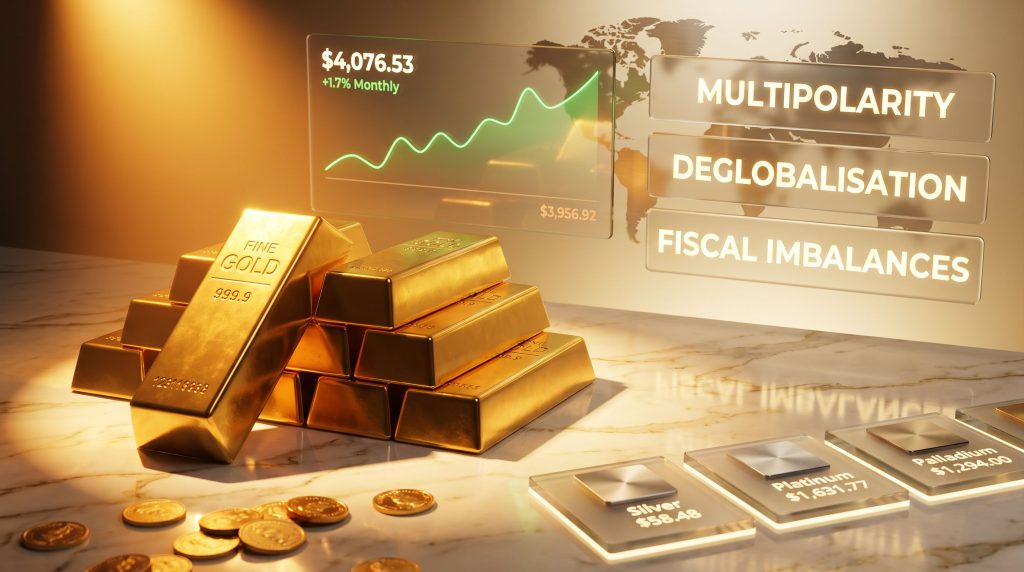
Gold slips but on track to end four-month losing streak — that was the defining headline of the final trading session of July 2026. Spot gold declined 0.6% to $4,076.53 per ounce during early Friday trading, with U.S. gold futures for August delivery falling 0.4% to $4,074.20. The catalyst was a partial recovery in the U.S. dollar, which gained approximately 0.3% after suffering its sharpest single-session collapse since January 2023 the prior day, when it fell 2.4% in one trading session.
That Thursday dollar decline had briefly amplified gold's upward momentum. Friday's reversal consequently triggered profit-taking, with traders locking in gains after the metal's recent run. Despite the intraday weakness, the broader picture remained constructive: gold was tracking a weekly gain of approximately 0.6% and, more significantly, was positioned to close July with a monthly gain of roughly 1.7%, ending a sequence of four consecutive monthly declines.
Tim Waterer, chief market analyst at KCM Trade, noted that gold had been experiencing a mild negative bias driven by profit-taking and the dollar's moderate recovery, while also acknowledging that the $4,000 level had functioned as a reliable demand cushion throughout the month, consistently attracting buyers during dips.
The $4,000 Level: More Than Just a Round Number
In technical analysis, round numbers often carry outsized psychological significance. Traders and algorithms alike tend to cluster orders around these levels, creating self-reinforcing support and resistance zones. The $4,000 per ounce threshold has taken on this character throughout July 2026, repeatedly drawing in buyers whenever prices approached or breached it from above.
This matters beyond the day-to-day chart watching. The $4,000 level represents a significant anchoring point for institutional buyers who may have established cost bases or strategic accumulation targets at or near this price. Its resilience throughout the month helped prevent a deeper correction and ultimately underpinned the monthly recovery.
| Period | Approximate Spot Price | Monthly Direction |
|---|---|---|
| June 30 (month-end close) | ~$3,956.92 | Fourth consecutive monthly decline |
| Mid-July (weekly low) | ~$4,009.38 | Still tracking fourth weekly loss |
| July 31 (Friday intraday) | $4,076.53 | First monthly gain in five months |
| Monthly change (July) | +~1.7% | Streak-ending recovery |
Federal Reserve Policy: The Rate Hike Risk Looming Over Gold
The Federal Reserve kept interest rates unchanged at its most recent policy meeting, with Chair Kevin Warsh offering limited forward guidance on the central bank's next move. That ambiguity has allowed markets to fill in the gaps themselves, and what they are pricing is notably hawkish: CME Group's FedWatch tool currently reflects a 63% probability of a rate hike in September.
For gold investors, this probability carries direct implications. Gold generates no yield, pays no dividends, and offers no coupon. When competing assets such as government bonds, money market instruments, and interest-bearing deposits deliver higher returns, the relative attractiveness of holding gold diminishes. This is the opportunity cost dynamic that has historically weighed on precious metals analysis during rate-hiking cycles.
The critical distinction for investors is between the direction of rates and the pace of rate changes. A single hike already priced into markets may have limited incremental impact on gold, whereas a surprise acceleration in tightening, or conversely a pivot toward pausing hikes, could generate disproportionate price moves.
What makes the current environment particularly complex is the degree of uncertainty embedded in Fed communications. When central banks signal clearly, markets can price assets efficiently. When guidance is opaque, as it has been under the current chair, volatility tends to cluster around policy decision dates, creating both risk and opportunity for precious metals traders.
Why the Opportunity Cost Argument Has Limits
While the rate-gold relationship is real and well-documented, it is not absolute. Several periods in recent financial history have seen gold rise alongside rates, particularly when inflation expectations outpaced nominal rate increases. If real interest rates (nominal rates minus inflation) remain low or negative despite nominal hikes, gold's inflation-hedging appeal can persist even in a tightening cycle.
This nuance is often lost in simplified headlines. Investors who reduce their gold thesis entirely to a rate-direction trade may be underweighting inflation dynamics, currency debasement risks, and structural demand shifts that operate independently of central bank policy.
Geopolitical Flashpoints and the Safe-Haven Premium
Beyond monetary policy, the Middle East continues to inject a geopolitical risk premium into gold pricing. A drone strike that sparked fires aboard two gas vessels at Egypt's Mediterranean port of Damietta introduced fresh uncertainty around Suez Canal shipping operations. This is particularly significant given that the Suez Canal represents one of the last functional major export corridors for Saudi oil amid the ongoing escalation of the U.S.-Iran conflict.
Furthermore, gold's safe-haven role becomes especially pronounced when disruption to this route carries compounding market implications:
- Upward pressure on global energy prices as supply rerouting increases shipping costs and transit times
- Heightened risk aversion across asset classes, historically a positive catalyst for safe-haven demand
- Secondary inflationary effects from energy price spikes, which can reinforce the case for gold as a purchasing power hedge
- Reduced confidence in the stability of global trade infrastructure, a variable that tends to support demand for non-sovereign stores of value
Analysts at BCA Research have framed the current environment not merely as a crisis-driven safe-haven trade but as part of a longer structural transition. Their assessment identifies three compounding forces that are likely to sustain elevated gold demand well beyond any single geopolitical flashpoint.
Three Structural Forces Supporting Long-Term Gold Demand
1. Geopolitical Multipolarity
The post-Cold War era of U.S.-led unipolarity is giving way to a more fragmented international order. As great-power competition intensifies and multilateral institutions lose credibility, demand for non-sovereign assets that sit outside any single country's financial system tends to rise. Gold has served this function across centuries and different geopolitical configurations, and its role appears to be strengthening rather than diminishing in the current environment.
2. Deglobalisation and Supply Chain Fragmentation
The reversal of hyper-globalisation trends introduces persistent inflationary pressures that are structurally different from the demand-driven inflation central banks are equipped to address through rate policy. Supply chain reshoring, trade fragmentation, and the weaponisation of economic interdependence all create long-tail inflation risks that support gold as a store of value. Unlike interest rate-driven inflation, this variety is sticky and difficult to fully suppress through monetary tightening alone.
3. U.S. Fiscal Imbalances
Persistent and growing U.S. deficit spending raises questions about the long-term credibility of dollar-denominated assets. Central bank gold demand, particularly from emerging markets and economies seeking to reduce dollar dependency, has been steadily increasing gold reserve allocations. This buying represents a category of demand that is largely insensitive to short-term price movements and rate cycles, providing a structural demand floor that retail and institutional traders often overlook.
The BCA Research thesis makes a compelling case that investors fixated on the rate cycle as the primary driver of gold are analysing the wrong variable. The structural forces operating beneath the surface are slower-moving but potentially far more durable.
The Broader Precious Metals Complex: A Friday Snapshot
Friday's weakness was not confined to gold. Every major precious metal declined during the session, reinforcing the view that dollar strength rather than metal-specific selling pressure was responsible for the broad-based pullback.
| Metal | Friday Price | Friday Change | Monthly Direction |
|---|---|---|---|
| Gold (Spot) | $4,076.53/oz | -0.6% | Monthly gain (~+1.7%) |
| Silver (Spot) | $58.48/oz | -0.8% | Monthly gain |
| Platinum | $1,631.77/oz | -1.7% | Monthly gain |
| Palladium | $1,294.00/oz | -0.8% | Monthly gain |
Platinum's 1.7% single-session decline was the sharpest of the group, though its monthly trajectory remained positive. The synchronised nature of the decline across all four metals is analytically important: when metals with fundamentally different industrial demand profiles all move in the same direction on the same day, the common variable is almost always currency movement.
This also suggests that the monthly recovery in precious metals was genuinely broad-based rather than a gold-specific phenomenon driven by geopolitical fear alone.
Investor Psychology and the Four-Month Losing Streak Narrative
Market psychology plays a measurable role in how investors interpret streak data. The framing of gold slips but on track to end four-month losing streak carries psychological weight that goes beyond the arithmetic of monthly closes. Extended losing streaks create negative narrative momentum, discouraging new buyers and encouraging existing holders to reduce positions.
The reversal of such a streak, even a modest one, can trigger a sentiment recalibration that amplifies buying interest disproportionate to the fundamental change. This dynamic is well-documented in behavioural finance. Investors tend to extrapolate recent trends, assigning higher probability to continuation than mean reversion actually warrants. When a streak ends, the recalibration of those trend extrapolation assumptions can accelerate price recovery beyond what fundamental analysis alone might justify.
For gold specifically, the shift from a narrative of prolonged decline to one of recovery reactivates a class of momentum and trend-following buyers who had previously been sidelined. Combined with structural support at the $4,000 level and ongoing geopolitical risk premiums, the psychology of streak-ending can act as a force multiplier on price.
The next major ASX story will hit our subscribers first
What July's Recovery Signals for the Months Ahead
Taken together, July's performance offers several instructive signals for the gold price outlook in the months ahead:
- The $4,000 support level demonstrated genuine resilience, absorbing selling pressure across multiple dip attempts throughout the month
- The dollar's extreme single-session volatility (a 2.4% decline followed by a 0.3% recovery) highlights the degree of macro uncertainty that remains embedded in currency markets
- A 63% September rate hike probability represents a meaningful near-term headwind that has not yet fully resolved
- Geopolitical risk in the Middle East is unlikely to de-escalate quickly, maintaining a floor of safe-haven demand
- Structural buying by central banks and sovereign wealth managers provides a demand category that is largely immune to short-term rate sentiment
However, according to broader market reporting, the consensus view amongst analysts is that while near-term volatility remains elevated, the structural backdrop for gold remains broadly supportive as the year progresses.
This article is intended for informational purposes only and does not constitute financial advice. Precious metals prices are volatile and subject to rapid change based on macroeconomic, geopolitical, and currency factors. Forecasts and probability estimates referenced herein reflect market pricing at the time of writing and should not be relied upon as predictive of future outcomes. Investors should consult a qualified financial adviser before making investment decisions.
Want to Stay Ahead of the Next Major Mineral Discovery on the ASX?
While gold's structural tailwinds and currency dynamics shape the broader precious metals landscape, Discovery Alert's proprietary Discovery IQ model scans ASX announcements in real time, instantly identifying significant mineral discoveries and turning complex data into actionable insights — explore the historic returns major discoveries have generated and begin a 14-day free trial to position yourself ahead of the market.