
July 31, 2026
When Capital Costs Rise but the Math Still Works: Decoding the Kinross Lobo-Marte Project Cost Increase
Large-scale open-pit gold development has always operated within a tension between cost certainty and long-term value creation. Feasibility studies are snapshots frozen in time, reflecting labour rates, equipment prices, and engineering assumptions that can shift dramatically across a four-to-five-year development cycle. When those estimates are eventually updated, headline percentage increases often trigger reflexive concern among investors, even when the underlying economics have improved substantially. The Kinross Lobo-Marte project cost increase of 67% is a textbook example of this dynamic, and understanding what sits beneath that figure matters far more than the number itself.
When big ASX news breaks, our subscribers know first
Lobo-Marte Within Kinross' Strategic Architecture
Situated roughly 160 km east of Copiapó in Chile's Atacama region, Lobo-Marte occupies a uniquely advantaged position within Kinross Gold's (TSX: K; NYSE: KGC) portfolio. Its location within 50 km of both the La Coipa and Maricunga operations means Kinross is not approaching this as a blank-canvas greenfield build. Existing knowledge of regional geology, contractor relationships, grid infrastructure, and logistical networks all reduce the execution unknowns that typically inflate both costs and timelines for remote mining developments.
Strategically, the project is designed to extend Kinross' Chilean operational footprint through the 2040s, a timeframe that speaks to the company's long-range capital planning horizon. For a senior gold producer managing portfolio longevity, having a 15-year producing asset anchored in a jurisdiction with established operations represents meaningful optionality. Furthermore, the gold price outlook for the coming decade adds further weight to developing such a substantial resource base.
The Scale of the Resource Base
The magnitude of Lobo-Marte's mineral inventory is central to understanding its strategic importance:
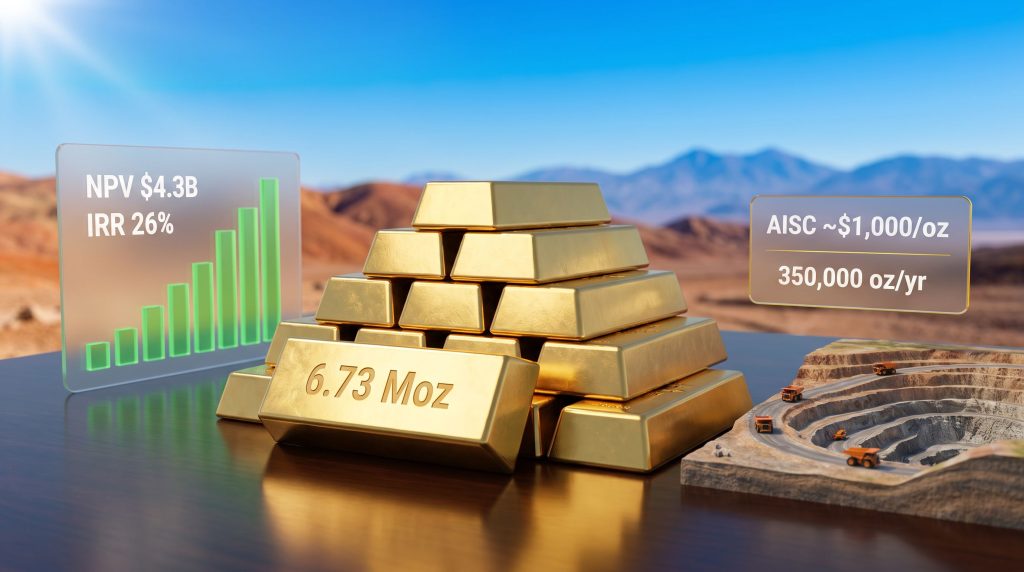
- Proven and probable reserves: 160.7 million tonnes at 1.3 g/t gold, containing 6.73 million ounces
- Indicated resources: 120.8 million tonnes at 0.71 g/t for 2.75 million ounces
- Inferred resources: 32.9 million tonnes at 0.63 g/t for 670,000 ounces
- Both the Marte and Lobo deposits remain open at depth, suggesting resource expansion potential beyond current estimates
The initial mine plan targets recovery of approximately 4.6 million ounces, meaning a substantial portion of the total resource base sits outside the current reserve pits. This creates a layer of optionality that is not reflected in the base-case economics.
Dissecting the 67% Capital Cost Increase
The Kinross Lobo-Marte project cost increase to $1.8 billion USD (C$2.5 billion) from the 2021 feasibility study figure has drawn attention, but framing it correctly requires looking at each contributing factor individually. The increase is not the product of a single systemic failure; it reflects a combination of macroeconomic forces, deliberate strategic decisions, and conservative engineering practice. In addition, the relationship between gold price and miners illustrates why rising project costs do not necessarily translate into diminished investor returns.
Capital Cost Breakdown
| Cost Component | Estimated Value |
|---|---|
| Total Initial Capital (USD) | ~$1.8 billion |
| Total Initial Capital (CAD) | ~C$2.5 billion |
| Direct Spending | ~$1.1 billion |
| Indirect Costs and Contingency | ~$700 million |
| Process Facilities | ~$490 million |
| Site Work and Infrastructure | ~$410 million |
| Contingency Rate | 19% (up from 14%) |
What Actually Drove the Increase?
Kinross Chief Technical Officer Will Dunford outlined the contributing factors during the company's Q2 2026 earnings call. Rather than a single cost blowout, the increase reflects several distinct layers:
- Inflation: More than $400 million of the total increase is directly attributable to materials, labour, and equipment cost inflation accumulated since the original 2021 estimate. This alone accounts for the majority of the escalation.
- Strategic equipment procurement decision: An additional ~$100 million was added after Kinross elected to purchase new mining equipment rather than repurpose machinery from its adjacent Maricunga operation. This was a deliberate choice to preserve Maricunga as an independent development asset, not a cost management failure.
- Construction planning revisions: Updated execution strategies and higher indirect costs account for a meaningful portion of the remaining increase, reflecting more current contracting environments.
- Elevated contingency buffer: The contingency rate was raised from 14% to 19%, acknowledging that four years had elapsed since the detailed engineering underpinning the original study was completed. A higher contingency on a stale estimate is standard risk management practice, not a signal of project deterioration.
Is This the Final Number?
This is a critical distinction that investors should fully absorb. The $1.8 billion figure is an interim, high-level estimate based on a refresh of the 2021 feasibility study economics, not a ground-up detailed engineering exercise. Kinross retained the original pit designs and reserve base specifically to avoid disrupting the environmental permitting process, which is built on years of accumulated baseline data that cannot be quickly recreated.
Understanding what a definitive feasibility study entails helps contextualise why this interim figure differs meaningfully from a fully engineered capital cost. Consequently, this $1.8 billion should be treated as a planning-stage benchmark, and a more definitive, engineering-grade capital cost will be issued after detailed engineering is complete — that figure could move in either direction depending on market conditions at the time.
How the Returns Profile Holds Up Against Higher Costs
The economic case for Lobo-Marte has not weakened alongside the capital cost increase. In fact, the NPV expansion since 2021 dwarfs the cost escalation in relative terms, driven by a structurally higher gold price environment.
Project Economics at Two Gold Price Scenarios
| Metric | At $4,100/oz Gold | At $3,500/oz Gold |
|---|---|---|
| Post-Tax NPV | $4.3 billion | $3.2 billion |
| Internal Rate of Return | 26% | 22% |
| Payback Period | 2.3 years | 2.7 years |
| Annual Gold Production | ~350,000 oz. | ~350,000 oz. |
| Mine Life | 15 years | 15 years |
| All-In Sustaining Cost (AISC) | ~$1,000/oz. | ~$1,000/oz. |
The NPV-to-capex ratio of approximately 2.4x at the $4,100/oz gold price is a compelling benchmark for a large-scale open-pit heap-leach operation. For context, many mid-tier gold development projects that attract institutional capital sit in the 1.5x to 2.0x NPV-to-capex range. Lobo-Marte's ratio reflects the project's combination of high heap-leach grade, low processing costs, and a lean strip ratio.
Analyst commentary from Scotiabank following the earnings release noted that the capital estimate came in approximately 10% below prior modelling, while projected mine operating costs were roughly 30% lower than anticipated. BMO Capital Markets maintained an outperform rating on Kinross despite trimming its target price, affirming that the project continues to support significant valuation upside.
The Operational Design and What Makes It Competitive
Mine Plan Structure
Lobo-Marte is designed around sequential open-pit mining of the Marte and Lobo deposits using conventional truck-and-shovel methods. The processing configuration centres on a three-stage crushing and heap-leach circuit rated at 35,000 tonnes per day.
Key operational parameters:
- Total ore processed over mine life: 161 million tonnes
- Gold recovery rate: 69%
- Waste-to-ore strip ratio: 2:1, lean by open-pit industry standards
- Peak mining rate: 50 million tonnes per year
Unit Operating Costs
| Cost Category | Estimated Unit Cost |
|---|---|
| Mining Cost | $3.25 per tonne |
| Processing Cost | $12.30 per tonne |
| All-In Sustaining Cost | ~$1,000 per oz. |
The processing cost of $12.30 per tonne is notably competitive. Heap-leach operations benefit from lower capital intensity and operating costs relative to conventional milling circuits, but the typical trade-off is lower gold recovery. At Lobo-Marte, a feed grade of 1.3 g/t partially offsets this recovery limitation, making the operation's margin per tonne processed materially higher than most heap-leach peers.
It is worth understanding why cut-off grade economics matter so acutely in heap-leach processing. The leaching process extracts gold through chemical percolation rather than fine grinding and flotation, meaning the ore's inherent gold content has an outsized influence on per-ounce economics. A heap-leach operation running at 1.3 g/t is operating well above the industry norm for this processing method, which typically sits closer to 0.7 to 0.9 g/t at comparable operations globally.
Infrastructure Design and Sustainability Features
The remote Atacama location requires purpose-built infrastructure:
- A 75-km access road to connect the site to regional networks
- A 60-km power transmission line tied to Chile's national grid
- A 40-km water pipeline connected to the well field currently supplying La Coipa
The design incorporates renewable grid power, electric shovels, and covered conveyors to manage dust in the sensitive Atacama environment and reduce the operational carbon intensity of the project.
Growth Optionality Beyond the Base Case
The Pit Optimisation Gap
One of the least discussed but most consequential aspects of Lobo-Marte's value profile is the gap between the pit shells used in the current mine plan and what those shells would look like if re-optimised at today's gold prices. The 2021 pit designs were modelled at a $1,200/oz gold price, a figure now substantially below current market levels.
In open-pit mining economics, pit optimisation software generates Lerchs-Grossmann shells, which define the outermost economic boundary of the pit at a given metal price. As that price assumption rises, the optimal shell expands to incorporate ore that was previously sub-economic at the margin. At gold prices significantly above $1,200/oz, a fresh optimisation exercise at Lobo-Marte would almost certainly generate materially larger pit boundaries.
What the Resource Base Suggests
The combination of 2.75 million indicated ounces and 670,000 inferred ounces sitting largely outside current pit boundaries represents a meaningful resource conversion opportunity. Both deposits remain open at depth, and gold drilling results from future programmes targeting down-dip extensions could add further tonnes to the resource inventory before any pit re-optimisation is completed.
Kinross has made a deliberate decision to defer this work until after production commences, a rational choice given that the already-permitted plan supports mining through the 2040s. Re-optimising pits at higher gold prices post-commissioning, when operational cash flows are available to fund drilling, represents a low-risk value creation pathway.
The next major ASX story will hit our subscribers first
Permitting Timeline and Development Pathway
Chile's Environmental Assessment Service formally accepted Lobo-Marte's environmental impact application for review in April 2026. The anticipated review duration of two to three years is consistent with Chile's established regulatory process for large-scale mining applications, which involves technical assessment by multiple government agencies and a structured public consultation process. Kinross has outlined its confidence in this timeline, describing the permitting acceptance as an exciting project milestone.
Key development milestones:
- Environmental review completion: anticipated 2028 to 2029
- Construction commencement: targeted near end of the decade
- First gold production: forecast for the early 2030s
Funding the Build Without Balance Sheet Stress
Kinross has indicated its intention to fund the three-year construction programme entirely from operating cash flow, without requiring debt issuance or equity dilution. The company's balance sheet as at June 30, 2026 provides considerable room to execute this:
- Cash position: $2.7 billion
- Net cash: $1.9 billion
- Total liquidity: approximately $4.4 billion
A $1.8 billion construction programme funded from operating cash flow against a $4.4 billion liquidity base means Kinross can build Lobo-Marte without compromising its dividend, buyback capacity, or flexibility to pursue other opportunities in its pipeline.
Lobo-Marte's Role in Kinross' Grade Enhancement Strategy
Dunford described Lobo-Marte as a central pillar of Kinross' grade enhancement strategy during the Q2 earnings call, citing the combination of low mining cost, low processing cost, high heap-leach grade, and resource scale as the defining characteristics that place it at the core of the company's portfolio evolution.
The AISC contrast is stark. Lobo-Marte's projected ~$1,000/oz. AISC sits well below Kinross' current group-wide Q2 2026 AISC of $1,821/oz., underscoring the margin-accretive impact of bringing this asset into production. However, it is worth noting that the Lobo-Marte pre-feasibility results already signalled this competitive cost profile several years prior to the updated 2026 estimate.
Kinross Q2 2026 Operating Snapshot
| Metric | Q2 2026 Result |
|---|---|
| Adjusted EPS | 71¢ per share |
| Attributable Free Cash Flow | $726.8 million |
| Gold Production | 477,879 oz. |
| Silver Production | 761,479 oz. |
| Year-over-Year Production Change | -4% |
| All-In Sustaining Cost | $1,821/oz. (+22% YoY) |
| Full-Year Production Guidance | 2 million gold-equivalent oz. |
| Full-Year AISC Guidance | $1,730/oz. |
A 37% rise in Kinross' realised gold price during the quarter more than offset the lower production volumes and elevated sustaining costs, driving $726.8 million in attributable free cash flow. The adjusted EPS of 71¢ beat Scotiabank's 66¢ estimate, though analysts characterised the beat as largely tax-driven rather than reflecting operational outperformance.
Frequently Asked Questions: Kinross Lobo-Marte Project Cost Increase
What is the Kinross Lobo-Marte project?
Lobo-Marte is a large-scale open-pit, heap-leach gold development project in Chile's Atacama region. It holds proven and probable reserves of 6.73 million ounces and is designed to produce around 350,000 ounces per year over a 15-year mine life at an AISC of approximately $1,000/oz.
Why did the Lobo-Marte capital cost increase by 67%?
The increase from the 2021 feasibility study reflects four compounding factors: inflation accounting for over $400 million, a strategic decision to purchase new mining equipment rather than reuse Maricunga machinery (~$100 million), revised construction planning and higher indirect costs, and a contingency provision raised from 14% to 19% to reflect the four-year gap since original detailed engineering.
Is the $1.8 billion figure a final capital cost?
No. Kinross has described this as an interim, high-level estimate. A more precise engineering-grade capital cost will be published after detailed engineering is complete.
What is the NPV of Lobo-Marte after the cost increase?
At $4,100/oz gold, the post-tax NPV is estimated at $4.3 billion with a 26% IRR and 2.3-year payback. At $3,500/oz, the NPV is $3.2 billion with a 22% IRR and 2.7-year payback.
When will Lobo-Marte begin production?
Subject to environmental review completion (expected within two to three years from April 2026), construction is anticipated near the end of the decade with first gold production targeted for the early 2030s.
How will Kinross fund the Lobo-Marte build?
Kinross plans to fund the three-year construction programme from operating cash flow. As of June 30, 2026, the company held approximately $4.4 billion in total liquidity. Furthermore, Kinross' broader $3 billion Chile strategy underscores the company's long-term conviction in the district's development potential.
Key Takeaways: Evaluating the Lobo-Marte Cost-Benefit Equation
- The 67% capital cost increase is substantial but explainable, with inflation alone accounting for the majority of the escalation
- An NPV-to-capex ratio of ~2.4x at current gold prices reframes the narrative as value creation rather than cost blowout
- The $1.8 billion estimate is not a final figure; a detailed engineering-grade cost update will follow and could revise this in either direction
- Lobo-Marte's 1.3 g/t heap-leach grade positions it as a genuinely premium asset within its processing category globally
- Pit re-optimisation at higher gold prices and depth extensions at both deposits represent a meaningful but currently unpriced upside layer
- A $4.4 billion liquidity position means Kinross can fund construction without balance sheet compromise
Disclaimer: This article contains forward-looking statements and financial projections that are subject to material risks and uncertainties. Gold price assumptions used in NPV and IRR calculations are not guaranteed to materialise. Readers should conduct their own due diligence and consult a qualified financial adviser before making investment decisions. Capital cost estimates referenced in this article are interim figures and are subject to revision following detailed engineering.
Want to Track the Next Major ASX Mineral Discovery Before the Market Moves?
Discovery Alert's proprietary Discovery IQ model scans ASX announcements in real time, instantly identifying significant mineral discoveries and turning complex data into actionable investment insights — explore the historic returns major discoveries have generated to understand the opportunity, then begin a 14-day free trial at Discovery Alert to position yourself ahead of the broader market.