July 30, 2026
When Regulatory Walls Stop Billion-Dollar Deals in Their Tracks
Cross-border mining acquisitions have never been purely about price. Behind every headline-grabbing takeover bid sits an architecture of regulatory approvals, geopolitical risk assessments, and sovereign-level scrutiny that can quietly dismantle even the most strategically compelling transaction. When the acquiring party is a Chinese state-linked mining giant and the target holds assets in one of West Africa's most volatile jurisdictions, that regulatory architecture becomes particularly formidable.
The collapse of Zijin Mining's proposed full acquisition of Allied Gold is a textbook case study in how Chinese outbound investment controls interact with frontier market risk to reshape cross-border M&A outcomes. What emerged in its place, the Zijin Allied Gold stake deal, offers a window into how China's largest resource companies are adapting their global growth strategies when full control proves unattainable.
When big ASX news breaks, our subscribers know first
The Structure of the Replacement Transaction
From C$5.5 Billion Acquisition to a US$295 Million Minority Stake
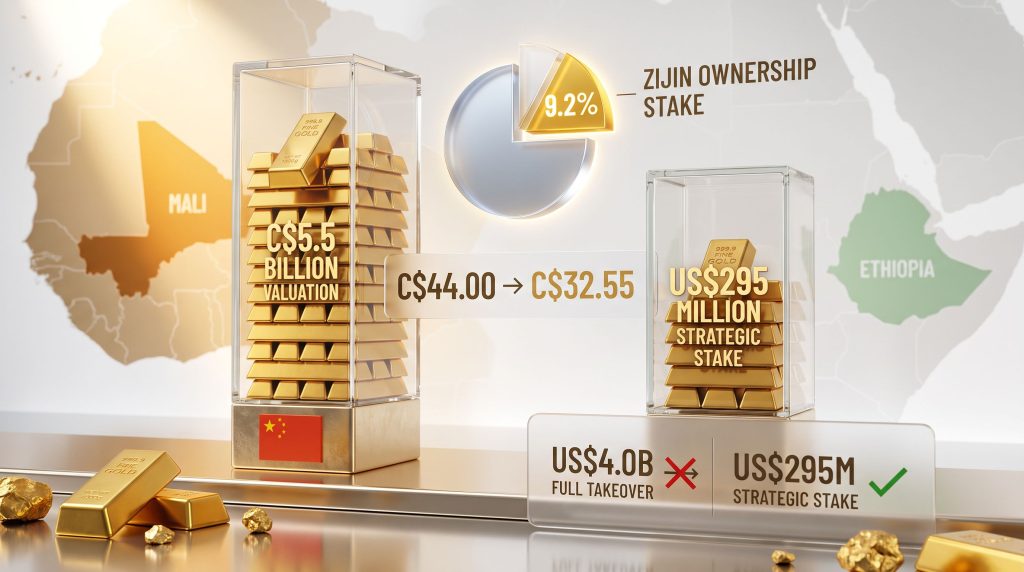
When Zijin Mining Group's international arm first announced its intention to acquire Allied Gold in January 2026, the terms were unambiguous: a full takeover priced at C$44 per share, valuing the Canadian-listed gold producer at approximately C$5.5 billion (US$4.0 billion). Allied Gold shareholders approved the transaction in March 2026, clearing one of the key hurdles in the deal's path to completion.
What followed was a protracted regulatory holding pattern that ultimately proved insurmountable. By the time the deal's extended outside date of July 29, 2026 arrived, the conditions required to close the transaction had not been satisfied, and Allied Gold confirmed there was no realistic expectation they would be fulfilled within any reasonable additional timeframe.
The replacement transaction announced simultaneously on July 29 operates on an entirely different structural footing:
- Zijin Gold International subscribes for approximately 12.8 million new Allied common shares
- The subscription price is set at C$32.55 per share, based on Allied's 30-day volume-weighted average price (VWAP)
- Total proceeds raised amount to approximately US$295 million (C$417 million)
- Upon completion, Zijin will hold approximately 9.2% of Allied Gold's issued and outstanding common shares
- The transaction requires TSX and NYSE approval, with closing targeted around August 10, 2026
- Critically, no change of control is triggered
*The pivot from a C$5.5 billion full acquisition to a US$295 million minority placement represents a deal value reduction of approximately 93%, making this one of the most dramatic restructurings of a Chinese-backed mining M&A transaction in recent memory.*
Side-by-Side Transaction Comparison
| Parameter | Original Takeover | Replacement Stake Deal |
|---|---|---|
| Deal structure | Full acquisition | Private placement / minority stake |
| Price per share | C$44.00 | C$32.55 |
| Total deal value | ~C$5.5B (US$4.0B) | ~C$417M (US$295M) |
| Zijin ownership post-deal | ~100% | ~9.2% |
| Pricing basis | Negotiated premium | 30-day VWAP |
| Regulatory path | Full M&A approvals | TSX + NYSE listing approval |
| Allied control outcome | Change of control | No change of control |
Why the Original Takeover Failed
China's NDRC and the Mechanics of Outbound Investment Review
China's National Development and Reform Commission (NDRC) functions as the primary gatekeeper for large outbound capital deployments by Chinese entities. Its review mandate extends beyond simple financial scrutiny to encompass strategic risk assessments, including the geopolitical exposure of target assets and the reasonableness of acquisition premiums relative to intrinsic valuations.
In the case of the Allied Gold acquisition, the NDRC raised two distinct categories of concern:
- The premium paid by Zijin relative to Allied's prevailing market valuation, which regulators viewed as potentially excessive
- Geopolitical risk concentration arising from Allied's operational exposure to Mali in West Africa
It is worth noting that the NDRC's scrutiny of acquisition premiums reflects a broader policy posture that emerged more forcefully after several high-profile Chinese overseas mining investments delivered disappointing returns. Chinese regulators have grown increasingly attentive to whether the strategic rationale of an outbound deal justifies its pricing, particularly in volatile commodity environments. Consequently, understanding the geopolitical mining risks involved has become essential for any cross-border resource transaction of this scale.
The Mali Factor: Understanding Why Sadiola Complicated Everything
Allied Gold's highest-producing current asset is the Sadiola gold mine in Mali, a project with genuine scale but situated in a country experiencing active security deterioration. Sadiola is a large-tonnage, open-pit operation processing ore through conventional carbon-in-leach circuits, with the mine's economics underpinned by its capacity to process lower-grade material at volume. Its importance to Allied's production profile is substantial.
The geopolitical problem is equally substantial. Mali's Sahel region has experienced a documented and widening expansion of militant activity from both jihadist networks and separatist armed groups. As reported by MiningMX, Islamist militants have widened their reach across Sahel mining zones, creating a security environment that poses material operational risk for companies with assets in the corridor.
For Chinese regulators assessing an outbound acquisition, concentrating billions of dollars of Chinese capital in a jurisdiction with this risk profile was always going to face resistance. The NDRC's concerns about Mali exposure were not abstract — they reflected a concrete assessment of sovereign risk that the deal's premium pricing did not adequately compensate for in their view.
Gold Price Dynamics and Valuation Complexity
When the original takeover was announced in January 2026, gold was trading at approximately $5,000 per ounce, a level that already reflected extraordinary safe-haven and monetary demand. Furthermore, the gold price outlook for the year had introduced significant complexity into valuation modelling. Gold subsequently surged to an all-time high above $5,400/oz before pulling back amid geopolitical developments, particularly events involving US military action against Iran.
This price trajectory introduced a paradox. Rising gold prices should, in theory, make a gold mine acquisition more attractive. However, from a regulatory approval standpoint, a gold price surge that followed the announcement effectively made the original C$44/share premium appear even more stretched against the backdrop of a volatile spot price that could reverse. Chinese regulators assessing long-term capital deployment risks are unlikely to anchor valuation models to all-time high spot prices.
The Timeline That Ran Out
| Milestone | Date |
|---|---|
| Original deal announced | January 2026 |
| Allied shareholder approval | March 2026 |
| Original outside date | May 29, 2026 |
| Extended outside date | July 29, 2026 |
| Termination confirmed | July 29, 2026 |
| Stake deal announced | July 29, 2026 |
| Stake deal expected to close | ~August 10, 2026 |
The extension from May 29 to July 29 bought additional time but did not resolve the underlying NDRC objections. By the time the final deadline arrived, Allied Gold's own assessment was that there was no realistic pathway to satisfying the regulatory conditions within any reasonable further period.
How Allied Gold Plans to Deploy the $295 Million
Capital Allocation Across a Two-Asset Growth Strategy
The proceeds from the Zijin stake placement are earmarked across three operational priorities:
- Kurmuk Mine Ramp-Up (Ethiopia): Kurmuk represents Allied Gold's primary near-term production growth catalyst. Located in Ethiopia's Benishangul-Gumuz region, the project is at an advanced development stage and requires capital to accelerate its production ramp toward nameplate capacity. Notably, Ethiopia presents a geopolitically distinct risk profile from Mali — one that Chinese regulators were likely more comfortable with in the context of a minority investment rather than full ownership.
- Sadiola Phased Expansion (Mali): Despite the security concerns that complicated the full acquisition, Allied remains committed to advancing Sadiola's staged capacity expansion. The economics of scaling a large open-pit gold system like Sadiola are compelling at elevated gold prices, provided operational continuity can be maintained.
- Exploration Programs: A portion of the capital will fund resource definition drilling and greenfield exploration across Allied's portfolio, extending the company's longer-term production optionality.
With US$295 million in fresh capital secured at a discount to the failed takeover price, Allied Gold retains full operational independence while gaining a strategically aligned anchor shareholder. This outcome preserves management flexibility without ceding control — arguably a more durable outcome for Allied's long-term shareholder base than an outright acquisition at a premium that Chinese regulators were unwilling to approve.
What the Zijin Allied Gold Stake Deal Signals About Chinese M&A Strategy
The Strategic Minority Stake as a Regulatory Workaround
The outcome of the Zijin Allied Gold stake deal reflects a pattern that has become increasingly visible in Chinese resource sector investment strategy. When full acquisitions face regulatory barriers, strategic minority positions offer a compliant alternative that preserves meaningful exposure without triggering the full weight of NDRC review. This development also mirrors broader trends in gold M&A activity across global markets, where deal structures are evolving in response to regulatory and geopolitical headwinds.
A minority stake at 9.2% achieves several objectives that a blocked full acquisition cannot:
- Maintains financial exposure to Allied's gold production upside at spot prices above $5,000/oz
- Establishes a board-level relationship and information rights that position Zijin for future consolidation if regulatory conditions ease
- Avoids the sovereign risk concentration that triggered NDRC objections, since a minority stake does not make Zijin operationally responsible for assets in Mali
- Creates a potential offtake negotiation pathway without the commercial and regulatory complexity of direct ownership
Geopolitical Risk Pricing and the Africa Premium Discount
One of the less-discussed dimensions of this transaction's collapse is what it reveals about how Chinese regulatory bodies are pricing African political risk into outbound investment approvals. The Mali-Ethiopia corridor represents some of the most prospective undeveloped gold geology on the continent, but the security environment in the Sahel has materially altered the risk calculus for large-scale capital commitments.
The NDRC's reluctance to approve a full acquisition premium for Allied's African asset base suggests Chinese regulators are applying an explicit geopolitical risk discount to frontier market mining acquisitions, particularly in jurisdictions where state authority is contested. This dynamic has implications well beyond the Zijin Allied Gold stake deal, potentially reshaping how African gold producers are valued in any cross-border M&A process involving Chinese acquirers. In addition, Zijin's geopolitical expansion approach more broadly appears to be recalibrating toward structures that minimise sovereign exposure.
Strategic Scenarios for Zijin's 9.2% Anchor Position
Three Pathways Forward
The nature of a 9.2% minority stake creates genuine optionality for both parties. Three distinct scenarios are plausible over the medium term:
Scenario A: Pathway to Future Acquisition
If Chinese regulatory conditions soften, if gold prices stabilise at levels that make the acquisition economics more straightforward to justify, or if Mali's security situation improves materially, Zijin's existing stake provides the foundation for a renewed full acquisition attempt. Creeping acquisitions — where a strategic investor incrementally increases ownership over time — are a well-established mechanism in mining M&A. Furthermore, Zijin's global expansion strategy suggests the group remains committed to building meaningful positions in tier-one gold assets wherever regulatory pathways allow.
Scenario B: Long-Term Strategic Partnership
Zijin maintains and potentially builds its minority position over time, using its shareholder relationship to negotiate offtake agreements, technical collaboration arrangements, or joint venture rights on specific Allied assets. This model has precedent in Chinese resource investment strategy, particularly for assets in jurisdictions where operational control is impractical.
Scenario C: Dilution or Orderly Exit
If Allied pursues additional capital raises or Zijin's strategic priorities shift, the 9.2% position could be diluted through subsequent equity issuances or divested in the secondary market. This represents the lowest-value outcome for Zijin's strategic ambitions but preserves financial flexibility.
The next major ASX story will hit our subscribers first
Valuation Implications for Allied Gold Shareholders
The 26% Discount Problem
Allied Gold shareholders who approved the original C$44 per share acquisition now face a market reality where the effective new entry price for Allied's largest single shareholder is C$32.55 per share, representing a 26% discount to the original takeover price. This repricing carries an uncomfortable signal about Allied's perceived standalone valuation in the absence of a full control premium.
It is important to note, however, that the C$32.55 subscription price is anchored to a 30-day VWAP, meaning it reflects actual market trading levels rather than a distressed discount. The gap between C$44 and C$32.55 is better understood as the difference between a negotiated control premium and an arm's-length market price — a distinction that matters considerably for how investors should interpret Allied's fundamental value.
Disclaimer: This article contains forward-looking statements, scenario analysis, and financial commentary based on publicly available information. It does not constitute financial advice. Investors should conduct their own due diligence and consult qualified financial advisers before making investment decisions.
FAQ: Zijin Allied Gold Stake Deal Explained
Why did the Zijin Allied Gold takeover fail?
China's National Development and Reform Commission did not clear the full acquisition within the required timeframe. Regulatory concerns centred on the premium being paid and the geopolitical risks tied to Allied's operations in Mali.
What is the value of the Zijin Allied Gold stake deal?
Approximately US$295 million (C$417 million), structured as a private placement of 12.8 million new Allied common shares at C$32.55 per share.
How much of Allied Gold will Zijin own?
Approximately 9.2% of Allied Gold's issued and outstanding shares upon completion.
When does the stake deal close?
Closing was targeted for around August 10, 2026, subject to TSX and NYSE approval.
What will Allied Gold do with the $295 million?
Proceeds are directed toward the Kurmuk mine ramp-up in Ethiopia, the phased expansion of Sadiola in Mali, and broader exploration activities.
What was the original takeover price?
The original deal was priced at C$44 per share, valuing Allied Gold at approximately C$5.5 billion (US$4.0 billion).
Want to Track the Next Major Gold Discovery Before the Market Catches On?
Discovery Alert's proprietary Discovery IQ model scans ASX announcements in real time, instantly identifying significant mineral discoveries and turning complex data into actionable insights for both traders and long-term investors — explore historic examples of major discovery returns to understand the potential at stake, and begin your 14-day free trial at Discovery Alert to position yourself ahead of the broader market.