
July 31, 2026
Nevada's Heap-Leach Gold Sector Is Built on Operational Evidence, Not Exploration Promise
In gold mining, the gap between promise and proof is where most value is either created or destroyed. Across the Great Basin of the western United States, a long lineage of open-pit, heap-leach gold operations has demonstrated something that exploration geologists and capital markets analysts alike have come to appreciate: real production data is the most powerful geological tool available. When an operating mine commissions a full feasibility study informed by years of actual throughput, recovery rates, and cost performance, the resulting document occupies an entirely different category of reliability than anything produced from desktop modelling alone.
That context is essential for understanding what the Integra Florida Canyon feasibility study represents. Filed on July 30, 2026, with an effective date of May 31, 2026, and prepared by independent consultants Global Resource Engineering Ltd., the study draws on nearly two years of operational history to reframe the long-term economics of a mine already in production.
When big ASX news breaks, our subscribers know first
From Operating Asset to Bankable Platform: What a Full Feasibility Study Actually Signals
Mining projects move through a defined hierarchy of technical studies. A Preliminary Economic Assessment explores theoretical viability with minimal drilling data. A Pre-Feasibility Study narrows assumptions using more representative sampling. A definitive feasibility study, by contrast, is designed to meet the standard required for project financing from institutional lenders, providing the level of confidence needed to underwrite capital commitments.
When a producing mine completes a bankable feasibility study rather than a greenfield one, the signal is qualitatively different. It is not an exploration company trying to attract capital into an uncertain asset. It is an operating business using empirical performance to formally redefine its reserve base, production profile, and economic potential within a rigorous technical framework. The distinction matters enormously for how investors should weight the credibility of reported figures.
Why Independent Authorship Matters to Institutional Investors
Global Resource Engineering Ltd.'s role as lead author and consultant on the Florida Canyon report is not a bureaucratic formality. Under NI 43-101 standards, the technical report must be authored by a Qualified Person who is independent of the company. This independence requirement ensures that reserve classifications, recovery assumptions, and economic projections cannot be unduly influenced by management optimism. For institutional investors conducting due diligence, an independently authored feasibility study provides a credible foundation for financial modelling in a way that internally prepared studies cannot replicate.
Florida Canyon's Geological Setting and Operational Foundation
Florida Canyon sits within Pershing County in northwestern Nevada, a region that forms part of the broader Great Basin gold belt. Pershing County has hosted heap-leach gold mining for decades, and the jurisdiction is characterised by relatively streamlined permitting frameworks compared to many other western US states, established mine services infrastructure, and a workforce with deep heap-leach operational experience.
Heap-leach processing is fundamentally suited to low-to-medium grade, oxidised ore bodies. In this method, crushed ore is stacked onto lined pads, and a dilute cyanide solution is applied to the surface. As the solution percolates through the ore, it dissolves gold particles, which are then recovered through carbon adsorption or Merrill-Crowe processes. The capital cost profile is substantially lower than milling-based alternatives, making heap-leach operations highly sensitive to gold price upside and relatively capital-efficient to sustain.
Florida Canyon operates on this conventional model, and the updated mine plan deliberately leverages the existing crushing circuit and site infrastructure. Avoiding a major processing plant rebuild removes a layer of capital execution risk that has derailed many mid-tier gold projects elsewhere.
How Two Years of Production Data Transformed the Reserve Picture
Breaking Down the 74% Reserve Increase to 1.19 Million Ounces
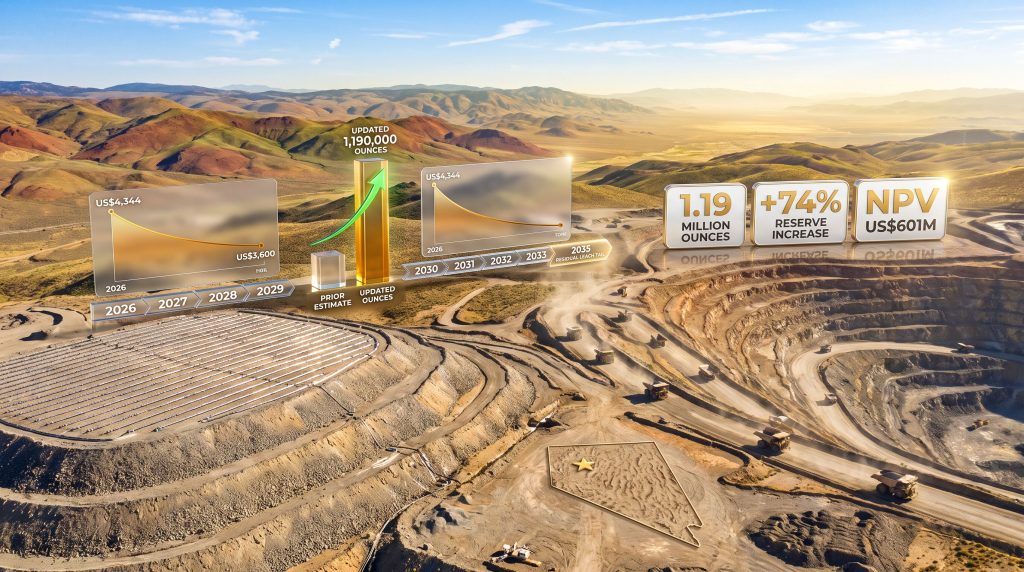
The single most striking output of the Integra Florida Canyon feasibility study is the 74% increase in Proven and Probable Mineral Reserves, bringing the total to 1.19 million ounces of gold. Understanding what drives such an uplift at an operating asset requires unpacking several interconnected technical factors.
Real production data does something that pre-production modelling cannot: it tests the geological model against reality at scale. When actual recovery rates, ore dilution factors, and metallurgical behaviour are measured over extended periods, the resulting data allows engineers to refine cut-off grade economics with far greater precision. A reduction in the economic cut-off grade, driven by better-than-modelled recoveries or lower operating costs, can reclassify substantial tonnage from the resource category into the reserve category without any new drilling being required.
Furthermore, infill drilling campaigns that tighten geological confidence across previously inferred zones allow material to migrate from Inferred Resource status into the Measured and Indicated categories, ultimately supporting Proven and Probable Reserve classification. The combination of updated cut-off economics and improved geological confidence is the most common mechanism behind large reserve increases at operating heap-leach mines. For additional context on how drilling programmes influence reserve classifications, interpreting gold drill results is a critical skill for investors evaluating these technical updates.
Key Insight: A 74% reserve uplift grounded in nearly two years of actual production performance carries materially greater credibility than equivalent increases reported by exploration-stage projects relying exclusively on desktop modelling and limited drilling.
Production Profile and Life-of-Mine Summary
The updated plan projects average annual gold production of approximately 82,000 ounces during active mining, representing a 17% increase over the prior plan. Active mining extends through 2033, followed by a two-year residual leaching phase before operations conclude.
| Metric | Prior Plan | Updated Feasibility Study | Change |
|---|---|---|---|
| Proven & Probable Reserves | ~684,000 oz (est.) | 1,190,000 oz | +74% |
| Average Annual Production | ~70,000 oz (est.) | ~82,000 oz | +17% |
| Active Mine Life | — | 8 years (to 2033) | — |
| Residual Leaching Period | — | 2 years (post-2033) | — |
| Total Life-of-Mine Gold Sold | — | ~685,000 oz | — |
The residual leaching phase deserves specific attention because it is frequently misunderstood as a risk or complication. In heap-leach systems, gold recovery from stacked ore continues for months or years after active ore placement ceases. This tail production requires no additional mining capital, no incremental ore haulage, and no additional crushing costs. It is an engineered feature of the process, contributing to the total 685,000 ounces of gold sold over the life of mine without proportionate additional expenditure.
The Economics Behind the Florida Canyon Feasibility Study
NPV, Free Cash Flow, and What the Numbers Actually Mean
The base-case after-tax NPV at a 5% discount rate is US$601 million, discounted to January 1, 2026. Total after-tax free cash flow across the life of mine is projected at approximately US$0.8 billion. These are substantial figures for a mid-tier gold operation, and they warrant careful contextualisation rather than face-value acceptance.
The choice of a 5% discount rate reflects a relatively benign cost-of-capital assumption. In the current interest rate environment, where risk-free rates have been materially higher than in the prior decade, investors with a more conservative framework may apply discount rates in the 7% to 8% range. At those levels, the NPV would be lower than the headline US$601 million figure, though the directional conclusion about asset viability remains intact given the scale of projected free cash flow.
Analytical Note: Free cash flow and AISC are non-GAAP financial measures without standardised definitions under IFRS. They should be evaluated alongside audited financial statements and not treated as substitutes for GAAP-compliant reporting.
The Gold Price Deck: Forward Curve Methodology Over Flat Assumptions
One of the more technically sophisticated aspects of the Integra Florida Canyon feasibility study is its use of a forward gold price curve rather than a single flat long-term price assumption. This approach is methodologically superior because it reflects actual market pricing signals for near-term production while applying conservatism to the outer years where price visibility is lower.
| Year | Assumed Gold Price (US$/oz) |
|---|---|
| 2026 | US$4,344 |
| 2027 | US$4,414 |
| 2028 | US$4,169 |
| 2029 | US$3,824 |
| 2030-2035 | US$3,600 |
The declining trajectory from near-term to long-term pricing is standard practice in feasibility-grade economic modelling. It avoids the error of extrapolating elevated spot prices through the full mine life while still capturing the economic benefit of current market conditions. Consequently, for investors evaluating downside sensitivity, the long-term assumption of US$3,600/oz is the critical variable, as it governs the economics of the majority of the mine's producing years.
Understanding the AISC of US$2,331 Per Ounce
Site-level all-in sustaining costs of approximately US$2,331 per ounce sit at the higher end of the global gold cost curve. This is an important fact that requires honest framing rather than dismissal.
For open-pit heap-leach operations, AISC is influenced heavily by ore grade, stripping ratio, haulage distances, and reagent costs. At Florida Canyon, the cost structure reflects the operational realities of a lower-grade heap-leach system that compensates through scale and mine life rather than high-grade selectivity. The key question is not whether US$2,331/oz is low in absolute terms, but what operating margin it generates against realistic gold price scenarios.
- At the long-term gold price assumption of US$3,600/oz, the implied margin is approximately US$1,269/oz
- At current spot gold prices above US$3,200/oz (as of mid-2026), the margin remains meaningfully positive
- The 17% increase in annual production volume contributes to economies of scale that support sustaining cost efficiency over the extended mine life
Cost Context: Higher-AISC operations carry compressed margins at lower gold prices but generate disproportionate free cash flow leverage during elevated price environments. At US$3,600/oz, US$2,331/oz AISC produces a margin structure that justifies the mine's continued development investment.
Infrastructure Efficiency and the Heap-Leach Capital Advantage
The updated mine plan's reliance on existing site infrastructure and the current crushing circuit is not simply a cost-saving measure. It reflects a fundamental strategic principle in mine planning: sunk capital, once deployed and proven operational, represents a structural advantage that cannot be replicated by development-stage competitors without equivalent expenditure.
New heap-leach operations must construct lined leach pads, install crushing circuits, build solution management infrastructure, and develop access roads before a single ounce of production is achieved. Florida Canyon has all of this in place and generating returns. The feasibility study extends that value rather than recreating it, which fundamentally changes the risk-adjusted economics relative to a greenfield alternative with an equivalent reserve base.
The two-year residual leach tail contributes additional ounces to the total life-of-mine figure while requiring only solution management and processing costs, with no incremental mining or crushing expenditure. This makes the terminal cash flow period more capital-efficient per ounce than the active mining years.
The next major ASX story will hit our subscribers first
How Florida Canyon Funds Integra's Development Pipeline
The Internal Capital Allocation Model
One of the more strategically significant aspects of the Integra Florida Canyon feasibility study is what it implies for the company's capital allocation framework. A producing asset capable of generating US$0.8 billion in after-tax free cash flow over its remaining life creates a meaningful internal funding mechanism for advancing development-stage projects without the dilutive equity raises that typically constrain junior and mid-tier miners.
This model, where a producing mine finances the advancement of development assets, is increasingly common among disciplined mid-tier precious metals companies. It reduces dependence on external capital markets, preserves shareholder value during development phases, and creates a sequenced pathway to portfolio expansion. However, it also introduces sequencing dependency between production performance and development timelines that investors must factor into their models.
| Project | Location | Stage | Processing Method | Primary Funding Source |
|---|---|---|---|---|
| Florida Canyon | Pershing County, NV | Producing | Heap-leach | — |
| DeLamar | Southwestern Idaho | Development | Heap-leach | Florida Canyon FCF |
| Nevada North | Western Nevada | Development | Heap-leach | Florida Canyon FCF |
DeLamar and Nevada North: The Development Targets
DeLamar is located in southwestern Idaho and carries a past-producing designation, meaning the district has prior commercial production history. This matters because it reduces greenfield geological uncertainty, typically simplifies environmental baseline assessments, and often benefits from legacy infrastructure. Past-producing districts in the western United States also tend to have more defined community relationships and established regulatory precedents compared to entirely new developments.
Nevada North operates within the same jurisdiction as Florida Canyon, which creates operational and regulatory familiarity advantages. Managing permitting, community engagement, and regulatory compliance within a single state framework reduces execution complexity across the portfolio. Furthermore, understanding how gold price and mining equities interact is essential context when evaluating the broader implications of this capital allocation model.
What Investors Should Model When Evaluating the Feasibility Study
Key Risk Factors That Demand Honest Assessment
The US$601 million NPV figure provides a useful reference point, but sophisticated investors will pressure-test each assumption before drawing conclusions about valuation. The key variables to stress-test include:
-
Gold price sensitivity: The long-term deck of US$3,600/oz is below current spot levels. A reversion toward historical averages in the US$1,800-US$2,000/oz range would fundamentally alter the NPV calculation, though the probability weighting of such a scenario depends on macro framework assumptions
-
AISC execution risk: Sustaining US$2,331/oz at a consistent 82,000 oz annual throughput requires operational stability. Unplanned downtime, reagent price increases, or labour disruptions compress margins disproportionately at heap-leach operations where fixed costs are significant
-
Residual leach recovery uncertainty: Gold recovery rates during the tail leaching phase can vary from projections depending on ore mineralogy and solution management. This introduces modest uncertainty into the terminal cash flow period
-
Development pipeline sequencing risk: DeLamar and Nevada North advancement depends on Florida Canyon delivering its projected free cash flow on schedule. Any production underperformance creates a cascading funding constraint across the portfolio
Reading the NPV-to-Market Cap Relationship
The filing of a formal feasibility study on SEDAR+ and EDGAR creates a public disclosure record that institutional investors can reference directly in due diligence. This formalisation matters because it transforms a series of management projections into an independently verified technical document. For market participants comparing enterprise value against stated NPV, the post-feasibility discount rate narrows substantially compared to the risk premium applied to pre-feasibility assets.
A producing asset with a freshly filed, independently authored feasibility study typically commands a valuation multiple that reflects reduced geological and technical risk while retaining commodity price sensitivity. The question investors must answer is whether the current market capitalisation of the company adequately reflects the de-risked NPV of its primary producing asset, before attributing any optionality value to the development pipeline. In contrast to the largest gold mines globally, Florida Canyon is a mid-tier asset, yet its de-risked economics make it a credible standalone investment case.
Frequently Asked Questions: Integra Florida Canyon Feasibility Study
What is the Florida Canyon feasibility study and when was it filed?
The Florida Canyon feasibility study is a formal NI 43-101 technical report prepared by Global Resource Engineering Ltd. evaluating the reserves, mine plan, and economics of the producing Florida Canyon gold mine in Pershing County, Nevada. It carries an effective date of May 31, 2026, and was filed July 30, 2026, on both SEDAR+ and EDGAR.
How much did Proven and Probable Reserves increase?
Proven and Probable Mineral Reserves increased by 74% to 1.19 million ounces of gold, informed by nearly two years of operational performance data that enabled more precise cut-off grade modelling and improved geological confidence across the reserve envelope.
What is the projected NPV and free cash flow?
The base-case after-tax NPV at a 5% discount rate is US$601 million, discounted to January 1, 2026. Total projected after-tax free cash flow across the life of mine is approximately US$0.8 billion. Both figures are non-GAAP measures and should be evaluated alongside standardised financial disclosures.
What gold price assumptions does the study use?
The study applies a forward price curve ranging from US$4,344/oz in 2026 to a long-term assumption of US$3,600/oz from 2030 through 2035, reflecting near-term market pricing with declining conservatism applied to outer years.
What happens after active mining ends in 2033?
Florida Canyon enters a two-year residual heap-leach drainage phase, contributing additional gold recovery from ore already placed on the leach pad without incremental mining costs, contributing to the total life-of-mine figure of approximately 685,000 ounces of gold sold.
Key Takeaways: What the Florida Canyon Feasibility Study Establishes
-
A 74% reserve increase to 1.19 million ounces, grounded in nearly two years of actual operating data, materially de-risks the geological and economic assumptions underpinning the mine plan
-
An 8-year active mine life through 2033, followed by a two-year residual leaching tail, provides a defined production horizon extending to approximately 2035
-
The US$601 million NPV5% and US$0.8 billion in projected after-tax free cash flow establish Florida Canyon as a financially substantial asset capable of self-funding a development pipeline
-
AISC of US$2,331/oz, while elevated relative to the global cost curve median, generates a meaningful positive margin against both near-term spot pricing and the conservative long-term gold price assumption applied in the study
-
The existing infrastructure and crushing circuit eliminate major reinvestment requirements, improving capital efficiency and reducing execution risk relative to a greenfield equivalent
-
Florida Canyon's role as the primary internal funding mechanism for DeLamar and Nevada North creates a coherent capital allocation strategy, though it introduces sequencing dependency between production performance and development advancement that investors should model carefully
Readers seeking additional context on feasibility study methodologies, heap-leach gold operations, and Nevada mining jurisdiction analysis can explore publicly available technical disclosures filed under Integra Resources' profile on SEDAR+ and EDGAR, as well as related industry coverage available at Crux Investor.
Want to Know When the Next Major Gold Discovery Hits the ASX?
Discovery Alert's proprietary Discovery IQ model delivers real-time alerts the moment significant mineral discoveries are announced on the ASX, turning complex geological data into actionable investment insights for both short-term traders and long-term investors — explore historic discoveries and their returns to understand the scale of opportunity, then start your 14-day free trial at Discovery Alert to position yourself ahead of the broader market.