July 20, 2026
The Free Cash Flow Supercycle Reshaping Gold Producer Capital Strategy
Something structurally unprecedented is unfolding across the global gold mining sector. The relationship between gold price cycles and producer financial behaviour has historically followed a predictable pattern: elevated prices generate excess cash, which miners then redirect toward aggressive exploration, gold M&A activity, or debt repayment. What the current cycle reveals is a materially different instinct. The industry's largest operators are choosing to return capital to shareholders at a scale and pace that has no modern precedent, and the AngloGold share buyback program sits squarely at the centre of that shift.
Understanding why this is happening, and what it means for investors, requires looking beyond a single company's shareholder meeting and examining the broader forces that have converged to make 2026 a genuinely exceptional moment in gold equity market history.
When big ASX news breaks, our subscribers know first
The Numbers Behind the Capital Return Surge
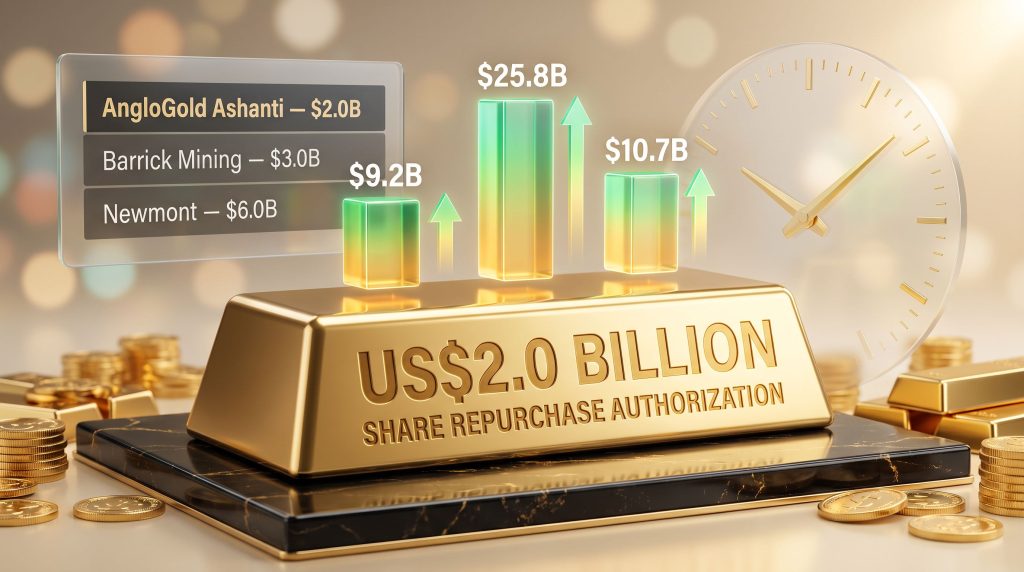
The scale of cash generation across the gold sector in 2025 and into 2026 is difficult to overstate. According to Metals Focus, the UK-based precious metals consultancy, the world's largest gold producers collectively generated $25.8 billion in free cash flow during 2025. For context, that figure was nearly three times the $9.2 billion recorded in 2024, a year that itself marked a significant step up from prior cycles.
The momentum has not faded. By the first quarter of 2026, aggregate post-capital expenditure cash flow across the major producers had climbed to a record $10.7 billion, representing a 10% increase quarter-on-quarter. Metals Focus noted this was the largest single-quarter increase recorded since the consultancy began tracking sector-wide cash flow data in 2009.
These figures matter because they establish the financial logic underpinning what would otherwise appear to be an aggressive capital return posture. Miners are not borrowing to fund buybacks. They are deploying genuinely surplus cash generated by a combination of elevated gold prices and years of structural cost discipline.
How Gold Price Dynamics Are Reshaping Miner Balance Sheets
Gold reached a peak of $5,369 per ounce in January 2026, a level that compressed all-in sustaining cost margins to historically wide levels for the major producers. Although the metal has since consolidated by approximately 25% from that peak, prices have demonstrated meaningful floor support above $4,000 per ounce, a level that still delivers very strong margins relative to most producers' cost structures.
The northern hemisphere summer period introduces a specific technical dynamic worth noting: seasonal liquidity in commodity markets tends to thin significantly between June and August, which can amplify short-term price movements in either direction without necessarily reflecting a change in underlying fundamentals. Investors interpreting near-term gold price weakness during this window should account for this seasonal distortion effect.
Furthermore, the gold price outlook remains a key factor influencing how aggressively producers choose to execute their capital return programs. Toni Teves, precious metals strategist at UBS, has maintained a constructive view on the gold market through the consolidation phase, stating that the structural demand drivers underpinning the multi-year bull cycle remain firmly intact and forecasting a price rebound from current levels before year-end 2026.
What Is the AngloGold Share Buyback Program?
The AngloGold share buyback program was unveiled in May 2026 following a first quarter that included another record cash flow instalment. The proposal brings buybacks into a capital allocation framework that had already been upgraded through a more generous dividend policy, consistent with how the company's major peers have been approaching shareholder returns.
The core mechanics of the program are summarised below:
| Program Feature | Detail |
|---|---|
| Total Authorized Value | Up to US$2.0 billion (approx. R32 billion) |
| Authorization Period | Five years from the July 2026 shareholder meeting |
| Execution Method | Off-market repurchases via J.P. Morgan (US and South Africa entities) |
| Purchase Obligation | Fully discretionary – no minimum repurchase commitment |
| Regulatory Requirement | South African FinSurv clearance required for JSE-listed transactions |
| Shareholder Vote Date | July 23, 2026 general meeting |
| Resolution Threshold | Simple majority required for passage |
The Q1 2026 financial results that anchored the buyback case included:
- Net profit of $1.28 billion for the quarter
- Gold production of 724,000 ounces
- A record quarterly dividend of 116 cents per share
- Retirement of approximately $666 million in principal bond obligations in the preceding month
These metrics collectively demonstrate that the buyback is being layered on top of an already robust capital return and debt reduction program, rather than substituting for either.
The Role of J.P. Morgan as Execution Partner
The appointment of J.P. Morgan to execute repurchases across both US and South African market venues reflects the logistical complexity of buying back shares in a company listed across multiple jurisdictions. Off-market repurchase mechanisms allow for greater price certainty and reduced market impact compared to open-market purchases, though they also introduce a degree of opacity that some governance observers flag as a transparency concern. The requirement for South African Financial Surveillance Department (FinSurv) approval on JSE-listed transactions adds an additional regulatory layer that is absent in single-jurisdiction programs run by North American peers.
How the AngloGold Program Compares to Major Gold Producer Peers
The AngloGold share buyback program exists within a competitive peer context where capital return programs have become a defining differentiator for institutional investor allocation decisions. The comparison below illustrates how the program stacks up:
| Gold Producer | Buyback Program Size | Authorization Structure |
|---|---|---|
| AngloGold Ashanti | Up to $2.0 billion | Five-year mandate |
| Newmont | $6.0 billion | Open-ended, tied to free cash flow |
| Barrick Mining | $3.0 billion (doubled in May 2026) | 12-month rolling authorization |
| Agnico Eagle | Undisclosed | 12-month rolling authorization |
| Kinross Gold | Undisclosed | 12-month rolling authorization |
At an implied annualised execution rate of approximately $400 million per year, AngloGold's program is meaningfully more conservative than both Newmont's $6 billion open-ended framework and Barrick's recently doubled $3 billion rolling authorization. This conservatism is not necessarily a weakness; it reflects a board that has chosen to prioritise flexibility and balance sheet resilience alongside shareholder returns, particularly given the ongoing capital requirements associated with projects such as the Arthur development in Nevada.
Why Buybacks Attract North American Institutional Capital
Share repurchase programs carry particular appeal across North American institutional markets for a reason that is mechanically straightforward but frequently underappreciated: by reducing the total share count outstanding, buybacks generate earnings-per-share growth without requiring any expansion in underlying profitability. This creates a form of financial leverage on future earnings that tends to attract momentum-oriented institutional investors. In addition, the relationship between gold price and mining equities means that buyback programs gain even greater traction during periods of elevated metal prices, as expanding margins translate directly into outsized EPS accretion.
For cross-listed miners like AngloGold, which trades on both the NYSE and JSE, successfully executing a visible buyback program serves a dual purpose: it communicates financial discipline to US growth-oriented funds while simultaneously rewarding South African institutional holders who have watched the company navigate years of operational restructuring.
The Proxy Adviser Split: ISS vs. Glass Lewis
The most distinctive governance dimension of the AngloGold share buyback program is the rare public disagreement it has produced between the two most influential proxy advisory firms operating in global institutional markets.
ISS (Institutional Shareholder Services) has recommended that shareholders vote against the resolution. Its objection centres entirely on the five-year authorization duration, which exceeds ISS's internal guideline threshold of 18 months for buyback mandates. ISS's concern is that a five-year window without mandatory shareholder re-approval grants the board a degree of discretionary authority over capital deployment that institutional shareholders should periodically reassess.
Glass Lewis, by contrast, has recommended voting for the resolution. Its analytical conclusion is that the five-year framework is consistent with capital return structures commonly deployed by North American gold producers and does not represent a material governance outlier when assessed in the context of the $2 billion aggregate cap. According to AngloGold Ashanti's investor relations, the board has been proactive in engaging shareholders directly ahead of the vote to address governance concerns raised by proxy advisers.
This divergence matters to investors for reasons that extend beyond AngloGold specifically:
- It highlights the jurisdictional complexity facing companies incorporated in one regulatory environment (UK company law) but operationally active and shareholder-based across multiple geographies.
- It raises a genuine question about whether 12-month rolling mandates, while offering more frequent shareholder oversight, are actually more protective of shareholder interests or simply generate more procedural governance activity.
- It signals a growing tension in global governance standards between US-centric proxy advisory frameworks and the governance norms embedded in UK corporate law.
AngloGold's Legal and Governance Defence
AngloGold's board has responded to the ISS recommendation with a specific legal argument: the five-year repurchase authorization is fully consistent with UK corporate law, the jurisdiction under which the company is incorporated. The board's position is that the existence of the $2 billion aggregate cap provides the substantive protection against unchecked capital deployment that ISS is seeking, and that the duration of the authorization is therefore a procedural rather than substantive governance concern.
This argument has genuine merit from a structural standpoint. An authorization with a defined financial ceiling is arguably more protective than a 12-month rolling mandate with no stated upper limit on total deployment, since the latter theoretically permits unlimited cumulative spend provided annual re-approvals are obtained. Consequently, the company has urged shareholders to focus on the cap structure rather than the duration when casting their votes. According to reports ahead of the general meeting, AngloGold has called the July 23 meeting specifically to approve the program, underscoring the board's confidence in securing majority support.
Important Note for Investors: The buyback program carries no binding execution guarantee. AngloGold's board retains full discretion to pause, reduce, or suspend repurchase activity based on prevailing cash flow conditions, regulatory approvals, and broader market circumstances.
Three Scenarios for How the $2 Billion Could Be Deployed
Because the program is entirely discretionary, the range of plausible execution outcomes is wide. The table below models three scenarios across the five-year authorization window:
| Scenario | Annual Spend | Total Deployed | Implied Outcome |
|---|---|---|---|
| Conservative | ~$200M/year | ~$1.0 billion | Partial utilization; dividend remains primary return vehicle |
| Base Case | ~$400M/year | ~$2.0 billion | Full authorization utilized; aligned with board implied pace |
| Accelerated | ~$600M+ in peak years | ~$2.0 billion (front-loaded) | Rapid EPS accretion if gold prices remain elevated |
The accelerated scenario would likely only materialise if gold prices sustain above $4,500 per ounce for an extended period, generating free cash flow well in excess of dividend and capital expenditure commitments. The conservative scenario becomes more probable if the Arthur project in Nevada requires materially higher capital draws, or if a significant acquisition opportunity emerges within the authorization window.
The next major ASX story will hit our subscribers first
What the Governance Debate Reveals About Cross-Listed Mining Companies
The proxy adviser conflict over the AngloGold share buyback program is a symptom of a deeper structural issue facing any mining company that straddles multiple regulatory jurisdictions. Companies incorporated under UK law but listed in both New York and Johannesburg face a patchwork of investor expectation sets, none of which were designed to coexist seamlessly.
ISS's 18-month guideline was developed primarily with US-listed companies in mind, where annual shareholder meetings create a natural governance rhythm. UK company law, operating within a different shareholder engagement tradition, has historically permitted longer mandate durations balanced by the use of aggregate financial caps. Neither framework is inherently superior; they reflect different underlying assumptions about the appropriate locus of corporate control.
What this debate does confirm is that investors evaluating the AngloGold share buyback program should focus less on the procedural duration question and more on the company's demonstrated track record of capital discipline, the sustainability of its free cash flow generation, and the degree to which the $2 billion ceiling provides meaningful structural protection against value-destructive deployment. The gold bull market catalysts currently in play provide important context for assessing whether that cash flow sustainability is likely to persist across the five-year window.
Frequently Asked Questions: AngloGold Share Buyback Program
What is the total size of the AngloGold share buyback program?
AngloGold Ashanti has proposed a share repurchase authorization of up to US$2.0 billion, equivalent to approximately R32 billion, subject to shareholder approval at its July 23, 2026 general meeting.
How long will the AngloGold buyback authorization last?
The proposed authorization covers a five-year period commencing from the date of shareholder approval, which distinguishes it from the 12-month rolling mandates used by several North American peers.
Why did ISS recommend voting against the AngloGold buyback?
ISS objected to the five-year mandate duration, which exceeds its internal governance guideline of 18 months for buyback authorizations. The firm argued the extended timeframe grants the board disproportionate flexibility without requiring periodic shareholder re-approval.
Is AngloGold required to spend the full $2 billion?
No. The program is entirely discretionary. There is no minimum purchase commitment, and execution may be paused or suspended without prior notice depending on cash flow availability, regulatory conditions, and market circumstances.
How does AngloGold's buyback compare to Newmont and Barrick?
At an implied annualised pace of approximately $400 million, AngloGold's program is materially smaller than Newmont's $6 billion open-ended framework and Barrick's $3 billion 12-month rolling authorization, suggesting a conservative posture relative to sector peers.
What regulatory approvals are needed for the buyback to proceed?
Repurchases executed on South African exchanges require clearance from the South African Financial Surveillance Department (FinSurv), adding a regulatory layer beyond the standard shareholder vote that is not present in single-jurisdiction North American programs.
Key Takeaways for Investors Evaluating the AngloGold Share Buyback Program
The AngloGold share buyback program is, at its core, a consequence of a genuinely exceptional period of gold sector financial performance. However, gold miners outperforming the market does not automatically translate into guaranteed buyback execution, and investors should weigh each of the following critical considerations carefully:
- The program is additive to, not a replacement for, AngloGold's upgraded dividend policy, making the total shareholder return proposition more robust than any single component suggests.
- The discretionary execution structure means investors cannot model the buyback as a guaranteed cash return stream; it functions more as a conditional commitment contingent on sustained free cash flow generation.
- The proxy adviser split introduces a modest governance uncertainty ahead of the July 23 vote, though the simple majority threshold required for passage makes defeat unlikely if institutional holders follow Glass Lewis rather than ISS.
- The $4,000 per ounce gold price floor that has held through the current consolidation phase remains the most important external variable determining whether the base case or accelerated deployment scenario unfolds.
- Cross-listed mining companies operating across UK, US, and South African regulatory environments will increasingly face this type of governance framework friction as buyback programs become a more central feature of sector capital allocation.
This article is intended for informational purposes only and does not constitute financial advice. All forecasts, scenario analyses, and price projections involve inherent uncertainty. Past financial performance does not guarantee future results. Investors should conduct their own due diligence before making investment decisions.
Want to Track the Next Major ASX Mineral Discovery Before the Market Does?
Discovery Alert's proprietary Discovery IQ model delivers real-time alerts on significant ASX mineral discoveries, transforming complex mineral data into actionable insights for both short-term traders and long-term investors — explore historic discoveries and their exceptional returns to understand the opportunity, then begin your 14-day free trial at Discovery Alert to position yourself ahead of the broader market.