July 20, 2026
The Geopolitics of Upstream Vulnerability: Why Conflict Zones Punish Single-Asset Oil Producers
The relationship between upstream oil production and geopolitical stability has rarely been more visible than in 2026. Across the Middle East, the convergence of US-Iran hostilities, contested maritime corridors, and semi-autonomous regional governance structures has created a risk environment that no operational hedging strategy can fully neutralise. For independent oil producers concentrated in a single region, this reality is not a theoretical concern. It is a balance sheet event. Furthermore, oil price movements during the trade war have already demonstrated how rapidly geopolitical shocks translate into revenue disruption for upstream operators.
Gulf Keystone shuts in Iraq's Shaikan oil field offers a precise case study in how geopolitical shockwaves travel from sovereign conflict to field-level operations, stripping revenue visibility in the process.
When big ASX news breaks, our subscribers know first
What the Shaikan Oil Field Represents in Kurdistan's Production Architecture
Positioned approximately 60 kilometres northwest of Erbil, Shaikan sits at the productive core of the Kurdistan Region of Iraq's upstream sector. Operated under an 80% working interest production sharing contract with the Kurdistan Regional Government (KRG), the field has consistently ranked among Kurdistan's highest-volume producers.
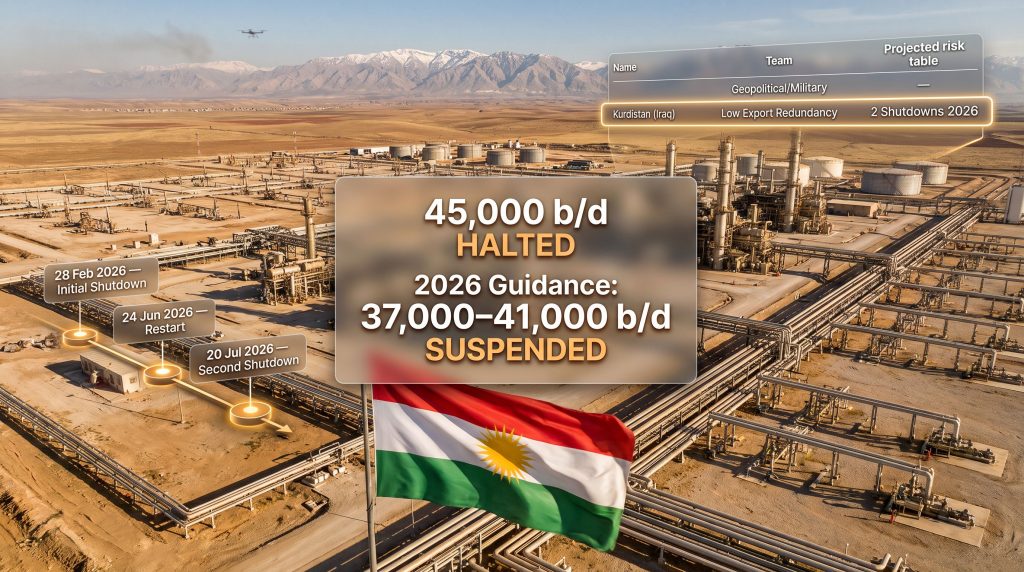
At the time of its most recent shutdown in July 2026, Shaikan was delivering 45,000 barrels per day, a figure that reflects both the field's geological productivity and the considerable operational infrastructure supporting it. Earlier in the year, production had reached approximately 41,560 b/d, with 2026 annual guidance set at 37,000 to 41,000 b/d. That guidance has since been suspended entirely.
Kurdistan's Export Infrastructure: Structurally Constrained from the Start
Understanding why a Shaikan shutdown carries outsized regional consequences requires understanding Kurdistan's export architecture. Unlike Iraq's southern fields, which connect to multiple marine loading terminals at Basra and benefit from substantial pipeline redundancy, Kurdistan's export system funnels overwhelmingly through a single arterial route.
The Iraq-Turkey Pipeline (ITP) remains the primary northern export corridor, and its history is one of repeated disruption, whether from technical failures, political disputes, or physical attacks. Shaikan's production feeds into a tightly integrated system of KRG-controlled export logistics where the absence of redundant routing options means any field-level shutdown produces disproportionate downstream consequences. In addition, OPEC's influence on global oil markets compounds these structural pressures when regional producers are already operating at reduced capacity.
Key Structural Risk: Kurdistan's upstream sector operates without the pipeline redundancy available to southern Iraqi fields. A single producing field's shutdown can cascade through the entire regional export chain with minimal capacity to reroute volumes, amplifying the financial impact far beyond the raw barrel count.
The Timeline of Conflict-Driven Shutdowns: A Recurring Cycle
The July 2026 shutdown of Shaikan was not the field's first conflict-driven halt in 2026. That distinction belongs to an earlier closure triggered by the outbreak of US-Iran hostilities, creating a damaging stop-start production cycle within a single calendar year. Production halted at three Kurdistan oil fields during the initial February-March disruption period, underscoring that Shaikan's vulnerability was part of a broader regional pattern.
| Event | Date | Operational Impact |
|---|---|---|
| US-Israel strikes on Iran | 28 February 2026 | Initial Shaikan shutdown triggered as precautionary measure |
| Iran retaliatory strikes on regional energy infrastructure | March 2026 | Heightened security risk across Mideast Gulf and northern Iraq |
| Interim US-Iran ceasefire agreement signed | 18 June 2026 | Shaikan production and export operations restarted |
| Ceasefire breakdown; US reimposed Iran blockade | 15 July 2026 | Regional security environment deteriorated again |
| Strikes reported on Kuwait and Bahrain energy infrastructure | Late July 2026 | Second precautionary shutdown triggered |
| Second Shaikan shutdown confirmed | 20 July 2026 | 45,000 b/d halted; field assets reported unimpacted |
The pattern visible in this timeline reveals something more troubling than a single disruption event. It demonstrates that conflict-driven shutdowns for Kurdistan operators are cyclical rather than isolated, and that a restart following a precautionary halt does not provide durable operational security when the underlying geopolitical conditions remain unresolved.
The restart on 24 June followed the interim US-Iran ceasefire signed on 18 June. Within weeks, the ceasefire collapsed, the US reimposed its naval blockade of Iranian ports on 15 July, and Iranian retaliatory activity expanded to include strikes on energy infrastructure in Kuwait and Bahrain. These developments directly triggered the second Shaikan shutdown on 20 July 2026.
How Precautionary Shutdowns Differ From Force Majeure Events
A critical distinction in understanding the Shaikan closures is the difference between a force majeure event and a precautionary operational halt. Force majeure applies when physical infrastructure damage renders production technically impossible. A precautionary shutdown, by contrast, is a risk-based decision made before physical damage occurs.
This distinction matters financially and legally. In a precautionary scenario, assets remain intact, infrastructure is undamaged, and the operator retains the technical ability to produce. The decision to halt is driven entirely by health, safety, and environment (HSE) protocols assessing threat proximity thresholds: drone strike corridors, missile trajectory overlaps with operational perimeters, and security breach risk assessments.
Independent operators use a layered threat assessment model in these environments:
- Threat monitoring involves continuous real-time intelligence on military activity within the operational radius of the field.
- Threshold triggers are predefined security conditions that automatically initiate shutdown protocols when certain risk parameters are breached.
- Restart criteria establish defined security benchmarks that must be met before production can responsibly resume.
The challenge for independent operators is that unlike national oil companies or diversified international majors, they typically lack private security infrastructure, dedicated government liaison networks, and in-country intelligence capability. This makes precautionary shutdown the dominant and often only available risk response tool available to them.
The Financial Consequences of Repeated Shutdowns on a Single-Asset Operator
At 45,000 b/d, each day of suspended production represents a material volume loss measured against prevailing crude benchmarks. Across a multi-week shutdown, the cumulative barrel deficit compounds quickly. When the same field has already experienced one shutdown earlier in the year, the arithmetic becomes structurally damaging to full-year production averages and annual revenue realisation.
Financial Risk Callout: Independent operators with single-asset or single-region exposure face binary revenue risk during geopolitical disruptions. Unlike diversified majors capable of offsetting regional production losses elsewhere in their portfolio, a Kurdistan-only operator's revenue profile rises and falls almost entirely with the operational status of its producing fields.
The suspension of 2026 production guidance (previously set at 37,000 to 41,000 b/d) eliminates forward earnings visibility entirely. For investors and analysts attempting to model full-year outcomes, guidance suspension converts a quantifiable risk into an open-ended uncertainty — a fundamentally different category of concern. Consequently, understanding the broader tariff and trade war economic impact is equally relevant, as global demand signals feed directly into the commercial viability of restarting halted production.
The Strategic Value of a Debt-Free Balance Sheet
What separates operators who survive repeated shutdown cycles from those who face existential financial pressure is, in large part, the composition of their balance sheet at the moment the conflict begins.
A debt-free financial position is not merely a conservative accounting preference in this context. It is a first-order risk management tool. With no debt covenants to breach and no lender pressure requiring accelerated production to service obligations, an operator can sustain a prolonged shutdown without triggering a restructuring scenario.
The contrast with leveraged operators is instructive. An upstream independent carrying significant debt into a conflict-adjacent environment faces a compounding risk: operational revenues decline precisely when debt service obligations remain fixed. The runway to a financially damaging outcome shortens with each day of suspended production.
Iraq's Federal Government and the Geopolitical Paradox of Investment
The backdrop against which Gulf Keystone shuts in Iraq's Shaikan oil field is not solely a bilateral US-Iran conflict. It encompasses a complex web of sovereign actors whose interests frequently contradict one another. Indeed, the geopolitical landscape shaping metals and mining in 2025 foreshadowed the same dynamics now playing out across Iraq's upstream energy sector.
Iraqi Prime Minister Ali al-Zaidi's visit to the White House on 14 July 2026 illustrated this paradox with unusual clarity. Al-Zaidi's government is aligned with the Shiite Co-ordination Framework, which historically maintained close ties with Tehran. Yet al-Zaidi met with President Trump to discuss expanding US oil company investment in Iraq, with agreements involving Chevron, Halliburton, and other international partners already in motion.
The central contradiction: Baghdad is simultaneously pursuing US oil investment and preparing for the scheduled departure of the remaining US military forces from Iraq by 30 September 2026. US forces are currently positioned in bases within the Kurdistan region, the same region whose oil infrastructure is most exposed to Iranian retaliatory activity.
Argus estimates placed Iraqi crude output at approximately 2.15 million b/d as of June 2026, a figure dramatically below the country's OPEC+ target of 4.35 million b/d. This shortfall reflects the cumulative production damage caused by the conflict environment, particularly the effective closure of the Strait of Hormuz from March to June 2026, which constrained Iraq's southern export capacity and placed greater strategic weight on northern pipeline routes through Kurdistan.
Iran's Targeting Logic and the Energy Infrastructure Threat
Iran's documented approach to asymmetric retaliation has consistently incorporated energy infrastructure, ports, and commercial shipping as preferred target categories. This pattern is not incidental. Energy infrastructure attacks maximise economic disruption to adversaries while maintaining a degree of ambiguity regarding escalation thresholds.
Kurdistan's oil fields carry particular symbolic weight in this calculus. The region has historically served as a base for US-aligned military forces, and its producing assets represent both an economic and symbolic target for Iranian retaliation. The late July 2026 strikes reported on Kuwait and Bahrain oil and power infrastructure demonstrated that Iran was willing to extend the geographic scope of energy-sector targeting well beyond Iraq's borders, validating the threat assessment that triggered Shaikan's second shutdown.
The Strait of Hormuz dimension added a further layer of complexity. Between March and June 2026, the effective closure of the strait constrained seaborne exports from Iraq's southern terminals, counterintuitively elevating the strategic importance of northern Kurdistan pipeline routes to Turkey. However, this elevation of strategic importance occurred precisely during the period when security conditions made northern fields most operationally vulnerable.
The next major ASX story will hit our subscribers first
Comparing Kurdistan's Risk Profile Across Conflict-Adjacent Producing Regions
Kurdistan is not the only region where upstream operators manage production under active conflict conditions. A comparative assessment reveals both the relative severity and the distinguishing features of its risk environment.
| Region | Primary Risk Type | Export Route Redundancy | Government Stability | Recent Shutdown Frequency |
|---|---|---|---|---|
| Kurdistan, Iraq | Geopolitical / Military | Low | Moderate | High (2026: 2 shutdowns) |
| Libya | Civil conflict | Low | Low | Very High |
| South Sudan | Civil conflict | Very Low | Low | High |
| Yemen | Active war | Minimal | Collapsed | Extreme |
Kurdistan's position in this comparison highlights a meaningful distinction. Despite its elevated risk profile, the KRG has maintained a track record of honouring operator agreements under its production sharing contract framework, and the region's underlying resource base remains substantial. This combination of large discovered reserves, an established contractual framework, and KRG institutional credibility is what continues to draw independent operators despite the conflict exposure. Furthermore, the shift toward a multi-polar world economy means that even operators in high-risk regions face a more complex set of geopolitical allegiances and competing commercial interests than in previous decades.
Three Scenarios for Shaikan's Operational Trajectory Through H2 2026
With no confirmed restart timeline established following the July 2026 shutdown, the range of forward outcomes for Shaikan is wide. Three scenarios frame the realistic possibility space:
- Rapid de-escalation: US-Iran tensions recede to manageable levels, security conditions stabilise across the broader region, and Shaikan resumes production within weeks. 2026 guidance could be partially recovered, though cumulative lost production would still depress full-year averages materially below original targets.
- Prolonged conflict cycle: The pattern of ceasefire, breakdown, and re-escalation continues through H2 2026, producing additional stop-start cycles. Full-year production falls significantly below guidance, KRG fiscal pressure intensifies, and outstanding payment disputes between Baghdad and Erbil become harder to manage.
- Structural escalation: Direct strikes on Kurdistan energy infrastructure trigger extended force majeure declarations, moving the risk discussion from precautionary halt to physical asset damage. This scenario would prompt a fundamental reassessment of the region's operational viability for independent upstream producers.
The scheduled US troop withdrawal from Kurdistan by 30 September 2026 introduces a new variable into each of these scenarios. The removal of US military presence from Kurdistan bases eliminates a security deterrent that has, whether explicitly or implicitly, formed part of the operational risk calculus for independent producers in the region for over a decade. Gulf Keystone's ongoing operations at Shaikan reflect a calculated commitment to the field despite these compounding uncertainties.
Frequently Asked Questions: Gulf Keystone and the Shaikan Oil Field Shutdown
What is the Shaikan oil field and who operates it?
Shaikan is one of the Kurdistan Region of Iraq's largest oil-producing fields, located approximately 60 km northwest of Erbil. It operates under an 80% working interest production sharing contract with the Kurdistan Regional Government.
Why did Gulf Keystone shut in Shaikan during July 2026?
Production was halted as a precautionary safety measure in response to a deteriorating regional security environment, including reported strikes on energy infrastructure in Kuwait and Bahrain. No physical damage to Shaikan's assets was reported.
How much oil was Shaikan producing before the July 2026 shutdown?
The field was producing approximately 45,000 barrels per day at the time of the shutdown.
Has Shaikan experienced shutdowns before 2026?
The field has faced previous disruptions, including during periods of heightened regional instability. Within 2026 alone, it was shut in twice: first following the outbreak of US-Iran hostilities in late February, and again in late July following the ceasefire breakdown.
When will Shaikan restart production?
No confirmed restart timeline has been announced. The operator has indicated it is monitoring the evolving regional security situation and will provide updates as conditions develop.
What happens to 2026 production guidance during the shutdown?
The operator suspended its 2026 production guidance of 37,000 to 41,000 b/d pending resumption of operations. The maintenance of a debt-free balance sheet provides financial flexibility during the halt, avoiding the compounding pressure faced by leveraged operators.
How does the broader US-Iran conflict affect Kurdistan's oil sector specifically?
The conflict creates a multi-layered security risk environment encompassing threats to export infrastructure, heightened military activity near producing fields, expanded Iranian targeting of regional energy assets, and the broader disruption of seaborne export logistics through the Strait of Hormuz. The scheduled withdrawal of US troops from Kurdistan bases by 30 September 2026 adds a further forward risk variable. For further context, Argus reporting on Shaikan's earlier conflict-driven halt provides additional detail on the sequence of events preceding the July 2026 shutdown.
This article contains forward-looking analysis, scenario projections, and references to developing geopolitical conditions. Readers should treat scenario-based content as illustrative rather than predictive. The article does not constitute investment advice. Investors should seek independent financial guidance before making decisions based on company-specific or sector-level analysis.
Want to Stay Ahead of the Next Major Resource Discovery Before the Market Reacts?
While geopolitical shocks continue to disrupt upstream oil producers, savvy investors are turning their attention to ASX mineral discoveries — where Discovery Alert's proprietary Discovery IQ model delivers real-time alerts the moment significant discoveries are announced, transforming complex resource data into actionable opportunities. Explore historic discoveries and their extraordinary returns, then start your 14-day free trial to position yourself ahead of the broader market.