July 22, 2026
The Hidden Cost of Borrowing Against Tomorrow's Oil
Across sub-Saharan Africa, the history of sovereign finance is punctuated by a recurring pattern: resource-rich nations with limited access to international capital markets turn to their underground reserves as collateral, pledging barrels not yet extracted to pay for infrastructure already built. This model of commodity-backed borrowing offered immediate liquidity but embedded structural fragility into the fiscal architecture of nations whose revenue base was already hostage to price cycles beyond their control.
Angola's experience with Angola oil-backed debt reduction represents one of the most instructive case studies in how an oil-dependent sovereign can systematically dismantle this legacy exposure while simultaneously rebuilding creditor diversity and market credibility. The numbers tell a story of deliberate, sustained fiscal reform that few African economies have managed at comparable scale or speed.
When big ASX news breaks, our subscribers know first
Understanding Oil-Backed Loans and Why Angola Relied on Them
The Mechanics of Commodity-Collateralised Borrowing
Oil-backed loans are a distinct class of sovereign debt instrument in which repayment obligations are secured not against general government revenues or treasury cash flows, but against future crude oil shipments. Under these arrangements, the borrowing government typically directs a national oil company to channel a pre-agreed volume of crude oil exports to a designated account, from which the lender extracts principal and interest repayments before any surplus reaches the government.
For Angola, a country that generates the overwhelming majority of its fiscal revenue from petroleum, this structure held intuitive appeal during the 2000s and early 2010s. Angola is sub-Saharan Africa's second-largest oil producer, and at peak output, petroleum revenues funded the bulk of state spending. When large-scale infrastructure financing was required and conventional capital market access was limited or expensive, oil-backed arrangements provided a viable, if ultimately costly, pathway to liquidity.
"The compounding vulnerability embedded in oil-backed loans is rarely discussed openly: when crude oil prices decline simultaneously with production volumes, the collateral underpinning the debt erodes at precisely the moment when the borrower is least positioned to service obligations through any alternative means."
This is not a theoretical risk. Angola experienced precisely this dynamic in 2015 and 2016 when an oil price crash exposed the fragility of a fiscal model built on commodity-linked debt service, accelerating the urgency of structural reform.
Peak Exposure and the China Concentration Problem
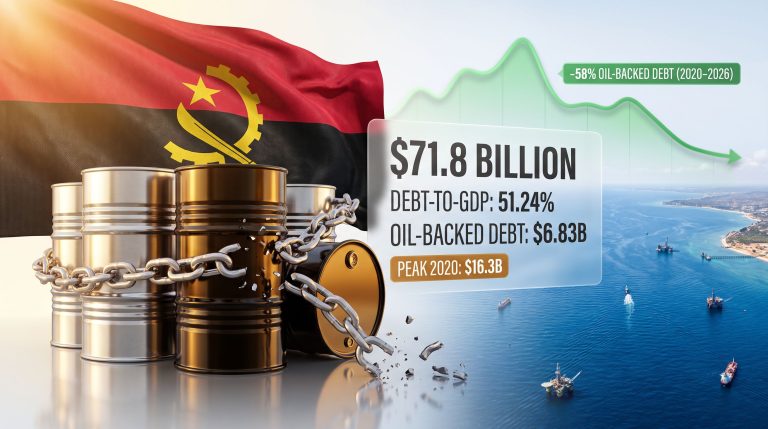
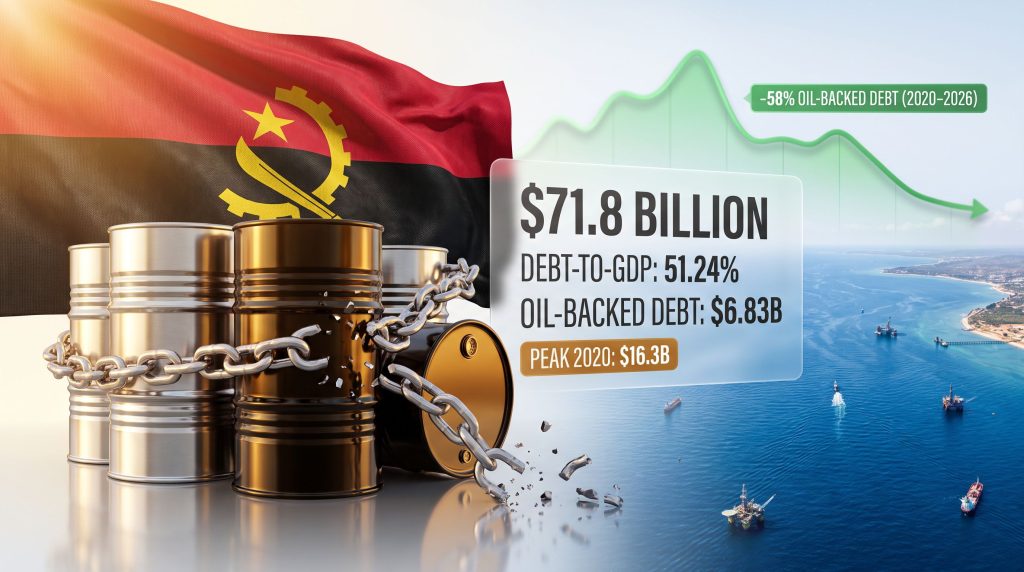
Angola's oil-backed debt reached approximately $16.3 billion in 2020, representing one of the largest commodity-collateralised sovereign debt positions on the African continent. At that point, the country's total public debt-to-GDP ratio had climbed to a precarious 116%, creating acute vulnerability across multiple dimensions simultaneously.
What made Angola's position particularly sensitive was not just the scale of oil-backed obligations, but their concentration. Virtually all oil-backed loans were held by a single bilateral creditor: China. This created a geopolitical dependency that extended beyond economics, tying Angola's fiscal flexibility to the state of Sino-Angolan diplomatic relations and the negotiating posture of Chinese state-owned lenders. Furthermore, geopolitical trade tensions of this nature can amplify borrowing risks well beyond their initial scope.
Critically, Angola had not contracted new oil-backed loans with China since 2017. The accumulation of legacy obligations continued to dominate the debt profile purely through the weight of existing loan structures, even as the government quietly pivoted its financing strategy toward diversified sources.
Angola's Debt Position in Mid-2026: A Transformed Fiscal Landscape
Key Metrics Across the Public Debt Portfolio
Data presented on July 20, 2026, by Ottoniel dos Santos, Secretary of State for Finance and Treasury, during a review of Angola's Annual Borrowing Plan, provided a comprehensive picture of the country's evolving fiscal position.
| Metric | Value (H1 2026) |
|---|---|
| Total Public Debt (Kwanza) | 65.8 trillion kwanzas |
| Total Public Debt (USD) | $71.8 billion |
| Debt-to-GDP Ratio | 51.24% |
| External Debt | $50.7 billion (46.5 trillion kwanzas) |
| Domestic Debt | 19.3 trillion kwanzas |
| Oil-Backed Debt (June 2026) | $6.83 billion |
| Oil-Backed Debt (Dec 2025) | $7.37 billion |
| Oil-Backed Debt (June 2025) | ~$8.9 billion |
| Oil-Backed Debt (Peak, 2020) | ~$16.3 billion |
Source: Angola Ministry of Finance (Ministério das Finanças), July 2026 Annual Borrowing Plan Review
External debt at $50.7 billion accounts for the largest share of total obligations. The domestic market has emerged as Angola's single largest creditor category, representing approximately 29% of total public debt, followed by holders of UK-issued Eurobonds and then China, whose share has declined from 19% to 17% of the total debt portfolio.
The Trajectory of Oil-Backed Debt Reduction
The pace of Angola oil-backed debt reduction since its 2020 peak deserves closer examination, as it illustrates both the scale of progress achieved and the natural deceleration that occurs as the absolute balance shrinks. According to reporting from Further Africa, Angola's plan to cut this exposure has been a deliberately structured programme rather than an opportunistic response to favourable conditions.
| Period | Oil-Backed Debt Level | Reduction |
|---|---|---|
| 2020 (Peak) | ~$16.3 billion | Baseline |
| December 2024 | ~$10.2 billion | -$6.1 billion |
| June 2025 | ~$8.9 billion | -$1.3 billion |
| December 2025 | $7.37 billion | -$1.53 billion |
| June 2026 | $6.83 billion | -$0.54 billion |
The cumulative reduction from peak to mid-2026 amounts to approximately $9.5 billion, or roughly 58% of the 2020 high-water mark. This has been achieved entirely through the natural amortisation of existing loan structures rather than accelerated repayment or debt restructuring events, which speaks to the sustained nature of Angola's fiscal consolidation programme.
The 2026 Eurobond Strategy: Restructuring the Creditor Base
Dual Issuances and the Shift Toward Market-Based Financing
Angola's return to international capital markets in 2026 marked a defining moment in its debt transition. The government executed two separate Eurobond issuances in March and May 2026, collectively raising approximately $4 billion from international institutional investors. Both instruments were issued under UK law, consistent with Angola's established Eurobond programme architecture.
The combined raise represented one of Angola's most substantial single-year international capital market operations and demonstrated that arms-length institutional investors were willing to allocate meaningful capital to Angolan sovereign paper without the commodity collateralisation that previously characterised the country's bilateral borrowing.
Early Repayment as a Liability Management Tool
Approximately $1.2 billion of the Eurobond proceeds was deployed to retire existing debt obligations ahead of their scheduled maturity. This early repayment operation simultaneously achieved two distinct objectives:
- Reduced refinancing concentration risk by eliminating near-term maturity cliffs that could create stress in adverse market conditions
- Restructured the creditor composition by replacing bilateral commodity-backed exposure with diversified bondholder ownership spread across international institutional investors
The distinction between these outcomes matters for sovereign credit analysis. Reducing maturity concentration addresses technical liquidity risk, while diversifying the creditor base reduces geopolitical and structural dependency. Angola's 2026 operations achieved both simultaneously.
"Accessing international bond markets at scale conveys a meaningful signal to multilateral institutions and credit rating agencies: that a sovereign has achieved sufficient macroeconomic credibility to attract capital from investors who have no bilateral political relationship to protect, and who are pricing risk on fundamentals alone."
What Eurobond Governance Means for Angola's Transparency
A less-discussed dimension of the shift from bilateral oil-backed lending to publicly traded Eurobonds is the governance transformation it implies. Eurobond structures introduce market discipline that bilateral commodity-backed arrangements historically lacked, including:
- Standardised disclosure requirements and prospectus obligations under UK securities law
- Ongoing covenant structures and negative pledge clauses that constrain the sovereign's ability to encumber assets without bondholder consent
- Secondary market pricing that provides real-time signals about investor confidence in fiscal management
- A creditor class with collective action mechanisms, creating structured accountability absent from opaque bilateral arrangements
These features collectively improve the quality of Angola's debt governance framework, not merely its headline metrics.
Institutional Architecture Behind the Debt Reduction
The Annual Borrowing Plan as a Fiscal Governance Instrument
The Plano Anual de Endividamento (PAE) functions as Angola's sovereign debt management framework, governing both the quantum and composition of new borrowing across each fiscal year. The PAE establishes financing targets across domestic and international markets, enabling the Public Debt Management Unit to actively manage creditor diversification as a deliberate policy objective rather than a residual outcome.
Semi-annual reviews, such as the July 2026 presentation, provide structured accountability checkpoints at which actual borrowing outcomes are measured against plan targets. This institutionalisation of debt management review is itself a governance innovation, creating a regular public forum for transparency on sovereign financing activities.
The Role of the Public Debt Management Unit
The Public Debt Management Unit (UGD), operating within Angola's Ministry of Finance, exercises operational control over the borrowing programme. Director General Dorivaldo Teixeira confirmed that Angola's progress in reducing oil-backed debt concentration reflects the development of domestic refinancing capacity, institutional progress, and expanded access to international bond markets working in combination rather than isolation.
Key operational functions of the UGD include:
- Monitoring creditor composition and identifying concentration risks before they become acute
- Executing market operations including bond issuances, early repayments, and debt swap arrangements
- Reporting transparently against PAE targets to government stakeholders and external observers
- Coordinating with multilateral development banks to optimise the blend of concessional and commercial financing
Complementary Instruments Supporting Fiscal Consolidation
Angola's debt reduction has been supported by a broader toolkit beyond Eurobond issuances:
- Debt swaps that convert existing obligations into instruments with more favourable maturity profiles or reduced interest costs
- Budget support facilities drawing on concessional multilateral financing to reduce dependence on commercial borrowing at higher rates
- Domestic market development expanding the local investor base for government securities, which builds capital market depth and reduces reliance on external financing flows
The World Bank has documented that sustained primary budget surpluses since 2018 were the foundational mechanism enabling Angola to compress its debt-to-GDP ratio from 116% in 2020 to approximately 52% by 2025, a reduction of 64 percentage points in five years achieved without formal debt restructuring or creditor haircuts.
Angola as a Regional Benchmark for Commodity-Debt Transition
The African Peer Comparison
Angola's deliberate reversal of oil-backed borrowing distinguishes it meaningfully within its peer group of African oil producers. Several comparable sovereigns, including Nigeria, Chad, and the Republic of Congo, have maintained or expanded commodity-backed borrowing arrangements in recent years, leaving their fiscal positions structurally exposed to the same vulnerabilities Angola is systematically dismantling.
What makes Angola's trajectory particularly noteworthy from an analytical standpoint is that the debt-to-GDP compression from 116% to approximately 51% was accomplished without triggering a formal debt restructuring event. Creditors were not asked to accept haircuts, and no Paris Club or comparable process was required. The adjustment was achieved through:
- Sustained primary surpluses maintained across a multi-year consolidation cycle
- Natural amortisation of legacy oil-backed obligations without new commodity-collateralised borrowing
- Strategic refinancing through international capital markets at scale
- Gradual development of domestic capital market capacity
This combination offers a replicable, if demanding, framework for other commodity-dependent African sovereigns contemplating similar transitions.
The next major ASX story will hit our subscribers first
IMF Assessment and the Time-Sensitive Nature of Angola's Window
The International Monetary Fund's position on Angola's trajectory carries important nuance. The IMF acknowledged that elevated oil prices in the period provided Angola with improved access to international capital markets, enhancing the country's ability to execute its Eurobond strategy at favourable terms. Understanding broader crude oil price trends is consequently essential context for evaluating how durable this window of opportunity may be.
However, the Fund characterised this oil price strength as a temporary offset rather than a structural solution. Angola's crude oil production has been trending downward from peak levels as mature offshore fields experience natural decline, meaning the revenue base supporting debt service is inherently shrinking over time, independent of price movements.
The IMF's framing carries a clear implication for Angola's debt management timeline: the window during which favourable oil prices enhance international market access and create space for refinancing may be limited. Locking in creditor diversification and extending debt maturities while conditions are supportive is therefore not merely strategically sound but potentially time-critical.
Remaining Risks to Angola's Debt Reduction Strategy
Oil Price and Production Sensitivity
Despite substantial progress, Angola's fiscal position retains structural exposure to crude oil price movements. A sustained price correction would simultaneously compress fiscal revenues, reduce the government's capacity to maintain primary surpluses, and increase the relative weight of remaining dollar-denominated obligations as kwanza revenues fall in real terms.
Production decline from mature offshore fields adds a second dimension of risk that is largely independent of price: even at high oil prices, falling volumes reduce the absolute petroleum revenue available for debt service and government spending.
Eurobond Refinancing in the Medium Term
The 2026 Eurobond issuances, while improving Angola's near-term debt profile, introduce future refinancing obligations that will require continued market access over the medium term. Angola's ability to roll over these maturities will depend on maintaining macroeconomic credibility and investor confidence through successive fiscal consolidation cycles. Currency risk compounds this challenge: external debt denominated in US dollars creates exposure to kwanza depreciation, which inflates the local-currency cost of servicing these obligations.
Domestic Market Capacity Constraints
The domestic market's position as Angola's largest single creditor category at approximately 29% of total public debt reflects progress in local capital market development. However, the depth and liquidity of Angola's domestic securities market remain constrained relative to the financing volumes that sovereign borrowing requirements demand. Over-dependence on domestic borrowing risks crowding out private sector credit and generating inflationary pressure, particularly if international market access becomes periodically constrained. In addition, tariff impacts on supply chains globally may further complicate Angola's export revenue outlook, adding another layer of fiscal uncertainty.
Frequently Asked Questions: Angola Oil-Backed Debt Reduction
What is oil-backed debt and why does it matter for Angola?
Oil-backed debt refers to loan arrangements where repayment is guaranteed through future crude oil deliveries rather than cash payments from the government budget. For Angola, this financing model became dominant during the 2000s and 2010s as the country sought large-scale infrastructure capital. It matters because it directly ties export revenues to debt service obligations, compressing fiscal flexibility and creating vulnerability to simultaneous oil price and production shocks.
How much has Angola reduced its oil-backed debt since 2020?
Angola's oil-backed debt has fallen from approximately $16.3 billion in 2020 to $6.83 billion by June 2026, a reduction of roughly $9.5 billion or approximately 58% over six years. This decline has occurred entirely through natural amortisation of existing obligations, as Angola has not contracted new oil-backed borrowing since 2017.
Who holds Angola's remaining oil-backed debt?
All of Angola's oil-backed debt is concentrated with China. This bilateral concentration was a central motivation for Angola's strategy of diversifying toward Eurobond markets and multilateral financing, distributing creditor exposure across a broader, more transparent, and more market-disciplined investor base. Broader concerns about a sovereign debt crisis in emerging markets have, furthermore, reinforced the urgency of this diversification agenda.
What is Angola's current debt-to-GDP ratio?
As of the first half of 2026, Angola's public debt stood at 51.24% of GDP, equivalent to 65.8 trillion kwanzas or approximately $71.8 billion. This compares favourably to the peak ratio of 116% of GDP recorded in 2020, representing a 65-percentage-point improvement over six years.
What role did the 2026 Eurobond issuances play in Angola's strategy?
Angola raised approximately $4 billion through two Eurobond issuances in March and May 2026. The government deployed approximately $1.2 billion of these proceeds to retire existing debt ahead of schedule, reducing refinancing concentration risk and restructuring the creditor composition away from bilateral commodity-backed arrangements toward diversified institutional bondholder ownership. Detailed analysis of Angola's 2026 annual debt plan, including projected servicing costs, is available via LinkedIn commentary from sovereign debt analysts tracking the programme.
Key Takeaways
- Angola's oil-backed debt has declined by approximately 58% since its 2020 peak, falling from roughly $16.3 billion to $6.83 billion by June 2026
- Total public debt of $71.8 billion (51.24% of GDP) represents a dramatic improvement from the 116% of GDP recorded at peak exposure
- The 2026 dual Eurobond strategy raised $4 billion and deployed $1.2 billion for early repayment, achieving simultaneous risk reduction and creditor diversification
- China's share of total public debt declined from 19% to 17%, with the domestic market now the largest single creditor at approximately 29%
- The IMF frames current oil price strength as a temporary enabling condition, reinforcing the time-sensitive nature of Angola's debt diversification opportunity
- Angola's consolidation trajectory offers a replicable framework for commodity-dependent African sovereigns seeking to transition away from opaque bilateral commodity-backed financing arrangements
Readers seeking additional context on Angola's sovereign debt management and broader African fiscal policy developments can explore coverage from Ecofin Agency at ecofinagency.com, which provides ongoing reporting on public finance across African markets.
Want to Track the Next Major Resource Discovery Before the Market Does?
Angola's fiscal transformation underscores just how powerfully commodity discoveries and price cycles shape sovereign economies — and individual investment outcomes. Discovery Alert's proprietary Discovery IQ model delivers real-time ASX mineral discovery alerts, translating complex resource data into actionable opportunities the moment they are announced — explore historic discovery returns to see what early positioning in major finds has historically meant for investors, and begin a 14-day free trial to secure your market-leading edge.