July 22, 2026
When Commodity Prices Speak, the ASX Listens
Few investment environments reveal market structure as clearly as a commodity surge day. When industrial metals and precious metals rally simultaneously, the Australian Securities Exchange behaves differently from virtually every other major global bourse — not because of coincidence, but because of architecture. The ASX carries one of the highest concentrations of resource-sector weighting of any developed-market index in the world, meaning that price inflection points in copper, gold, and oil do not merely influence the index — they can temporarily define it.
July 22, 2026 was precisely that kind of session. ASX miners lead gains as copper surges and gold rebounds became the defining narrative of the trading day, with the materials and energy sectors delivering the upward impulse that kept the ASX 200 in positive territory while healthcare and technology eroded from the other side. Understanding why this happened — and what it means structurally — requires looking beyond the session's headline numbers.
When big ASX news breaks, our subscribers know first
The Structural Amplifier: Why the ASX Responds So Powerfully to Commodity Moves
The ASX 200's materials sector weighting sits significantly higher than comparable weightings within the S&P 500 or the FTSE 100. This is not accidental. Australia's economic identity as a commodity producer means that its listed equity market naturally reflects the country's resource endowment — copper, gold, iron ore, uranium, and increasingly, battery metals. Furthermore, the ASX commodity pressure experienced across recent cycles has only reinforced how tightly resource pricing and index performance are intertwined.
The practical consequence for investors is that commodity price moves that might register as minor sector noise on Wall Street can translate into meaningful index-level events on the ASX. This amplification effect is well understood by institutional investors but often underappreciated by retail participants who benchmark ASX performance against US indices without accounting for this structural difference.
"Structural Insight: The ASX's overweight to resource equities creates an asymmetric sensitivity to commodity cycles. During commodity bull phases, this generates index-level outperformance relative to more diversified global benchmarks. During commodity downturns, the inverse applies with equal force."
A useful way to think about this is through the concept of beta to commodities — the degree to which a company's share price moves relative to underlying commodity price changes. Large-cap ASX miners like BHP and Rio Tinto carry meaningful commodity beta, while junior explorers can carry multiples of that beta, amplifying both upside and downside.
What Pushed Copper to a Multi-Week High?
Demand Fundamentals and the Electrification Premium
Copper's advance to its highest level in more than a month on July 22, 2026 was not driven by a single catalyst — it reflected a layering of demand-side conviction that has characterised the copper market through much of 2026. The metal's centrality to global electrification infrastructure — spanning EV charging networks, grid-scale battery storage, solar and wind installation, and data centre power systems — has created a persistent demand premium that floor analysts and commodity desks have been pricing into forward curves.
What makes this dynamic particularly significant is the supply-side counter-narrative. The copper supply crunch has been building for years, with copper ore grades at major operating mines declining for decades. The average head grade processed at Chilean copper operations, which collectively represent the largest national copper supply source globally, has fallen from above 1% copper in the early 2000s to well below 0.7% in recent years. Lower grades mean higher processing costs, greater energy intensity per tonne of refined copper produced, and ultimately, structural upward pressure on the marginal cost of production.
This grade decline problem is compounded by permitting timelines. The average lead time from copper discovery to first production at a new mine has extended significantly — with many analysts citing figures of 16 to 20 years for large greenfield copper projects. This means that even if exploration activity accelerates today in response to current price signals, meaningful new supply is structurally constrained through the early 2030s at minimum.
Geopolitical Risk and the Oil-Copper Correlation
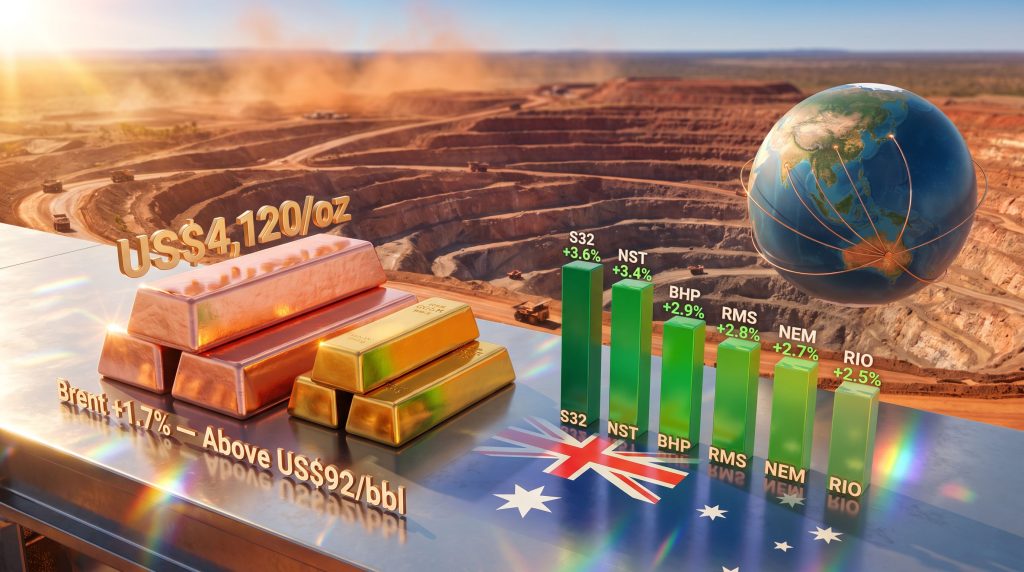
Simultaneously, Brent crude climbing 1.7% to above US$92 per barrel added a geopolitical risk premium across commodity markets. US President Donald Trump's public statements playing down near-term Iran negotiations whilst signalling further military action in the Middle East introduced supply disruption anxiety into energy markets — and that anxiety has a documented tendency to bleed across into industrial metals pricing through correlation channels.
The oil-copper correlation is not mechanistic, but it is real. Both commodities respond to global growth expectations, and both carry geopolitical risk premiums during periods of Middle Eastern instability. When Brent moves sharply on supply-side fear, copper often follows on demand-expectation optimism, creating a simultaneous tailwind across the energy and materials sectors. Consequently, the copper price drivers active in this environment are unusually broad-based, spanning both supply constraints and demand conviction.
Copper Price Sensitivity: Framework for ASX Investors
| Copper Price Movement | Typical ASX Mining Sector Response | Primary Beneficiaries |
|---|---|---|
| +1% to +2% | Moderate sector lift; large-caps lead | BHP, Rio Tinto, South32 |
| +3% to +5% | Broad rally; mid-caps and copper hybrids join | Sandfire Resources, diversified base metal names |
| +5%+ | Sector-wide re-rating; junior explorers activate | Small-cap copper and copper-gold plays |
How ASX Miners Performed on July 22, 2026
The Large-Cap Surge
The session's performance across ASX Top 200 mining names was broad-based and decisive. Institutional capital rotated visibly into resources, with gains spanning diversified miners, pure-play copper producers, and gold-focused names alike. Miners surging on the ASX when copper hits record highs has become an increasingly familiar pattern for market watchers tracking the relationship between base metal pricing and Australian equity performance.
- South32 (S32) surged 3.6%, the strongest performer among the major diversified miners — consistent with its proportionally higher exposure to energy transition metals including copper, zinc, and aluminium
- BHP climbed 2.9%, reflecting its global copper portfolio alongside iron ore and potash contributions
- Rio Tinto advanced 2.5%, supported by copper price strength across its Oyu Tolgoi and other copper assets
South32's outperformance relative to BHP and Rio Tinto is analytically instructive. Its portfolio skews more heavily toward the exact commodity mix — copper, zinc, aluminium — that benefits most directly from energy transition demand narratives. During commodity re-rating events tied to electrification themes, this composition difference tends to express itself in relative outperformance.
Gold Producers: Bullion's 1% Recovery Does Heavy Lifting
Gold's rebound to approximately US$4,120 per ounce — representing a 1% gain on the session — provided a separate but equally powerful catalyst. The relationship between gold and mining equities has rarely been more apparent, with the gold price remaining above the psychologically significant US$4,000 level reflecting a structural shift in bullion demand dynamics, with central bank accumulation, geopolitical hedging, and real yield compression all contributing to the elevated floor.
- Northern Star Resources rose 3.4%
- Newmont gained 2.7%
- Ramelius Resources added 2.8%, further supported by high-grade drilling results building the case for its next underground gold mine development
Ramelius Resources deserves particular attention here. Its session gain was amplified by a company-specific catalyst — high-grade drilling results — layered atop the broader gold sector tailwind. This combination of macro support and project-level news is the type of dual catalyst that tends to produce outsized single-session moves for mid-tier gold producers. In addition, gold hitting record highs has historically translated into accelerated institutional flows toward ASX-listed producers, compressing valuation multiples for names operating at high free cash flow margins.
Session Performance Snapshot
| Company | Primary Commodity Exposure | Session Gain |
|---|---|---|
| South32 (S32) | Copper, Zinc, Aluminium | +3.6% |
| Northern Star Resources | Gold | +3.4% |
| BHP | Copper, Iron Ore, Potash | +2.9% |
| Ramelius Resources | Gold | +2.8% |
| Newmont | Gold | +2.7% |
| Rio Tinto | Copper, Iron Ore, Aluminium | +2.5% |
Energy Stocks Rise; Defensive Sectors Retreat
Oil's Lift Flows Through to ASX Energy Names
The crude oil advance generated a secondary positive wave across ASX-listed energy producers:
- Karoon Energy climbed 3.5%
- Santos added 1.0%
- Paladin Energy surged 3.9%, though its move was driven as much by company-specific news as by sector tailwinds
Paladin's production forecast of 5.6 million pounds of uranium from its Langer Heinrich mine in Namibia for FY2026-27 — issued following the completion of its operational ramp-up phase — provided a meaningful fundamental catalyst. Langer Heinrich's restart has been closely watched by uranium market participants as a bellwether for whether long-idled assets can successfully return to commercial production at scale. The forecast validates the ramp-up progress, and broader uranium market trends suggest that sustained price support is encouraging further producer confidence in forward guidance.
Risk-On Rotation: Healthcare and Technology Sold
The flip side of resources strength was a meaningful selloff across defensive and growth-oriented sectors — a textbook expression of risk-on rotation dynamics.
Healthcare headwinds:
- Pro Medicus fell 4.0%
- CSL dropped 3.3% following a Morgan Stanley target price reduction
Technology under pressure:
- Xero fell 3.5%
- TechnologyOne declined 3.4%
- WiseTech Global slipped 2.7% after announcing a $10 million acquisition of an AI-powered supply chain company
"Rotation Signal: When materials and energy outperform simultaneously while healthcare and technology underperform, the market is expressing a coherent macro view: improving commodity demand expectations, elevated inflation concerns, or geopolitical risk premiums are all driving capital away from defensive and growth-duration assets toward real asset exposure."
Corporate Events That Added Dimension to the Session
Lynas Rare Earths: Capital Cost Discipline Under the Microscope
Lynas Rare Earths fell 6.3% after disclosing higher-than-anticipated costs for its heavy rare earths expansion project in Malaysia. This is a reminder of a risk that runs throughout the mining sector but is particularly acute in rare earths processing: the complexity of separating and refining individual rare earth elements requires sophisticated chemical processing infrastructure that is highly sensitive to cost escalation.
Heavy rare earths — which include dysprosium and terbium, both critical to permanent magnet production for EV motors and wind turbines — are processed through solvent extraction circuits that are technically demanding and capital-intensive to build. Cost overruns at this stage of project development are not unusual in the rare earths industry, but they are consistently penalised by markets that have grown increasingly sensitive to capital expenditure discipline following a period of widespread project cost inflation globally.
SkyCity Entertainment: Debt Reduction Rewarded
SkyCity Entertainment jumped more than 8% after announcing the sale of Auckland's Grand Hotel, with proceeds directed toward debt reduction. In a higher-for-longer interest rate environment, markets continue to reward proactive balance sheet repair — particularly for hospitality and gaming operators where debt servicing costs directly compress operating margins.
Dusk Group: Regulatory Enforcement Risk Materialises
Dusk Group slumped more than 13% after the Australian Competition and Consumer Commission launched legal proceedings alleging the candle retailer sold products containing non-compliant batteries. The severity of the market reaction reflects the uncertainty that unresolved regulatory proceedings introduce — potential remediation costs, reputational damage, and the possibility of material financial penalties all become unknowable variables until proceedings conclude.
Origin Energy: Cybersecurity Disclosure Adds to Sector Pattern
Origin Energy disclosed it was investigating a potential cybersecurity incident involving customer data. The company stated that there was no indication that credit card or bank account information had been accessed. Whilst the immediate market impact was contained, the disclosure adds to a growing pattern of cybersecurity incidents across ASX-listed corporates — raising broader questions about data governance investment adequacy across the utilities and energy sector.
The next major ASX story will hit our subscribers first
The Long-Term Copper Thesis: Why This Rally Has Structural Legs
Supply-Side Constraints That Short-Term Trading Misses
One dimension of the copper market that daily price moves often fail to capture is the depth of the structural supply deficit thesis. Beyond declining ore grades, new copper project development faces a compounding set of challenges:
- Water scarcity in major copper-producing regions like the Atacama Desert in Chile constrains processing capacity at existing operations
- Energy transition for mines themselves — the push to decarbonise mining operations adds capital costs to copper producers even as they benefit from copper demand growth
- Community consent and indigenous land rights requirements have extended permitting timelines and created project cancellation risk at several advanced copper development projects globally
- Tailings management regulations are tightening in multiple jurisdictions, adding operating cost pressure to existing mines
These factors collectively support the view that copper prices need to remain elevated — possibly significantly above current levels on a sustained basis — to incentivise the scale of new investment required to close the projected supply gap through the 2030s.
The ASX as a Copper Equity Access Point
For international investors seeking listed equity exposure to copper, the ASX represents one of the most liquid and regulatory-transparent access points outside of North American and Chilean-listed names. The combination of BHP's tier-one copper assets, South32's diversified base metals mix, Sandfire Resources' operating copper mines in Australia and Spain, and a substantial bench of junior copper explorers makes the ASX structurally significant within any copper bull market investment thesis.
"Speculative Scenario: If copper prices sustain current multi-week highs through Q3 2026 and LME inventory levels continue to draw down, historical precedent from prior copper re-rating cycles suggests ASX copper-exposed equities could experience a further re-rating of 8% to 15% from current levels. Junior copper explorers could deliver multiples of that return, albeit with substantially elevated risk. This scenario assumes institutional confirmation of the move rather than a short-covering bounce — a distinction that forward LME positioning data will help clarify. This represents a speculative scenario and should not be treated as investment advice."
Forward-Looking Signals Investors Should Track
The session's commodity-driven momentum raises a natural question: does this rally have structural depth, or is it a tactical bounce? Several forward-looking data points will help answer that question:
- RBA August policy decision: An interest rate hold or cut signal will affect the Australian dollar's trajectory, which inversely influences the AUD-denominated earnings of commodity exporters and the relative attractiveness of ASX resource equities to foreign capital
- LME copper inventory levels: Sustained drawdowns in London Metal Exchange copper warehouse stocks are the most reliable real-time validation of the structural demand thesis
- Gold price relative to US real yields: Bullion's sustained elevation above US$4,000 per ounce signals genuine safe-haven and inflation-hedge demand rather than speculative momentum
- Australian labour force data: The upcoming release is a key RBA input and will shape rate expectations heading into the August policy meeting
- Brent crude trajectory: Sustained oil above US$90 per barrel supports earnings upgrade cycles for ASX energy producers
FAQ: Understanding ASX Mining Sector Dynamics
Why do ASX miners rise when copper prices surge?
Australian miners including BHP, Rio Tinto, and South32 generate substantial revenue from copper production. Higher copper prices directly improve projected earnings, and markets reprice shares upward in anticipation of stronger cash flow generation. ASX miners lead gains as copper surges and gold rebounds precisely because this earnings sensitivity is structurally embedded in the index's composition.
What does gold above US$4,000 per ounce signal for ASX gold producers?
At gold prices above US$4,000 per ounce, the majority of ASX-listed gold producers are operating at historically high free cash flow margins. This environment supports dividend growth, balance sheet strengthening, and in some cases, re-rating of reserves to higher economic value — all of which attract incremental institutional buying.
Why did South32 outperform BHP and Rio Tinto on the day?
South32's portfolio is proportionally more exposed to energy transition metals — copper, zinc, and aluminium — relative to BHP and Rio Tinto, which carry larger iron ore weightings. During commodity rallies specifically tied to electrification demand narratives, South32's mix tends to generate stronger relative performance.
What is the significance of Paladin's uranium production forecast?
Paladin's 5.6 million pound uranium production forecast from Langer Heinrich for FY2026-27 signals the successful completion of a complex operational ramp-up. This is significant for the uranium sector broadly, as Langer Heinrich's return to commercial-scale production validates the operational feasibility of restarting idled uranium mines in response to improved market conditions.
Why did Lynas fall while the broader mining sector rose?
Lynas's decline was driven entirely by a company-specific cost escalation announcement for its Malaysian heavy rare earths processing expansion. Project-level negatives of this nature override sector tailwinds, demonstrating that stock selection discipline remains essential even within a strong commodity-driven sector rally. In other words, ASX miners lead gains as copper surges and gold rebounds across the broader market, but individual project risk can still dominate single-stock performance on any given session.
The material in this article is provided for informational purposes only and does not constitute investment advice. Readers are encouraged to conduct independent research and consult a qualified financial adviser before making investment decisions.
Want to Capitalise on the Next Major ASX Commodity Discovery Before the Market Moves?
Discovery Alert's proprietary Discovery IQ model delivers real-time alerts the moment significant mineral discoveries hit the ASX, instantly transforming complex geological data into actionable investment insights for both copper and gold opportunities — exactly the commodities driving today's index-level moves. Explore historic discovery returns on Discovery Alert's dedicated discoveries page to understand the scale of opportunity these moments can represent, and begin your 14-day free trial to position yourself ahead of the broader market.