July 22, 2026
The Hidden Architecture of India's Fuel Pricing Problem
When crude oil markets convulse, most countries absorb the shock through price signals at the pump. India absorbs it differently. The cost passes not to consumers immediately, but into the balance sheets of three state-owned corporations that collectively supply the majority of the country's transport and cooking fuel. This arrangement is neither a subsidy in the conventional sense nor a market mechanism. It is something more structurally complex, and when crude spikes sharply enough, it produces financial damage on a scale that tests the limits of fiscal policy.
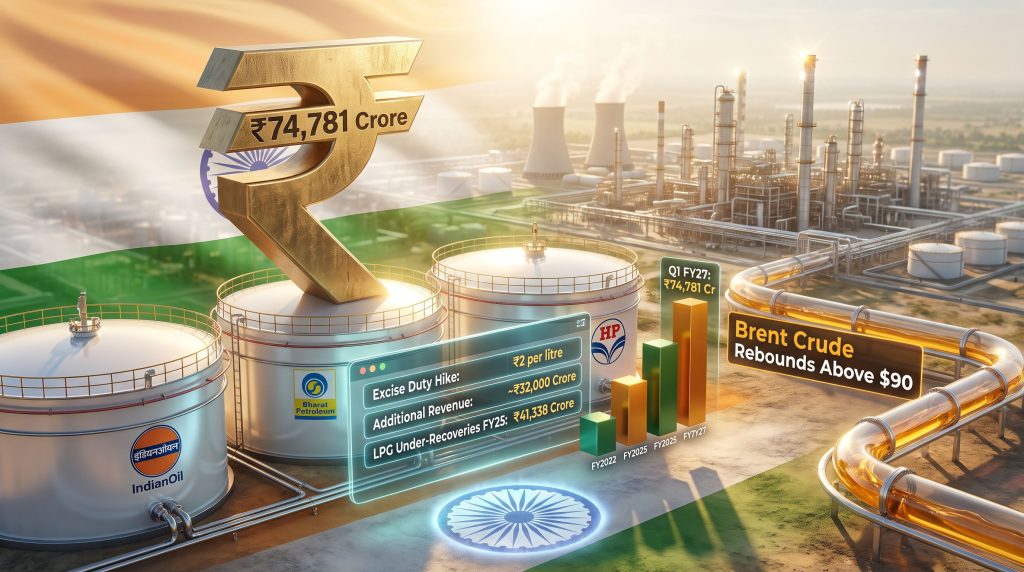
That threshold was crossed during the April to June 2026 quarter, when Indian Oil Corporation (IOC), Bharat Petroleum Corporation Limited (BPCL), and Hindustan Petroleum Corporation Limited (HPCL) collectively recorded under-recoveries of ₹74,781 crore. Oil Minister Hardeep Singh Puri confirmed this figure publicly. The oil ministry plan to offset OMC loss is now underway, though the path from proposal to disbursement is considerably more complicated than the headline number suggests.
When big ASX news breaks, our subscribers know first
Understanding Under-Recoveries: Why the Term Matters
The phrase under-recovery is itself a technical distinction worth understanding. It is not the same as an accounting loss in the traditional sense. Under-recovery refers specifically to the gap between what an OMC spends to procure and refine fuel at international market rates and what it actually collects from consumers at politically anchored retail prices.
This distinction carries regulatory significance. Because petrol and diesel were officially deregulated under reforms implemented over a decade ago, the government cannot formally classify retail price shortfalls on these fuels as subsidies requiring compensation without creating a structural contradiction in its own energy policy framework. Furthermore, the import tax structure in India adds another layer of complexity to how these losses are calculated and reported. LPG, which remains a regulated fuel under Indian law, faces no such classification problem.
The three OMCs began accumulating losses on February 28, 2026, when the US-Iran conflict triggered a crude oil price surge. After a ceasefire temporarily pulled Brent crude down to approximately $71 per barrel, the companies anticipated a recovery window. That window closed when renewed West Asian tensions pushed prices back above $90 per barrel, eliminating any prospect of natural balance sheet repair through market movement alone.
How the Oil Ministry Plan to Offset OMC Loss Is Structured
The oil ministry's compensation proposal is built around a specific revenue mechanism rather than a direct budget line item. The central funding idea involves directing revenues generated from a ₹2 per litre excise duty increase on petrol and diesel into the government's Consolidated Fund of India, from which Cabinet-approved compensation would then be disbursed to the affected OMCs.
This excise levy is estimated to generate approximately ₹32,000 crore annually, providing a partial but not complete offset against the confirmed ₹74,781 crore quarterly loss. The gap is substantial, and it will require either additional funding sources, phased disbursements, or a combination of direct compensation and equity infusion to address comprehensively.
The compensation pipeline, as currently understood, follows this sequence:
- Excise duty of ₹2 per litre applied to petrol and diesel at the point of sale
- Estimated annual additional revenue of approximately ₹32,000 crore flows to the Consolidated Fund
- Finance Ministry evaluates fiscal headroom and inter-ministerial implications
- Proposal escalated to Cabinet for formal approval
- Compensation disbursed to IOC, BPCL, and HPCL against confirmed under-recoveries
- OMCs expected to self-recover approximately ₹9,000 crore in FY26 through LPG retail price adjustments, partially reducing the residual gap
Before any of this reaches OMC balance sheets, the Ministry of Finance must sign off on the package, a process that analysts familiar with India's inter-ministerial budget dynamics expect could take several weeks to several months given competing fiscal consolidation commitments.
The Fiscal Arithmetic Behind the Shortfall
| Funding Element | Estimated Value |
|---|---|
| Confirmed Q1 FY27 OMC under-recoveries | ₹74,781 crore |
| Projected annual excise revenue uplift (₹2/litre) | ~₹32,000 crore |
| OMC self-recovery via LPG price adjustments (FY26) | ~₹9,000 crore |
| Previous LPG compensation provided (FY2025) | ₹30,000 crore |
| Total FY25 LPG under-recoveries confirmed | ₹41,338 crore |
| Uncollected taxes already being foregone by Centre | ~₹10 per litre on petrol/diesel |
Even combining the excise revenue pathway and OMC self-recovery, the arithmetic leaves a residual shortfall of roughly ₹33,000 to ₹35,000 crore that must be addressed through either direct budget allocation, an equity infusion structure similar to the ₹30,000 crore mechanism proposed in the February 2023 budget, or a phased compensation schedule extending across multiple quarters.
The government is also managing the silent fiscal cost of already foregoing approximately ₹10 per litre in uncollected taxes on petrol and diesel, a revenue sacrifice that does not appear as a budget line item but effectively constrains available fiscal headroom for any fresh compensation commitment. In addition, oil price movements in volatile global markets continue to shift this arithmetic unpredictably quarter by quarter.
LPG Versus Petrol and Diesel: A Policy Fault Line With Real Consequences
The regulatory distinction between LPG and transport fuels is not merely administrative. It shapes the entire compensation logic and determines which losses the government can defend politically and legally.
Policy Reality: Because LPG remains a regulated fuel, compensation payments to OMCs for LPG shortfalls are legally defensible and consistent with the framework under which those prices are set. Compensating losses on officially deregulated petrol and diesel, however, creates a precedent that private sector fuel retailers such as Reliance Industries and Nayara Energy could use to demand equivalent treatment from the state.
This dynamic explains the government's historical preference for equity infusions over direct loss subsidies when it comes to transport fuel under-recoveries. By injecting capital rather than compensating specific losses, the government strengthens OMC balance sheets without formally acknowledging that deregulated fuels are being priced below market rates under state direction.
The historical compensation record for LPG illustrates the pattern:
| Financial Year | Government Action | Amount |
|---|---|---|
| FY2022 | Direct compensation for LPG under-recoveries | ₹22,000 crore |
| FY2025 | Direct compensation for LPG under-recoveries | ₹30,000 crore |
| FY2025 | Total confirmed LPG under-recoveries | ₹41,338 crore |
| FY2027 Q1 | Combined petrol, diesel and LPG under-recoveries | ₹74,781 crore |
The FY2025 data point is particularly instructive. Even with a ₹30,000 crore payment, total LPG losses reached ₹41,338 crore, leaving more than ₹11,000 crore uncompensated within a single financial year. The current situation is approximately 1.8 times larger in scale than that entire FY25 LPG loss figure, compressing a comparable funding problem into a single quarter.
What Happens If the Compensation Is Delayed or Insufficient
The downstream consequences of inadequate or delayed relief extend well beyond quarterly earnings reports. For the three OMCs, the financial exposure creates pressure across multiple dimensions simultaneously:
- Borrowing costs rise as lenders and credit agencies reassess the risk profile of entities carrying unresolved nine-digit losses on their books
- Capital expenditure programmes face deferral, including refinery modernisation investments and clean energy transition commitments that require sustained financial capacity
- Dividend distributions to the government, which holds majority stakes in all three companies, could be constrained, creating a secondary fiscal feedback loop
- Private sector fuel retailers gain a structural competitive advantage during periods when state-run pricing is held below market rates, accelerating a quiet shift in market share dynamics
If compensation does not materialise in sufficient volume, OMCs face a narrow set of options. Absorbing losses indefinitely is not viable at this scale. Raising pump prices closes the under-recovery gap but introduces inflationary pressure through diesel's role in freight, agricultural logistics, and last-mile supply chains. According to reporting on OMC losses and government relief, even a modest fuel price hike has been shown to cut daily losses by roughly 25 per cent, demonstrating the scale of sensitivity involved. State election cycles have historically made price increases politically constrained, meaning the burden tends to accumulate rather than correct organically.
The next major ASX story will hit our subscribers first
How India's Approach Compares to Other State-Owned Energy Frameworks
A critical structural weakness in India's OMC financing model, relative to comparable systems globally, is the absence of a rules-based, pre-defined compensation settlement mechanism. Each compensation round requires fresh political negotiation, Cabinet approval, and inter-ministerial alignment, introducing uncertainty that complicates long-term financial planning for the affected entities.
By contrast:
- Indonesia's Pertamina operates under a government-guaranteed quarterly compensation settlement system, reducing balance sheet exposure before it accumulates to crisis scale
- China's state refiners (Sinopec and PetroChina) operate within a managed pricing band with defined adjustment triggers, making relief mechanisms more predictable and less politically contested
- Malaysia's approach incorporates means-tested subsidy targeting, reducing blanket exposure while maintaining consumer protection for lower-income segments
India's model, by placing the compensation decision in the political and fiscal negotiation space each time a crisis emerges, creates a recurring cycle where OMC losses grow large enough to become a fiscal emergency before the institutional machinery responds. A pre-committed compensation formula tied to crude price benchmarks, similar to Indonesia's quarterly settlement model, would significantly reduce this vulnerability. The current situation represents precisely the outcome that such a mechanism would be designed to prevent.
The Investor Perspective: Reading OMC Financial Stress as a Policy Signal
For investors tracking Indian energy sector equities, under-recovery cycles carry a specific signal value that goes beyond quarterly earnings misses. Historically, large confirmed under-recoveries have preceded one of three government responses: direct compensation, equity infusion, or a combination of both. Each response has distinct implications for share price recovery trajectories and balance sheet repair timelines. Understanding the broader importance of oil to the global economy provides essential context for why these decisions carry such significant downstream consequences.
The February 2023 equity infusion precedent is relevant here. When the government structured ₹30,000 crore as a capital investment rather than a loss subsidy, it strengthened the equity base of affected OMCs without triggering the political and legal complications of formal loss compensation. Furthermore, the trade war impact on oil continues to influence Brent crude benchmarks in ways that directly shape how deep the next under-recovery cycle may run.
How Do Current Prices Factor Into Future Risk?
Current crude oil prices remain a critical variable in determining whether the oil ministry plan to offset OMC loss will need to be revised upward before Cabinet approval is secured. If the oil ministry plan to offset OMC loss follows a similar structural logic to the 2023 equity infusion, equity-classified relief would support book values and borrowing capacity without resolving the deregulation contradiction on petrol and diesel. Additionally, analysts tracking OMC compensation timelines have noted that the absence of a formal bailout commitment creates ongoing uncertainty for investors assessing balance sheet risk in this sector.
Disclaimer: This article is intended for informational purposes only and does not constitute financial advice. Investors should conduct independent research and consult qualified financial advisers before making investment decisions based on government policy developments or OMC financial data.
For ongoing coverage of India's fuel pricing policy and OMC financial dynamics, ET EnergyWorld provides detailed reporting on developments in the oil and gas sector at energy.economictimes.indiatimes.com.
Want to Stay Ahead of Major Resource and Commodity Discoveries Before the Broader Market?
Discovery Alert's proprietary Discovery IQ model delivers real-time alerts on significant ASX mineral discoveries, transforming complex resource data into actionable investment insights for both short-term traders and long-term investors. Explore how historic mineral discoveries have generated exceptional returns by visiting Discovery Alert's dedicated discoveries page, and begin your 14-day free trial today to secure a market-leading advantage.