July 22, 2026
The Mathematics of Scale: Why Repeating a 235% Gain Gets Harder as a Company Grows
There is a principle in capital markets that is well understood by professional fund managers but consistently underestimated by retail investors: the larger a company becomes, the harder it is to sustain exceptional percentage returns. This is not a reflection of management quality or asset value. It is simply the arithmetic reality of compounding at scale. When a company's market capitalisation exceeds A$300 billion, the absolute dollar gain required to deliver a tripling of its share price is staggering. For BHP Group Ltd (ASX: BHP), this mathematical constraint sits at the heart of any honest assessment of whether BHP shares could triple again over the coming decade.
That is not to say the long-term investment case for BHP is weak. Quite the opposite. However, understanding what a tripling actually requires, versus what the structural commodity cycle realistically supports, is essential groundwork before forming any long-term view.
When big ASX news breaks, our subscribers know first
Anatomy of the Last Decade's 235% Gain
BHP's approximate 235% share price appreciation over the past ten years was a product of a very specific set of conditions: a sustained Chinese infrastructure buildout, iron ore prices that periodically surged well above long-run equilibrium, a capital return programme of exceptional scale, and a period of broad commodity reflation following the post-2015 mining sector downturn.
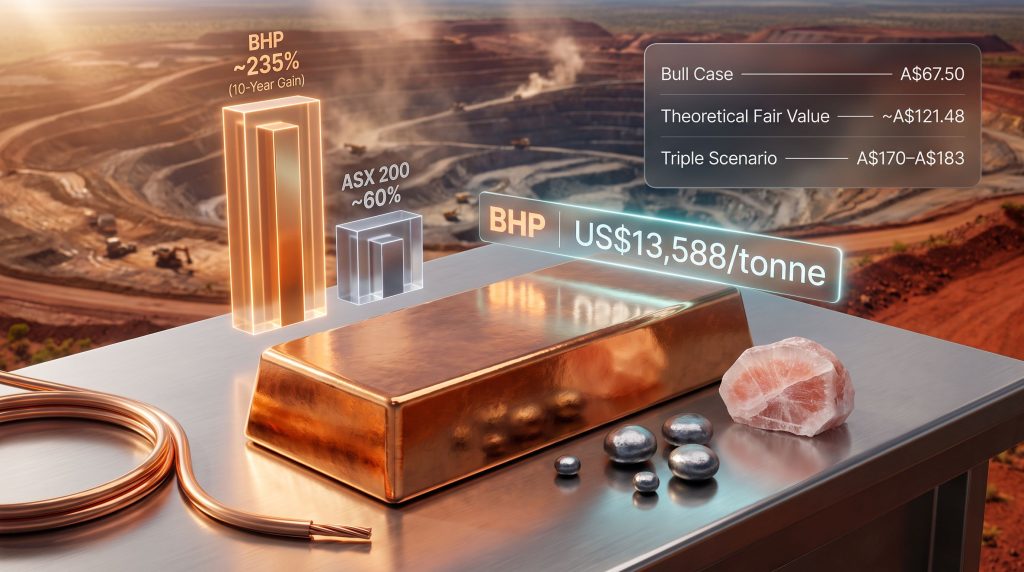
By comparison, the S&P/ASX 200 Index delivered roughly 60% over the same timeframe, meaning BHP outperformed the broader market by nearly four to one. That is an extraordinary result for a mega-cap company, and it sets a formidable benchmark.
The critical question is not whether the past was impressive. It is whether the next decade's earnings drivers, commodity mix, and capital allocation environment can replicate that outcome, or whether the more likely scenario is something meaningfully positive but structurally different. Furthermore, the BHP strategic pivot away from coal and towards future-facing metals adds another layer of complexity to any long-term return projection.
What Tripling Actually Demands: A Numerical Reality Check
The numbers here matter enormously and deserve careful examination:
- A tripling of BHP's share price from the current range of approximately A$57 to A$61 would imply a target price somewhere between A$170 and A$183
- The current 12-month analyst consensus sits at approximately A$51.79 to A$52, which is actually below the current trading price
- Morgan Stanley, one of the more constructive institutional voices on BHP, carries a price target of A$67.50, implying upside of only 11% to 15%
- A theoretical long-term discounted cash flow fair value estimate of approximately A$121.48 represents a potential doubling at the extreme optimistic end, not a tripling
- The gap between a doubling and a tripling in percentage terms is the difference between ~100% upside and ~200% upside, a full 100 percentage points of additional return
This data does not make BHP a poor investment. It makes exaggerated return expectations a poor framework for evaluating it.
The Copper Crossover: A Genuine Structural Shift
The most consequential development in BHP's recent corporate history has nothing to do with iron ore. For the first time ever, copper earnings exceeded iron ore earnings in the first half of FY2026, representing a fundamental change in how BHP generates its profits.
Copper now accounts for more than 50% of group earnings, and this shift has been driven by two converging forces: BHP's deliberate repositioning of its asset portfolio through the 2023 acquisition of OZ Minerals, and a dramatic surge in copper prices of approximately 43% over 12 months to reach around US$13,588 per tonne. Indeed, the broader copper supply crunch unfolding across global markets has only strengthened the investment rationale for BHP's strategic repositioning.
The OZ Minerals acquisition was not simply a bet on commodity prices. It was a strategic repositioning of BHP's asset mix ahead of what management identified as a structural demand inflection point in electrification-linked metals. The deal meaningfully expanded BHP's copper and nickel exposure at a time when those commodities were beginning to attract serious attention from both industry and financial markets.
BHP's Three-Pillar Earnings Architecture
| Commodity | Portfolio Role | Primary Asset | Current Status |
|---|---|---|---|
| Copper | Growth engine (>50% earnings) | Olympic Dam + OZ Minerals assets | Operational and expanding |
| Iron Ore | Legacy cash generator | Pilbara operations, Western Australia | Mature, high-margin |
| Potash | Emerging third pillar | Jansen project, Saskatchewan, Canada | Under construction |
This three-pillar structure represents a meaningful diversification away from the iron ore dependency that characterised BHP's earnings profile for much of the previous decade.
Why Copper's Demand Fundamentals Are Genuinely Different This Cycle
Copper has been described as a critical transition metal for decades. What makes the current cycle structurally distinct is the simultaneity of demand drivers arriving at the same time, rather than one dominant source of demand pulling the market higher.
Consider the breadth of demand sources now active in the copper market:
- Electric vehicles require approximately 2.5 to 4 times more copper per unit than internal combustion engine equivalents, and global EV penetration continues to accelerate
- Data centres and AI infrastructure represent among the fastest-growing categories of copper demand globally, requiring dense power distribution networks, cooling systems, and wiring at enormous scale
- Renewable energy installations, including utility-scale solar and wind farms, are significantly more copper-intensive per megawatt of generation capacity than the fossil fuel assets they are replacing
- Global electricity grid upgrades across Europe, North America, and emerging markets are creating a multi-decade capital expenditure cycle that is deeply copper-intensive
- Urbanisation across Southeast Asia, India, and sub-Saharan Africa is adding a structural population-driven demand layer that extends well beyond China's cyclical influence
The China Variable: Risk Factor, Not Demand Ceiling
China has historically accounted for approximately 50 to 55% of global copper consumption, a concentration that creates both opportunity and risk for companies with significant copper exposure. The evolving dynamics around China steel and iron ore add further complexity to how BHP's earnings mix may perform through the cycle.
A meaningful deceleration in Chinese industrial output, a prolonged property sector contraction, or a structural shift toward domestic substitution materials could suppress copper prices even as Western demand accelerates. This is the central tension in BHP's copper thesis: the transition-driven demand from Europe, North America, and emerging markets is real and growing, but it has not yet fully offset China's historical dominance of the demand picture.
Asset Quality, Cost Position, and the Free Cash Flow Engine
One of BHP's most durable competitive advantages is its position as one of the world's lowest-cost mining operators at scale. This matters enormously across a commodity cycle because low-cost producers maintain positive free cash flow at price levels that force higher-cost competitors to curtail production, reduce capital expenditure, or exit the market entirely.
In practical terms, BHP's Pilbara iron ore operations produce at a cash cost that keeps margins healthy even during iron ore price troughs. Olympic Dam, one of the world's largest known deposits of copper, uranium, gold, and silver in a single orebody, provides multi-commodity optionality that few other assets on the planet can match.
However, the free cash flow story in FY2025 included an important reality check. The dividend was reduced to 60 cents per share, the lowest level in eight years, demonstrating that even BHP's cash generation capacity is not immune to commodity cycle pressures. Investors relying on a stable or growing dividend as part of their total return model should factor in this variability. Understanding how commodity prices and miners interact across the cycle is consequently essential context for any long-term holder.
Shareholder returns from BHP are not simply a function of commodity prices. They reflect the interaction of price, volume, cost structure, capital allocation decisions, and balance sheet management. All of these variables can move simultaneously in either direction.
The Jansen Potash Question: Growth Asset or Capital Allocation Risk?
The Jansen potash development in Saskatchewan, Canada, is designed to provide BHP with a third major earnings stream anchored to global food security and agricultural fertiliser demand. Potash is a compelling long-cycle commodity: it is non-substitutable in crop nutrition, globally traded, and increasingly important as arable land productivity pressures intensify.
However, Jansen has not been without controversy. The project experienced a significant cost escalation of approximately US$4.9 to US$5.4 billion, triggering a 3.2% single-day decline in BHP's share price when the revision was announced and raising legitimate questions about capital discipline on large-scale development projects.
Analyst Consensus and the Scenario Spectrum
Understanding the full range of institutional forecasts provides important context for how professional investors are currently framing BHP's upside and downside potential.
| Scenario | AUD Price Target | Implied Move from ~A$59 | Primary Assumption |
|---|---|---|---|
| Bear Case | A$44 to A$48 | -19% to -25% | Commodity downturn or China slowdown |
| Base Case (Consensus) | A$51.79 to A$52 | -12% to -13% | Current institutional average |
| Bull Case (Morgan Stanley) | A$67.50 | +14% to +15% | Copper cycle acceleration |
| Theoretical Fair Value | ~A$121.48 | ~+106% | Long-term DCF modelling |
| Triple Scenario | A$170 to A$183 | ~+190% | Not supported by current forecasts |
The persistence of the tripling narrative among retail investors reflects a well-documented behavioural finance phenomenon known as recency anchoring, where the most recent significant outcome serves as the baseline expectation for future outcomes, regardless of whether the underlying conditions are comparable. Furthermore, analysis of the Rio versus BHP valuation gap illustrates how differently the market is pricing each company's growth prospects and risk profile at present.
The next major ASX story will hit our subscribers first
Five Risk Factors That Could Derail the Bull Case
Long-term investors in BHP should model the following material risks as part of any position sizing or portfolio construction decision:
- China demand shock: A structural rather than cyclical deceleration in Chinese industrial activity could simultaneously compress iron ore and copper prices, hitting BHP's earnings across multiple divisions at once
- Capital allocation execution: Cost overruns at Jansen and potential future acquisitions carry real execution risk that could dilute per-share returns
- Commodity price mean reversion: Copper at US$13,588 per tonne reflects a strong cycle; the historical average sits materially lower, and mean reversion would significantly reduce BHP's earnings power
- Valuation premium risk: BHP currently trades at a forward price-to-earnings ratio of approximately 14.87x, above its historical average and above several major mining peers, which limits the margin of safety for new investors
- Energy transition timing uncertainty: While electrification structurally supports copper demand, the pace and geographic distribution of the transition introduce meaningful demand timing risk over a ten-year horizon
BHP vs. Peers: Contextualising the Relative Value Proposition
| Metric | BHP (ASX: BHP) | Rio Tinto (ASX: RIO) | South32 (ASX: S32) |
|---|---|---|---|
| Market Capitalisation | ~A$300B+ | ~A$180 to A$200B | ~A$15 to A$20B |
| Primary Commodity | Copper and Iron Ore | Iron Ore and Aluminium | Base Metals and Aluminium |
| Approximate Dividend Yield | ~3% to 4% | ~4% to 5% | ~3% to 5% |
| Key Growth Driver | Copper and Potash | Lithium (Rincon) and Aluminium | Base metals transformation |
| Forward P/E | ~14.87x | ~10 to 12x | ~12 to 14x |
Rio Tinto's lower forward earnings multiple is worth noting for value-oriented investors. BHP's premium valuation reflects the market's recognition of its copper positioning and asset quality, but it also means that a greater portion of the future copper upside may already be priced in.
Modelling a Doubling: More Realistic, Still Demanding
For BHP shares to double from current levels to approximately A$118 to A$121 by 2036, a specific set of conditions would need to hold simultaneously over the decade:
- Copper prices sustaining above US$10,000 to US$12,000 per tonne on a through-cycle basis
- Jansen potash delivering production on a revised schedule and within its updated cost parameters
- Iron ore prices holding above US$90 to US$100 per tonne despite ongoing Chinese property sector headwinds
- BHP executing consistent capital returns through dividends and buybacks that compound meaningfully over the period
- No major geopolitical disruption to commodity export routes or global pricing mechanisms
Even a doubling represents an ambitious scenario that requires sustained commodity market health across multiple product lines for an extended period.
The Dividend Reinvestment Dimension: A Frequently Underestimated Return Component
Investors focused exclusively on capital appreciation often overlook the compounding contribution of reinvested dividends to total shareholder return. Even at the reduced payout level of 60 cents per share in 2025, dividends reinvested consistently over a decade generate meaningful incremental returns that do not appear in share price charts.
BHP's historical total shareholder return has consistently exceeded its share price appreciation alone, and this gap widens materially when dividends are systematically reinvested rather than withdrawn. For investors seeking clarity on whether BHP shares could triple again, this dividend dimension is frequently the most underappreciated variable in long-run return modelling. Some analysts suggest that BHP's recent momentum may extend further on this basis alone.
Frequently Asked Questions About BHP's Long-Term Potential
Could BHP shares triple in the next 10 years?
Based on institutional consensus and the mathematical challenge of tripling a A$300 billion-plus market capitalisation company, a tripling of BHP shares is not supported by mainstream analysis. The most optimistic institutional price target sits at A$67.50, implying approximately 14 to 15% upside. A theoretical doubling to around A$121 represents the outer boundary of long-cycle valuation models under optimistic copper and potash assumptions.
Why did BHP's share price rise approximately 58% in the past year?
The strong recent performance was primarily driven by a roughly 43% surge in copper prices to approximately US$13,588 per tonne, combined with the historic earnings milestone in which copper surpassed iron ore as BHP's largest earnings contributor for the first time in company history.
What is BHP's most important long-term growth driver?
Copper is now the primary growth engine, accounting for more than 50% of group earnings as of the first half of FY2026. The electrification of energy systems, AI infrastructure buildout, and renewable energy expansion are expected to sustain elevated copper demand throughout the decade ahead.
What are the key risks to a long-term BHP position?
The primary risks include a structural deceleration in Chinese industrial demand, cost overruns and execution risk at the Jansen potash project, copper price mean reversion from currently elevated levels, BHP's above-average forward valuation at approximately 14.87x earnings, and the inherent cyclicality of global commodity markets.
Is BHP still a viable dividend investment?
BHP has historically been among the ASX's most generous dividend payers, but the payout was reduced to 60 cents per share in 2025, the lowest level in eight years, reflecting earnings pressure during a softer commodity cycle phase. As copper earnings recover, dividend growth is expected to resume, though investors should model for ongoing variability rather than a consistent upward trajectory.
The Compounding Investment Case: Returns Without the Hype
The most intellectually honest framing of BHP's next decade is not as a tripling candidate but as a potential long-run compounder that delivers superior risk-adjusted returns relative to the ASX 200, as it did over the previous decade, through a combination of moderate capital appreciation, reinvested dividends, and structural exposure to a genuine copper demand supercycle.
The copper pivot is real, strategically credible, and supported by multiple independent demand drivers that are unlikely to reverse simultaneously. The quality of BHP's asset base, particularly its low-cost production profile and multi-decade reserve life, provides genuine earnings resilience across commodity cycles.
The productive question for long-term investors is not whether BHP shares could triple again. The evidence suggests that outcome sits well outside any base-case scenario. The more relevant question is whether BHP can continue delivering superior risk-adjusted total returns relative to the broader Australian equity market over a full decade. On that narrower but more achievable standard, the structural case remains compelling.
This article is intended for general informational purposes only and does not constitute personalised financial advice. Past performance is not indicative of future returns. Investors should consider their own financial circumstances and seek independent advice before making investment decisions. Commodity price forecasts and analyst price targets referenced in this article are subject to change and may not reflect current market conditions at the time of reading.
Want to Spot the Next Major ASX Mineral Discovery Before the Broader Market Does?
While BHP's copper pivot illustrates how transformative commodity exposure can reshape a company's earnings profile, smaller ASX explorers can deliver outsized returns when a significant discovery is announced — and timing is everything. Discovery Alert's proprietary Discovery IQ model delivers real-time alerts the moment significant ASX mineral discoveries hit the exchange, turning complex geological data into actionable investment insights, with historic examples of exceptional returns documented on the Discovery Alert discoveries page — start your 14-day free trial today and position yourself ahead of the market.