
July 22, 2026
When a Single Mine Shapes a Nation's Economic Destiny
Few economic relationships in the developing world illustrate the concept of asset concentration risk as starkly as Panama's dependency on a single open-pit copper operation. In most diversified economies, the closure of one industrial facility, however large, produces a manageable fiscal bruise. In Panama's case, the November 2023 shutdown of Cobre Panamá delivered something closer to a structural wound, one visible in GDP figures, sovereign credit assessments, and labour market data simultaneously.
Understanding the Cobre Panamá reopening impact on Panama GDP requires looking beyond headline numbers. It demands an examination of how a mid-sized, dollarised, trade-dependent economy becomes so exposed to a single productive asset, and what the transmission channels look like when that asset either operates or sits idle.
When big ASX news breaks, our subscribers know first
Panama's Economic Architecture: Services, Trade, and the Mining Outlier
Panama's economy is primarily services-driven. The Panama Canal, a world-class logistics corridor, international banking, and a growing financial services sector form the backbone of national output. This structure gives Panama an unusual profile among Latin American nations: relatively low exposure to commodity price cycles in most sectors, a stable dollar-based monetary environment, and strong institutional connectivity to global trade flows.
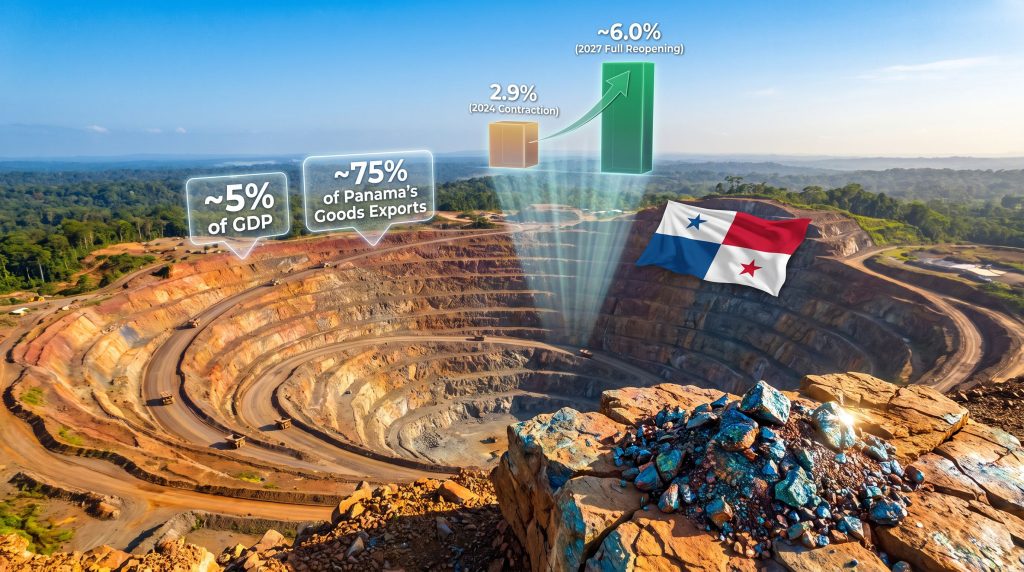
Yet within this services-dominant framework, Cobre Panamá occupied an anomalous position. As an open-pit copper mine and one of the largest of its kind in the Western Hemisphere, it contributed approximately 5% of national GDP, generated roughly $1.8 billion in annual export revenue, and accounted for an estimated 75% of Panama's total goods exports before its closure. Approximately 40,800 workers held direct or indirect employment linked to its operations.
| Economic Indicator | Pre-Closure Value | Share of National Economy |
|---|---|---|
| Annual Revenue Contribution | ~$1.8 billion | ~5% of GDP |
| Share of Goods Exports | ~75% | Dominant export earner |
| Direct and Indirect Employment | ~40,800 workers | ~2% of national workforce |
| Export Value Lost at Closure | ~$2.5 billion | ~4.5% of GDP |
In a services economy, a goods export contributor of this magnitude does not merely fill trade statistics. It anchors fiscal revenues through royalties and corporate taxation, supports ancillary industries across logistics and supply chains, and underpins consumer spending in regional labour markets, particularly in the Colón province.
The Cost of Closure: Measuring the 2023-2024 Growth Collapse
Panama's GDP growth trajectory between 2023 and 2024 offers one of the clearest natural experiments in recent Latin American economic history. The economy expanded at 7.4% in 2023, a robust pace reflecting post-pandemic recovery momentum and strong Canal-linked trade volumes. By 2024, that figure had collapsed to approximately 2.9%, a deceleration of nearly 4.5 percentage points in a single year.
The timing is not coincidental. The loss of approximately $2.5 billion in export value at closure cascaded through multiple economic channels simultaneously:
- Fiscal receipts contracted as royalty payments and corporate tax flows from the mine ceased
- Household consumption weakened as tens of thousands of workers faced employment disruption
- Ancillary service industries, from port logistics to equipment maintenance contractors, experienced demand withdrawal
- Supply chain linkages that had been built around the mine's operational requirements fell dormant
Beyond the domestic demand contraction, rating agencies began reassessing Panama's sovereign credit outlook. The closure introduced a new category of fiscal risk: contingent liabilities from international arbitration proceedings that First Quantum Minerals (the mine's operator) initiated following the forced shutdown. Furthermore, the Cobre Panamá arbitration claims, which could run into the billions of dollars, represent an ongoing overhang on Panama's public balance sheet that has no straightforward resolution pathway in the near term.
The Labour Market Dimension
The 40,800-worker employment figure understates the true labour market impact. In mining economics, the concept of the employment multiplier captures how each direct mining job typically supports multiple additional positions in connected industries. Transport, catering, equipment supply, maintenance contracting, and community retail all exhibit sensitivity to mining payroll flows.
For communities in the Colón province surrounding the mine, the economic disruption was not experienced as a macroeconomic statistic. It arrived as reduced local business revenue, constrained household budgets, and diminished regional tax bases. The regional concentration of this impact created a geography of hardship that aggregate national GDP figures do not fully represent.
How a Restart Translates Into GDP Points: The Five Transmission Channels
Fitch Ratings has estimated that a successful resumption of Cobre Panamá operations could add approximately 2 percentage points to Panama's real GDP growth rate. To understand why this figure is analytically credible rather than optimistic speculation, it is necessary to map the specific channels through which mine output flows into national accounts.
-
Export Revenue Restoration: Copper concentrate and cathode shipments re-enter the trade balance, directly expanding the current account and improving Panama's external position.
-
Fiscal Revenue Recovery: The government receives restored royalty streams, profit-sharing arrangements, and corporate tax contributions, compressing deficit pressure without requiring additional borrowing.
-
Wage Income Injection: Approximately 40,800 workers return to employment, generating household income that circulates through domestic consumption and strengthens demand-side growth dynamics.
-
Capital Expenditure Reactivation: An operational restart requires procurement, maintenance contracting, and logistics mobilisation across multiple industries, creating a short-term investment stimulus.
-
Sovereign Risk Signal: Resumption communicates to international capital markets that Panama's regulatory environment is stable enough to support large-scale foreign investment, potentially reducing risk premiums on sovereign borrowing and attracting complementary foreign direct investment.
The 2-percentage-point estimate from Fitch reflects the interaction of all five channels, not simply the direct output contribution. This multiplier logic is why the number exceeds what a straightforward 5%-of-GDP calculation might suggest.
Growth Scenario Modelling: Where Could Panama Land by 2027?
The IMF projects Panama's GDP at approximately 4% in its medium-term forecast, absent a mine restart. This baseline reflects the continued strength of Canal-linked logistics, financial services expansion, and modest construction activity. It is a serviceable growth rate by regional standards but falls well short of the high-expansion trajectory Panama demonstrated before 2023.
| Growth Scenario | Projected GDP Growth (2027) | Key Drivers | Fiscal Outcome |
|---|---|---|---|
| Full Reopening | ~6.0% | Export recovery, employment, Canal synergies | Arbitration risk reduced; revenues restored |
| Continued Closure | ~3.7% | Services-led growth only | Ongoing fiscal pressure; arbitration exposure |
| Partial or Delayed Restart | ~4.5-5.0% (est.) | Phased export recovery; partial employment gains | Mixed fiscal relief |
The Union of Industrialists of Panama (SIP) has modelled a scenario in which a mine restart, combined with active Canal-linked infrastructure investment, could push Panama toward 6% GDP growth by 2027. This ceiling scenario depends on timing: the faster operations resume, the more the fiscal and export multipliers compound over the projection period.
A critical and underappreciated dynamic here is the Canal synergy factor. Several major Panama Canal expansion-related infrastructure projects are progressing on overlapping timelines. If mine-related export and logistics activity reactivates simultaneously with increased Canal capacity utilisation, the port and logistics sector would experience compounded demand, stretching the GDP uplift beyond what either catalyst could deliver independently.
The Barriers: What Stands Between Panama and a 2-Point Boost
Environmental Governance and Assessment Requirements
Any credible pathway to restarting Cobre Panamá runs through a comprehensive environmental reassessment process. Panama's environmental authority would need to evaluate updated impact assessments before operational permits could be reinstated. This is not a procedural formality. The 2023 protests that precipitated the constitutional court ruling were substantially driven by public concern over environmental stewardship of the mine site and surrounding ecosystems, including watersheds of national significance.
International sustainability standards, increasingly demanded by institutional investors and export-market counterparties, add a further layer of complexity. A restart that cannot demonstrate credible environmental compliance would struggle to attract the financing and offtake agreements that large-scale copper operations require. Environmental governance is therefore not simply a political hurdle. It is a commercial prerequisite.
Legal Complexity and Arbitration Exposure
The Panama copper mine dispute has seen First Quantum Minerals pursue international arbitration claims against Panama following the closure. The scale of potential liability associated with these proceedings creates a fiscal shadow over any reopening negotiation. Panama's government must balance the revenue benefits of a restart against the risk of committing to contractual terms that either expose the state to future legal challenge or lock in arrangements that constrain future policy flexibility.
Legal resolution and a new concession framework are effectively prerequisites for bankable operational restart planning. Without contractual clarity, the operator cannot commit capital, and financiers cannot underwrite the restart costs.
Political Consensus in a Divided Landscape
The constitutional court ruling that triggered the closure was itself a response to the political earthquake of mass public protests. Successive Panamanian administrations have approached the mine's future from different ideological positions, reflecting genuine divisions among Panamanians about whether the economic benefits of the mine are equitably distributed and whether its environmental risks are acceptable.
Building the political consensus required for a durable restart is arguably the most difficult barrier, precisely because it cannot be resolved through technical analysis or financial structuring alone. It requires a social contract around the mine's operational terms that commands sufficient legitimacy to withstand future legal or political challenge.
The next major ASX story will hit our subscribers first
Copper's Global Context: Why the Timing Matters
The Cobre Panamá situation unfolds against a backdrop of structurally elevated global copper demand. The global copper supply crunch has been driven by the electrification of transport systems, the buildout of renewable energy infrastructure, and the expansion of power grids to support data centre growth — all copper-intensive processes. Supply-side constraints, including declining ore grades at major existing mines and a thin pipeline of new large-scale projects reaching production, have created a market environment where new copper supply carries genuine strategic value.
Investor Note: Copper ore grade is a critical variable that is often overlooked in commodity market analysis. As globally significant deposits are mined out, average grades at producing operations have declined over decades, making large, higher-grade deposits like Cobre Panamá increasingly scarce assets on a global inventory basis. This scarcity dynamic means that any restart would feed into a supply chain under structural pressure, not merely a cyclical upturn.
For Panama, this global demand context adds a dimension to the domestic economic calculus. The copper demand drivers suggest that a successfully restarted Cobre Panamá would not simply restore pre-2023 export volumes. It would do so into a copper market that is arguably more receptive to new supply than at any point in recent decades, potentially commanding stronger pricing and longer-term offtake security.
Frequently Asked Questions
What is Cobre Panamá?
It is one of the largest open-pit copper mines in the Western Hemisphere, located in Panama's Colón province and operated by First Quantum Minerals. It produces copper concentrate and copper cathodes for export.
Why was it shut down?
Panama's constitutional court ruled in November 2023 that the concession contract underpinning the mine's operations was unconstitutional, following mass public protests. The government subsequently ordered the mine to cease operations.
What GDP growth rate is Panama projected to achieve without the mine?
The IMF's medium-term baseline is approximately 4%. Fitch and other analysts project a range of 3.7-4% under a continued closure scenario.
How long would it take for a restart to show up in GDP data?
Export and fiscal revenue effects would likely appear within 12 to 18 months of operational restart. Full labour market recovery, including indirect and induced employment effects, could take considerably longer.
What are the most critical barriers to reopening?
Environmental reassessment, resolution of international arbitration proceedings, negotiation of a new concession framework, and the construction of durable political consensus are the four interlocking prerequisites.
The Concentration Risk Lesson
Perhaps the most instructive dimension of the Cobre Panamá reopening impact on Panama GDP for economic policymakers extends beyond the mine itself. The 7.4% to 2.9% growth collapse demonstrates with unusual clarity the vulnerability of an economy that allows a single productive asset, however beneficial, to accumulate such a large share of export earnings and fiscal revenues.
No other available growth lever in Panama's near-term economic toolkit approaches the 2-percentage-point uplift that a mine restart would deliver. Canal expansion projects might contribute 0.5 to 1.0 percentage points. Financial services growth and tourism expansion each offer fractions of that. The concentration of economic potential in a single industrial facility is the problem and the opportunity simultaneously.
| Growth Driver | Estimated GDP Contribution Potential | Timeline | Certainty Level |
|---|---|---|---|
| Cobre Panamá Reopening | ~+2.0 percentage points | 2026-2027 | Conditional |
| Panama Canal Expansion | ~+0.5-1.0 percentage points | 2026-2028 | High |
| Financial Services Growth | ~+0.3-0.5 percentage points | Ongoing | Moderate |
| Tourism Expansion | ~+0.2-0.4 percentage points | Ongoing | Moderate |
The Cobre Panamá reopening impact on Panama GDP is not a marginal policy question. It is the central variable in Panama's near-term economic trajectory. Furthermore, the future of copper mining and how Panama navigates its environmental, legal, and political complexity will determine whether a framework durable enough to support the multi-billion dollar operational commitment that a restart would require can be achieved.
Disclaimer: This article draws on publicly available macroeconomic projections from Fitch Ratings, the IMF, and industry analysis. GDP growth figures and scenario projections represent estimates and forecasts that are subject to material revision. Nothing in this article constitutes investment advice. Readers should conduct independent due diligence before making financial decisions related to any companies or assets referenced. For additional industry context on the Cobre Panamá situation and Panama's macroeconomic outlook, BNamericas provides ongoing analysis at bnamericas.com.
Want to Capitalise on the Next Major Copper Discovery Before the Market Does?
The structural supply constraints driving copper's long-term demand outlook mean that significant new discoveries can deliver outsized returns for investors who act early — Discovery Alert's proprietary Discovery IQ model instantly identifies significant ASX copper and mineral discoveries in real time, turning complex announcement data into clear, actionable insights for both traders and long-term investors. Explore what historic major discoveries have returned for early investors on Discovery Alert's dedicated discoveries page, and begin your 14-day free trial today to position yourself ahead of the broader market.