July 22, 2026
The Hidden Logic of Mining Giants Shedding Their Most Sophisticated Products
There is a counterintuitive reality embedded in the structure of modern mining conglomerates: the more technically advanced a downstream product becomes, the less strategic value it holds for a company whose core competency lies in extracting and processing primary commodities at scale. This paradox sits at the heart of Rio Tinto's decision to exit the aluminum metal matrix composite (MMC) business, transferring its commercial customer base to Canadian advanced materials firm Cymat Technologies in a deal announced in July 2026.
Understanding why Rio Tinto exits aluminum composites and transfers customers to Cymat requires looking well beyond the transaction itself. The deal reflects a fundamental reordering of capital priorities across the global mining industry, and it opens a strategically significant door for a specialist firm that has spent years building its entire business model around the very material Rio Tinto is walking away from.
When big ASX news breaks, our subscribers know first
What Aluminum Metal Matrix Composites Actually Are (And Why They Matter)
Most industry coverage of this transaction skips past the material science entirely. That omission matters, because understanding what MMC is explains precisely why the customer transfer creates asymmetric value for Cymat while remaining commercially irrelevant to Rio Tinto.
Aluminum metal matrix composites are not standard aluminum alloys. They are manufactured by embedding ceramic reinforcement particles, typically silicon carbide or alumina, directly into an aluminum matrix during processing. The result is a material that retains aluminum's well-known lightweight properties while gaining dramatically superior wear resistance, thermal stability, and stiffness compared to conventional aluminum alloys.
These properties make MMC uniquely suited to safety-critical applications where thermal performance under repeated mechanical stress is non-negotiable. The primary end markets are:
- Automotive brake disk manufacturing, particularly for commercial vehicles where thermal load during braking far exceeds passenger car requirements
- Rail transport braking systems, where brake disks must withstand sustained high-temperature cycling across long operational lifespans
- Specialty structural components where weight reduction and dimensional stability under heat are simultaneously required
Why Does MMC Outperform Conventional Alternatives?
Aluminum MMC delivers a combination of lightweight construction and high thermal conductivity that conventional cast iron brake components cannot replicate at equivalent weight. This distinction becomes increasingly significant as electrified commercial vehicles and next-generation rail platforms demand braking systems capable of regenerative energy management alongside conventional friction performance.
Rio Tinto had been producing and commercialising this proprietary ceramic-infused aluminum material for more than 40 years before announcing the exit. That operational longevity underscores a critical point: this was not a failed experiment or an abandoned research program. It was a mature, functioning business with an established European customer network. The exit was driven entirely by portfolio logic, not product failure.
Breaking Down the Commercial Agreement
The transaction between Rio Tinto Alcan and Cymat Technologies is structured as a customer base transfer rather than a conventional asset acquisition. No manufacturing facilities, patents, or production equipment changed hands. The commercial relationships themselves were the asset being transferred.
The financial mechanics are deliberately simple:
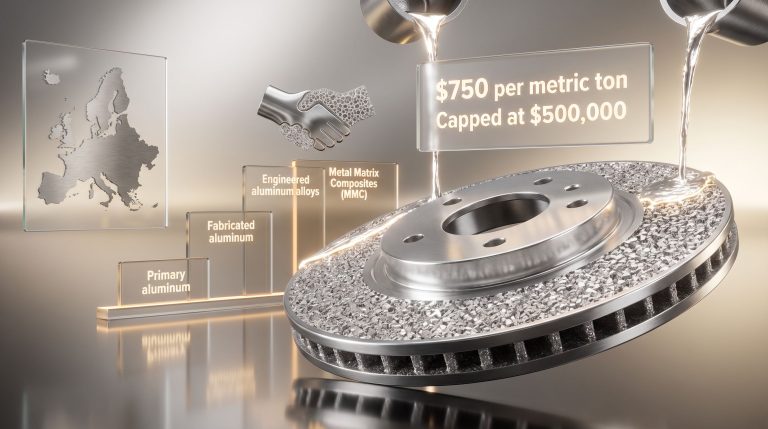
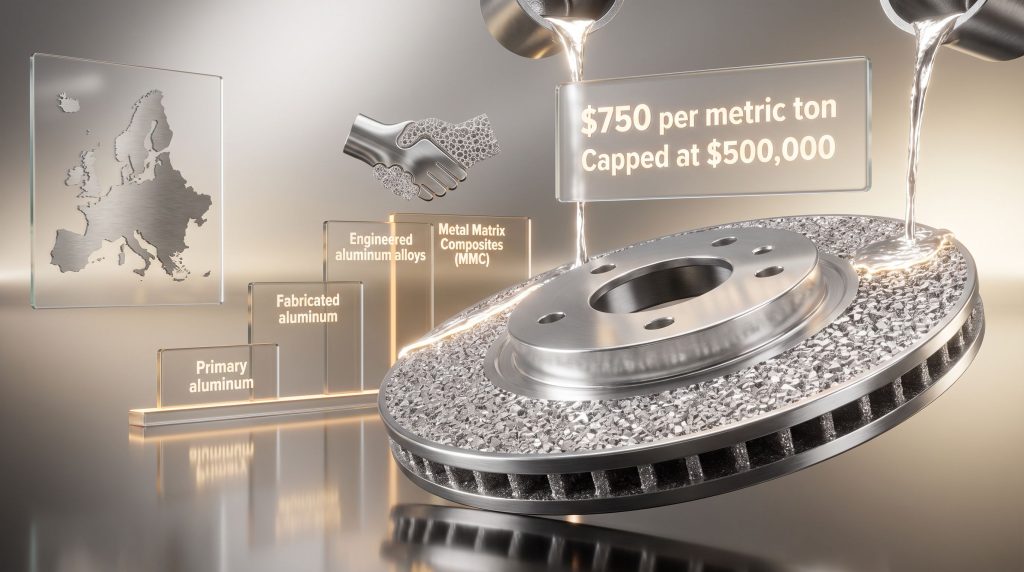
- Cymat pays Rio Tinto $750 per metric ton of MMC material sold or utilised across the transferred customer base
- The payment obligation runs for five years
- Total payments are capped at $500,000 across the full agreement term
- Rio Tinto also transferred its business development pipeline and commercial opportunities within the MMC product category
How Does the Royalty Rate Compare to Market Pricing?
To contextualise the royalty rate against prevailing market conditions, aluminum futures were trading at approximately $3,314 per metric ton at the time of the deal announcement. Cymat's $750 per ton obligation therefore represents roughly 22.6% of commodity aluminum futures pricing, applied to a specialty product that commands a significant premium above commodity aluminum given its enhanced performance characteristics.
The comparison with Rio Tinto's previous downstream exit is instructive. Furthermore, the commercial agreement executed between both parties highlights a clear structural divergence from earlier transactions:
| Transaction | Year | Counterparty | Structure | Value |
|---|---|---|---|---|
| Alcan Composites Division Sale | 2009 | Schweiter Technologies | Full asset acquisition | $349 million |
| MMC Customer Base Transfer | 2026 | Cymat Technologies | Commercial relationship transfer | Capped at $500,000 |
The 2009 Alcan Composites transaction, which involved the sale of manufacturing assets serving wind energy and industrial sectors, bore almost no structural resemblance to the 2026 deal. Conflating the two misrepresents the nature of what is actually being exchanged. In 2026, Rio Tinto is not selling a factory or a patent portfolio. It is handing over the commercial trust it has built with European brake component manufacturers over four decades.
Why Cymat Is the Logical Successor, Not a Speculative Bet
Cymat Technologies occupies a position in the advanced aluminum materials space that makes this customer transfer strategically coherent rather than opportunistic. The company's primary product is stabilised aluminum foam (SAF), a lightweight structural material manufactured through a process that uses MMC as its core input feedstock.
This is not a peripheral connection. Cymat's entire production architecture depends on ceramic-infused aluminum composite material. Where a generalist aluminum processor would face a steep learning curve in absorbing Rio Tinto's MMC customer base, Cymat already possesses the processing expertise, quality standards familiarity, and material handling capability to serve those customers without significant transition friction.
The strategic benefits flowing to Cymat from this transfer are layered:
- Immediate market access: An established European customer network in automotive and rail brake disk manufacturing, built over 40 years of Rio Tinto commercial relationships
- Vertical integration potential: The ability to align MMC supply more directly with its own SAF production reduces dependency on third-party material sourcing and may compress input costs over time
- Business development pipeline: Rio Tinto's transferred commercial opportunities represent forward revenue optionality beyond the existing customer base
- Revenue visibility: A five-year structured commercial framework provides earnings predictability while the customer integration process matures
The Deeper Strategic Signal: Mining Majors and the Specialty Materials Retreat
Rio Tinto's exit from a four-decade-old MMC business is best understood as one data point in a broader strategic reorientation occurring across global mining conglomerates. Consequently, as capital allocation frameworks among mega-miners increasingly prioritise critical minerals supply chains, copper growth assets, lithium development, and iron ore optimisation, legacy specialty downstream units face systematic scrutiny under return-on-capital thresholds.
Rio Tinto's green metals strategy is closely aligned with this capital reorientation, directing investment toward decarbonisation-linked commodities rather than niche downstream materials. Similarly, Rio Tinto copper expansion has absorbed significant capital attention, further reducing the strategic appetite for maintaining peripheral specialty businesses.
For a company generating billions in revenue from primary commodity operations, an MMC business generating niche volumes for European brake manufacturers is commercially immaterial in absolute terms. The management bandwidth required to maintain and grow that business arguably costs more than the revenue it generates relative to what the same capital could earn deployed elsewhere in the portfolio.
This asymmetry creates a structural opportunity for specialist materials companies. As mining majors continue to rationalise legacy downstream divisions through mining asset sales and commercial transfers, niche operators with the technical competency to absorb those businesses may encounter a recurring pipeline of opportunities at favourable economics.
Market Positioning: Where MMC Sits in the Aluminum Value Chain
| Aluminum Product Tier | Examples | Market Characteristics |
|---|---|---|
| Primary aluminum | Ingot, billet, slab | High volume, commodity pricing, margin-thin |
| Fabricated aluminum | Sheet, extrusions, foil | Mid-value, broad industrial application |
| Engineered aluminum alloys | Aerospace-grade, automotive sheet | Specialty pricing, performance specification |
| Metal matrix composites | Ceramic-infused brake components | Ultra-niche, safety-critical, premium-priced |
MMC occupies the highest value-density tier of the aluminum processing chain while representing the smallest addressable volume. For Rio Tinto, which processes millions of metric tons of primary aluminum annually through its Alcan division, MMC volumes are a rounding error. However, for Cymat, whose entire commercial model is built around advanced aluminum material processing, the same volumes represent a meaningful revenue contribution and a strategic market position worth defending. In addition, the top aluminium companies operating at scale face similar tensions between commodity throughput and specialty downstream margin.
The commodity price impact on portfolio decisions like this one is significant, as rising primary aluminum prices make niche downstream units appear even less attractive relative to core extraction operations.
The next major ASX story will hit our subscribers first
The European Brake Market and Long-Cycle Demand Dynamics
The customer base being transferred carries structural growth optionality that extends well beyond current volumes. European commercial vehicle brake disk manufacturers and rail transport component suppliers sit at the intersection of two long-cycle demand trends that are still in early stages of deployment:
- Commercial vehicle electrification is transforming braking system requirements. Electric and hybrid commercial trucks use regenerative braking as a primary energy recovery mechanism, but still require friction braking systems capable of high-load stops. MMC brake disks offer thermal management advantages over cast iron that become more pronounced as vehicle systems grow more sophisticated.
- Rail infrastructure investment across Europe continues under multi-decade planning horizons. Rail rolling stock tends to have 25 to 35-year operational lifespans, meaning brake component specifications set today create demand commitments extending well into the 2050s.
Neither of these structural tailwinds is speculative. They reflect existing procurement cycles and engineering decisions already embedded in European transport infrastructure planning. Cymat, through the transferred customer relationships, gains exposure to both demand vectors with minimal upfront capital expenditure.
What Investors and Industry Observers Should Watch
Several forward-looking dynamics warrant attention following this transaction:
- Customer retention rates during the handover period will be the primary near-term indicator of deal success. European industrial customers tend to value long-term supplier relationships and technical continuity, which Cymat's existing MMC expertise should help preserve.
- Vertical integration progress between Cymat's SAF production and the transferred MMC customer base could reduce input cost variability and improve margin structure over the five-year payment window.
- Further divestiture activity by Rio Tinto or comparable mining majors in adjacent specialty materials segments may emerge, given the systemic nature of the portfolio rationalisation trend rather than it being isolated to this single transaction.
- The $500,000 payment cap signals that neither party views the royalty economics as the primary value driver. The commercial pipeline and customer trust are the real assets being transferred, and their long-term value far exceeds the contractual ceiling.
Disclaimer: This article contains forward-looking analysis and scenario projections based on publicly available information. It does not constitute financial advice. Readers should conduct independent research before making any investment decisions. Market conditions and company strategies are subject to change.
Want to Catch the Next Major ASX Mineral Discovery Before the Market Does?
Discovery Alert's proprietary Discovery IQ model delivers real-time alerts on significant ASX mineral discoveries, instantly converting complex geological data across more than 30 commodities into clear, actionable insights for both short-term traders and long-term investors — explore Discovery Alert's discoveries page to understand how historic finds have generated exceptional returns, and begin your 14-day free trial today to position yourself ahead of the broader market.