June 7, 2026
How Does Angola's Production Target Align with Global Energy Market Dynamics?
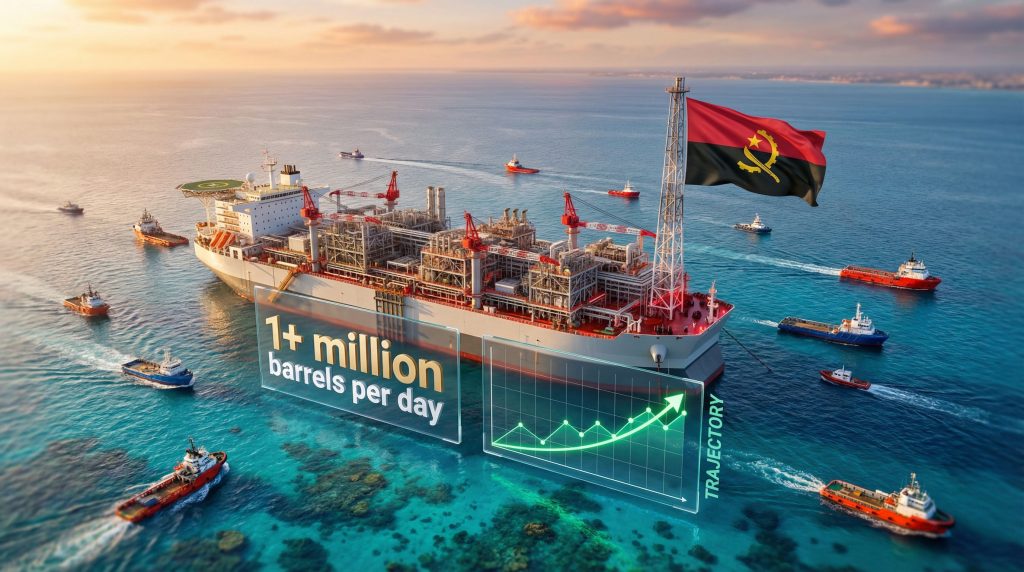
Angola's oil production target reflects sophisticated economic planning rather than simple volume maximisation. The country's commitment to sustaining output above one million barrels per day serves as a cornerstone for macroeconomic stability, representing approximately $31.6 billion annually in gross revenues at current pricing levels.
This strategic threshold emerged from hard-learned lessons during the 2020-2021 oil price collapse, when Brent crude fell from $60 to $40 per barrel. During this period, Angola's budget execution rate dropped to 75%, forcing painful spending cuts and highlighting the vulnerability of oil-dependent fiscal frameworks.
The production discipline approach contrasts sharply with neighbouring producers. While Nigeria struggles with security challenges that constrain output to 1.5 million barrels per day despite higher capacity, Angola has maintained consistent performance through systematic reinvestment in existing infrastructure.
Current Production Metrics:
• Target maintenance floor: 1+ million barrels daily
• Recent performance: 1.084 million bpd (November 2023)
• Capacity utilisation: 52% of historical peak levels
• Annual revenue generation: $31-35 billion at current prices
Strategic Independence Through OPEC Exit
Following Angola's departure from OPEC in January 2024, the country gained operational flexibility previously constrained by cartel quotas. This independence allows production scheduling based on market conditions rather than external mandates, positioning Angola to optimise revenue capture during peak demand windows.
The timing proves strategic as global oil demand approaches projected peaks in the 2030-2035 timeframe. Furthermore, the oil price stagnation caused by geopolitical tensions ensures maximum value extraction during this critical period while avoiding overinvestment in capacity that would become stranded as demand transitions.
When big ASX news breaks, our subscribers know first
What Economic Factors Drive Angola's Production Strategy?
Angola's economic architecture depends fundamentally on petroleum revenues, with hydrocarbons generating 90-95% of merchandise exports and 55-65% of government budget receipts. This dependency creates both opportunities and vulnerabilities that shape production planning.
The Central Bank of Angola's monetary policy operates within constraints imposed by oil sector dynamics. Without consistent export revenues, the institution struggles to maintain foreign exchange reserves necessary for import financing and currency stability.
Fiscal Dependency Framework:
• Government salary payments: 40% of total spending
• Infrastructure investment: 25-30% of budget allocation
• External debt servicing: 20-25% of revenues
• Strategic reserve accumulation: 10-15% during surplus periods
Currency Stability Mechanisms
Angola's Kwanza experienced dramatic volatility correlated with crude export performance. During the 2020-2021 crisis, the currency depreciated 40% as oil prices collapsed, demonstrating the direct transmission mechanism between production levels and macroeconomic stability.
Conversely, the 2022-2023 recovery period saw the Kwanza appreciate 15-20% as Brent crude returned to $80-90 per barrel ranges. This correlation underscores why production floors matter beyond simple revenue generation, extending to price stability and import cost management.
External Balance Sheet Dynamics
Angola faces a petroleum paradox: despite being a major crude producer, the country imports 200,000-300,000 barrels daily of refined products due to limited domestic refining capacity. This creates dual exposure where crude export revenues must cover both government operations and fuel import costs.
The production target serves as an anchor point ensuring sufficient foreign exchange generation to meet both fiscal obligations and energy security requirements.
Which Investment Strategies Support Long-Term Production Goals?
Sustaining Angola's oil production target increasingly depends on sophisticated capital allocation across aging offshore infrastructure. The country's investment philosophy prioritises proven assets over speculative exploration, reflecting both financial constraints and strategic timing considerations.
Investment Allocation Framework:
| Investment Category | Percentage Allocation | Expected Returns | Timeline |
|---|---|---|---|
| Brownfield Enhancement | 60% | 8-15% production uplift | 12-24 months |
| Infill Drilling Programs | 25% | 5-12% recovery improvement | 6-18 months |
| New Field Development | 15% | Future capacity building | 5-8 years |
Technology-Driven Recovery Optimisation
Advanced recovery techniques enable operators to extract additional value from mature fields without proportional capital increases. Digital optimisation systems, including real-time reservoir monitoring and predictive analytics, consistently deliver 8-18% production improvements in existing wells.
Combined technological interventions can exceed 20% efficiency gains in optimal cases. These improvements prove crucial as Angola's offshore fields experience natural decline rates of 5-7% annually without intervention.
Technical Enhancement Methods:
• Water injection optimisation for pressure maintenance
• Subsea infrastructure upgrades and tieback systems
• Horizontal drilling for improved reservoir contact
• Enhanced oil recovery through gas cycling
Brownfield Project Success Examples
The Girassol field demonstrates effective brownfield investment, where subsea infrastructure upgrades increased production from 200,000 to 250,000 barrels daily. Similar interventions across Angola's mature asset base could sustain current production levels for an additional 10-15 years.
Sonangol allocates approximately $2.5-3.0 billion annually to upstream projects, with the majority focused on production maintenance rather than exploration. This strategy reflects both capital efficiency considerations and recognition that peak oil demand approaches within the next decade.
How Do Global Demand Patterns Influence Angola's Output Planning?
Angola's crude marketing strategy leverages geographic advantages and oil quality characteristics to optimise revenue across diverse international markets. However, evolving oil price movements continue to influence strategic positioning between Atlantic and Indian Ocean trade routes.
Regional Export Distribution:
• Asian Markets: 65% of exports driven by expanding refining capacity
• European Markets: 20% of exports focused on high-specification crude grades
• Regional African Markets: 15% of exports supporting continental energy security
Strategic Buyer Diversification
The expansion of commercial relationships with Gulf region financial institutions and Asian energy companies reduces traditional dependency on Western oil majors. This diversification creates more competitive pricing environments and flexible commercial terms that enhance revenue optimisation.
Chinese and Indian refineries increasingly value Angola's medium-sweet crude characteristics, particularly the Cabinda blend which commands premium pricing in Asian markets. Long-term supply agreements with these buyers provide revenue predictability that supports production planning.
Moreover, understanding trade war oil impacts helps Angola navigate complex international relationships whilst maximising market opportunities.
Market Access Infrastructure
Angola's offshore loading terminals can accommodate Very Large Crude Carriers (VLCCs), enabling efficient transport to distant markets. This infrastructure advantage allows direct shipments to Asia without costly transshipment, improving netback pricing relative to competitors requiring smaller vessels.
Transportation Economics:
• VLCC capacity: 2+ million barrels per vessel
• Transport cost to Asia: $3-5 per barrel
• Premium pricing in Asian markets: $2-4 per barrel above Brent
• Net advantage: $1-3 per barrel versus regional competitors
What Role Does Regulatory Reform Play in Production Sustainability?
Angola's regulatory modernisation efforts focus on creating investment-friendly frameworks while maintaining strategic state participation. The National Agency for Petroleum, Gas and Biofuels (ANPG) has implemented comprehensive licensing rounds designed to attract $60-70 billion in cumulative investments over the next decade.
These reforms address historical inefficiencies that constrained foreign investment and technology transfer. Streamlined procedures reduce project approval timelines from 3-5 years to 18-24 months, improving capital efficiency for both domestic and international operators.
Key Reform Areas:
• Simplified exploration block licensing procedures
• Fiscal incentive structures for enhanced recovery projects
• Environmental compliance frameworks aligned with international standards
• Local content requirements supporting domestic capacity development
Institutional Capacity Building
ANPG's multi-year licensing strategy targets specific production outcomes rather than simply maximising bid premiums. Furthermore, the recent Saudi exploration licenses model provides valuable benchmarks for Angola's approach, prioritising operators with proven technical capabilities and financial resources to execute projects that sustain the Angola oil production target.
The agency's focus on technology transfer requirements ensures knowledge spillovers that benefit the broader petroleum sector. International operators must demonstrate training programmes and local hiring commitments that build domestic technical expertise.
Investment Climate Improvements
Recent regulatory changes include transparent pricing mechanisms for natural gas and standardised environmental impact assessments. Additionally, Angola targets 60 oil and gas concessions by the end of 2025 through its licensing drive, reducing regulatory uncertainty that previously deterred long-term investment commitments.
Foreign exchange regulations have been liberalised to enable more efficient capital repatriation, addressing a historical concern for international oil companies operating in Angola.
How Does Production Targeting Support Economic Diversification?
While maintaining oil output stability, Angola simultaneously pursues revenue diversification strategies that reduce long-term petroleum dependency. The Angola oil production target provides fiscal space for investments in alternative economic sectors without sacrificing immediate revenue needs.
Diversification Investment Channels:
• Infrastructure development funded through oil stabilisation revenues
• Manufacturing sector growth supported by reliable energy pricing
• Agricultural modernisation enabled by foreign exchange stability
• Financial sector development through sovereign wealth accumulation
Sovereign Wealth Management Strategy
Consistent production above one million barrels daily enables systematic contributions to Angola's sovereign wealth funds. The State Oil Fund of Angola (FSDEA) serves as a fiscal buffer for economic transition periods and enables counter-cyclical policy implementation.
During high price periods, surplus revenues flow into the fund rather than current consumption, creating reserves for future non-oil investments. This approach follows successful models from Norway and other resource-rich economies that transformed oil wealth into diversified economic foundations.
Fund Performance Metrics:
• Target annual contributions: 10-15% of oil revenues
• Investment focus: International diversified portfolios
• Withdrawal rules: Limited to economic emergencies
• Performance benchmark: Global sovereign wealth fund averages
Industrial Development Linkages
Angola's oil sector creates upstream and downstream economic opportunities beyond direct production. Local content requirements drive investments in fabrication yards, logistics services, and technical training facilities that serve broader industrial development.
The Soyo Industrial Complex exemplifies this approach, combining oil and gas processing with manufacturing facilities that serve regional markets. Reliable energy supplies from the petroleum sector enable competitive industrial operations across multiple sectors.
The next major ASX story will hit our subscribers first
What Are the Long-Term Implications for Energy Transition?
Angola's production strategy acknowledges global energy transition trends while maximising value extraction during remaining decades of peak oil demand. This approach balances immediate fiscal needs with preparation for post-carbon economic transformation, aligning with broader energy transition strategies emerging globally.
The International Energy Agency projects global oil demand will plateau in the early-to-mid 2030s under most scenarios. Angola's current production levels position the country to capture maximum revenues during this peak demand window while building financial reserves for subsequent energy transition investments.
Transition Timeline Considerations:
• 2025-2030: Peak demand period with premium pricing opportunities
• 2030-2035: Demand plateau requiring cost optimisation focus
• 2035-2040: Managed production decline with renewable investment
• 2040+: Post-carbon economy supported by accumulated reserves
Strategic Asset Management
Rather than pursuing maximum extraction rates that would accelerate field depletion, Angola's approach optimises depletion schedules aligned with global decarbonisation timelines. This strategy prevents stranded asset risks while ensuring optimal revenue capture.
The country's offshore infrastructure could potentially support renewable energy projects, including offshore wind and floating solar installations. Existing subsea cable networks and port facilities provide ready-made infrastructure for energy transition investments.
Skills Transfer and Workforce Development
Angola's petroleum sector has developed significant technical expertise in offshore engineering, project management, and complex industrial operations. These capabilities transfer readily to renewable energy projects, particularly offshore wind development and industrial-scale solar installations.
Training programmes funded through oil revenues create workforce capacity for energy transition sectors. This approach ensures smooth economic transformation rather than abrupt sectoral shifts that could create unemployment and social disruption.
Workforce Transition Planning:
• Offshore engineering skills applicable to wind energy
• Project management expertise transferable across energy sectors
• Technical maintenance capabilities relevant to renewable infrastructure
• Financial and commercial skills supporting green energy development
Risk Management and Market Volatility Considerations
Angola's production targeting incorporates sophisticated risk management approaches that account for oil price volatility, geopolitical uncertainties, and technological disruptions. The one million barrel threshold provides a buffer against market shocks while maintaining economic stability.
Historical analysis reveals that production discipline during volatile periods outperforms boom-and-bust cycles. Countries that maintained steady output during the 2008 financial crisis and 2020 pandemic recovered faster than those that dramatically reduced production.
Risk Mitigation Strategies:
• Production hedging through long-term supply contracts
• Currency diversification in export pricing mechanisms
• Infrastructure redundancy to prevent single-point failures
• Emergency production protocols for crisis response
Climate Policy Integration
Angola's production planning increasingly incorporates climate policy scenarios and carbon pricing mechanisms. The country participates in international climate frameworks while balancing development needs with environmental commitments.
Carbon capture and storage technologies could extend the economic life of Angola's oil fields while reducing emissions intensity. Pilot projects explore subsurface CO2 injection using existing well infrastructure, potentially creating additional revenue streams through carbon credit markets.
Frequently Asked Questions About Angola's Oil Production Strategy
Why does Angola prioritise production stability over maximum output?
Production discipline prevents premature reservoir depletion while ensuring consistent revenue streams that support broader economic planning objectives. Maximum extraction would accelerate field decline and create long-term fiscal vulnerabilities.
How does the Angola oil production target compare to regional competitors?
Angola's approach emphasises sustainability over peak production volumes. While Nigeria produces 1.5 million barrels daily despite higher potential capacity, Angola's steady 1+ million barrel target provides more reliable fiscal planning foundations.
What external factors could impact the production target?
Global oil price volatility, technological disruptions in energy markets, and international climate policy developments represent primary external variables affecting production planning. Angola's strategy builds flexibility to adapt to these changing conditions.
How does the production target support Angola's economic diversification goals?
Reliable oil revenues provide fiscal space for investments in alternative sectors including agriculture, manufacturing, and services. The production floor ensures sufficient resources for economic transition without compromising current development needs.
What role does technology play in sustaining the Angola oil production target?
Advanced recovery techniques and digital optimisation systems enable sustained production from mature fields. Additionally, Angola seeks gas growth whilst oil output remains stable, with these technologies typically delivering 8-18% efficiency improvements while extending field economic life by 10-15 years.
This analysis reflects current market conditions and policy frameworks as of early 2026. Oil market dynamics and regulatory environments continue evolving, requiring ongoing assessment of production strategies and economic implications.
Looking to Capitalise on Energy Market Opportunities?
Discovery Alert's proprietary Discovery IQ model delivers real-time alerts on significant ASX mineral discoveries, including energy transition metals crucial for the evolving global energy landscape. Visit Discovery Alert's dedicated discoveries page to understand how major mineral discoveries can generate substantial market returns, then begin your 30-day free trial today to position yourself ahead of market-moving announcements.