June 7, 2026
When Quota Math Meets Geopolitical Reality: OPEC+ Faces Its Deepest Crisis
There is a fundamental misunderstanding embedded in most coverage of oil cartel mechanics. Mainstream analysis tends to treat OPEC+ decisions as the dominant variable in global crude pricing, as though announcement of a production target automatically translates into market movement. That model held reasonable predictive power for decades. It no longer does. The Iran conflict has exposed a structural blind spot that cartel theory was never designed to account for: the difference between the authority to produce and the physical ability to export.
Understanding why the OPEC+ meeting Iran war oil prices nexus has become so dangerously complex requires a step back from the quota spreadsheets and into the geography of petroleum logistics. Furthermore, OPEC's global oil market influence has rarely been tested so severely, exposing deep cracks in the conventional model of cartel-driven price management.
When big ASX news breaks, our subscribers know first
The Strait of Hormuz: A Chokepoint That Cartel Tools Cannot Replace
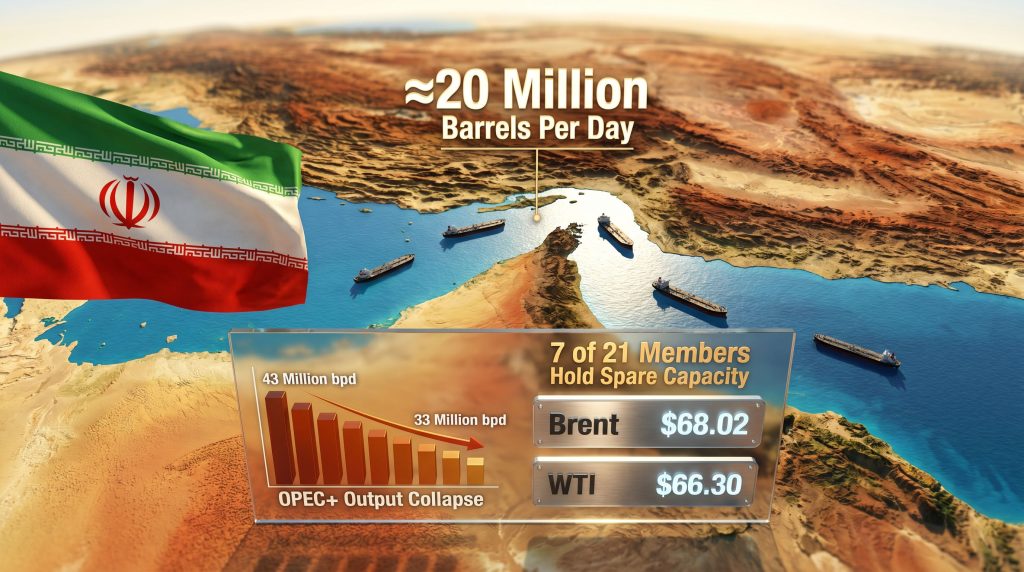
The Strait of Hormuz is one of the narrowest and most consequential maritime passages on the planet. At its tightest point, the navigable channel used by laden tankers is only about two miles wide in each direction, yet through this corridor flows roughly 20 million barrels of oil and gas per day under normal operating conditions. That volume represents approximately one-fifth of total global petroleum supply, making the strait not merely important but genuinely irreplaceable in the short term.
No pipeline network, no alternative sea route, and no collection of non-Gulf producers can substitute for the volume normally transiting Hormuz. The Red Sea and Suez Canal routes are geographically and logistically distinct corridors serving different production basins. The Cape of Good Hope bypass adds weeks of transit time and significant cost. There is no realistic rapid-deployment alternative for Gulf crude.
When US and Israeli military strikes on Iran in late February 2026 triggered retaliatory threats that effectively blockaded this corridor, the result was not a managed supply reduction. It was a logistics severance event. Consequently, geopolitical oil price tensions of this magnitude had not been seen for decades, and Gulf crude did not merely become more expensive to ship — it became largely inaccessible to international markets altogether.
The Tanker Economics Behind the Blockade
A detail rarely discussed in mainstream oil market commentary is how tanker insurance markets respond to conflict-zone classifications. When a maritime passage is designated a war risk zone by Lloyd's of London or equivalent underwriters, insurance premiums for vessels transiting the area can spike by several hundred percent within days. At a certain premium threshold, shipping becomes economically unviable even if the physical passage remains technically navigable.
This insurance-market mechanism means that effective blockades can be enforced without a single vessel being physically intercepted. Tanker operators simply divert. This dynamic amplifies the real-world impact of conflict-driven threats far beyond what military analysts alone would predict, and it explains why Gulf crude export volumes can collapse rapidly even in the absence of a formal naval blockade.
OPEC+ Production Reality: From 43 Million to 33 Million Barrels Per Day
Before the conflict escalated, the OPEC+ coalition was collectively producing close to 43 million barrels per day, representing a substantial share of global supply. Since the effective closure of Gulf shipping routes, that figure has contracted to approximately 33 million barrels per day, according to the organisation's own internal data. The arithmetic is stark. According to reporting from Reuters, the organisation has been actively debating output responses even as the physical capacity to deliver on those responses remains severely constrained.
| Metric | Pre-Conflict | Post-Hormuz Closure | Change |
|---|---|---|---|
| OPEC+ Daily Output | ~43 million bpd | ~33 million bpd | -10 million bpd |
| Hormuz Daily Flow | ~20 million bpd | Severely restricted | Near cessation |
| Members With Spare Capacity | 21 (nominal) | 7 (practical) | -14 members |
| Compliance Framework Status | Active | Effectively irrelevant | Structural breakdown |
What makes this situation analytically distinct from a voluntary production cut is the nature of the reduction. OPEC+ has historically managed markets by choosing to restrict supply. The current contraction is involuntary, driven by physical inaccessibility rather than strategic coordination. Rystad Energy analyst Jorge Leon has indicated that the likely quota increase to be discussed at the June 2026 meeting sits around 188,000 barrels per day, consistent with recent quarterly adjustment patterns.
However, there are elevated and stress scenarios on the table ranging up to 411,000 bpd and even 548,000 bpd respectively, reflecting the severity of the pricing environment. None of these figures come close to addressing a 10-million-barrel-per-day involuntary production gap. Indeed, the scale of this global oil price shock has few precedents in modern energy history.
The Seven-Member Capacity Reality
Of the 21 OPEC+ member states, only seven possess the technical spare capacity and export infrastructure to meaningfully increase output in the near term:
- Saudi Arabia
- Russia
- Iraq
- Kuwait
- Kazakhstan
- Algeria
- Oman
Every other member either is operating at or near maximum capacity, faces its own export route complications, or both. This means that OPEC+ production decisions are, in practical terms, being made by a seven-country coalition operating under the fiction of a 21-nation consensus. The gap between nominal membership and operational relevance has never been wider.
Why Announced Production Increases Cannot Move Prices in the Current Environment
Saxo Bank commodities analyst Ole Hansen has been direct in his assessment, noting that any announced production increases or changes to output targets carry limited practical value given current geopolitical realities. This view reflects a growing consensus among energy market professionals that the traditional OPEC+ price stabilisation mechanism has been structurally compromised. Furthermore, geopolitical trade disruption of this scale has consistently overwhelmed the cartel's ability to restore market confidence through quota announcements alone.
The reasoning is straightforward when broken into its components:
- Physical export barriers mean that Gulf producers cannot deliver increased volumes to market regardless of what their quota paperwork says
- US port blockades on Iranian exports mean actual deliverable supply is likely below even the headline 33 million bpd figure, as noted by Kpler head of crude oil analysis Homayoun Falakshahi
- Non-Gulf members with spare capacity (Russia, Kazakhstan, Algeria) face their own logistical constraints, sanctions environments, and infrastructure limitations that cap rapid output increases
- Market psychology has already moved past cartel announcements as the primary price signal, with geopolitical risk premium now dominating benchmark pricing
Falakshahi's observation that actual supply is likely even lower than the official 33 million bpd figure due to US port blockade enforcement represents a significant downside risk to supply estimates that markets may not have fully priced.
The UAE Departure: Structural Fracture or Rational Defection?
The United Arab Emirates' decision to exit OPEC represents more than a diplomatic disagreement. It is a rational economic calculation by a nation with significant excess production capacity that concluded the opportunity cost of quota compliance exceeded the benefits of cartel membership. Abu Dhabi has been explicit about its intent to maximise output revenues independently.
University of Brighton finance lecturer Lawrence Haar has framed this accurately: nations with large capacity surpluses have the most to lose from output restrictions and the most to gain from operating outside collective frameworks. The UAE's exit is the clearest expression of that logic to date. As reported by the Straits Times, OPEC's decision to hike production more than expected following the outbreak of hostilities has done little to stabilise the political dynamics within the bloc.
What makes the situation particularly precarious for OPEC+ cohesion is the precedent effect. Iraq, one of the coalition's largest producers by volume, is being watched closely by analysts. Falakshahi has suggested that an Iraqi departure could represent a terminal event for the organisation's functional credibility. Saudi Arabia's likely response, according to the same analysis, would be to offer increasingly generous compliance terms or reduced penalties to retain wavering members. However, every concession that makes membership more flexible simultaneously weakens the collective output discipline that gives the cartel its market relevance.
The Paradox of Cartel Preservation
Saudi Arabia finds itself in a structural paradox: the tools available to prevent further defections are the same tools that, when deployed, undermine the cartel's price management function. Loosening quota enforcement, reducing overproduction penalties, and allowing bilateral output arrangements all reduce the friction of membership while simultaneously reducing its purpose. A cartel that permits members to produce at will in order to retain those members is not a cartel in any meaningful economic sense.
China's Strategic Reserve Drawdown: The Hidden Price Ceiling
One factor receiving insufficient attention in standard market analysis is China's role as an informal price dampener. As the world's largest crude importer, the relationship between China and oil prices has become a critical lever in determining how far benchmark prices can run during supply shocks of this magnitude. However, Beijing has been systematically drawing down its strategic petroleum reserves rather than purchasing at elevated spot prices.
This behaviour serves multiple Chinese strategic objectives simultaneously:
- Insulates domestic industry from the full impact of supply-shock pricing
- Reduces foreign exchange exposure to elevated commodity prices
- Preserves negotiating leverage with suppliers by signalling reduced spot demand
- Delays reserve replenishment until prices normalise, effectively timing commodity procurement
The critical limitation of this strategy is its finite nature. Strategic petroleum reserves are, by definition, bounded stockpiles. Once drawdowns reach a threshold that Beijing considers strategically uncomfortable, China will return to spot market purchasing. At that point, the demand-side brake on price escalation will be removed at precisely the moment when supply disruption may still be ongoing. This creates a potential second-wave price shock scenario that markets have not fully priced.
The next major ASX story will hit our subscribers first
Benchmark Pricing and What Markets Are Actually Signalling
Ahead of the June 2026 OPEC+ meeting, the benchmark crude prices reflected a market navigating competing pressures:
| Benchmark | Pre-Meeting Price | Primary Driver |
|---|---|---|
| Brent Crude | $68.02 per barrel | Geopolitical risk premium offset by demand concerns |
| WTI Crude | $66.30 per barrel | Supply disruption vs. strategic reserve releases |
These figures are significantly below the peak levels reached immediately following the Hormuz closure, when prices nearly doubled from pre-conflict baselines. The moderation reflects the combined effect of China's reserve drawdowns, coordinated strategic petroleum reserve releases by International Energy Agency member nations, and demand destruction as elevated energy costs suppress industrial and consumer activity.
The fact that prices have not returned to pre-conflict levels despite these demand-side suppressants tells a critical story: the market does not believe the supply disruption is temporary. Geopolitical risk premium is being structurally embedded into benchmark pricing in a way that routine OPEC+ quota announcements cannot dislodge.
Scenario Analysis: Three Pathways for the Second Half of 2026
The range of plausible outcomes for oil markets through the remainder of 2026 is unusually wide, reflecting the genuine uncertainty surrounding both conflict resolution timelines and OPEC+ cohesion.
Scenario A: Partial Hormuz Reopening
Diplomatic channels produce sufficient de-escalation to allow limited tanker traffic to resume under international naval escort arrangements. OPEC+ production increases begin translating into actual deliverable supply. Brent stabilises in the $65 to $75 range, inflation pressures ease gradually, and cartel credibility partially recovers.
Scenario B: Prolonged Blockade With Cartel Fragmentation
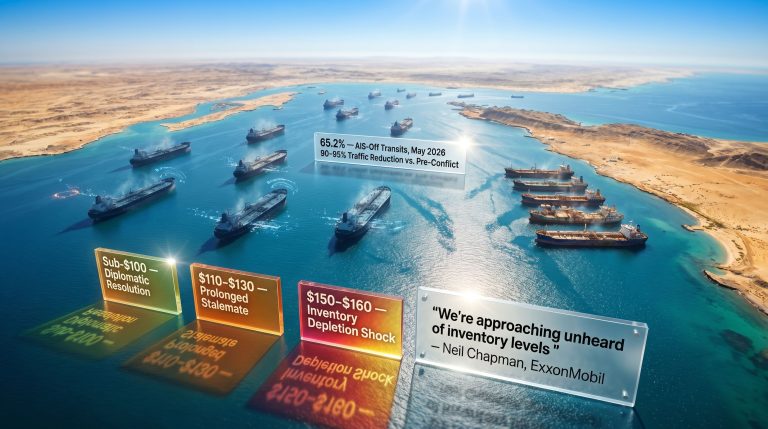
The Hormuz closure extends through the third quarter of 2026. Additional OPEC+ members signal intent to operate outside quota frameworks. Brent tests $90 to $100 or above. IEA member nations coordinate emergency strategic reserve releases. Global recession risk elevates materially.
Scenario C: Conflict Escalation Beyond Iran
Military activity expands to affect Saudi Arabian or Iraqi production infrastructure directly. Supply removal exceeds the compensating capacity of all non-Gulf producers combined. A structural multi-year energy price shock follows with consequences for global inflation that dwarf anything seen since the 1970s oil embargo period.
Disclaimer: The scenario projections above represent analytical frameworks for understanding risk distribution, not investment advice or price forecasts. Energy markets are subject to rapid, unpredictable change driven by geopolitical, meteorological, and macroeconomic factors beyond any model's predictive capacity.
What OPEC+'s Crisis Reveals About the Limits of Cartel Economics
The deeper lesson embedded in the current OPEC+ meeting Iran war oil prices dynamic is about the boundary conditions of cartel theory itself. Output coordination mechanisms are powerful tools when the primary variable in price formation is willingness to produce. They become largely irrelevant when the primary variable shifts to physical ability to export.
OPEC+ was designed for a world where the organisation's members could choose how much oil reached global markets. The Iran conflict has introduced a world where that choice is being made by geography, military threat dynamics, insurance market responses, and port blockade enforcement — none of which appear on a cartel quota spreadsheet.
The organisation's internal compliance architecture, which historically functioned by penalising overproduction, has been rendered operationally meaningless by widespread involuntary production shut-ins. You cannot penalise a member for underproducing when the underproduction is caused by an external military conflict rather than strategic defection from quota commitments.
What emerges from this analysis is a picture of an institution at a genuine inflection point: one where the tools it has are not matched to the problem it faces, and where the political dynamics of retention are eroding the economic mechanics of coordination. Whether OPEC+ emerges from the post-conflict period as a reformed and more resilient framework, or as an increasingly nominal organisation struggling to retain relevance in a restructured global energy market, will depend heavily on decisions being made in the coming weeks and months by Riyadh, Baghdad, and Abu Dhabi.
Want to Know Which ASX Energy and Resources Stocks Could Be Positioned for Major Moves?
Discovery Alert's proprietary Discovery IQ model delivers real-time alerts on significant ASX mineral discoveries, cutting through market complexity to surface actionable opportunities the moment they emerge — explore the historic returns major discoveries have generated and begin your 14-day free trial at Discovery Alert to position yourself ahead of the broader market.