August 6, 2026
When the World's Most Important Energy Corridor Goes Silent
For decades, maritime intelligence analysts have operated under a foundational assumption: vessels move, transponders broadcast, and the global oil market maintains a reasonably accurate picture of supply in transit. That assumption has been systematically dismantled in the Strait of Hormuz over the course of 2026. What was once a predictable, measurable flow of energy has become something far more opaque, and the consequences for price discovery, inventory management, and geopolitical risk assessment are only beginning to be understood.
The surge in dark tanker traffic in the Strait of Hormuz represents more than a shipping anomaly. It is a structural breakdown in the information architecture that underpins global energy markets, and understanding its mechanics, its scale, and its downstream effects has become essential for anyone tracking oil prices, supply chains, or geopolitical risk.
When big ASX news breaks, our subscribers know first
The Chokepoint That Cannot Be Replaced
Geography as Destiny
The Strait of Hormuz is a narrow maritime passage approximately 33 kilometres wide at its narrowest navigable point, connecting the Persian Gulf to the Gulf of Oman before opening into the broader Indian Ocean. Before the current conflict, roughly 20 to 21 million barrels per day of crude oil and refined petroleum products transited this corridor, representing approximately 20% of global oil consumption handled by a single passage.
The strategic weight extends beyond crude oil. Qatar's liquefied natural gas exports, which serve both European and Asian buyers, depend on the same transit corridor. No viable bypass fully compensates for a closure. Saudi Arabia's East-West Pipeline carries approximately 5 million barrels per day. The UAE's Habshan-Fujairah pipeline adds roughly 1.5 million barrels per day. Even at combined maximum utilisation, these alternatives replace less than one-third of pre-conflict Hormuz throughput.
How Conflict Has Reshaped Shipping Behaviour
The practical result of the current disruption has been stark. Tanker traffic through the strait has contracted by an estimated 90 to 95% relative to pre-conflict baseline volumes. More than 150 vessels were reported stranded or holding position outside the strait as of early June 2026. War-risk insurance premiums have climbed to multiples of historical norms, pricing out large portions of the conventional commercial fleet.
Kuwait's situation illustrates the cascading timeline problem with particular clarity. The Kuwaiti government has publicly acknowledged that even once the strait reopens, its own oil production recovery will require 10 to 12 weeks to normalise. Kuwait has no meaningful pipeline bypass option, making it one of the most acutely exposed producers in the region. The lag between physical reopening and market restoration is a detail that price models have consistently underweighted. These developments echo broader oil shock warnings that analysts raised well before the current crisis escalated.
Understanding Dark Tanker Traffic in the Strait of Hormuz
The AIS System and Its Vulnerabilities
The Automatic Identification System is a mandatory maritime tracking protocol requiring vessels above 300 gross tonnes to continuously broadcast their identity, position, speed, and heading. This system forms the backbone of real-time global shipping intelligence. When a vessel deactivates or spoofs its transponder, it disappears from open-source tracking platforms, creating what analysts refer to as a dark transit.
It is important to understand that dark transits do not automatically indicate illegal activity. A vessel operating in dark mode may be evading sanctions, managing commercial confidentiality, or responding rationally to security risks in an active conflict zone. What dark transits do indicate, without exception, is a reduction in tracking transparency that degrades the accuracy of real-time supply monitoring.
Three Distinct Categories of Dark Traffic
The composition of dark tanker traffic in the Strait of Hormuz has evolved significantly as the conflict has extended. What began as a tool associated almost exclusively with sanctioned Iranian tonnage now encompasses a much broader operational reality:
| Category | Vessel Profile | Primary Motivation |
|---|---|---|
| Sanctions-evasion vessels | Iran-linked tankers | Circumvent U.S. and EU export restrictions |
| Shadow fleet operators | Older, opaquely owned tonnage | Move discounted sanctioned crude to Asian buyers |
| Mainstream commercial operators | Non-sanctioned cargo vessels | Security risk mitigation in active conflict zone |
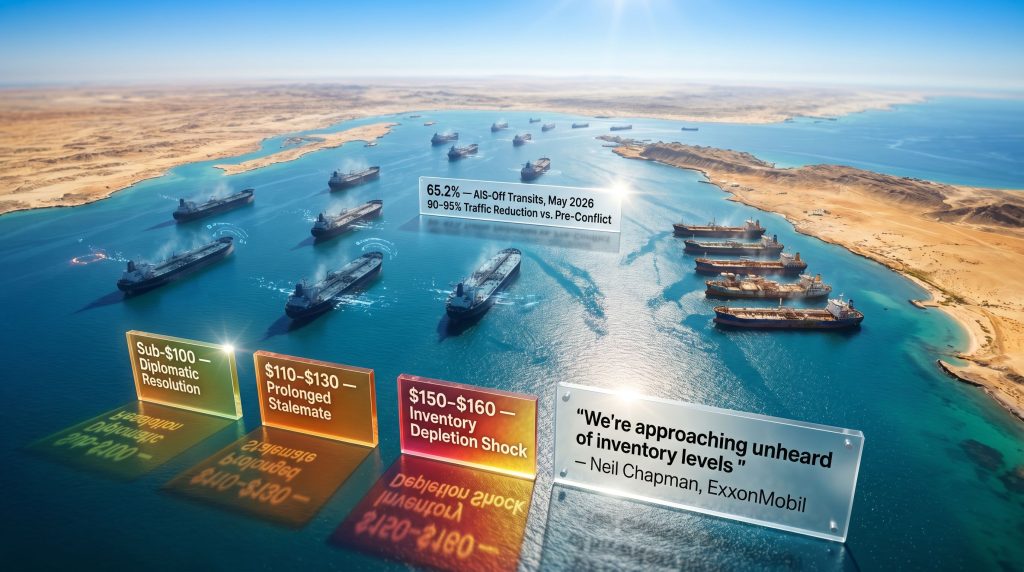
According to vessel tracking data published by Vortexa, dark transits accounted for approximately 57% of all recorded transits through the Strait of Hormuz during the conflict period, with this figure peaking at 65.2% in May 2026. Claire Jungman, Director of Maritime Risk and Intelligence at Vortexa, has described the shift as a wider commercial response to conflict risk and operational uncertainty, rather than simply a sanctions-evasion signal, per Vortexa's published insights. Furthermore, Gulf News reporting on vessels going dark highlights how IRGC activity has intensified this hide-and-seek dynamic at sea.
Detecting Vessels That Don't Want to Be Seen
The degradation of AIS coverage has accelerated investment in alternative vessel detection methodologies. Analysts are increasingly relying on a layered intelligence approach:
- Satellite synthetic aperture radar (SAR) imaging identifies vessel silhouettes regardless of transponder status
- Optical satellite surveillance cross-references known vessel dimensions and hull profiles
- Port call data and cargo manifests provide retrospective confirmation of routes and buyers
- Ship-to-ship transfer records near staging locations such as Larak Island and Qeshm Island help reconstruct loading sequences
- Tanker arrival data at destination refineries allows backward inference of transit volumes
This multi-source approach is significantly more expensive and less timely than AIS-dependent monitoring. The transition from broadcast-based to inference-based vessel tracking represents a permanent uplift in analytical cost for anyone attempting to accurately model global oil supply flows.
The Epistemic Crisis Behind the Physical Crisis
When Market Intelligence Fails
The core challenge facing energy traders, policymakers, and supply chain planners is not simply the physical disruption of oil flows. It is the epistemic disruption — the inability to know with confidence how much oil is actually moving, where it is headed, and when it will reach refineries. When 57 to 65% of Hormuz transits are operating in dark mode, the primary input layer of real-time supply tracking becomes structurally compromised.
The information gaps now extend well beyond crude oil. Jungman's analysis at Vortexa has noted that clean petroleum products, LPG, and LNG cargoes are also transiting with reduced AIS visibility. This expansion of dark-mode operations into refined products and gas creates compounding uncertainty across multiple commodity markets simultaneously, affecting refinery feedstock arrival timelines, regional product inventory levels, and destination-level demand assessment. In addition, LNG supply pressures were already tightening before the current disruption, compounding the challenge for buyers seeking alternative sources.
The Inventory Crisis Forming Beneath the Price Surface
Even as Brent crude remained below $100 per barrel in early June 2026, senior executives at two of the world's largest integrated oil companies issued unusually direct warnings about the trajectory of global inventories.
Neil Chapman, Senior Vice President at ExxonMobil, speaking at the Bernstein 42nd Annual Strategic Decisions Conference, stated that global inventory levels were approaching thresholds that price models associate with sharp upward repricing, with dated Brent potentially reaching $150 to $160 per barrel once critically low inventory levels are breached. His remarks were sourced from the published conference transcript made available by ExxonMobil.
Mike Wirth, Chief Executive of Chevron, speaking at the same event, conveyed that the market's shock-absorption capacity has been substantially eroded from where it stood at the conflict's outset, and that physical price pressure was expected to intensify through June and into July 2026, per Chevron's published conference materials.
The gap between Brent's sub-$100 market price and the physical inventory reality described by major oil company executives represents one of the most significant disconnects in recent energy market history.
Price Scenarios Under Different Conflict Trajectories
The range of potential price outcomes reflects the breadth of geopolitical uncertainty. Consequently, understanding the relationship between crude oil volatility and physical supply signals has never been more critical for market participants.
| Scenario | Brent Price Projection | Key Trigger |
|---|---|---|
| Near-term diplomatic resolution | Below $100 | Deal reached, Hormuz reopens within weeks |
| Prolonged stalemate (2-3 months) | $110 to $130 | No deal, dark-mode traffic continues |
| Inventory depletion shock | $150 to $160 | Inventories hit critical threshold |
| Broader escalation | $160 and above | Additional infrastructure attacked, bypass routes disrupted |
The Goldman Sachs CEO has separately warned that an oil shock of sufficient magnitude could alter consumer behaviour in ways that extend well beyond short-term demand destruction, per OilPrice.com reporting on the Bernstein conference.
The Shadow Fleet's Expanding Role
From Sanctions Tool to Crisis Infrastructure
The shadow fleet — a loosely defined network of older tankers operating outside mainstream Western insurance and regulatory frameworks — predates the current Hormuz crisis. It was originally developed as a mechanism for sustaining Iranian and Russian crude exports in the face of Western sanctions. The conflict has accelerated its integration into a much broader commercial shipping function.
Sky News, citing Lloyd's List data, reported that a significant share of tankers continuing to transit the strait after the conflict began were shadow fleet vessels. This fleet now serves as the primary conduit for Persian Gulf energy flows reaching Asian buyers, operating under corridor arrangements that appear to require approval from Iranian authorities. The Conversation's analysis of shadow tankers offers a thorough examination of why these vessels have become the dominant maritime presence in the strait.
Vessel clustering has been observed near Larak Island, Qeshm Island, southeastern Hormuz approaches, and Chabahar — locations consistent with export staging and convoy-style transit operations. The pattern suggests a degree of coordinated logistics management rather than isolated individual vessel movements.
Why Enforcement Remains Structurally Limited
The shadow fleet's resilience against enforcement stems from several overlapping structural features:
| Enforcement Lever | Current Effectiveness | Binding Constraint |
|---|---|---|
| AIS monitoring | Severely degraded | Cannot track what isn't broadcasting |
| Port state control | Limited at Asian destination ports | Reduced enforcement incentive for buyers |
| Insurance denial | Partially effective | Fleet uses non-Western P&I clubs or self-insures |
| Satellite surveillance | Growing but not real-time | High cost, incomplete coverage |
| Sanctions designation | Ongoing but lagging | Fleet adapts faster than designation lists update |
The normalisation of shadow fleet participation in Hormuz transits carries a risk that persists beyond any diplomatic resolution: the permanent embedding of opaque ownership structures and non-Western insurance frameworks as standard features of Persian Gulf energy logistics.
Asian Importers Caught in the Crossfire
India, China, and Pakistan: Three Distinct Exposures
Asian energy importers are navigating the Hormuz crisis from materially different positions:
India continues to receive discounted Persian Gulf crude through Iran-approved corridors, with major refiners including the 400,000 barrel per day Nayara facility recently completing scheduled maintenance. However, Indian companies have simultaneously been exploring Venezuelan oil fields as imports from that source surged 51% in a single month, reflecting active diversification pressure. A sustained supply shock is projected to compress India's oil demand growth to pandemic-era lows.
China's independent teapot refiners, which have been major buyers of discounted Iranian and Russian crude, have begun pulling back on import volumes. Iranian and Russian crude premiums have softened as Chinese demand signals weakened, suggesting buyer leverage is increasing even within a constrained supply environment.
Pakistan is simultaneously receiving cargo through Iran-approved Hormuz corridors and rushing to secure LNG supplies as summer power demand peaks — a task complicated by disruption to gas flows through the same chokepoint.
South Korea's Strategic Pivot as a Template
South Korea has moved further and faster than most in restructuring its energy import portfolio. The country has locked in Canadian crude and LNG supply contracts as part of a comprehensive overhaul explicitly motivated by Hormuz dependency risk. This represents a structural demand shift that may persist well beyond any diplomatic resolution, permanently redirecting some volume away from Persian Gulf suppliers toward Atlantic Basin and Pacific sources.
The next major ASX story will hit our subscribers first
The Market Psychology Sustaining a $100 Price Ceiling
Diplomatic Optimism vs. Physical Reality
Oil markets have repeatedly demonstrated a preference for pricing diplomatic resolution rather than physical supply scarcity. Brent has remained below $100 even as the conflict entered its fourth month in June 2026, well beyond the consensus expectation established in March that normalisation would begin by May.
Iran has publicly stated there has been no tangible progress in talks with the United States — a signal that markets have periodically discounted in favour of social media commentary suggesting progress. This pattern of selective attention to information has produced price volatility at multi-year highs without producing a price level consistent with the physical fundamentals. However, the broader oil market disruptions that preceded this conflict had already conditioned traders to absorb considerable uncertainty.
The behaviour reflects a well-documented dynamic in commodity markets: when the tail risk is catastrophic, traders systematically underweight low-probability, high-impact scenarios in favour of base-case resolution assumptions. The longer the conflict extends without resolution, the more precarious this positioning becomes.
Strategic Outlook: A Corridor That May Never Fully Recover
Three Paths Through the Next 90 Days
Scenario A, Negotiated Resolution: A U.S.-Iran framework is reached, Hormuz gradually reopens, and Iran retains some form of oversight role over passage approvals. Traffic recovers to 40 to 60% of pre-conflict levels within 8 to 10 weeks. Prices ease but remain structurally elevated due to inventory rebuild requirements and persistent risk premiums.
Scenario B, Frozen Conflict: Talks stall indefinitely. Dark-mode transit becomes the permanent operational standard. Inventory depletion forces a price spike into the $130 to $160 range. Buyers accelerate long-term supply diversification away from Persian Gulf dependence, permanently redirecting demand.
Scenario C, Escalation: The June 2026 Oman oil terminal attack demonstrated that the conflict's geographic perimeter can expand. Further attacks on bypass route infrastructure would render pipeline alternatives unreliable and push war-risk insurance to prohibitive levels across the entire region. The geopolitical risk landscape across multiple commodity sectors is deteriorating in parallel, amplifying the consequences of any further escalation.
Rebuilding Intelligence for a Post-Dark World
Even under Scenario A, the market intelligence architecture will not simply reset to its pre-conflict state. The widespread adoption of dark tanker traffic in the Strait of Hormuz as a commercial norm — independent of sanctions considerations — has revealed the fragility of AIS-dependent supply monitoring in ways that cannot be unseen by analysts, traders, or policymakers.
Rebuilding accurate real-time supply intelligence for a world where a majority of transits through a critical chokepoint may operate without transponder visibility will require sustained investment in satellite surveillance capacity, alternative data sourcing frameworks, and analytical models that do not treat AIS coverage as a reliable primary input.
The Strait of Hormuz disruption has exposed something more fundamental than a geopolitical crisis. It has exposed the degree to which global energy market confidence rests on informational infrastructure that was never designed to function under these conditions.
This article contains forward-looking price projections and scenario analyses drawn from publicly available statements by oil company executives and market analysts. These projections represent modelled scenarios under specific conditions and should not be construed as financial advice. Energy market outcomes are subject to rapid change based on geopolitical developments.
Want to Stay Ahead of Commodity Market Shifts Driven by Geopolitical Disruption?
When energy corridors go dark and supply intelligence breaks down, the ripple effects reach across commodity markets — including the ASX mineral discoveries that Discovery Alert's proprietary Discovery IQ model tracks in real time, delivering instant alerts on significant finds to help investors identify actionable opportunities before the broader market reacts. Explore historic discovery returns on Discovery Alert's discoveries page and begin a 14-day free trial to position yourself ahead of the next major market move.