August 5, 2026
When the World's Busiest Oil Corridor Goes Dark, Unlikely Suppliers Step Into the Light
Global energy markets have long operated on the assumption that Middle Eastern supply is effectively uninterruptible. That assumption has now been stress-tested in real time. The partial closure of the Strait of Hormuz, through which roughly one-fifth of the world's hydrocarbon supply normally flows, has exposed a structural vulnerability in the global oil system that took decades to build and cannot be unwound quickly. The immediate consequence is a scramble for alternative barrels, and that scramble has redirected attention toward a country that most energy investors had written off as uninvestable: Venezuela.
Venezuela oil production growth in 2026 is not simply a story about one country's domestic politics. It is a story about how oil market geopolitics forces the revaluation of stranded assets, resets supply chains, and creates unexpected windows of strategic relevance for producers that previously sat at the margins of global markets.
When big ASX news breaks, our subscribers know first
Venezuela's Production Numbers: What the Data Actually Shows
The pace of Venezuela's output recovery in 2026 has been measurable and significant, even if the absolute volumes remain well below historical norms.
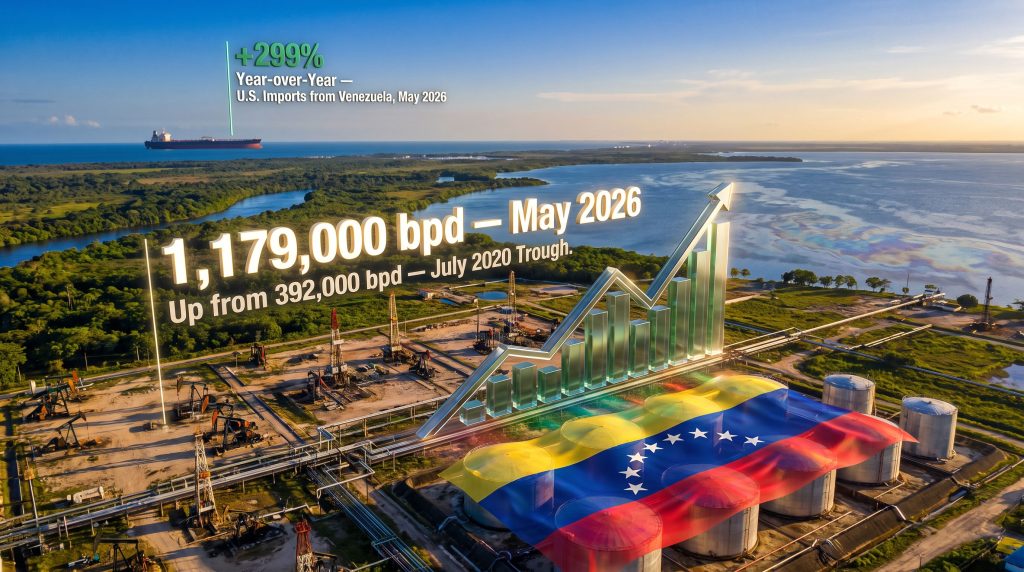
According to OPEC secondary source data, Venezuela's crude production crossed the 1 million barrels per day (bpd) threshold in June 2026, representing a 17.6% year-over-year increase compared to 2025 production levels. Reuters reported output climbing from approximately 942,000 bpd in January 2026 to over 1.1 million bpd by March 2026, with Trading Economics data placing the May 2026 figure at approximately 1,179,000 bpd.
To place these numbers in proper historical context:
| Period | Estimated Production | Key Context |
|---|---|---|
| 1970s peak | ~3.75 million bpd | All-time production record |
| Late 1990s | ~3.4 million bpd | Pre-Chavez era high |
| End of 2018 | ~1.0 million bpd | Pre-Trump sanctions baseline |
| July 2020 | ~392,000 bpd | Historic low, COVID-era trough |
| August 2025 | ~1.0 million bpd | Gradual pre-transition recovery |
| January 2026 | ~942,000 bpd | Pre-political transition dip |
| March 2026 | ~1.1 million bpd | Post-Maduro sanctions relief |
| May 2026 | ~1,179,000 bpd | Foreign operator expansion |
| June 2026 | >1.0 million bpd | OPEC secondary source confirmed |
What the table illustrates is not simply a recovery but a return to a plateau. Venezuela's monthly production has oscillated between 900,000 and 1.1 million bpd throughout 2026, indicating that the easy gains from sanctions relief have largely been absorbed. The next increment of growth will require capital, not just politics.
Current Venezuelan output at roughly 1.1 to 1.2 million bpd represents only 30 to 35 percent of the country's all-time peak capacity, underscoring the scale of the rehabilitation challenge ahead.
The Heavy Crude Dimension: Why Venezuela's Oil Quality Matters
A detail frequently overlooked in general coverage of Venezuela's oil sector is the specific grade characteristics of the country's dominant crude streams. The Orinoco Belt, which holds an estimated 1.3 trillion barrels of heavy oil in place, produces what is technically classified as extra-heavy crude, typically with API gravity ratings in the range of 8 to 16 degrees. This is substantially denser and more sulfur-rich than benchmark grades like West Texas Intermediate, which trades at around 39 to 40 degrees API.
This matters for several reasons:
- Extra-heavy crude requires upgrading or blending with lighter diluents before it can flow through pipelines or be processed in standard refineries
- The Orinoco Belt's crude is often upgraded to synthetic crude grades or blended with naphtha and light oils to create exportable blends, adding a layer of processing cost and infrastructure complexity not present in lighter-grade production
- Heavy and extra-heavy crude consistently trades at a structural discount to WTI, which makes it economically attractive to refineries specifically configured to handle it, but unattractive to facilities without that conversion capacity
- During the 1980s, a significant portion of U.S. Gulf Coast refinery capacity was reconfigured specifically for heavy, high-sulfur feedstocks, creating an enduring infrastructure lock-in that makes Venezuelan supply particularly well-matched to this refining corridor
This grade-market alignment is a critical but underappreciated dimension of why Venezuela oil production growth carries outsized relevance for U.S. Gulf Coast refiners specifically, as opposed to the global refining market broadly.
U.S. Import Flows: The Trade Numbers Tell the Story
The shift in U.S. crude import patterns over the past 18 months provides a quantitative lens through which to assess Venezuela's rising strategic importance. Furthermore, crude oil price trends have amplified the urgency of Gulf Coast refiners diversifying their feedstock sources.
According to U.S. Energy Information Administration data, petroleum imports from Venezuela reached 471,000 bpd in May 2026, which was approximately 10% above the April 2026 figure and nearly four times the 118,000 bpd imported in May 2025. This represents the highest volume of U.S. crude imports from Venezuela since January 2019, when shipments reached approximately 561,000 bpd.
| Month/Year | U.S. Imports from Venezuela | Year-on-Year Change |
|---|---|---|
| January 2019 | ~561,000 bpd | Peak pre-sanctions era volume |
| May 2025 | ~118,000 bpd | Near-sanctions-era low |
| April 2026 | ~428,000 bpd (approx.) | Post-transition recovery |
| May 2026 | ~471,000 bpd | Highest since January 2019 |
| Year-on-year (May 25 vs May 26) | +~299% | Near-quadrupling in 12 months |
The scale of this reversal is striking. A near-quadrupling of import volumes within 12 months reflects not just political change in Caracas but a fundamental reordering of Gulf Coast refiners' procurement strategies. Consequently, the reduction in Middle Eastern crude availability driven by Hormuz disruption has accelerated this shift considerably.
Chevron's Venezuela Strategy: Disciplined Expansion With a Hard Ceiling
Among the major Western energy companies with any meaningful Venezuelan presence, Chevron stands in a category of one. It is the only U.S. supermajor to have maintained continuous operational activity through the sanctions era, and its three joint venture operations now form the backbone of Venezuela's foreign-operated production.
During Chevron's second quarter 2026 earnings call, CFO Eimear Bonner outlined the company's production trajectory and forward-looking targets. The figures are significant:
| Milestone | Production Level |
|---|---|
| Historical starting baseline | ~40,000 bpd |
| Pre-2026 recovery level | ~250,000 bpd |
| H1 2026 (following political transition) | ~280,000 bpd |
| Target by end-2028 | Up to ~420,000 bpd |
| Implied growth (mid-2026 to end-2028) | Up to ~50% |
The less-discussed aspect of Chevron's strategy is its self-funding constraint. The company has committed to financing its Venezuelan expansion exclusively from cash flows generated within Venezuela, with no incremental capital allocation from the parent balance sheet. This approach is rational from a risk management perspective, as it quarantines Venezuela-specific political and legal exposure from Chevron's global capital programme.
However, it also creates a structural ceiling on the pace of growth. If global oil prices fall materially, Venezuelan cash flows compress, and the expansion timeline either slows or stalls. The self-funding model is simultaneously a sign of Chevron's confidence in the near-term opportunity and a clear signal of the limits of that confidence over a longer horizon.
Chevron's approach to Venezuela essentially treats the country as a contained, self-liquidating investment rather than a platform for long-cycle capital deployment, which reflects the broader institutional wariness that still pervades the sector.
Why Big Oil Remains on the Sidelines: The Expropriation Legacy
To understand why Venezuela oil production growth cannot simply be unlocked by policy announcements, it is necessary to revisit the events that caused the most capable operators to exit the country in the first place. In addition, the broader context of U.S. policy on Venezuela and its evolution continues to shape investor sentiment across the sector.
Beginning in 2007, the Chavez government initiated a systematic nationalisation of petroleum assets across multiple joint venture structures. The financial consequences for foreign operators were severe:
- ExxonMobil reported losses of approximately $16.6 billion in expropriated assets. The company pursued international arbitration but ultimately recovered only approximately $1.4 billion, a fraction of the claimed loss
- ConocoPhillips absorbed a $4.5 billion balance sheet impact and similarly exited Venezuela following the nationalisations
- Both companies have shown no meaningful indication of returning to Venezuelan operations, and the absence of enforceable property rights under the current framework provides no basis for that position to change in the near term
The reforms signed into law on July 8, 2026 by interim president Delcy Rodriguez represent an incremental improvement to the investment climate, but they fall short of the institutional guarantees that large-scale capital allocators require. Crucially, Venezuela's oil minister retains broad discretionary authority over tax rates and contract allocations.
Francisco J. Monaldi, Director of the Latin America Energy Program at Rice University's Baker Institute for Public Policy, has assessed that restoring Venezuelan production to sustainable levels above 2 million bpd would require approximately $100 billion in capital and at least a decade of consistent institutional rebuilding. His analysis further emphasises that this outcome is conditional on genuine rule-of-law restoration and democratic governance, neither of which can be delivered through regulatory reform alone.
The next major ASX story will hit our subscribers first
The Environmental Liability That Investors Rarely Price Correctly
One of the least-discussed barriers to large-scale investment in Venezuela's oil sector is the inherited environmental liability exposure that any incoming operator would face. For many major international oil companies operating under stringent ESG disclosure requirements, this is potentially a decisive factor.
- Lake Maracaibo, the historic nucleus of Venezuelan petroleum production, has been subject to decades of chronic contamination. Oil slicks, algal blooms, and surface pollution are endemic. Remediation cost estimates exceed $2.5 billion, and the timeline for meaningful ecological restoration is measured in decades rather than years
- The Orinoco Belt has sustained extensive spill damage affecting the Orinoco River system and the adjacent coastal wetlands, which represent one of the most biodiverse ecosystems in the Western Hemisphere
- The "production-at-any-cost" operational philosophy maintained through the Chavez and Maduro eras left wellheads, pipelines, and processing facilities in advanced states of deterioration, with ongoing leak and spill events rather than episodic ones
Total infrastructure restoration cost estimates, which encompass both physical rehabilitation and environmental remediation, range from $100 billion to $220 billion depending on methodology and scope. Any operator entering Venezuela must factor potential inherited liability into its investment calculus, adding another dimension to the already-elevated risk premium.
Three Scenarios for Venezuela's Oil Output Through 2028
Given the interplay of political transition, capital constraints, infrastructure degradation, and geopolitical demand pull, Venezuela's production trajectory over the next two years is best understood through a scenario framework rather than a single-point forecast.
Scenario 1: Constrained Recovery (Most Likely Near-Term)
- Output range-bound between 1.0 and 1.2 million bpd through end-2026 and into 2027
- Chevron's self-funded expansion provides incremental growth but no step-change
- Absence of new major IOC commitments caps the ceiling
- Monthly output oscillations continue within the 900,000 to 1.1 million bpd band observed throughout 2026
Scenario 2: Moderate Expansion (Achievable by 2028)
- Chevron successfully executes its 50% growth target, reaching approximately 420,000 bpd from its joint ventures alone
- Selective participation by mid-tier operators and national oil companies adds incremental volumes
- Overall Venezuelan output approaches 1.5 million bpd by late 2028
- Conditional on sustained oil prices above the level required to fund Chevron's self-financed expansion
Scenario 3: Accelerated Rebound (Long-Term, Post-2030 at Earliest)
- Would require an estimated $100 billion or more in committed capital
- Conditional on demonstrable rule-of-law restoration and enforceable property rights
- Full environmental remediation of Lake Maracaibo and the Orinoco Belt is a prerequisite for unlocking social licence to operate at scale
- A return toward 2 million bpd or beyond is a multi-decade ambition, not a near-term projection
Investors and analysts treating Venezuela's current production recovery as the beginning of an uninterrupted return to historical capacity should treat that assumption with considerable caution. The gap between 1.2 million bpd and 3 million bpd is not primarily a resource gap. It is a governance, capital, and infrastructure gap of historic proportions.
The India Wildcard: A New Capital Source Enters the Frame
A development that has received relatively limited attention in Western energy coverage is the active consideration of Indian participation in PDVSA field operations. India's state-linked energy companies, operating under an energy security mandate rather than purely commercial return metrics, have a different risk tolerance profile than Western IOCs.
Reports indicate that Indian operators are evaluating the possibility of taking over operational responsibility for certain Venezuelan oil fields from PDVSA. For Venezuela, this would introduce a new source of technical capacity and potentially capital. This dynamic also intersects with the broader consequences of the oil prices and trade war environment, which has prompted Asian economies to accelerate their energy diversification strategies.
For India, direct operational control over Venezuelan production would serve its broader energy diversification strategy, reducing dependence on Middle Eastern supply at a time when Hormuz reliability is in question. This shift illustrates how, as Western supermajors remain risk-averse, national oil companies from Asia are willing to accept governance risk in exchange for supply security, potentially reshaping who actually develops Venezuela's petroleum resources over the next decade.
Frequently Asked Questions: Venezuela Oil Production Growth
What is Venezuela's current oil production level?
As of mid-2026, Venezuelan crude output is approximately 1.1 to 1.2 million bpd, up from a trough of roughly 392,000 bpd in July 2020. This represents a meaningful recovery but remains well below the country's historical peak of approximately 3.4 to 3.75 million bpd.
Why did Venezuelan production collapse so severely?
The decline accelerated from late 2018 onward as a combination of lower oil prices, progressively stricter U.S. sanctions, chronic underinvestment in infrastructure, and severe operational dysfunction at PDVSA eroded production capacity. The COVID-19 pandemic worsened conditions further through mid-2020. However, the global oil supply shock dynamics of recent years have since renewed focus on Venezuelan volumes as a potential stabilising source.
Can Venezuela realistically reach 2 million bpd again?
Under current conditions, no. Reaching that level requires an estimated $100 billion or more in capital investment and a minimum of one decade of sustained institutional and infrastructure rehabilitation. This is contingent on genuine governance reform that has not yet occurred.
Why won't ExxonMobil return to Venezuela?
ExxonMobil suffered losses of approximately $16.6 billion through the Chavez-era nationalisations and recovered only around $1.4 billion through arbitration. Without legally enforceable property rights and credible protection against future expropriation, the risk-return profile for large-scale reentry remains untenable.
How does the Hormuz disruption affect Venezuela's strategic value?
Approximately one-fifth of global hydrocarbon supply transits the Strait of Hormuz. Disruption of this corridor increases the premium placed on Western Hemisphere supply, particularly heavy crude grades that are already matched to U.S. Gulf Coast refinery infrastructure. For further context on this subject, the history of the Venezuelan oil industry provides valuable background on how this infrastructure alignment developed over decades.
Disclaimer: This article is intended for informational purposes only and does not constitute investment advice. Production figures, cost estimates, and scenario projections are based on third-party sources and are subject to change. Readers should conduct their own due diligence before making any investment decisions related to the energy sector.
Could Geopolitical Shifts in Energy Markets Be Signalling the Next Major Resource Discovery?
When supply disruptions reshape global commodity flows, the ripple effects extend well beyond oil — and Discovery Alert's proprietary Discovery IQ model scans the ASX daily to identify significant mineral discoveries the moment they are announced, ensuring subscribers are positioned ahead of the broader market. Explore historic discovery returns on Discovery Alert's dedicated discoveries page and begin your 14-day free trial today to gain an immediate edge on actionable opportunities.