August 25, 2026
Aluminium at the Crossroads: How Recycled Metal Became a Climate Imperative for Carmakers
The materials that build a car have always mattered. But for most of automotive history, what mattered was strength, weight, and cost. Today, a fourth dimension has entered the calculus with equal force: carbon. The embedded emissions locked inside raw materials are no longer invisible to regulators, investors, or consumers. For aluminium, this shift is particularly consequential, because the metal sits at the intersection of two competing realities: it is indispensable for lightweight electric vehicle design, yet primary production remains among the most energy-intensive industrial processes on the planet.
It is within this tension that the Mercedes-Benz Hydro recycled aluminium deal, formalised in July 2026, takes on a significance that extends well beyond a bilateral procurement agreement. It represents a structural inflection point in how the automotive sector thinks about upstream materials, verified carbon credentials, and the race to build circular supply chains before regulators make that choice compulsory.
When big ASX news breaks, our subscribers know first
The Carbon Embedded in Every Electric Vehicle
The popular assumption that electric vehicles are inherently low-carbon understates the complexity of lifecycle emissions. While tailpipe emissions disappear, the manufacturing phase carries a heavier carbon burden than equivalent combustion vehicles, largely because of the energy-intensive materials involved in battery and structural component production.
Aluminium is a central part of this story. According to Transport & Environment, aluminium accounts for approximately 20% of embedded emissions in electric vehicles, and the automotive sector consumes more than one-third of European aluminium output. That makes the metal's carbon intensity a strategic variable, not a background footnote.
The energy arithmetic behind recycling makes the opportunity stark. Furthermore, the critical raw materials transition underway across global supply chains is accelerating how quickly these figures are being scrutinised:
- Primary aluminium smelting, using the global average energy mix, generates an estimated ~16 kg of CO₂ equivalent per kilogram of metal produced
- Secondary aluminium production from post-consumer scrap requires roughly 5% of the energy needed for primary production
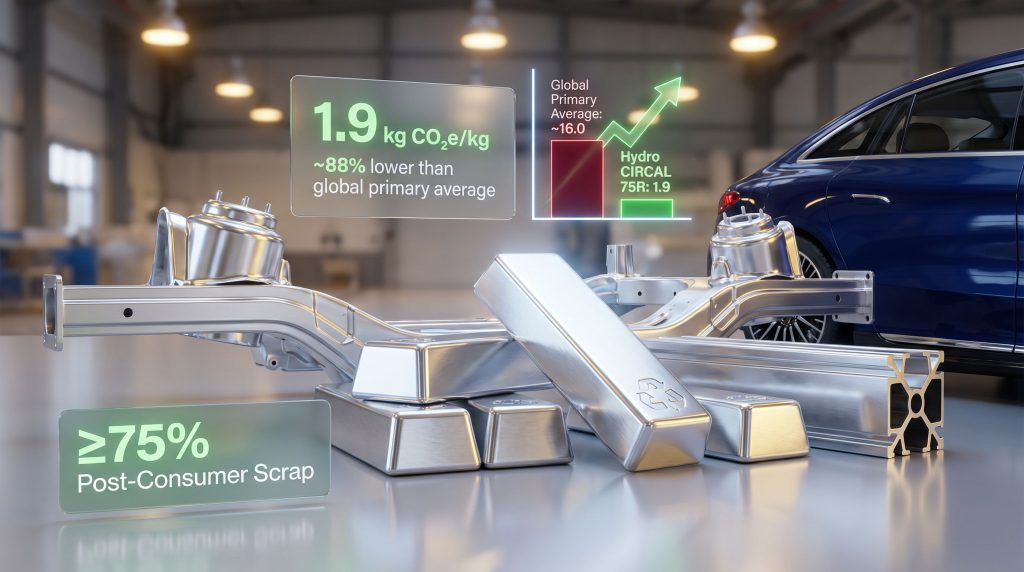
- Hydro CIRCAL 75R, made with at least 75% post-consumer scrap, carries a carbon footprint of 1.9 kg CO₂e per kg of aluminium, approximately 88% below the global primary average
- CIRCAL 100R, produced entirely from post-consumer scrap, achieves below 0.5 kg CO₂e per kg, a reduction of up to 97%
These figures reframe recycled aluminium from a niche sustainability gesture into one of the highest-leverage decarbonisation tools accessible to vehicle manufacturers today.
What the Mercedes-Benz Hydro Deal Actually Involves
Understanding why this agreement matters requires looking at its architecture, not just its headline.
Partnership Timeline and Structural Escalation
| Milestone | Year | Detail |
|---|---|---|
| Letter of Intent | 2022 | Low-carbon technology roadmap established for 2023-2030 |
| First Supply Phase | 2023 | CO₂-reduced aluminium with at least 25% post-consumer scrap content delivered to Untertürkheim plant |
| Value Chain Expansion | 2024 | Collaboration extended across the full aluminium value chain, including joint Corridor Program in Brazil |
| Serial Production Agreement | July 2026 | Mercedes-Benz confirmed as the first European automaker to use Hydro CIRCAL in large EV serial production |
The escalation from 25% to a minimum of 75% post-consumer scrap content is not a marginal improvement; it represents a tripling of recycled material intensity within the same supply relationship. This trajectory signals genuine strategic intent rather than incremental greenwashing.
Components and Platforms Confirmed for CIRCAL Integration
The material has moved beyond pilot-grade or aesthetic applications. Confirmed uses include:
- Shock towers for the EQS, EQE, S-Class, GLC, and C-Class models
- Support frames for the electric powertrain within the upcoming Mercedes Modular Architecture (MMA) platform
- Structural body-in-white components at the Untertürkheim plant's Mettingen foundry section
Safety-critical and crash-relevant structural applications are held to the most demanding metallurgical standards in vehicle production. Deploying high-recycled-content aluminium in these roles signals a critical threshold: the material has passed engineering validation at the performance level required for mass production.
Understanding Hydro CIRCAL: Product Architecture and Carbon Credentials
How Post-Consumer Scrap Becomes Premium Automotive Material
Not all recycled aluminium is equivalent. The distinction between pre-consumer scrap (manufacturing offcuts and industrial waste) and post-consumer scrap (material recovered from end-of-life products) is technically and commercially significant. Post-consumer sources include:
- End-of-life vehicles
- Demolished building facades and window frames
- Decommissioned infrastructure
- Used consumer electronics
Post-consumer scrap arrives with a range of contaminants including paint, lacquer coatings, oils, plastics, iron, minerals, and organic compounds. Processing this material to automotive-grade output requires sophisticated sorting infrastructure, controlled melting protocols, and consistent alloy management — capabilities that represent meaningful barriers to entry and limit the number of viable large-scale producers.
Every CIRCAL production batch is tracked for post-consumer scrap content and independently verified by DNV, a global classification and certification organisation. This chain-of-custody documentation is what enables downstream manufacturers like Mercedes-Benz to make auditable, substantiable carbon claims rather than relying on estimates.
CIRCAL Product Tiers: Carbon Footprint Comparison
| Product | Post-Consumer Scrap Content | Carbon Footprint (kg CO₂e/kg Al) | Reduction vs. Global Primary Average |
|---|---|---|---|
| Hydro CIRCAL 75R | At least 75% | 1.9 | ~88% lower |
| Hydro CIRCAL 100R | 100% | Below 0.5 | Up to ~97% lower |
| Global Primary Average | N/A | ~16.0 (estimated) | Baseline |
CIRCAL 100R is currently available only in small, on-demand batches due to the complexity and time intensity of its production process. This scarcity dynamic creates a tiered premium market for the lowest-carbon material and points to significant investment requirements in upstream scrap collection and processing infrastructure before industrial-scale supply becomes viable.
Where CIRCAL Sits Within Hydro's Broader Portfolio
Hydro operates two principal low-carbon product lines:
- CIRCAL: Targets emissions reduction at the material origin stage through post-consumer scrap recovery
- REDUXA: Primary aluminium produced using renewable electricity, targeting emissions reduction at the smelting stage
The Mercedes-Benz Hydro recycled aluminium deal integrates both product streams, suggesting a blended decarbonisation strategy that addresses emissions across both the recycled content and energy production dimensions simultaneously. In 2025, Hydro sold 58,000 tonnes of CIRCAL products and 470,000 tonnes of REDUXA, with combined revenue from these lines growing more than 50% year on year.
This revenue trajectory confirms that premium pricing for verified low-carbon aluminium is being accepted across the industrial buyer base, not merely absorbed as a reluctant compliance cost. The renewable energy solutions powering primary smelting operations will, however, remain central to reducing overall lifecycle emissions.
The Regulatory Architecture Accelerating Demand
The End-of-Life Vehicles Regulation and Its Aluminium Implications
The EU's End-of-Life Vehicles Regulation, formally adopted in mid-2026, currently mandates recycled content targets only for plastics. However, it explicitly creates a legislative pathway for the European Commission to introduce equivalent requirements for aluminium and steel in subsequent regulatory cycles. The ELVR also expands manufacturer responsibility, requiring carmakers to cover collection and treatment costs for end-of-life vehicles across the EU.
A critical technical distinction embedded in the advocacy around this regulation carries significant commercial weight: Transport & Environment has argued that only post-consumer scrap, not pre-consumer manufacturing offcuts, should qualify for recycled local-content targets. This framing, if adopted, would directly advantage products like Hydro CIRCAL, which is architecturally built on verified post-consumer material, and disadvantage recycled aluminium producers relying on industrial scrap to meet content thresholds.
Transport & Environment's Green Aluminium Roadmap
| Year | Proposed Minimum Green Aluminium Content in New Cars |
|---|---|
| 2035 | 60% |
| 2040 | 85% |
| 2045 | 95% |
T&E's analysis estimates that green aluminium — defined as a combination of recycled and low-carbon primary material with declining carbon intensity thresholds over time — could be cost-competitive by 2040. The group projects that meeting these requirements would add approximately €25 (roughly $28) per vehicle, a figure that challenges the persistent assumption that sustainable materials carry prohibitive cost premiums at mass-market scale.
If the European Commission introduces a 60% green aluminium content requirement for new vehicles by 2035, European automakers producing approximately 10 million vehicles annually would need to secure verified low-carbon aluminium supply across a substantial share of their total aluminium bill of materials. At current CIRCAL production volumes, the gap between certified supply and projected demand would be considerable, creating both a commercial opportunity for recycled aluminium producers and a strategic vulnerability for OEMs that delay building verified supply chain relationships.
Serial Production: Why the Industry Is Paying Attention
The Difference Between a Pilot and a Platform
Previous automotive applications of Hydro CIRCAL operated within the controlled parameters of foundry trials or lower-volume specialty runs. Serial production, by contrast, means integration into standardised manufacturing workflows at volumes that track full model production cycles. The distinction matters enormously for supply chain planning, procurement contracts, and capital allocation decisions.
Mercedes-Benz has already committed to deploying more than one-third low-carbon aluminium in the new CLA model and approximately two-thirds in the new GLC. These are not concept vehicles or limited editions; they are mass-market models produced across multiple global facilities.
Mercedes-Benz's Ambition 2039 strategy targets aluminium with a carbon footprint 90% below the European average by 2030. Achieving this at scale requires not just bilateral supplier agreements but structural changes to procurement processes, scrap logistics, and product traceability systems. The decarbonisation benefits achievable through such commitments are increasingly being recognised across heavy industry more broadly.
The Closed-Loop Opportunity: A Vehicle-to-Vehicle Circular System
One of the less prominently discussed dimensions of the expanded Mercedes-Benz Hydro collaboration is the exploration of closed-loop recycling, in which aluminium recovered from end-of-life vehicles is reintroduced directly into new vehicle production. This contrasts with open-loop post-consumer scrap procurement from mixed sources.
Closed-loop systems offer several advantages over open-market sourcing:
- Higher consistency in alloy chemistry, reducing processing complexity
- More predictable scrap volumes linked to known vehicle retirement timelines
- Stronger traceability for carbon accounting and regulatory verification
- Reduced exposure to open-market scrap price volatility
The 2024 expansion of the partnership to include scrap collection logistics signals intent to build proprietary circular infrastructure. This is a meaningfully different strategic posture from simply purchasing recycled content on the spot market, and it creates structural supply chain advantages that cannot be quickly replicated by competitors.
The next major ASX story will hit our subscribers first
What This Means for the Wider Low-Carbon Aluminium Market
Supply Constraints and Investment Signals
The current production limitations on CIRCAL 100R highlight a systemic challenge: demand for the lowest-carbon aluminium is growing faster than supply infrastructure can be scaled. Building post-consumer scrap collection networks, investing in advanced sorting and processing facilities, and developing the logistics required for closed-loop systems all require significant capital and long lead times.
Hydro's more than 50% revenue growth across its low-carbon product lines in 2025 provides a commercial signal that should, over time, attract that capital. However, the investment cycle for this infrastructure is measured in years, not quarters.
The Regional Supply Chain Argument
Both Mercedes-Benz and Hydro have emphasised the importance of building strong regional supply chains within Europe. Dependence on imported primary aluminium from regions with higher carbon intensities creates compounding exposure: elevated scope 3 emissions and geopolitical supply risk operating simultaneously.
Developing European post-consumer scrap collection and processing capacity addresses both simultaneously, reducing carbon intensity while shortening supply chains. In this context, understanding how aluminium supply leaders are repositioning their businesses becomes increasingly relevant to automotive procurement strategy.
The inclusion of a joint Corridor Program in Brazil within the expanded partnership adds an international dimension, but the core manufacturing and supply logic is centred on European industrial resilience. Hydro's position on regulatory frameworks is also instructive: the company has indicated that effective policy creates demand for lower-emission materials, provides transparency and traceability, and recognises the contribution of circular materials across value chains.
Furthermore, Hydro and Mercedes-Benz's commitment to scaling low-carbon aluminium in Europe reflects a broader industry shift that is now being closely tracked by competitors and policymakers alike. Initiatives such as the low-carbon aluminium venture emerging elsewhere in the sector indicate that this model of deep supplier partnership is becoming a template, not an exception. Indeed, reporting from ESG Today confirms that the Mercedes-Benz Hydro recycled aluminium deal is being watched across the automotive and sustainability investment communities as a bellwether for what responsible procurement looks like at scale.
Frequently Asked Questions
What distinguishes Hydro CIRCAL from standard recycled aluminium?
Hydro CIRCAL uses a minimum of 75% post-consumer scrap, recovered from end-of-life products, and tracks the content of every production batch through a verification process conducted by DNV. Standard secondary aluminium may incorporate pre-consumer manufacturing scrap, which carries different carbon credentials and does not meet the post-consumer threshold being advocated under evolving EU regulatory frameworks.
Why does the post-consumer vs. pre-consumer distinction matter for regulation?
Transport & Environment has argued that only post-consumer scrap should qualify for recycled content targets under the ELVR. If this position is adopted by the European Commission when it extends recycled content mandates to aluminium, it would create a direct compliance advantage for materials sourced from verified post-consumer recovery systems, and a potential disadvantage for producers relying on industrial manufacturing offcuts to meet content claims.
How does the cost of low-carbon aluminium compare to conventional primary material?
T&E estimates that meeting green aluminium content targets could add approximately €25 per vehicle by 2040, positioning the premium as commercially manageable at mass-market scale. Mercedes-Benz has emphasised that decarbonisation must be economically competitive to be durable, and Hydro's growing revenue from low-carbon product lines suggests industrial buyers are increasingly accepting this premium as a structural procurement cost rather than an exceptional charge.
Is CIRCAL 100R available at industrial scale?
Currently, CIRCAL 100R — which achieves a carbon footprint below 0.5 kg CO₂e per kg of aluminium from 100% post-consumer scrap — is available only in small, on-demand batches. The complexity of its production process limits scalability without substantial upstream investment. This scarcity creates pricing dynamics distinct from the broader secondary aluminium market and indicates where future capital deployment will be concentrated.
This article contains forward-looking analysis, scenario projections, and references to regulatory proposals that have not yet been formally adopted. Readers should treat market projections, cost estimates, and regulatory timelines as indicative rather than certain. Nothing in this article constitutes investment or procurement advice.
Want to Track the ASX Miners Supplying the Green Metals Revolution?
As demand for low-carbon materials reshapes automotive and industrial supply chains, the mineral discoveries underpinning that transition are being made right now on the ASX — and Discovery Alert's proprietary Discovery IQ model delivers real-time alerts the moment significant discoveries are announced, turning complex data across more than 30 commodities into clear, actionable insights. Explore historic discovery returns on Discovery Alert's dedicated discoveries page and begin your 14-day free trial to position yourself ahead of the market.