August 24, 2026
The Geological Gamble: Why India's Most Valuable Minerals May Lie Far Beneath the Surface
Across the global mining industry, a persistent and largely underappreciated problem has shaped exploration strategy for decades. The Vedanta deep drilling rig in India critical minerals exploration program directly confronts this challenge. The richest, most geologically stable mineral deposits are not always the ones closest to the surface. In many of the world's most prospective terrains, the highest-grade mineralisation sits hundreds of metres below the reach of conventional drilling equipment, effectively invisible to exploration programs that never had the technology to look deeper.
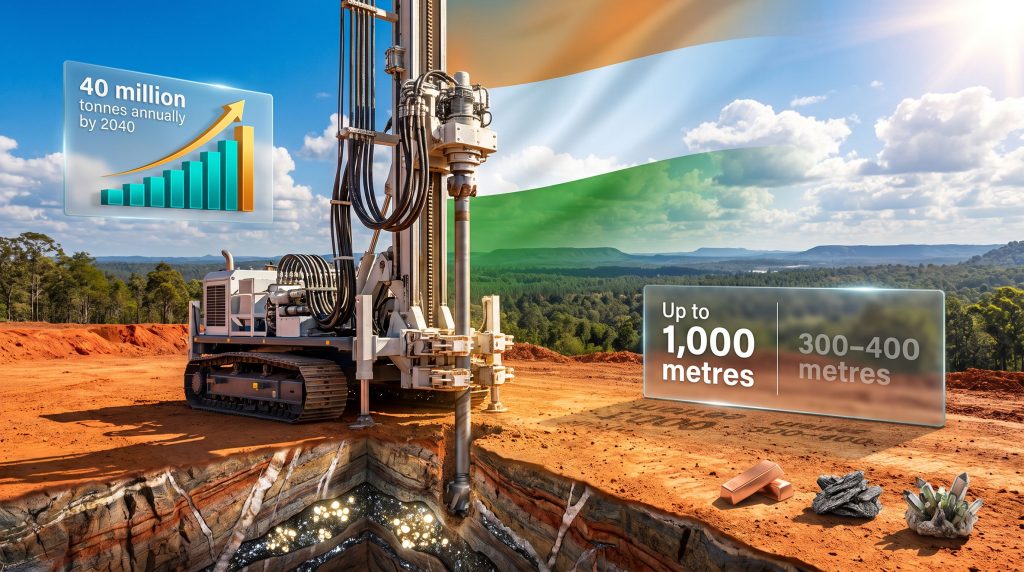
This is not a theoretical limitation. It is a physical one. Standard rotary drilling rigs used across much of the industry are typically capable of reaching depths between 300 and 400 metres. Below that threshold, most conventional equipment becomes increasingly impractical in remote or difficult terrain. The result is a geological blind spot that has left enormous volumes of subsurface rock untested, uncharacterised, and unaccounted for in national resource inventories.
For India, a country navigating deep structural import dependency across multiple critical minerals demand categories, that blind spot carries significant strategic consequences.
When big ASX news breaks, our subscribers know first
How Deep Is India's Critical Minerals Problem — And Why Conventional Exploration Has Failed to Solve It
The Geological Blind Spot: What Lies Below 400 Metres
India's geological survey history is extensive, but much of it was conducted using methods and equipment calibrated for shallow targets. The country's Precambrian shield terrains, particularly across central and peninsular India, are known to host geological formations associated with nickel, chromium, platinum-group elements, and other high-value mineralisation.
However, the deeper expression of these systems, where pressure, temperature, and geological history can concentrate minerals into economically significant grades, has remained largely uninvestigated. Furthermore, understanding mineral deposit tiers is essential for appreciating why some zones remain commercially viable only at depth.
This is partly a function of equipment availability, partly a function of terrain. Many of India's most geologically interesting areas sit in remote, forested, or topographically challenging environments where mobilising heavy conventional drilling infrastructure is slow, expensive, and logistically complex. The combination of limited depth capability and difficult access has produced a situation where large portions of India's mineral endowment remain a geological hypothesis rather than a measured reality.
India's Import Dependency on Critical Minerals: A Strategic Vulnerability
India currently imports a substantial proportion of the critical minerals it consumes. Nickel, cobalt, lithium, platinum-group elements, and minerals within rare earth supply chains are all sourced predominantly from overseas markets, with supply chains concentrated in a small number of producing countries. This concentration creates price exposure, geopolitical risk, and supply chain fragility at precisely the moment when domestic demand is accelerating.
The clean energy transition, electrification of transport, expansion of digital infrastructure, and growth in defence and aerospace manufacturing are all creating new and growing domestic demand vectors for minerals that India does not yet produce at meaningful scale. Reducing that import dependency requires finding domestic deposits first, which requires exploration infrastructure capable of reaching the geological zones where those deposits are most likely to occur.
Why Shallow Drilling Has Left Billions in Potential Resources Untested
Conventional drilling equipment typically reaches depths of only 300 to 400 metres, leaving an entire geological tier of potential mineralisation unexplored across India's most prospective terrains.
The economics of shallow drilling made sense in an era when surface and near-surface deposits were abundant and global commodity demand was lower. That calculus has shifted. As easily accessible deposits become rarer globally, the industry has moved progressively deeper, investing in technology and techniques capable of characterising mineralisation at depths that were previously uneconomical or technically impractical to investigate. India's exploration programs are now navigating the same transition, and the technology gap has become a strategic bottleneck.
What Is a High-Speed Hydrostatic Portable Drilling Rig — And Why Does It Matter?
How Hydrostatic Drilling Technology Works: A Technical Breakdown
Hydrostatic drilling systems replace the mechanical rotary drive mechanisms used in conventional rigs with pressurised fluid circuits. In a hydrostatic system, hydraulic power is transmitted through fluid to drive the drill head, providing more consistent torque delivery across varying rock hardness and formation types. This matters in deep drilling applications where rock characteristics can change significantly with depth, and where maintaining consistent penetration rates without equipment stress is critical to both data quality and operational longevity.
The fluid-drive approach also offers finer control over drilling parameters, allowing operators to adjust pressure and rotation speed more precisely than mechanical systems typically permit. In hard-rock exploration environments, where the geological formations hosting nickel uses and importance extend to chromium and platinum-group mineralisation, this control advantage translates directly into better core recovery — the physical rock sample that geologists analyse to characterise mineralisation.
Portable vs. Fixed Rigs: Why Mobility Changes the Economics of Exploration
The portability dimension of the new rig design is as commercially significant as its depth capability. Conventional deep drilling equipment is large, heavy, and expensive to move between sites. In remote terrain, relocation can consume weeks and significant capital, effectively limiting the number of targets that can be tested within a given exploration budget and timeframe.
A portable configuration reduces inter-site mobilisation time, allowing exploration teams to test more targets across a larger geographic area within the same budget envelope. For a company like Vedanta, which holds active exploration interests across multiple states and geological settings, that mobility advantage compounds across an entire portfolio rather than applying only to a single project.
Depth Capability Comparison: Conventional Rigs vs. 1,000-Metre Hydrostatic Systems
| Feature | Conventional Drilling Rig | High-Speed Hydrostatic Portable Rig |
|---|---|---|
| Maximum Depth | 300 to 400 metres | Up to 1,000 metres |
| Terrain Suitability | Accessible, flat sites | Remote and difficult terrain |
| Mobilisation Speed | Slower between sites | Faster inter-site movement |
| Site Disruption | Higher | Reduced footprint |
| Exploration Phase Impact | Limited deep-target access | Enables sub-surface target validation |
Why Pressurised Fluid Drive Systems Outperform Rotary Mechanical Drilling in Remote Conditions
Beyond depth and portability, hydrostatic systems carry a meaningful maintenance advantage in remote operating environments. Mechanical rotary systems involve more moving components subject to wear and failure, and sourcing replacement parts in geographically isolated locations can cause extended downtime. Hydraulic systems, while complex in their own right, tend to fail more gradually and are more amenable to field diagnostics and repair with a smaller logistics footprint.
In Chhattisgarh's exploration terrain, where road access and supply chain logistics remain challenging, this operational resilience has practical value beyond the technical performance specifications. Vedanta's commission of India's first portable rig represents a milestone in aligning exploration technology with the country's geological ambitions.
Where Is Vedanta Drilling? A State-by-State Breakdown of India's Critical Minerals Exploration Frontier
Chhattisgarh: The Primary Deployment Zone for Deep Drilling Operations
Chhattisgarh has emerged as the initial deployment location for the new drilling capability, hosting two exploration projects that are now the first in India to be investigated using this technology. The state sits within geological terrains associated with mafic and ultramafic intrusive complexes, the rock types most commonly associated with nickel, chromium, and platinum-group element mineralisation globally.
This geological context makes deeper investigation particularly compelling, as these mineral systems can extend to considerable depth and often show improving grades with depth in their upper portions.
What Mineral Targets Are Being Investigated at Depth
The Chhattisgarh sites are targeting a mix of critical minerals with distinct end-use profiles across emerging technology sectors:
- Nickel — essential for lithium-ion battery cathode chemistry, particularly in high-energy-density nickel-manganese-cobalt formulations, and a core input for stainless steel production
- Chromium — a critical alloying element for aerospace-grade and defence-grade steels, as well as a strategic input for superalloys used in high-temperature environments
- Platinum-Group Elements (PGEs) — used in hydrogen fuel cell catalysts, catalytic converters for internal combustion and hybrid powertrains, and in high-reliability electronic and medical applications where performance margins cannot be compromised
- Gold — a parallel exploration target running alongside the critical minerals program at the Chhattisgarh sites
Vedanta's Six-State Exploration Footprint: Maharashtra, Rajasthan, Bihar, Arunachal Pradesh, Karnataka, and Chhattisgarh
The deployment of deep drilling technology in Chhattisgarh is the visible edge of a much broader geographic program. Vedanta's exploration activities span six Indian states, encompassing a range of geological settings and mineral targets. This geographic diversification reflects both the company's scale and the reality that critical mineral deposits in India are distributed across multiple geological provinces, each with different host rock types, formation ages, and mineralisation styles.
The Punnam Manganese Block in Andhra Pradesh: What the Successful Bid Signals
The recent successful bid for the Punnam manganese block in Andhra Pradesh adds a further dimension to Vedanta's portfolio. Manganese occupies an increasingly important position in battery chemistry, particularly in lithium-manganese-iron-phosphate cathode formulations that are gaining ground in the electric vehicle sector. Securing a domestic manganese exploration position gives Vedanta early-stage optionality across multiple battery chemistry pathways, not just the nickel-dominated route.
How Large Is Vedanta's Critical Minerals Portfolio in India?
10 Critical Mineral Blocks Secured: What the Auction Wins Actually Mean
Winning a mineral block auction does not guarantee a mine. It grants the right to explore, and exploration must prove size, grade, geometry, and economic viability before any extraction decision can be made.
Vedanta has secured 10 critical mineral blocks through India's competitive auction process, covering a range of commodities that collectively span most of the major categories identified in global critical minerals frameworks. Five of those blocks are currently in active exploration, with the balance at earlier preparatory stages.
Mineral Coverage Across the Portfolio
| Mineral | Strategic Application |
|---|---|
| Copper | Electrification, EV wiring, data infrastructure |
| Nickel | Battery cathodes, stainless steel |
| Cobalt | Lithium-ion batteries, aerospace alloys |
| Chromium | Defence, aerospace, metallurgy |
| Vanadium | Grid-scale energy storage, high-strength steel |
| Tungsten | Industrial tooling, defence, electronics |
| Graphite | Lithium-ion battery anodes |
| Rare Earth Elements | Electric motors, wind turbines, electronics |
| Manganese | Steel production, battery chemistry |
| Potash | Agriculture, chemical processing |
Five Active Exploration Blocks: What "Active" Actually Means at This Stage
Active exploration at this stage of the development cycle means geological mapping, geophysical surveys, and drilling campaigns aimed at defining whether a mineralised system exists at sufficient scale and grade to justify further investment. It does not mean that resources have been defined, that feasibility studies are underway, or that any extraction decision is imminent. The five active blocks represent Vedanta's current exploration investment commitments, with the remaining blocks progressing through earlier administrative and preparatory stages.
What Does Global Critical Minerals Demand Look Like — And Where Does India Fit?
IEA Net Zero Scenario: Critical Mineral Demand Could Nearly Triple by 2030
The International Energy Agency's Net Zero Emissions Scenario projects that global demand for critical minerals used in clean energy technologies could nearly triple between now and 2030. This is not a gradual trend. It reflects the simultaneous acceleration of electric vehicle adoption, renewable energy infrastructure deployment, grid-scale battery storage expansion, and hydrogen economy development across multiple major economies.
The 40-Million-Tonne Threshold: Projected Annual Demand by 2040
By 2040, under the IEA's Net Zero Scenario, annual demand for critical minerals is projected to approach 40 million tonnes. That figure represents a quadrupling of current demand levels and implies a supply expansion challenge of extraordinary magnitude. Mining projects typically take between 10 and 20 years from initial discovery to first production. Exploration programs beginning now are therefore directly relevant to supply availability in the 2035 to 2045 window, precisely the period when the demand surge is projected to intensify most sharply.
Why Copper, Nickel, Graphite, and Rare Earths Are the Highest-Priority Targets
Under the International Energy Agency's Net Zero Emissions Scenario, global demand for critical minerals used in clean-energy technologies is projected to nearly triple by 2030 and approach 40 million tonnes annually by 2040, creating an urgent supply gap that domestic exploration programs are designed to partially address.
Copper underpins electrification at every scale, from individual EV wiring harnesses to national grid expansion. A single electric vehicle requires roughly two to three times the copper content of a conventional internal combustion vehicle, and data centre buildouts for artificial intelligence infrastructure are creating additional, rapidly growing copper demand pools. Nickel's importance in high-energy-density battery chemistries makes it central to EV range performance. Graphite, as the dominant anode material in lithium-ion cells, is consumed in large volumes with every battery manufactured.
India's Role in Reducing Global Supply Chain Concentration Risk
One underappreciated dimension of India's domestic critical minerals exploration push is its potential contribution to global supply chain resilience, not just domestic self-sufficiency. Current global production of many critical minerals is highly concentrated, with a small number of countries controlling large proportions of both mining output and processing capacity. Consequently, developing additional production sources in geographically and politically diverse jurisdictions reduces systemic supply chain risk for end users across multiple industries globally. Indeed, Vedanta has outlined its vision for catalysing India's leadership in critical minerals as part of this broader strategic landscape.
The next major ASX story will hit our subscribers first
How Does Deep Drilling Fit Into the Broader Mine Development Timeline?
The Exploration-to-Production Pathway: A Step-by-Step Framework
Understanding where deep drilling fits within the full mine development lifecycle is essential for assessing what Vedanta's program actually represents at this stage:
- Geological mapping and target identification — surface surveys, geophysical analysis, and historical data review to identify priority drill targets
- Initial drilling campaigns — shallow core samples to confirm that mineralisation is present and to characterise near-surface geology
- Deep drilling deployment — extending investigation to sub-400-metre targets using equipment like Vedanta's new hydrostatic rig, to assess whether mineralisation continues at depth
- Resource estimation — independent geological assessment of the size, grade, geometry, and continuity of the mineralised system using internationally recognised reporting frameworks
- Feasibility studies — technical, economic, and environmental assessment of whether the deposit can be extracted profitably under realistic operating and market conditions
- Environmental approvals and permitting — regulatory compliance processes across state and national frameworks, including environmental impact assessments and community consultation
- Infrastructure planning and financing — capital structure determination, logistics planning, processing infrastructure decisions, and community engagement
- Mine construction and commissioning — physical development of the mine, processing plant, and associated infrastructure, typically spanning multiple years
The deployment of a deep drilling rig represents step three in this sequence. It is a critical step, because the data generated at this stage determines whether the program advances or is abandoned. However, it is emphatically not the final step, or even close to it.
Why the Data Produced by the Rig Matters More Than the Rig Itself
The strategic value of a deep drilling program is almost entirely a function of the quality and interpretability of the geological data it generates. Core recovery rates, the physical condition of drill core samples, the precision of downhole surveys, and the analytical quality of geochemical assays all determine whether the drilling investment translates into actionable geological understanding. Interpreting drill results correctly is therefore as important as the technical capability of the rig itself. A technically capable rig operated with poor geological planning or inadequate sample management produces unreliable data, regardless of its depth capability.
What "Resource Definition" Requires Before Any Commercial Decision Is Made
Converting drilling results into a declared mineral resource requires independent geological assessment conducted in accordance with internationally recognised frameworks such as the JORC Code or NI 43-101. This process involves statistical analysis of drill hole data, geological modelling of the mineralised body's geometry and grade distribution, and certification by a competent person with relevant professional qualifications. Only after this process can a company make credible public statements about the size and grade of a potential deposit, and only after feasibility studies can commercial viability be assessed with any confidence.
Is Vedanta's Deep Drilling Initiative Part of a Larger Strategic Shift?
Understanding the "Vedanta 2.0" Framework: Technology-Led Growth and Value-Added Processing
Vedanta has positioned the deep drilling deployment as a component of its broader corporate evolution, framed internally as a transition toward technology-led growth, critical minerals development, and greater integration of value-added processing within its operations. This strategic framing signals an intent to move beyond the conventional mining model, where raw ore is extracted and sold, toward a position where the company captures more of the value chain from exploration through to processed mineral products.
Vedanta's Global Mineral Asset Base: India, South Africa, Namibia, Liberia, and Zambia
The India exploration program exists within a global asset context. Vedanta operates mineral assets across India, South Africa, Namibia, Liberia, and Zambia, giving the company geological experience across multiple jurisdictions, commodity types, and operating environments. This international base provides both technical expertise that can be applied to the India program and a comparison set of geological and operational benchmarks against which Indian project economics can be assessed.
How Critical Minerals Exploration Complements Vedanta's Existing Base Metals Operations
Vedanta's existing operations in zinc, lead, silver, aluminium, and iron ore create operational infrastructure, regulatory relationships, and community engagement capabilities that can be leveraged in new exploration programs. The skills required to operate complex underground and open-pit mines, manage environmental compliance, and engage with state and national regulatory bodies are transferable assets that reduce the learning curve for new critical minerals projects.
Why Faster, Less Intrusive Exploration Methods Are Becoming a Competitive Differentiator
Across the global mining sector, the social licence to operate has become an increasingly important factor in project development timelines. Exploration programs that minimise surface disturbance, reduce community disruption, and demonstrate environmental responsibility move through community consultation and regulatory approval processes more smoothly than those with larger physical footprints. The portable, lower-disruption profile of Vedanta's new drilling equipment is therefore not just an operational efficiency advantage — it is a social licence management tool with direct implications for project development timelines.
What Are the Real-World Applications of the Minerals Being Targeted?
Clean Energy Infrastructure: Nickel, Copper, and Graphite's Role in the Energy Transition
The minerals being targeted in Chhattisgarh and across Vedanta's broader portfolio are not abstract commodities. They are functional inputs without which the physical infrastructure of the clean energy transition cannot be built. Every electric vehicle battery requires nickel for energy density, graphite for the anode structure that stores and releases lithium ions during charging cycles, and copper for the wiring that connects battery cells, motors, power electronics, and charging systems.
Emerging Technology Supply Chains: Rare Earths in EV Motors, Wind Turbines, and Electronics
Rare earth elements occupy a unique and structurally important position in the emerging technology supply chain. Neodymium and dysprosium, in particular, are critical inputs for the permanent magnets used in electric vehicle drive motors and direct-drive wind turbine generators. These magnets deliver power density and efficiency characteristics that alternative technologies cannot yet match at commercial scale. India's rare earth geological endowment is meaningful, but converting geological potential into domestic production requires the kind of deep exploration capability that Vedanta is now deploying.
Hydrogen Economy Enablers: Platinum-Group Elements in Fuel Cell Technology
Platinum-group elements, particularly platinum and iridium, serve as catalysts in hydrogen fuel cell systems and in the electrolysers used to produce green hydrogen by splitting water molecules using renewable electricity. As hydrogen gains traction as an industrial decarbonisation pathway for sectors including steel, chemicals, heavy transport, and aviation, demand for PGEs in these applications is projected to grow substantially. Current global PGE production is dominated by South Africa and Russia, making any domestic Indian discovery in this category strategically significant beyond its raw tonnage.
Medical and High-Reliability Applications: Why PGEs Have Non-Negotiable Supply Requirements
Beyond energy and transport applications, platinum-group elements are used in medical devices, laboratory equipment, and high-reliability electronic systems where performance margins are absolute rather than aspirational. These applications do not have readily available substitutes, which means demand is structurally inelastic. Supply disruptions translate directly into production halts and, in medical contexts, patient safety implications. This non-negotiable demand characteristic gives PGE discoveries a value profile distinct from many other critical minerals.
Frequently Asked Questions: Vedanta Deep Drilling Rig and India's Critical Minerals Exploration
What makes Vedanta's new drilling rig different from conventional exploration equipment?
The rig uses a hydrostatic, pressurised fluid drive system rather than a mechanical rotary mechanism, enabling deeper and more consistent drilling performance in hard-rock environments. Its portable configuration also allows faster mobilisation between exploration sites in remote terrain, reducing the time and cost of multi-target exploration campaigns.
How deep can the new hydrostatic portable rig drill?
The system is designed to investigate mineral targets at depths of up to 1,000 metres, compared to the 300 to 400 metre range typical of conventional drilling equipment used in Indian exploration programs.
Which minerals is Vedanta targeting in Chhattisgarh?
Current deep drilling targets include nickel, chromium, platinum-group elements, and gold. These targets reflect the geological character of the mafic and ultramafic rock sequences present in the region, which are globally recognised as favourable host environments for these mineral types.
How many critical mineral blocks has Vedanta secured in India?
Vedanta has secured 10 critical mineral blocks through India's competitive auction process, covering copper, nickel, cobalt, chromium, vanadium, tungsten, graphite, rare earth elements, manganese, and potash. Exploration is currently active at five of these blocks.
Does deploying a drilling rig mean Vedanta has found a commercial deposit?
No. Deploying a drilling rig is an exploration activity designed to generate subsurface geological data. It does not indicate that a commercial resource has been discovered. Establishing a commercial resource requires extensive drilling, independent resource estimation, and feasibility studies conducted over an extended period.
How long does it typically take to move from exploration drilling to active mining?
The timeline from initial exploration drilling to first production typically spans 10 to 20 years, depending on deposit complexity, regulatory environment, infrastructure requirements, financing conditions, and commodity market dynamics. The current deep drilling program represents an early stage in this extended development pathway.
Why is India prioritising domestic critical minerals exploration now?
Structural import dependency across multiple critical mineral categories, combined with accelerating domestic demand from clean energy, EV manufacturing, defence, and digital infrastructure sectors, has created urgency around building a domestic minerals supply base. Global demand projections under clean energy transition scenarios intensify the strategic case for early-stage exploration investment.
What Comes Next: The Milestones That Will Determine Whether Deep Drilling Delivers
Interpreting Drilling Results: What Encouraging Mineralisation Actually Confirms
When a drilling program intersects mineralised rock, it confirms that the geological system being targeted exists at depth. It does not establish the economic significance of that system. Grade, width, geometry, continuity along strike and at depth, and the relationship between mineralisation and the surrounding rock all require additional investigation before any resource estimate can be supported. Encouraging initial results typically trigger expanded drilling programs, not immediate commercial decisions.
The Independent Resource Estimation Process: Why Third-Party Validation Is Non-Negotiable
Resource estimation conducted by independent competent persons, operating under internationally recognised reporting codes, is the mechanism by which exploration results are translated into statements that can support investment decisions, regulatory applications, and public disclosure. The independence and qualification requirements of this process exist specifically to prevent the overstatement of geological potential, a historically significant problem in the mining sector.
Regulatory and Environmental Approval Timelines in India's Mining Sector
India's mining regulatory framework involves approvals at both state and national levels, covering environmental impact assessment, forest clearance where relevant, water use authorisation, and community consent processes. These approvals run in parallel across multiple agencies and can extend over several years for complex projects in sensitive environments. Early exploration results do not trigger these processes. They begin in earnest only when a project advances toward feasibility and pre-development stages.
The Infrastructure Challenge: Connecting Remote Chhattisgarh Discoveries to Processing Capacity
Even if drilling results are compelling, the path from geological discovery to producing mine in remote Chhattisgarh involves significant infrastructure development. Road access, power supply, water management, and proximity to processing facilities all factor into the economic viability assessment. For minerals like nickel and platinum-group elements, processing infrastructure capable of producing market-acceptable products from raw ore is particularly capital-intensive and technically demanding, adding further complexity to the development pathway.
The strategic value of Vedanta's deep drilling program will ultimately be measured not by the rig's deployment, but by the quality of subsurface data it generates, and whether that data supports the case for continued investment across India's most prospective critical mineral corridors.
Key Takeaways: What Vedanta's 1,000-Metre Drilling Program Means for India's Critical Minerals Ambitions
- India's structural import dependency across critical mineral categories creates a strategic vulnerability that domestic exploration is designed to progressively reduce
- Hydrostatic portable drilling technology unlocks geological targets previously inaccessible to conventional equipment, extending India's effective exploration depth to 1,000 metres
- Vedanta has secured 10 critical mineral blocks spanning gold, nickel, chromium, platinum-group elements, graphite, vanadium, rare earth elements, manganese, copper, and potash
- Active exploration is underway at five blocks, with Chhattisgarh serving as the primary deployment zone for the new deep drilling capability
- Global critical mineral demand is projected to approach 40 million tonnes annually by 2040 under the IEA's Net Zero Scenario, intensifying the strategic and commercial case for early-stage exploration investment today
- The Vedanta deep drilling rig in India critical minerals exploration represents the deployment of exploration infrastructure, not confirmed resource discovery — a distinction that is fundamental to understanding its current significance and long-term potential
Readers seeking additional context on India's critical minerals landscape and global supply chain dynamics are encouraged to review publicly available analysis from the International Energy Agency's Critical Minerals Market Review series and India's Ministry of Mines documentation on domestic mineral block auction outcomes and strategic mineral classifications.
Want to Know When the Next Major Mineral Discovery Hits the ASX?
Discovery Alert's proprietary Discovery IQ model scans ASX announcements in real time, instantly identifying significant mineral discoveries across critical commodities — from nickel and copper to rare earths and platinum-group elements — and delivering actionable alerts directly to subscribers. Explore how major mineral discoveries have historically generated substantial returns on Discovery Alert's dedicated discoveries page, and begin your 14-day free trial today to position yourself ahead of the broader market.