
August 25, 2026
What Section 301 Actually Does and Why It Matters for Brazil
Global trade policy rarely shifts in straight lines. It moves in cycles of pressure, retaliation, and negotiation, punctuated by moments where a single diplomatic exchange reshapes the entire trajectory of a dispute. The Brazil US tariffs after Lula Trump call represent a textbook case of how trade law mechanisms, domestic political timelines, and commodity market dependencies interact to create outcomes that extend far beyond any bilateral relationship.
Understanding the Brazil US tariffs after Lula Trump call requires first unpacking the legal mechanism at the centre of this dispute. Section 301 of the US Trade Act of 1974 grants the Office of the United States Trade Representative (USTR) sweeping authority to investigate foreign trade practices deemed unfair or discriminatory and to impose unilateral tariffs in response. Unlike anti-dumping duties, which follow a quasi-judicial process tied to pricing evidence, Section 301 actions are inherently discretionary.
Furthermore, they are as sensitive to diplomatic signals as they are to legal thresholds, which is precisely why a phone call between two heads of state carries genuine policy weight. The reciprocal tariffs impact of such measures extends well beyond any single bilateral agreement.
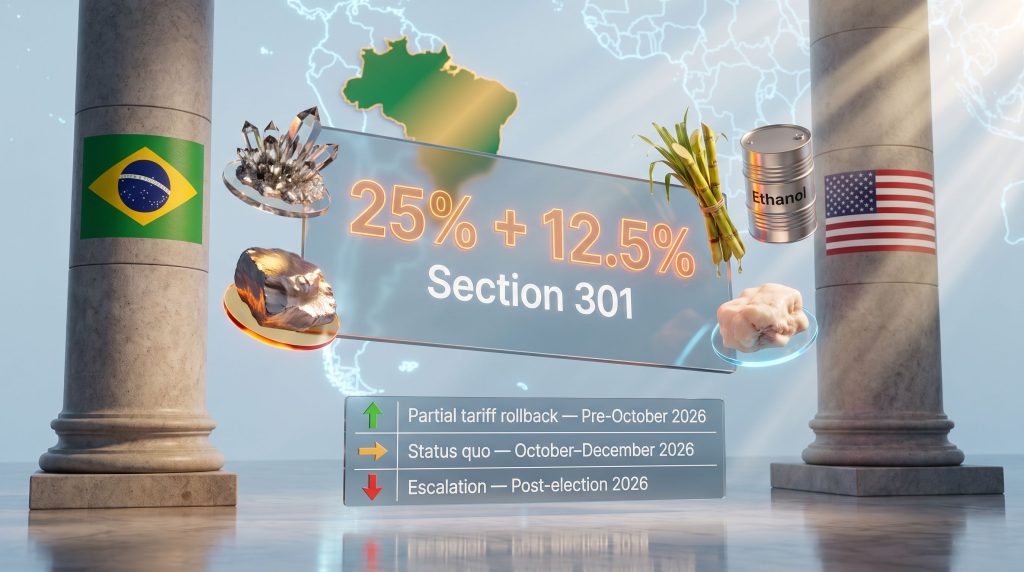
Following a year-long investigation, the USTR imposed a 25% tariff on a broad basket of Brazilian imports in July 2026. The investigation cited a multi-pronged set of concerns, spanning trade, governance, environmental, digital, and labour domains.
| Allegation Category | Specific Concern Cited |
|---|---|
| Market Access Barriers | Restrictive ethanol import market |
| Governance and Rule of Law | Organised crime and corruption concerns |
| Environmental Compliance | Deforestation practices |
| Digital Trade Distortion | Brazil's Pix payment system creating unfair competition |
| Labor Standards | Forced-labour-linked surcharge (additional 12.5%) |
The dual-tariff architecture is particularly significant. The base 25% levy applies broadly, while a separate 12.5% forced-labour surcharge compounds exposure for goods linked to labour-standard violations, creating a potential combined burden of up to 37.5% on affected product categories. This layered structure is unusual even by Section 301 standards and signals the breadth of the USTR's grievances with Brazilian trade practices.
Policy Insight: Unlike anti-dumping duties, Section 301 tariffs are politically discretionary. Their removal depends as much on diplomatic signalling as on legal compliance, which is why the Lula-Trump phone call represents a genuine inflection point in the dispute's trajectory rather than mere optics.
One element of the investigation that draws relatively little mainstream commentary is the inclusion of Brazil's Pix instant payments system as a trade distortion. Pix, launched by Brazil's central bank in 2020, has achieved extraordinary adoption rates and now processes trillions of reais in transactions annually. The USTR's argument that Pix creates competitive disadvantages for US financial services firms operating in Brazil is a novel application of digital trade law that could set a significant precedent for how payment infrastructure is treated in future trade investigations globally.
When big ASX news breaks, our subscribers know first
Which Brazilian Commodities Are in the Tariff Crossfire
Not all Brazilian exports are treated equally under the current tariff architecture. The USTR's framework creates a deliberately asymmetric structure that exempts commodities where the US has limited domestic substitutes or strategic dependencies, while applying full tariff pressure to sectors where Brazil is a competitive threat. The broader global commodity tariff effects of this approach are already being felt across multiple markets.
| Export Category | Tariff Status | Strategic Significance |
|---|---|---|
| Iron ore | Exempt | Critical US steelmaking input |
| Pig iron | Exempt | US manufacturing dependency |
| Rare-earth metals | Exempt | Strategic minerals priority |
| Crude oil | Exempt | Energy security considerations |
| Coffee | Exempt | Consumer goods inflation risk |
| Beef (select cuts) | Exempt | Partial exemption; subject to conditions |
| Ethanol | Tariffed | Central to Section 301 rationale |
| Sugar | Tariffed | Agri-commodity trade exposure |
| Beef tallow | Tariffed | Biofuels feedstock implications |
The exemption logic reveals a great deal about US strategic priorities. Iron ore, pig iron, and rare-earth metals were deliberately shielded because domestic US supply alternatives remain either limited or underdeveloped. Imposing tariffs on these materials would effectively raise costs for US steelmakers and defence-linked supply chains, creating domestic political blowback that far outweighs any negotiating leverage gained.
The inclusion of ethanol as the symbolic anchor of the investigation reflects a longer-standing frustration in Washington. Brazil's sugarcane ethanol market has historically maintained restrictive import conditions that limit US corn-based ethanol access, a grievance that has periodically surfaced in bilateral trade discussions over the past decade. The Section 301 action brought that grievance into enforceable legal territory for the first time.
The Beef Tallow Contradiction
Perhaps the most commercially counterintuitive element of the tariff list is beef tallow. Tallow has quietly transformed from a commodity associated with traditional livestock processing into a high-value feedstock for sustainable aviation fuel (SAF) production. As US airlines and fuel refiners accelerate SAF blending programmes in response to evolving fuel standards, Brazilian beef tallow has emerged as a sought-after feedstock precisely because of Brazil's scale in cattle processing.
Tariffing this commodity creates an internal policy contradiction: US SAF producers seeking cost-competitive feedstocks are penalised by a trade action ostensibly aimed at Brazil, not at domestic energy transition objectives. This friction between trade enforcement and clean energy supply chain economics is unlikely to resolve cleanly within the current tariff framework.
What the Lula-Trump Call Actually Accomplished
Following the presidential phone call, USTR Jamieson Greer reached out to Brazilian government officials, and Brazil's Trade Minister Marcio Rosa along with foreign affairs ministry representatives confirmed they would meet with the USTR. However, no specific date or formal agenda was publicly disclosed.
This deliberate ambiguity is worth examining. In trade diplomacy, the absence of a confirmed date typically reflects one of two conditions: either negotiations are moving faster than public disclosure can accommodate, or both sides are managing domestic constituencies by avoiding premature commitments. Given the Brazilian October 2026 election timeline, the latter interpretation appears more probable.
Lula's characterisation of the tariffs as unwarranted signals that Brazil is entering these talks from a position of principled resistance rather than conciliatory acceptance. This posture is consistent with Brazil's broader foreign policy tradition of asserting trade sovereignty while maintaining engagement, but it also narrows the space for the kind of quiet concessions that typically facilitate Section 301 resolutions.
Critical Framing: Brazilian officials have indicated they do not anticipate any tariff modification before October 2026. This timeline aligns precisely with Brazil's national election cycle, raising legitimate questions about whether electoral considerations on both sides are deliberately shaping the pace and ambition of negotiations.
Why October 2026 Is the Central Variable
Brazil's presidential election in October 2026 introduces a political economy dimension that fundamentally changes the incentive structure for both governments. For Lula, demonstrating that his administration is capable of standing firm against US trade pressure while actively pursuing a resolution serves dual electoral purposes. Capitulating too visibly on tariff terms risks being weaponised by domestic political opponents as evidence of foreign policy weakness.
Conversely, allowing tariffs to remain without any visible diplomatic progress opens the administration to criticism on economic management grounds. For Washington, the election timeline creates its own leverage. A Brazilian administration focused on pre-election economic performance may be more willing to offer substantive concessions in exchange for visible tariff relief.
Three resolution scenarios can be modelled against this political backdrop:
| Scenario | Probability Driver | Expected Timeline | Commodity Impact |
|---|---|---|---|
| Partial rollback via negotiated concessions | Diplomatic momentum from Lula-Trump call | Pre-October 2026 | Ethanol and sugar relief |
| Status quo through election period | Political stalemate; no concessions | October-December 2026 | Continued export margin pressure |
| Escalation via Brazilian reciprocal measures | Breakdown of USTR talks | Post-election 2026 | Bilateral trade volume decline |
Brazil's institutional capacity to mount countermeasures is credible. The country's foreign trade legal architecture, combined with its standing at the World Trade Organization, provides multiple pathways for formalising retaliatory measures. The question is not capability but political timing. A pre-election escalation carries electoral risks that the Lula government is likely to avoid unless negotiations collapse entirely.
Sector-by-Sector Commodity Exposure Analysis
Ethanol and Biofuels
Brazil is the world's second-largest ethanol producer, behind only the United States. Its sugarcane-based production model delivers cost and carbon efficiency advantages that corn-based US ethanol cannot easily replicate. The US Renewable Fuel Standard (RFS) has historically created a pathway for Brazilian ethanol imports as a compliance credit for advanced biofuel categories, making tariff barriers on Brazilian ethanol a double-edged issue for US renewable fuel policy.
Tariff-driven supply disruptions from Brazil are likely to accelerate trade reallocation toward Asian and European biofuel markets, where demand growth and policy mandates are creating new absorption capacity. This could have a lasting structural effect on trade flow patterns that persists even if the tariffs are eventually removed.
Sugar
Brazil accounts for roughly 40% of global sugar exports, a market concentration that gives it outsized influence over global benchmark pricing. Tariff barriers disrupting Brazilian sugar flows into the US create observable price signal effects in spot markets, particularly when combined with supply variability from weather-driven production cycles. Trade diversion from the US market toward Asia and the Middle East is the most likely near-term adjustment, though margins for Brazilian exporters in alternative markets vary considerably by destination.
Metals and Minerals: The Protected Tier
The deliberate exemption of iron ore, pig iron, and rare-earth metals reflects a US industrial policy calculation that prioritises supply chain security over trade leverage. The US iron ore tariff impact on steelmaking economics would be severe without Brazil's contribution. Brazil's iron ore exports, dominated by production from the Carajas and other major mining complexes, are integral to US steelmaking economics. Disrupting that supply without domestic alternatives would impose costs on US manufacturers that Congress would struggle to absorb politically.
Rare-earth exemptions carry even more strategic weight. With China accounting for approximately 90% of global rare earth refining capacity as of 2025, any action that further constrained alternative rare earth supply chains would conflict directly with US critical minerals policy objectives. The evolving critical minerals tariff landscape highlights just how carefully Washington must navigate these exemptions. Brazil's rare earth deposits and export capacity represent a meaningful diversification option that Washington has a strong incentive to preserve.
The Brazil-US Dispute Within the Wider 2026 Trade Landscape
The Brazil-US tariff dispute does not exist in isolation. In August 2026, trade negotiations between the US and Canada collapsed entirely, with Washington imposing 50% tariffs on approximately $28 billion in Canadian imports after talks broke down over last-minute changes to proposed terms. Canada subsequently pledged reciprocal countermeasures, describing the US position as unfair and uneconomic.
Macro Lens: The Lula-Trump tariff dispute is not a bilateral anomaly. It is one episode within a broader US trade enforcement posture that is simultaneously applying pressure across Canada, the EU, and multiple emerging-market partners. Analysing Brazil in isolation misses the systemic pattern.
The parallel Canada collapse is instructive for Brazil in several ways. It demonstrates that USTR Jamieson Greer is willing to allow negotiations to fail rather than accept terms that fall short of US objectives. Furthermore, it illustrates that diplomatic warmth at the presidential level does not necessarily translate into workable outcomes at the ministerial level, where the detailed terms get resolved. Indeed, the broader consequences of trade wars and supply chains remind us that these disputes reverberate far beyond their immediate participants.
The next major ASX story will hit our subscribers first
Key Indicators to Monitor Going Forward
For commodity market participants and trade policy observers, the following signals carry the highest informational value in the weeks and months ahead:
- USTR Federal Register activity: Any notice of Section 301 review, suspension, or modification would be the most direct early signal of a negotiated resolution
- Joint communiqué disclosure: Whether the USTR-Brazil trade ministry meeting produces a public statement or remains entirely confidential will indicate the degree of substantive progress
- Brazilian legislative response: Congressional movement on reciprocal trade legislation ahead of October elections would signal a hardening of Brazil's negotiating posture
- Commodity price movements: Ethanol, sugar, and beef tallow spot prices function as real-time barometers of market confidence in resolution prospects
- WTO filing activity: A formal dispute settlement filing by Brazil at the World Trade Organization would represent a significant escalation and market signal
- Brazilian Trade Minister communications: Marcio Rosa's public framing of talks after the USTR meeting will provide early signals of whether progress is being made or whether language is becoming more adversarial
Watch List: The interval between the USTR bilateral meeting and Brazil's October 2026 election represents the highest-probability window for either a partial negotiated resolution or a formal escalation. Participants across ethanol, sugar, and biofuels feedstock sectors should monitor USTR communications closely during this period.
FAQ: Brazil US Tariffs After the Lula-Trump Call
What tariffs did the US impose on Brazil in 2026?
The US imposed a 25% tariff on a broad range of Brazilian imports following a Section 301 investigation, with an additional 12.5% surcharge applied to goods linked to forced-labour allegations, creating a combined tariff burden of up to 37.5% on affected product categories.
Why did the US impose Section 301 tariffs on Brazil?
The USTR's investigation cited multiple concerns, including restricted access to Brazil's ethanol market, deforestation practices, corruption and organised crime activity, and competitive distortions created by Brazil's Pix digital payments infrastructure.
What happened after the Lula-Trump phone call?
Following the call, USTR Jamieson Greer reached out to Brazilian trade officials. Brazil's Trade Minister Marcio Rosa and foreign affairs ministry representatives confirmed they would meet with the USTR, though no specific date or agenda was publicly disclosed.
Will the tariffs be removed before Brazil's October 2026 election?
Brazilian officials have indicated they do not expect any tariff modification before October 2026, suggesting the dispute may extend through the current electoral cycle regardless of negotiation progress.
Which Brazilian products are exempt from US tariffs?
Iron ore, pig iron, rare-earth metals, crude oil, coffee, and certain beef cuts are currently exempt. Ethanol, sugar, and beef tallow remain subject to the full tariff regime.
Could Brazil retaliate with its own tariffs on US goods?
Brazil has signalled it is preparing potential reciprocal trade measures if negotiations fail to yield results. However, the government has prioritised diplomatic engagement over immediate escalation ahead of the October election.
Readers seeking commodity-specific trade flow analysis across energy, agriculture, and metals markets in the context of the Brazil-US tariff dispute may find additional context through market intelligence published by Argus Media, which covers bilateral trade developments in detail. In addition, the World Trade Organization's dispute settlement portal provides ongoing updates on any formal filings relevant to this dispute.
This article contains forward-looking analysis and scenario modelling based on publicly available information. It does not constitute financial or investment advice. Trade policy outcomes involve substantial uncertainty and actual developments may differ materially from scenarios described.
Want to Track the Commodity Opportunities Emerging From Global Trade Disruptions?
As Brazil's tariff dispute reshapes flows across ethanol, sugar, rare-earth metals, and biofuels feedstocks, Discovery Alert's proprietary Discovery IQ model delivers real-time alerts on significant ASX mineral discoveries — instantly translating complex commodity data into actionable investment intelligence for traders and long-term investors alike. Explore how historic mineral discoveries have generated substantial returns by visiting Discovery Alert's dedicated discoveries page, then begin your 14-day free trial to position yourself ahead of the next major market move.