June 25, 2026
The Grade Differential That Could Define America's Antimony Future
Most commodity stories begin with scarcity. The antimony story begins with something far more structurally uncomfortable: the United States consuming roughly 25,000 tonnes of antimony annually while producing precisely zero from domestic mines. That figure is not a projection or an estimate from a single study. It reflects a structural reality that has persisted for decades, quietly accumulating geopolitical risk until recent export curtailments forced the issue into Washington's policy foreground.
Understanding why the Resolution Minerals Idaho antimony project has attracted serious attention requires stepping back from the company entirely and examining what antimony actually does, why it cannot be easily replaced, and what the grade profile of Idaho's Antimony Ridge target means for the economics of domestic supply.
When big ASX news breaks, our subscribers know first
Why Antimony Is Not a Commodity You Can Simply Substitute
Antimony occupies an unusual position in the periodic table of industrial relevance. It is not glamorous in the way lithium or cobalt have become, but it is deeply embedded in applications where failure is not an option.
Its primary end uses span several industries:
- Defense munitions and military pyrotechnics, where antimony trioxide acts as a flame retardant and tracer compound in ammunition, flares, and incendiary devices
- Flame retardants for electronics and textiles, where antimony trioxide synergises with halogen compounds to suppress combustion in circuit boards, cable insulation, and aircraft interiors
- Lead-acid battery grid hardening, where antimony alloys strengthen the lead plates in conventional automotive and industrial batteries
- Semiconductor manufacturing, where antimony is used in certain compound semiconductors and infrared detectors
The substitution problem is real and widely acknowledged in materials science literature. In most of these applications, no commercially viable short-term replacement exists that delivers equivalent performance at comparable cost. This is precisely why the US Geological Survey and various defense policy bodies have classified antimony as a critical mineral, placing it alongside rare earths in terms of supply chain urgency. Furthermore, antimony in defense applications makes substitution especially difficult given the precision requirements of military-grade specifications.
China's Structural Control: A Risk Quantification
The concentration of global antimony supply in China is not simply a market share statistic. It represents a leverage mechanism with documented historical precedent. China has previously curtailed antimony exports to North American buyers, exposing the fragility of supply chains that had been treated as stable commodity flows.
| Supply Chain Metric | Estimated Figure |
|---|---|
| China's share of global antimony processing | ~80% |
| China's share of global antimony mining | ~60% |
| US annual antimony consumption | ~25,000 tonnes |
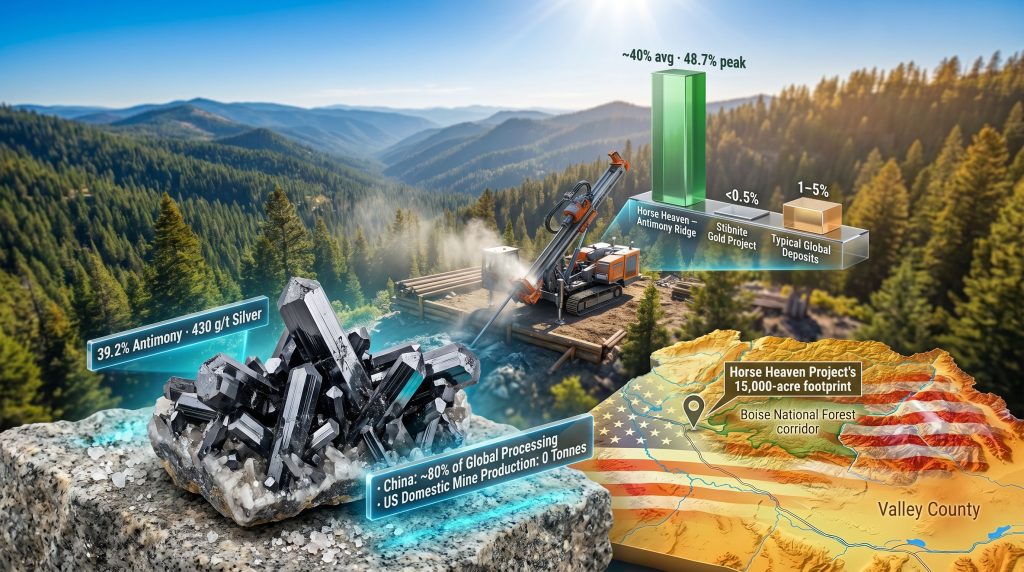
| Domestic US antimony mine production | 0 tonnes |
The asymmetry in this table is the core geopolitical problem. The US cannot currently produce a single tonne of antimony domestically from mine operations, yet its defense, electronics, and energy infrastructure depend on continuous supply. Any disruption, whether driven by export policy, sanctions dynamics, or bilateral trade tensions, translates immediately into shortfalls for industries with no domestic backstop. Consequently, the antimony shortage risks for US industry are severe and growing more acute with each passing year.
This is the macroeconomic backdrop against which the Resolution Minerals Idaho antimony project must be evaluated. In addition, Washington's critical minerals executive order has further elevated the urgency of developing domestic supply, making projects like Horse Heaven increasingly central to US industrial policy.
What Makes the Horse Heaven Grade Profile Exceptional
The Horse Heaven project covers approximately 15,000 acres (5,644 hectares) within the Boise National Forest in Valley County, Idaho, held in full ownership by Resolution Minerals (ASX-listed) without joint venture dilution on the core asset. Its immediate adjacency to Perpetua Resources' Stibnite Gold Project, the largest known antimony resource in the United States, provides geological context that is difficult to overlook.
However, the comparison between the two projects also illustrates a critical distinction that most market commentary glosses over: the difference between primary antimony production and byproduct antimony recovery. The strategic antimony project at Stibnite, for instance, recovers antimony as a secondary product of gold mining rather than as the primary target.
| Project | Operator | Antimony Grade Profile | Recovery Method |
|---|---|---|---|
| Antimony Ridge (Horse Heaven) | Resolution Minerals | ~40% average surface samples; up to 48.7% peak | Standalone primary extraction |
| Stibnite Gold Project | Perpetua Resources | Sub-0.5% average | Byproduct of gold production |
| Typical global antimony deposits | Various | 1–5% average | Varies |
Surface rock samples collected from massive stibnite mineralisation at Antimony Ridge in October 2025 averaged 39.2% antimony and 430 g/t silver, with peak samples reaching 48.7% antimony and 890 g/t silver. These are not drill intercept averages from deep resource blocks. They are surface grab samples from exposed mineralisation that historically supplied antimony to the US military across three wartime periods: World War One, World War Two, and the Korean War era.
The wartime production legacy is itself a form of geological due diligence. Historic stockpile grades from those periods are consistent with the recent sampling results, suggesting genuine deposit continuity rather than isolated high-grade pods.
Key geological insight: The Antimony Ridge vein system is characterised by stibnite (antimony trisulfide) concentrated in discrete veins ranging from a few centimetres to approximately 60 centimetres thick. This geometry concentrates extremely high-grade material in near-surface positions, which has significant implications for capital intensity. Unlike bulk-tonnage porphyry systems requiring large open-pit infrastructure, high-grade narrow vein systems can potentially be developed with lower upfront capital if the vein geometry proves consistent with depth.
The silver credits at 430 g/t average and up to 890 g/t peak are a lesser-discussed aspect of the deposit's economics. At spot silver prices, these credits could materially improve the per-tonne economics of any future processing operation, a factor that has not received proportionate attention in most public commentary on the project. Furthermore, the antimony price surge in recent years has only strengthened the economic case for high-grade primary production of this kind.
Fast-41 Permitting: What the Designation Actually Does and Does Not Do
The Fast-41 federal permitting framework is frequently cited in coverage of the Resolution Minerals Idaho antimony project, but it is rarely explained with precision. Understanding its actual mechanics is essential for investors modelling development timelines.
Fast-41 is not a permitting approval. It does not guarantee that any permit will be granted. What it does is impose defined review timelines on federal agencies participating in the permitting process. In Resolution's case, the relevant agency is the US Forest Service.
Without Fast-41 coverage, agency review periods can extend indefinitely with no mandatory deadline for completing environmental assessment or issuing decisions. With Fast-41 coverage, the Federal Permitting Improvement Steering Council (the Permitting Council) in Washington administers a structured timeline that agencies are required to meet.
Resolution secured this designation in April 2026. The practical significance is not that approval is certain, but that the process is now bounded. For project financing and offtake negotiations, a bounded permitting timeline reduces the open-ended regulatory risk that makes lenders and counterparties reluctant to commit capital. That translates into improved bankability, even at the pre-resource stage.
Management at Resolution has been explicit that permitting velocity is considered more consequential than government capital access for the project's near-term development trajectory. The reasoning is straightforward: capital can be raised from equity markets, as evidenced by the approximately $47 million raised over the six months preceding mid-2026, primarily from Australian institutional and retail investors through the ASX listing. Permitting cannot be purchased; it can only be accelerated through the right regulatory frameworks.
Three Pathways to Cash Flow Before Full-Scale Production
One of the more distinctive aspects of the Resolution Minerals Idaho project strategy is its phased approach to revenue generation, designed to avoid the common junior mining trap of complete capital dependency on a single large permitting and construction event.
Phase 1: Tungsten Stockpile Monetisation
Existing tungsten stockpiles on the Horse Heaven land package are available for near-term shipment to third-party processors. Letters of intent are in active discussion with potential offtake counterparties. This pathway requires no new mining permits and could generate initial cash flow within a relatively compressed timeframe.
Phase 2: Bulk Sample Antimony Extraction
A bulk sample extraction permit application has been submitted targeting a minimum of 500 tonnes of high-grade antimony material. To contextualise that figure: 500 tonnes represents approximately two years of US military antimony demand. Even a modest extraction program of this scale carries genuine strategic relevance, which may facilitate engagement with defense procurement channels beyond standard commercial offtake relationships.
Phase 3: Hub-and-Spoke Processing Infrastructure
The longer-term processing strategy is among the most strategically differentiated aspects of the Resolution plan. Rather than developing a conventional mine-to-mill operation dependent solely on its own ore feed, the company is evaluating sites for a centralised processing facility designed to accept both Horse Heaven ore and third-party material from other Idaho antimony and tungsten producers.
Strategic concept: A hub-and-spoke processing model transforms Resolution from a single-asset mine developer into a potential regional processing infrastructure operator. If realised, this positions the company to capture processing margins from multiple ore sources, improving facility utilisation rates and the economic case for processing capital investment.
In-house hydrometallurgical development is led by Dr. Adam Roer. Preliminary metallurgical results from early testwork have produced 99.4% antimony trioxide from high-grade stibnite samples. Antimony trioxide is the primary commercially traded form of antimony, used directly in flame retardant manufacturing and as a feedstock for other antimony compounds. Additional metallurgical validation programs are underway in Canada and Australia to confirm processing parameters at scale before any facility investment is committed.
The acquisition of a 25-acre private parcel containing the historic Johnson Creek Tungsten Mill is a critical enabling step for this strategy. Private land ownership provides significantly more permitting flexibility for processing infrastructure compared with operations conducted entirely on US Forest Service public land. Modular processing equipment can be deployed on private land under a different regulatory framework, potentially allowing processing activity to commence well ahead of full-scale mining permits on the adjacent public lands.
The next major ASX story will hit our subscribers first
The Drill Program: Scale, Progress, and What the Numbers Could Reveal
The current exploration campaign represents the most important near-term technical catalyst for the Resolution Minerals Idaho antimony project. The program involves approximately 45,000 feet (~13,700 metres) across roughly 45 holes, commenced in early May 2026. As of the most recent update, 60 holes had been completed, approaching 4,000 metres drilled, with drill results expected to begin flowing from late July 2026 through year-end.
The program targets two distinct systems:
- Antimony Ridge — the primary critical minerals target, focused on defining the three-dimensional geometry of high-grade stibnite veins to support a maiden resource estimate
- Golden Gate — a gold system with approximately 3 kilometres of strike length along the Johnson Creek shear zone
For the Antimony Ridge component, the geological objective is converting historical wartime trench and stockpile data, which documents the existence of high-grade mineralisation but not its subsurface geometry, into a modern JORC or NI 43-101 compliant resource. The maiden resource estimate is targeted for Q1 2027, with some project communications suggesting year-end 2026 as an aspirational timeline depending on results flow.
The Golden Gate system warrants separate analysis because it represents a different style of mineralisation and a different type of value proposition.
Golden Gate: Large-Tonnage Gold Optionality
Historic drilling from the late 1980s and early 1990s, combined with more recent work, has outlined a gold system that differs substantially from the high-grade narrow-vein antimony deposit. One notable intercept returned 253 metres at 1.5 g/t gold from surface, with mineralisation open at depth.
A lesser-discussed but potentially significant aspect of the system is its open-ended character: the connection between Golden Gate North and Golden Gate South along the Johnson Creek shear zone has not yet been confirmed by drilling, and testing that connectivity represents a future drill phase objective.
The system is characterised as a large-tonnage, lower-grade gold deposit more analogous to bulk-tonnage Nevada and Idaho gold deposits than to the historic high-grade underground mines of the western US, many of which are largely depleted. This distinction matters for how investors should model the contribution: Golden Gate is a balance sheet diversifier and NPV enhancer, not the primary investment thesis driver. The critical minerals story at Antimony Ridge is the core strategic case.
Key Risks Every Investor Should Model
Risk framework: Horse Heaven remains a pre-resource, pre-permit project for full-scale commercial operations. The investment thesis rests on converting exploration potential, geological precedent, and regulatory momentum into a permitted, producing asset. That transition carries material execution risk that must be honestly assessed alongside the grade and strategic advantages.
The principal risk categories for the Resolution Minerals Idaho antimony project include:
- Resource estimation risk: The maiden resource is dependent on drill results expected through late 2026. Vein geometry at depth may differ from surface sample patterns, and resource continuity between historical workings is not yet confirmed by modern drilling.
- Permitting risk: Fast-41 status imposes timelines on agency review but does not compel a positive outcome. Environmental or community consultation complexity within the Boise National Forest could extend timelines or require program modifications regardless of the designated review framework.
- Metallurgical scale-up risk: The 99.4% antimony trioxide result is from early-stage testwork on high-grade samples. Commercial-scale processing validation across variable ore types remains ongoing and unconfirmed.
- Funding risk: Federal grant outcomes from the Defense Industrial Base Consortium applications remain undisclosed and are not guaranteed. The NASDAQ listing timeline is subject to market conditions and regulatory approval.
- Antimony price risk: Antimony pricing has historically been volatile, with price moves frequently correlated to Chinese export policy decisions rather than underlying demand fundamentals. A period of Chinese export normalisation could compress near-term price realisations.
Scenario Analysis: Three Development Pathways Through 2028
| Scenario | Key Assumptions | Likely Outcome |
|---|---|---|
| Bull Case | Fast-41 delivers timely Forest Service engagement; bulk sample commences late 2026; NASDAQ listing successful; maiden resource confirms standalone economics | First commercial antimony production achievable by mid-2028; hub-and-spoke facility operational |
| Base Case | Permitting proceeds within framework but encounters standard complexity; bulk sample delayed to 2027; resource scale adequate but requires infill drilling | First commercial production late 2028 to 2029; capital requirements manageable with NASDAQ broadening |
| Bear Case | Forest Service review encounters environmental complexity; federal grants unsuccessful; NASDAQ delayed by market conditions; resource requires significant additional work | Project timeline extends beyond 2029; dilution risk increases; strategic thesis intact but execution delayed materially |
Milestones and Catalysts to Monitor Through 2027
| Milestone | Expected Timing |
|---|---|
| Drill results from 45,000-foot program | Late July 2026 through year-end 2026 |
| Bulk sample extraction permit application outcome | 2026 |
| Tungsten stockpile offtake agreement finalisation | Near-term (LOIs in discussion) |
| NASDAQ listing completion | Pending regulatory approval |
| Federal grant outcomes (Defense Industrial Base Consortium) | Undisclosed |
| Maiden resource estimate | Q1 2027 (aspirational: year-end 2026) |
| Golden Gate North to South connectivity drill test | Future drill phase |
Idaho's Emerging Role in the US Critical Minerals Geography
The Boise National Forest corridor has a production history in critical minerals that predates the current policy moment by more than a century. What has changed is the strategic framing applied to that history. The combination of a historically productive antimony district, documented near-surface high-grade mineralisation, existing mill infrastructure on private land, and Fast-41 permitting coverage creates a convergence of geological, logistical, and regulatory factors that is genuinely uncommon in the current domestic critical minerals landscape.
For investors, the Resolution Minerals Idaho antimony project occupies a specific position in the risk-reward spectrum: genuine grade advantages and strategic relevance, measured against real execution risk from a project that has not yet delivered a maiden resource estimate, full-scale operating permits, or first production. The combination of active drill news flow through late 2026, a resource estimate targeted for Q1 2027, and ongoing federal engagement means the next twelve months will be materially informative about which of the three development scenarios outlined above is actually unfolding.
This article is for informational purposes only and does not constitute financial advice. Readers should conduct their own due diligence before making any investment decisions. Forward-looking statements and scenario projections involve inherent uncertainty and may not reflect actual outcomes.
Want to Know When the Next Major Mineral Discovery Hits the ASX?
Discovery Alert's proprietary Discovery IQ model delivers real-time alerts the moment significant ASX mineral discoveries are announced, turning complex data across more than 30 commodities into clear, actionable insights for investors at every experience level. Explore Discovery Alert's discoveries page to understand how historic finds have generated substantial returns, and begin your 14-day free trial today to position yourself ahead of the broader market.