June 25, 2026
When Open Pits Run Deep: The Financial Architecture Behind Underground Mine Transitions
Across the Bushveld Complex, one of the most mineralogically rich geological formations on Earth, a quiet but capital-intensive shift is underway. The shallow, high-volume open-pit operations that defined an earlier era of platinum group metal (PGM) and chrome extraction are giving way to deeper, more technically demanding underground methods. This transition is not simply an engineering challenge — it is a financing puzzle requiring purpose-built capital structures that accommodate multi-year ramp-up timelines, specialised equipment procurement, and the inherent uncertainty of underground ore body development.
Understanding how mining companies fund this transition reveals something important about how institutional lenders assess long-term resource value, balance sheet resilience, and operational credibility in the South African mining sector. Furthermore, the Tharisa Nedbank revolving finance facility offers a particularly instructive case study in how these financial structures are architected in practice.
When big ASX news breaks, our subscribers know first
The Tharisa Nedbank Revolving Finance Facility: Structure and Strategic Purpose
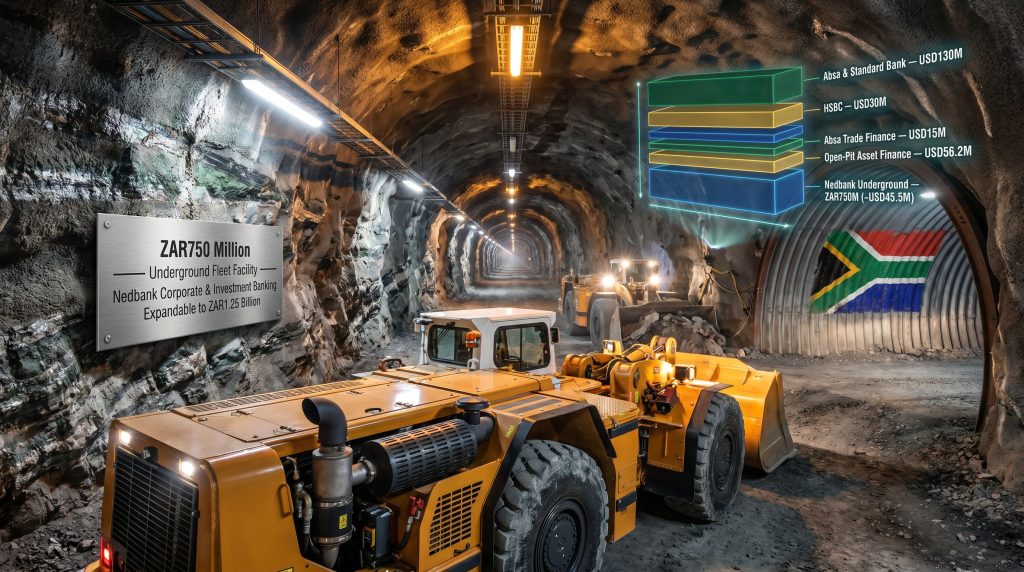
Tharisa, dual-listed on the Johannesburg and London stock exchanges, has secured a ZAR750 million (approximately USD45.5 million) asset revolving finance facility from Nedbank's Corporate and Investment Banking division. The facility is structured around the company's underground mining fleet requirements at Tharisa Mine, located on the western limb of the Bushveld Complex in South Africa.
Critically, the agreement includes an accordion feature — a contractual mechanism that allows Tharisa to expand the total facility size to ZAR1.25 billion (approximately USD75.8 million) without renegotiating the core terms of the original arrangement. This type of built-in scalability is increasingly common in mining finance, where capital requirements during underground ramp-up phases can shift as equipment needs evolve, ore development accelerates, or unforeseen ground conditions require additional machinery investment. For further context on how such facilities operate, Nedbank's overview of revolving loan structures provides useful background.
How Asset-Based Revolving Credit Works in a Mining Context
An asset revolving finance facility differs meaningfully from a standard corporate term loan. Rather than drawing a fixed sum against general balance sheet strength, the borrower draws capital against specific qualifying assets — in this case, underground mining equipment. As equipment is acquired, paid down, or rotated out of service, the facility revolves, allowing fresh drawdowns against newly acquired assets within the agreed limit.
This structure provides several advantages for a company in transition:
- It isolates underground capital expenditure from the broader corporate debt stack, reducing cross-contamination of risk between surface and underground operations.
- It gives treasury teams the flexibility to time equipment purchases against operational milestones rather than being locked into a fixed drawdown schedule.
- The accordion feature adds a second layer of flexibility, meaning Tharisa can access up to an additional ZAR500 million in capacity if underground fleet requirements expand beyond initial projections.
- Lenders benefit from asset-specific security, giving Nedbank a defined collateral position tied to identifiable physical equipment rather than abstract corporate credit risk.
From Open Pit to Underground: The Geological and Commercial Case at Tharisa Mine
Tharisa Mine sits within the Bushveld Complex, a layered igneous intrusion stretching across much of South Africa's northern interior. This geological structure hosts the world's largest known reserves of platinum group metals and is also a prolific source of chrome concentrates, with the two commodity streams often extracted simultaneously from the same ore horizons.
Open-pit operations at Tharisa have long exploited the near-surface expression of these ore bodies. However, every open-pit operation follows a natural depletion curve. Much like the largest open-pit mines around the world, as surface material is progressively removed, the ore body descends below the economic reach of conventional open-cut methods. Consequently, the stripping ratio increases to a point where underground methods become more cost-effective.
Underground development at Tharisa is not simply about accessing more ore. It is about accessing better ore at depth, where reef horizons tend to carry higher PGM grades and more consistent chrome mineralisation compared to the weathered and diluted near-surface zones that characterise mature open-pit operations.
Key Development Milestones in the Underground Program
| Milestone | Date | Significance |
|---|---|---|
| First underground blast at Apollo portal | March 2026 | Official commencement of underground development |
| First ore expected in mill | Early H2 2026 (calendar year) | Initial production from underground operations |
| Cementation Africa contractor engagement | Confirmed May 2026 | Five-year underground mining contract awarded |
| Tharisa Nedbank revolving finance facility secured | June 2026 | Full funding of underground fleet confirmed |
The Apollo portal serves as the primary access point for underground development. Portal-based entry methods are commonly used during the early stages of underground mine development because they allow horizontal or decline-based access to ore horizons without the upfront capital cost of a full shaft sinking program. This approach can significantly accelerate the timeline to first underground ore production.
Cementation Africa's Role in the Ramp-Up
Tharisa has engaged Cementation Africa as its underground mining contractor under a five-year agreement. The choice of contractor structure — rather than owner-operated mining — is a deliberate capital management decision. By outsourcing the underground workforce and associated operational overhead to a specialist contractor, Tharisa retains financial flexibility during the ramp-up phase while benefiting from Cementation Africa's established expertise in narrow reef and hard rock underground mining environments.
A five-year contract horizon also provides production continuity assurance, both to internal planning teams and to lenders assessing the facility's repayment profile. In addition, the contractor model transfers significant operational risk away from Tharisa's balance sheet during the most capital-intensive phase of development.
Mapping Tharisa's Full Financing Architecture
The Tharisa Nedbank revolving finance facility does not exist in isolation. It forms one layer within a multi-lender capital structure that has been carefully assembled to fund both the ongoing open-pit operations and the new underground development program simultaneously.
| Facility | Lender(s) | Value | Purpose | Date Secured |
|---|---|---|---|---|
| Term loan and revolving credit | Absa Bank and Standard Bank | USD130 million | Underground mine transition | November 2025 |
| Revolving trade finance | HSBC | USD30 million | Pre- and post-shipment commodity finance | March 2026 |
| Revolving trade finance | Absa Bank | USD15 million | Pre- and post-shipment commodity finance | March 2026 |
| Asset finance facility | Undisclosed | USD56.2 million | Open-pit mining fleet funding | Existing/ongoing |
| Asset revolving finance | Nedbank | ZAR750m (~USD45.5m) | Underground fleet funding | June 2026 |
This financing stack reveals a deliberate architectural logic. Open-pit fleet funding sits in a separate facility from underground fleet capital, preventing operational disruption to surface mining from being amplified by underground cost overruns, or vice versa. Trade finance lines from HSBC and Absa cover the working capital cycle of commodity shipments, while the larger Absa and Standard Bank term facility provides the primary balance sheet backbone. Tharisa's official announcement regarding the Absa and Standard Bank facilities confirms the structure and scope of those arrangements.
What Multi-Lender Participation Signals to the Market
When multiple Tier 1 banks — spanning South African domestic institutions like Nedbank, Absa, and Standard Bank alongside an international lender of HSBC's scale — participate in a single company's capital structure, it communicates something beyond mere creditworthiness. It reflects a shared institutional assessment that the underlying mine asset possesses sufficient long-term value to justify parallel lending exposures.
For mid-tier PGM producers, securing this depth of multi-lender participation is not straightforward. Lenders conduct independent credit assessments that incorporate ore reserve life, commodity price assumptions, management track record, environmental compliance history, and the technical credibility of the mining plan. The assembly of this financing stack across less than eight months suggests Tharisa's underlying credit case has held up robustly across multiple independent due diligence processes.
ESG Integration in Fleet Selection: More Than a Compliance Exercise
One of the less-discussed dimensions of the Tharisa Nedbank revolving finance facility is the degree to which sustainability criteria influenced the fleet selection process. The underground equipment being funded through the facility was chosen partly on the basis of improved energy efficiency, lower emissions profiles, and enhanced safety systems.
This is significant for several reasons:
- Underground mining environments are inherently high-emission spaces due to diesel-powered load-haul-dump machines, drilling equipment, and ancillary vehicles. Selecting lower-emission equipment from the outset reduces the future cost of retrofitting or replacing machinery to meet tightening emissions standards.
- Safety system enhancements in modern underground fleets — including proximity detection, automated collision avoidance, and real-time telemetry — reduce the frequency and severity of underground incidents, carrying direct cost implications for insurance, downtime, and regulatory compliance.
- Tharisa has publicly committed to a carbon neutrality roadmap targeting 2050. Embedding ESG-aligned equipment choices at the foundation of the underground fleet means the emissions baseline for the new operation starts lower than it would with conventional fleet procurement.
Furthermore, the principles of green mine design are increasingly influencing how operators structure their underground transitions from the outset, rather than retrofitting sustainability measures after the fact. This aligns directly with the broader mining decarbonisation benefits that operators and lenders are increasingly factoring into long-term project assessments.
Fleet financing decisions made today lock in emissions trajectories for the next decade or more. Choosing lower-emission underground equipment is not merely an ESG gesture — it is a long-term operational cost management strategy that reduces regulatory and carbon pricing risk over the mine's productive life.
Underground Equipment Categories in the Tharisa Fleet
While the specific equipment mix has not been publicly itemised in detail, underground fleet programs of this type and scale at Bushveld Complex operations typically involve:
- Development drill rigs for advancing decline tunnels and cross-cuts toward the ore horizon.
- Load-haul-dump (LHD) machines for mucking broken rock from the stope face and transporting it to ore passes or loading points.
- Underground haul trucks for secondary transport of ore from loading points to surface or underground crushing facilities.
- Roof bolters and ground support equipment to maintain tunnel and stope stability in the layered reef geometry of the Bushveld.
- Utility vehicles and personnel carriers for workforce movement and equipment maintenance underground.
Chrome and PGM Market Dynamics Supporting the Underground Investment Case
Tharisa's dual-commodity production model — generating revenue from both chrome concentrates and PGMs — is a structural advantage that most mono-commodity PGM producers cannot replicate. During periods when platinum or palladium prices underperform, chrome revenue provides a countercyclical buffer that supports cash flow continuity and debt serviceability.
This revenue diversification matters directly to lenders. A mine that generates meaningful income from two independent commodity markets presents a lower cash flow volatility profile than a pure-play PGM operation of similar size. In the context of the Tharisa Nedbank revolving finance facility, and the broader lending stack, this dual-revenue structure almost certainly contributed to the competitive terms and the willingness of multiple lenders to participate simultaneously.
Chrome concentrate demand, driven substantially by ferrochrome production for stainless steel manufacturing, has remained a relatively stable demand foundation. Meanwhile, PGM demand continues to evolve with the automotive sector's ongoing transition and the emerging hydrogen fuel cell economy, where platinum plays a critical catalytic role.
The next major ASX story will hit our subscribers first
What the Tharisa Financing Model Reveals About 2026 Mine Finance Trends
The assembly of Tharisa's financing architecture offers a useful lens through which to view broader trends in how South African mining companies are funding capital-intensive operational transitions in 2026. Moreover, several structural patterns within this case have direct implications for how lenders and operators alike approach underground mine development going forward.
Key patterns emerging from this case include:
- Ring-fenced asset financing is becoming the preferred structure for equipment-heavy underground transitions, allowing lenders to maintain clear collateral positions while borrowers retain operational flexibility.
- Accordion features are standard inclusions in new mining facilities, reflecting the genuine capital uncertainty that accompanies underground ramp-up programs.
- ESG-linked procurement criteria are being embedded into fleet acquisition decisions at the point of facility design, not retrofitted after the fact.
- Multi-lender syndication, even when facilities are separately structured rather than syndicated in the traditional sense, diversifies refinancing risk and demonstrates broad institutional validation of the underlying asset.
- Contractor-based underground development reduces the balance sheet burden during ramp-up by transferring operational overhead to specialist mining contractors under long-term agreements.
However, it is worth noting that the success of these structures ultimately depends on the technical rigour of the underlying mining plan. A definitive feasibility study forms the bedrock of any credible lender assessment, providing the ore reserve, cost, and production data against which facility terms are ultimately calibrated. In addition, cut-off grade economics play a critical role in determining which underground ore horizons are genuinely economic to develop — a factor lenders scrutinise closely when evaluating repayment capacity.
Disclaimer: This article is intended for informational purposes only and does not constitute financial advice. All financial figures, timelines, and facility details referenced are based on publicly available company announcements and may be subject to change. Readers should conduct their own due diligence before making investment decisions. Forward-looking statements regarding production timelines and market conditions involve inherent uncertainty and actual outcomes may differ materially from those described.
Want to Track the Next Major Mineral Discovery Before the Market Does?
Discovery Alert's proprietary Discovery IQ model scans ASX announcements in real time, instantly identifying significant mineral discoveries and translating complex geological data into actionable investment insights — whether you're a short-term trader or a long-term investor. Explore historic discoveries and their remarkable returns to understand what's possible, then begin your 14-day free trial to secure a genuine market-leading edge.