August 6, 2026
The Feedstock Problem That Defines Antimony Processing Economics
Critical mineral processing operations are frequently evaluated on the strength of their plant infrastructure, flowsheet design, and geological resource base. Yet in the antimony sector, one variable consistently determines whether a processing facility generates real commercial value or remains an expensive piece of idle capital: reliable access to ore. The EV Resources antimony ore supply agreement represents exactly the kind of commercially decisive development that separates viable processors from stranded assets.
Processing capacity without a secured feedstock pipeline is, in practical terms, a stranded asset. This distinction is particularly acute for antimony operations outside China, where the combination of limited global mine supply, geopolitical concentration risk, and volatile pricing creates an environment where ore supply security functions as the foundational commercial input, not an afterthought.
The structural gap between available ore and refining throughput has historically constrained non-Chinese antimony processors. Unlike vertically integrated Chinese operations, which benefit from domestic ore pipelines developed over decades, Western-facing processors must actively construct their feedstock architecture from scratch, typically through a combination of company-owned resources and third-party supply agreements.
Within this context, the legal and commercial character of a supply arrangement becomes strategically decisive. A memorandum of understanding signals intent but delivers no enforceable supply certainty, no pricing framework, and no production planning foundation. Converting an MOU into a binding multi-year commercial contract is not merely an administrative step. It is a fundamental change in the risk profile of an operation, transforming a speculative processing flowsheet into a commercially anchored production pathway with defined ore volumes, agreed pricing mechanics, and legal recourse in the event of non-performance.
Key Insight: In critical mineral processing, the difference between an MOU and a binding contract is the difference between a project on paper and a commercially viable operation. Legally enforceable supply certainty is what enables capital deployment, production scheduling, and downstream offtake negotiations to proceed with confidence.
When big ASX news breaks, our subscribers know first
What the EV Resources Antimony Ore Supply Agreement Establishes
Breaking Down the Structure of EVR's First Binding Feedstock Contract
EV Resources (ASX: EVR) has executed its first binding five-year ore supply agreement, marking a commercially meaningful inflection point in the development of its Tecomatlán antimony processing hub in the Mexican state of Puebla. The agreement was signed through Stibcorp, EVR's Mexican operating subsidiary, with Lucero Grupo Minero de Puebla as the supplying party.
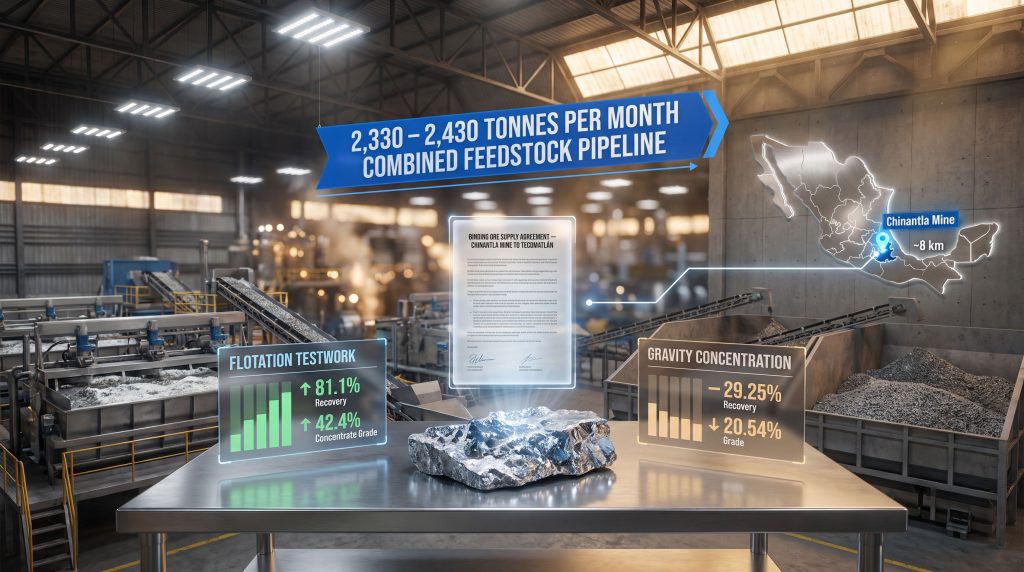
The ore source under the agreement is the Chinantla mine, situated approximately 8 kilometres from the Tecomatlán plant. This geographic proximity is operationally significant. Short haul distances reduce transport costs, limit ore degradation risks associated with extended haulage, and simplify logistics coordination between mining and processing schedules. In a sector where cost efficiency at the ore supply stage directly determines processing margins, proximity between mine and plant is a structural advantage that is often underappreciated by external observers.
The agreement includes automatic one-year renewal provisions, which extend the effective planning horizon beyond the initial five-year term. For a processing operation that requires sustained throughput to achieve meaningful economies of scale, this mechanism provides additional continuity assurance without requiring full renegotiation at each term expiry. EV Resources' ASX announcements provide further detail on the structure of this arrangement.
How Ore Pricing Is Structured Under the Agreement
The pricing architecture embedded within the EV Resources antimony ore supply agreement reflects the complexity of transacting at the raw ore level rather than the processed concentrate level. Because antimony does not trade on a liquid exchange in the same manner as base metals such as copper or zinc, pricing must be constructed from a combination of international benchmark references and ore-specific adjustment factors.
The core pricing formula links payment to prevailing international antimony benchmark prices, adjusted downward to reflect the actual payable antimony content of ore delivered. From this adjusted base value, a series of further deductions are applied.
| Pricing Variable | Function in the Agreement |
|---|---|
| International Antimony Benchmark | Sets the base reference price for ore purchases |
| Payable Antimony Grade | Adjusts payment based on actual ore quality delivered |
| Treatment and Refining Charges | Deducted from gross value to reflect processing costs |
| Transport and Moisture Adjustments | Corrects for physical delivery variables |
| Impurity Penalties | Reduces payable value where contaminants exceed thresholds |
This structure is standard practice in bulk concentrate trading and is now being applied at the upstream ore supply level. The benefit of benchmark linkage is that it provides both parties with a market-anchored reference point that automatically adjusts as antimony prices move, eliminating the need for periodic renegotiation of base price terms. In a commodity environment where the antimony price surge following China's 2024 export restrictions has demonstrated significant volatility, this mechanism provides a degree of commercial stability without locking either party into a fixed price that could become commercially unworkable under extreme market conditions.
How Metallurgical Validation Underpins the Commercial Case
Understanding the Testwork Behind the Chinantla Ore Selection
One aspect of the EV Resources antimony ore supply agreement that distinguishes it from a generic procurement arrangement is the metallurgical pre-qualification work completed on Chinantla ore prior to contract execution. In critical mineral processing, signing a supply agreement without metallurgical validation of the ore source is a significant commercial risk. Ore that cannot be efficiently processed into saleable concentrate represents a cost centre rather than a revenue input.
Two processing pathways were evaluated on Chinantla ore samples, producing results that clearly define the optimal processing route for this material.
Flotation vs. Gravity Concentration: A Performance Comparison
| Processing Method | Antimony Recovery (%) | Concentrate Grade (%) |
|---|---|---|
| Flotation Testwork | 81.1% | 42.4% |
| Gravity Concentration | 29.25% | 20.54% |
The performance differential between these two methods is substantial. Flotation testwork achieved an antimony recovery rate of 81.1%, producing a concentrate grading 42.4% antimony. Gravity concentration, by contrast, recovered only 29.25% of the antimony present and delivered a concentrate grade of just 20.54%.
Technical Callout: The flotation pathway recovers nearly three times the antimony content from the same ore input compared to gravity concentration. In processing economics, this gap is the difference between a viable commercial operation and one that consumes ore without generating sufficient concentrate value to cover costs.
What makes these results particularly noteworthy is that 42.4% antimony concentrate sits at a commercially attractive grade level for downstream smelting and refining. Antimony concentrates below approximately 45–50% can still be commercially viable depending on impurity profiles and smelter acceptance criteria, but grade is a primary driver of payability in downstream sales agreements. A concentrate grading above 40% provides a strong starting point for offtake negotiations.
The 81.1% recovery rate is also meaningful in a global context. Antimony ore typically presents processing challenges due to the presence of gangue minerals and sulphide associations, and recovery rates above 80% are a positive outcome for a flotation circuit at the testwork stage, where scale-up factors and plant-level variability have not yet been applied.
What Is the Tecomatlán Processing Hub and How Does It Fit Into EVR's Strategy?
The Architecture of a Multi-Source Feedstock Pipeline
The Tecomatlán plant is not conceived as a single-source processing operation. Its design intent is to function as a regional antimony processing hub capable of accepting ore from multiple independent suppliers, with EVR's own Los Lirios resource base providing an additional supply layer alongside third-party agreements. Furthermore, this multi-source model is what underpins the hub's long-term commercial resilience.
This multi-source feed model is architecturally superior to single-supplier dependency for several reasons. It distributes geological and operational risk across multiple ore sources. It creates competitive tension between suppliers, which supports pricing discipline. And it allows the plant to maintain throughput continuity even if one supply relationship is temporarily disrupted.
Previously reported combined feedstock volumes from EVR's broader supply pipeline have indicated potential throughput capacity in the range of approximately 2,330 to 2,430 tonnes per month across multiple supply agreements. The Chinantla binding agreement adds commercially secured volume to this pipeline, converting what was previously indicative capacity into contractually committed feed. Locksley Resources' ore supply agreement with EVR illustrates how this multi-source model is being assembled in practice.
The Proof-of-Concept Campaign: What It Must Demonstrate
The immediate operational application of the EV Resources antimony ore supply agreement is to provide feed for an upcoming proof-of-concept processing campaign at Tecomatlán. An initial stockpile of 200 tonnes of high-grade Chinantla ore is being acquired specifically for this purpose.
In the critical minerals commercialisation lifecycle, a proof-of-concept campaign occupies a pivotal position between testwork and sustained production. Its function is to validate at plant scale what bench-scale metallurgical testwork has demonstrated in the laboratory, confirming that:
- Recovery rates achieved in testwork can be replicated through the full processing circuit
- Concentrate quality and grade meet downstream commercial specifications
- Plant throughput capacity performs within design parameters
- The overall processing flowsheet is commercially scalable without fundamental redesign
Completing this campaign successfully is a prerequisite for credibly advancing to continuous commercial production and for substantiating any downstream offtake discussions with smelters or end-users.
EVR's Immediate Operational Priorities
The company has outlined a clear sequence of near-term milestones that must be executed before the proof-of-concept campaign can commence and before the broader commercialisation pathway can advance.
- Complete acquisition of the 200-tonne high-grade Chinantla ore stockpile
- Finalise all remaining commissioning activities at the Tecomatlán processing plant
- Execute the proof-of-concept processing campaign using the validated ore supply
- Convert remaining non-binding supply MOUs into long-term commercial contracts
Each of these steps is sequentially dependent. Commissioning must be complete before the campaign can run. The campaign must succeed before full production scheduling can be finalised. And converting additional MOUs into binding agreements is necessary to build the multi-source feedstock pipeline required for sustained throughput.
Why Non-Chinese Antimony Supply Has Become Strategically Critical
The Geopolitical Trigger That Reshaped the Global Market
China has historically accounted for the majority of global antimony production, with its dominance across mining, smelting, and refining stages of the value chain creating a supply concentration that has few parallels in critical minerals. When China introduced antimony export restrictions in 2024, the cascading effect on Western markets was immediate. Buyers who had relied on Chinese-sourced antimony were confronted with a structural availability gap that could not be quickly addressed through alternative supply.
This supply shock coincided with growing institutional recognition of antimony as a critical mineral with indispensable roles across defence, technology, and energy applications. The United States, European Union, and Australian governments have each formally designated it as such, reflecting the breadth of strategic exposure created by Chinese supply dominance.
The End-Use Demand Drivers Elevating Antimony's Strategic Profile
Antimony's demand base is structurally diversified across multiple high-priority sectors, which distinguishes it from critical minerals with single-sector demand exposure. The antimony defence applications alone justify significant supply chain investment by Western governments.
- Defence applications: antimony compounds are used in munitions, armour-piercing projectiles, and military-grade materials
- Semiconductor manufacturing: antimony features in compound semiconductors and electronic component production
- Energy storage: antimony is gaining prominence in next-generation battery chemistries, including antimony-based anode materials for sodium-ion batteries
- Flame retardants: antimony trioxide is a critical industrial input in the production of flame-retardant materials used across construction, textiles, and electronics manufacturing
Market Context: The breadth of antimony's end-use applications creates a demand profile that is insulated from single-sector downturns. Even if one application segment experiences reduced demand, the others provide structural support to pricing and volume requirements.
Why Mexico Represents a Strategically Viable Production Geography
Mexico has a documented history of antimony mining, particularly in the states of Oaxaca, San Luis Potosi, and Puebla, where geological conditions have supported antimony mineralisation over long time periods. The Tecomatlán project sits within a region that has hosted artisanal and small-scale antimony mining activity, providing an established ore supply ecosystem that EVR is now formalising through commercial agreements.
Beyond geology, Mexico's geographic positioning offers a structural advantage in the context of Western supply chain realignment. Its proximity to North American industrial and defence end-users reduces logistics costs and lead times for refined antimony products. As procurement frameworks in the United States evolve to prioritise domestically produced or allied-nation sourced critical minerals, Mexican production may carry preferential characteristics for buyers seeking supply chain diversification.
How Antimony Ore Supply Agreements Compare to Standard Offtake Structures
Structural Differences Across the Value Chain
Understanding the EV Resources antimony ore supply agreement requires an appreciation of where it sits within the broader critical mineral value chain. Most investors are more familiar with concentrate or metal offtake agreements, which are transacted at a more advanced stage of processing. Ore supply agreements, by contrast, are upstream arrangements that carry distinct characteristics.
| Contract Type | Stage of Value Chain | Pricing Complexity | Grade Variability Risk |
|---|---|---|---|
| Ore Supply Agreement | Mining to processor | High | High |
| Concentrate Offtake | Processor to smelter | Moderate | Moderate |
| Metal Supply Agreement | Smelter to end-user | Low | Low |
At the ore supply level, pricing complexity is highest because the raw material has not yet been homogenised through processing. Grade variability between geological survey estimates and actual mined material introduces uncertainty for both buyer and seller. Benchmark linkage and grade-adjusted payment structures directly address this variability by making payment a function of actual delivered quality rather than a fixed price per tonne.
What Makes a Five-Year Term Commercially Significant
In critical mineral project development, contract duration has a direct relationship with capital investment confidence. A five-year binding supply agreement provides the processing operator with a planning horizon that is long enough to justify capital expenditure on plant commissioning, working capital deployment, and downstream relationship development.
Long-term supply agreements also serve an indirect financing function. Lenders and project financiers evaluating a processing operation regard secured feedstock supply as a de-risking factor that reduces the probability of revenue disruption. Consequently, an operation with committed ore supply across a multi-year term presents a materially different risk profile to one that procures ore on a spot or short-term basis.
The automatic renewal provisions within the EV Resources antimony ore supply agreement extend this effective planning horizon further, creating continuity of supply expectation without requiring full renegotiation at the five-year mark. In addition, the strategic antimony financing frameworks being established at a government level in the United States further validate the commercial logic of securing long-term supply arrangements.
The next major ASX story will hit our subscribers first
The Commercialisation Roadmap: Three Phases Between Contract and Production
Structured Progression Toward Sustained Output
The pathway from a binding feedstock agreement to sustained commercial antimony production follows a structured sequence that cannot be compressed without introducing significant operational and commercial risk.
- Phase 1: Feedstock Consolidation involves converting multiple MOUs across different ore supply sources into binding commercial contracts, building the diversified ore pipeline required to support continuous plant throughput
- Phase 2: Proof-of-Concept Validation uses the secured ore supply to demonstrate plant-level metallurgical performance, confirming that laboratory testwork results translate to commercial-scale recovery rates and concentrate quality
- Phase 3: Commercial Scale-Up transitions the operation from campaign-based trial processing to continuous production, supported by contracted offtake arrangements with downstream buyers
Key Risk Factors That Investors Should Assess
Several risk categories can delay or complicate the progression through these phases. However, awareness of these variables allows investors to better assess progress against milestones.
- Ore grade variability between geological modelling and actual mined material, which affects processing economics and concentrate yield
- Commissioning delays at the Tecomatlán plant arising from equipment procurement timelines, permitting requirements, or logistics constraints in the local operating environment
- Antimony benchmark price volatility, which affects the economics of ore purchase agreements and the revenue achievable from concentrate sales. The antimony shortage risks facing Western industry further underscore the urgency of developing non-Chinese supply chains
- Regulatory or operating environment changes in Mexico that could affect mining permits or processing approvals
Disclaimer: This article contains forward-looking analysis and references to company milestones and market conditions. It does not constitute financial advice. Investors should conduct independent research and consult a qualified financial adviser before making investment decisions. ASX-listed companies involve risk, and past performance is not indicative of future results.
Frequently Asked Questions: EV Resources Antimony Ore Supply Agreement
What is the EV Resources antimony ore supply agreement?
A binding five-year commercial contract executed through EVR's Mexican subsidiary Stibcorp with Lucero Grupo Minero de Puebla, securing high-grade antimony ore supply from the Chinantla mine to feed the Tecomatlán processing plant. Pricing is referenced to international antimony benchmarks and adjusted for delivered grade, treatment charges, transport variables, and impurity content.
What antimony recovery rate did testwork achieve on Chinantla ore?
Flotation testwork on Chinantla ore samples achieved an antimony recovery rate of 81.1%, producing a concentrate grading 42.4% antimony. Gravity concentration testing on the same ore achieved significantly lower performance, recovering 29.25% at a concentrate grade of just 20.54%.
Why is converting an MOU to a binding agreement commercially significant?
A binding agreement provides legally enforceable supply certainty, enabling production planning, capital deployment, and downstream offtake discussions that an MOU cannot support. The conversion of an MOU into a binding contract represents a discrete de-risking milestone in the critical mineral development cycle.
What is the Tecomatlán proof-of-concept campaign?
A planned processing trial using an initial 200-tonne stockpile of high-grade Chinantla ore to validate the Tecomatlán plant's operational performance and confirm metallurgical recoveries at plant scale before committing to continuous production.
Why is antimony classified as a critical mineral by multiple governments?
Antimony is classified as a critical mineral by the United States, European Union, and Australian governments due to its irreplaceable applications in defence manufacturing, semiconductor production, energy storage systems, and industrial flame retardants, combined with a global supply chain heavily concentrated in China.
How does China's 2024 export restriction affect operations like Tecomatlán?
China's 2024 antimony export restrictions reduced the availability of the world's dominant supply source, creating a structural supply gap in Western markets. This environment elevates the commercial value of non-Chinese antimony processing operations capable of producing concentrate and refined products for Western industrial and defence buyers.
Key Takeaways for the Critical Minerals Sector
The evolution of the EV Resources antimony ore supply agreement from MOU to binding commercial contract illustrates a broader dynamic reshaping the critical minerals sector. Feedstock security is no longer a secondary consideration for processing operations. It is the primary determinant of commercial viability, financing eligibility, and investor confidence.
Several structural observations emerge from analysing this agreement in its broader market context.
- Binding multi-year ore supply agreements are becoming the critical infrastructure layer that separates commercially viable processing operations from speculative development projects
- Metallurgical pre-qualification of ore sources before contract execution is a non-negotiable practice standard in credible critical mineral commercialisation
- The conversion of supply MOUs into binding contracts represents a genuinely discrete de-risking event, not merely a procedural update
- Non-Chinese antimony supply chains are being constructed at the project level across multiple geographies, driven by government-level critical mineral designations and institutional procurement shifts
- Mexico's combination of geological endowment, established small-scale mining infrastructure, and geographic proximity to North American markets positions it as a structurally logical location for Western-aligned antimony processing capacity development
For investors tracking the critical minerals space, the structure and terms of supply agreements deserve as much analytical attention as resource grades and plant specifications. In a sector where supply chain architecture is increasingly the defining competitive variable, a well-constructed feedstock contract can be as valuable as the ore it secures.
For ongoing coverage of ASX-listed resource companies operating across critical mineral sectors, visit The Market Online.
Want to Stay Ahead of the Next Major Critical Mineral Discovery?
Discovery Alert's proprietary Discovery IQ model delivers real-time alerts on significant ASX mineral discoveries — including critical minerals like antimony — instantly translating complex data into actionable investment insights for both short-term traders and long-term investors. Explore why historic mineral discoveries have generated substantial returns and start your 14-day free trial today to position yourself ahead of the broader market.