August 6, 2026
When Geopolitics Meets Commodity Markets: Understanding the Hormuz-ASX Connection
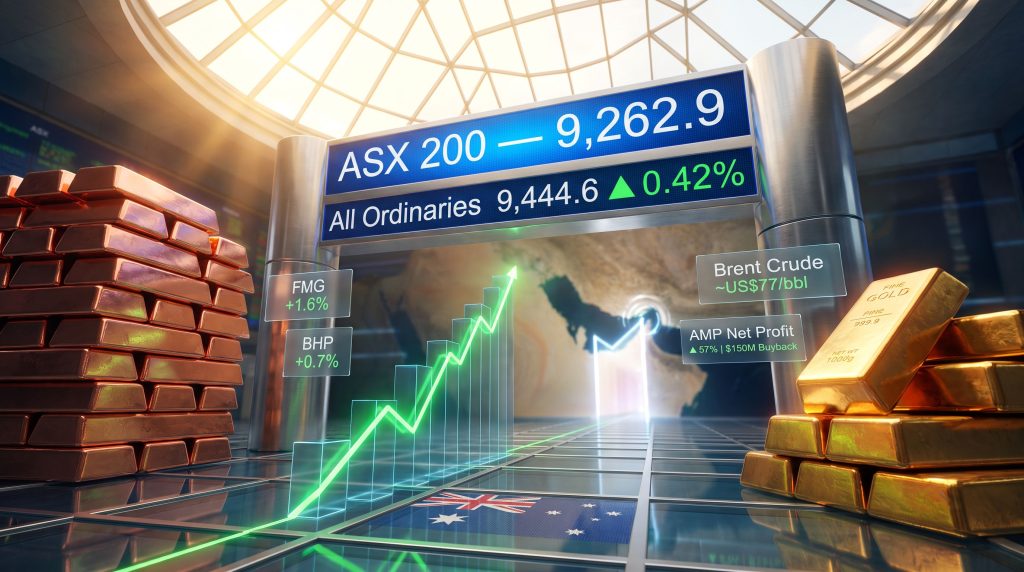
Few forces reshape equity markets as quickly as a shift in geopolitical risk perception. When the probability of a major shipping disruption recedes, the ripple effects move through commodity prices, inflation expectations, central bank outlooks, and ultimately equity valuations, all within the span of a single trading session. On Thursday, 6 August 2026, that sequence played out in real time on the Australian Securities Exchange, as the ASX 200 climbed to a record high of 9,262.9 points, powered by a convergence of forces that rarely align so cleanly.
Understanding why the ASX record high miners rally on Hormuz optimism unfolded the way it did requires more than reading the headlines. It demands an appreciation of how geopolitical chokepoints, commodity cycle dynamics, currency mechanics, and corporate earnings interact to produce a single index number.
When big ASX news breaks, our subscribers know first
The Architecture of a Record-Breaking Session
The broader All Ordinaries index advanced to 9,444.6, gaining 0.42% on the day, while the S&P/ASX Small Ordinaries added a more pronounced 0.98%, a detail worth examining carefully. When small-cap indices outperform large-caps during a rally, it typically signals genuine risk appetite rather than defensive repositioning into blue-chip names.
Retail and institutional investors were reaching further down the market-cap spectrum, a behaviour pattern associated with conviction-driven bull markets rather than cautious, headline-driven bounces. Furthermore, the ASX commodity pressure dynamics that characterised earlier in the year appeared to have meaningfully reversed during this session.
The session absorbed a mixed overnight lead from Wall Street without flinching. While the Dow Jones Industrial Average managed gains, the S&P 500 and Nasdaq both slipped as Alphabet and SpaceX faced selling pressure. US Federal Reserve Governor Lisa Cook's public remarks, in which she indicated a willingness to support further interest rate increases if inflation remains elevated, added a hawkish undertone that would typically weigh on risk assets. That the ASX not only shrugged off these headwinds but set a record high in the same session speaks to the strength of the local, commodity-driven tailwinds at play.
The Strait of Hormuz: A Chokepoint That Moves Markets Globally
The Strait of Hormuz is a maritime passage roughly 33 kilometres wide at its narrowest navigable point, connecting the Persian Gulf to the Gulf of Oman and ultimately the open ocean. Approximately 20% of global oil trade transits this corridor daily, including the majority of crude oil exports from Saudi Arabia, the UAE, Iraq, Kuwait, and Iran. Its strategic importance to global energy supply chains is almost impossible to overstate.
When shipping through the Strait faces disruption risk, the transmission mechanism into global markets is rapid and multi-layered:
- Energy prices spike as supply security fears dominate trader positioning.
- Inflation expectations rise, prompting central banks to signal tighter monetary policy.
- Global growth forecasts are revised downward as energy-intensive industries face cost shocks.
- Industrial metals demand outlooks deteriorate, hitting mining equity valuations.
- Risk appetite contracts broadly, compressing equity multiples across asset classes.
When that disruption risk eases, as optimism surrounding progress toward reopening the Strait suggested on 6 August 2026, the entire sequence reverses. The oil market volatility subsides, inflation fears moderate, growth expectations recover, and commodity-linked equities re-rate upward. For an index as heavily weighted toward materials as the ASX 200, this dynamic is particularly powerful. Consequently, understanding oil market volatility is essential for any investor with meaningful ASX exposure.
It is worth noting that Hormuz optimism does not require a formal resolution to move markets. Investor sentiment responds to probability shifts, not certainties. Even a credible signal that negotiations are progressing can be sufficient to trigger significant equity re-pricing, particularly in sectors with leveraged exposure to commodity prices.
Why Australian Miners Are Structurally Sensitive to Hormuz Dynamics
The connection between a Middle Eastern shipping lane and the share prices of companies mining iron ore in the Pilbara or copper in South Australia is not immediately obvious. The linkage operates through several transmission channels simultaneously:
| Factor | Mechanism | ASX Mining Impact |
|---|---|---|
| Oil price volatility | Fuel is a major mining operating cost | Lower volatility reduces cost uncertainty |
| Global growth sentiment | Drives industrial metals demand outlook | Copper, iron ore prices respond |
| USD strength / weakness | Commodities priced in USD | Weaker USD boosts commodity revenues |
| Central bank rate expectations | Affects equity discount rates | Lower rates expand mining valuations |
| AUD/USD exchange rate | Australian miners earn USD, report in AUD | Weaker AUD amplifies AUD-denominated revenue |
On 6 August 2026, several of these factors aligned favourably. Hormuz optimism contributed to a more constructive global growth narrative, supporting industrial metals. Meanwhile, domestic expectations that the Reserve Bank of Australia would hold rates steady reduced the discount rate applied to ASX mining valuations. The result was a powerful, simultaneous tailwind operating across multiple valuation inputs.
Copper at Record Highs: More Than a Cyclical Story
Copper's ascent to fresh all-time record price levels during Thursday's session was the single most important commodity event driving the materials sector outperformance. While short-term geopolitical sentiment contributed to the price action, the structural forces underpinning copper's bull market are far more durable. The copper supply crunch is less well understood by generalist investors and deserves closer examination.
The Supply Side Problem Most Investors Underestimate
What makes copper's supply challenge particularly acute is the concept of ore grade decline, a geological reality that affects producing mines as they age. As miners extract the highest-grade ore from a deposit first, the average copper content of ore processed over time typically decreases. This means more rock must be mined, crushed, and processed to produce the same quantity of refined copper, driving up per-unit production costs and capital intensity.
Major established copper mines globally are experiencing this grade decline simultaneously, even as demand accelerates. The construction of a new, large-scale copper mine from discovery to first production typically requires 15 to 20 years, meaning the supply response to current price signals cannot arrive quickly enough to prevent a prolonged deficit.
The Demand Side Acceleration
On the demand side, the energy transition is not a future event. It is an active, accelerating consumption driver:
- A conventional internal combustion engine vehicle contains roughly 23 kilograms of copper.
- A battery electric vehicle contains approximately 83 kilograms of copper, more than three times as much.
- Offshore wind turbines require approximately 9.5 tonnes of copper per megawatt of generating capacity.
- Grid infrastructure upgrades required to support electrification are among the most copper-intensive construction programs in history.
These figures help explain why copper's structural bull case is qualitatively different from previous commodity cycles, and why ASX-listed diversified miners with material copper exposure, including BHP and to a lesser extent Rio Tinto, attracted strong investor interest during Thursday's session.
BHP gained 0.7% on the day, supported by copper and iron ore price strength. Fortescue outperformed with a 1.6% advance, reflecting the market's broader enthusiasm for diversified miners with growth narratives. Rio Tinto edged marginally lower, however, following Glencore's confirmation of plans to pursue a secondary ASX listing, a development that introduced a degree of competitive noise into the diversified mining narrative for domestic investors.
Glencore's decision to seek an ASX secondary listing, following the collapse of merger discussions earlier in 2026, is a significant signal. It reflects growing institutional recognition of the ASX as a credible, liquid venue for allocating capital to global diversified mining companies. Over time, this could modestly dilute the scarcity premium that BHP and Rio Tinto currently enjoy as the dominant global diversified miners with primary ASX listings.
Gold's Six-Month Rally: Understanding the Driver Mix
Gold's extension of its strongest upward run in approximately six months added another layer of support to the materials sector on Thursday. Unlike previous gold cycles driven predominantly by a single catalyst such as pure safe-haven demand during a crisis, the current rally reflects a more complex and arguably more durable combination of forces.
What Is Driving Gold in This Cycle?
Central bank gold demand across emerging market economies has been accumulating at historically elevated rates as part of a deliberate strategy to reduce reliance on US dollar-denominated assets. This structural buyer base provides a demand floor that is largely insensitive to short-term price fluctuations.
Simultaneously, real interest rates, the inflation-adjusted return on cash and fixed income assets, remain historically low across many major economies despite central bank tightening cycles. When the real return on holding cash is low or negative, gold's lack of yield becomes a far less significant competitive disadvantage.
For Australian gold producers specifically, two additional factors compound the global gold price signal:
| Metric | Significance for ASX Gold Miners |
|---|---|
| Gold price at multi-month highs | Directly expands operating margins for AUD cost-base producers |
| AUD weakness against USD | Amplifies the AUD-denominated gold revenue received per ounce |
| Higher prices incentivise drilling | Junior miners accelerate exploration programs, increasing sector activity |
| M&A conditions improve | Senior producers pursue reserve acquisitions, generating premium transactions |
The next major ASX story will hit our subscribers first
Sector Performance Divergence: A Tale of Three Narratives
Thursday's session was not uniformly positive across all ASX sectors. The divergence between materials, energy, and technology tells a more nuanced story about where investor conviction was concentrated.
Energy: The Counterintuitive Underperformer
With Brent crude recovering toward US$77 per barrel on Hormuz optimism, one might expect energy stocks to have rallied alongside materials. Instead, Woodside Energy and Santos both traded lower. This apparent paradox reflects a sophisticated market judgment: Hormuz optimism that is strong enough to lift commodity sentiment broadly, but not yet sufficiently credible to trigger a full re-rating of energy equities whose earnings depend on sustained elevated oil prices.
Investors priced the geopolitical signal selectively, applying it to mining equities where the commodity price transmission is more immediate, while remaining cautious about energy names where the pathway from diplomatic progress to sustained revenue uplift is less direct.
Technology: Caught Between Two Headwinds
The ASX technology sector faced a compounding headwind on Thursday. The overnight US session saw selling pressure in major growth names, a dynamic that typically transmits directly into Australian technology equivalents given the sector's sensitivity to US growth stock sentiment. WiseTech Global and Life360 both retreated as a result.
Fed Governor Cook's hawkish commentary amplified this pressure. Rate-sensitive growth stocks are valued on discounted future cash flows, meaning higher discount rate expectations compress current valuations. This mechanism is particularly acute for high-multiple technology names where a significant portion of intrinsic value lies in earnings projected many years into the future.
Corporate Earnings: The Domestic Catalyst Layer
Beyond macro and commodity dynamics, Thursday's session featured a number of significant individual company results that shaped market direction at the stock level.
REA Group delivered an 11% increase in full-year revenue, beating market forecasts and lifting its dividend by 25%. The result demonstrated the resilience of Australia's dominant property listings platform, though management's forward guidance flagging softer listings conditions ahead tempered the share price response.
AMP Limited provided the session's most striking corporate result, reporting a 57% surge in half-year net profit that substantially exceeded consensus expectations. The announcement of a $150 million share buyback program added a second positive catalyst, signalling management's conviction that the current share price undervalues the business. AMP's result suggests domestic financial services firms are benefiting from improved interest margin dynamics and recovering investor confidence in the sector.
On the negative side, Beach Energy reported a 21% decline in full-year underlying profit, a result that reinforced sector-level caution already evident in the broader energy stock underperformance. Block Inc. demonstrated the classic sell-the-news dynamic, trading lower despite beating market expectations, as pre-result positioning unwound once the result was confirmed.
The Fed Risk Overlay: Scenarios That Could Interrupt the Rally
Fed Governor Cook's hawkish remarks represent the most significant macro risk variable hovering over the current ASX record high miners rally on Hormuz optimism. Understanding the scenario pathways is essential for investors assessing the durability of Thursday's record-setting advance.
| Fed Scenario | Commodity Price Impact | ASX Materials Equity Impact |
|---|---|---|
| One additional rate hike, then pause | Moderate USD strength; commodity consolidation | Mild valuation headwind, offset by earnings strength |
| Sustained hiking cycle resumes | Sharp USD rally; commodity prices under pressure | Material de-rating risk for high-multiple miners |
| Fed holds and signals cuts ahead | USD weakens; commodity prices re-accelerate | Strong upside for ASX materials sector broadly |
The AUD/USD exchange rate sits at the intersection of these scenarios. A resumption of aggressive Fed tightening would typically strengthen the USD, which simultaneously compresses USD-denominated commodity prices and weakens the AUD. For Australian miners, this creates a partial natural hedge, since a weaker AUD amplifies the AUD-equivalent revenue from commodity sales. However, if commodity prices fall sharply enough, the currency benefit is insufficient to offset the revenue decline.
In addition, the China iron ore outlook remains a critical variable for Australian iron ore producers, given that demand signals from Chinese steel mills have an outsized influence on the revenue assumptions underpinning ASX mining valuations.
Key Takeaways from 6 August 2026
| Data Point | Detail |
|---|---|
| ASX 200 intraday high | 9,262.9 points |
| All Ordinaries | 9,444.6 (up 0.42%) |
| S&P/ASX Small Ordinaries | 3,516.5 (up 0.98%) |
| Primary sector driver | Materials: copper and gold price strength |
| Key geopolitical catalyst | Strait of Hormuz shipping optimism |
| Top large-cap mover | Fortescue +1.6%; BHP +0.7% |
| Standout earnings result | AMP: +57% half-year profit; $150M buyback |
| REA Group revenue growth | +11% full-year revenue; dividend +25% |
| Beach Energy underlying profit | -21% full-year |
| Brent crude level | ~US$77 per barrel |
| Key macro risk | Fed hawkishness via Lisa Cook rate hike signal |
Frequently Asked Questions
What caused the ASX to hit a record high on 6 August 2026?
A convergence of geopolitical de-escalation signals around Strait of Hormuz shipping access, record copper prices, a six-month gold rally, domestic rate stability expectations, and strong individual company earnings results combined to push the ASX 200 to a fresh intraday all-time high. The miners' rally drove the ASX to levels not previously seen during Thursday's session.
Why did energy stocks fall even as Brent crude recovered?
The market appeared to price Hormuz optimism selectively. While the signal was strong enough to lift commodity-linked mining equities, investors remained cautious about energy stocks, judging that the pathway from diplomatic progress to sustained, higher oil revenues was less certain. This type of selective pricing is common when geopolitical catalysts are credible but not yet confirmed.
What does copper at record highs mean for ASX-listed miners?
Record copper prices translate directly into higher realised revenues for copper-exposed producers, improved free cash flow generation, and upward earnings revisions from analysts. These factors typically drive share price appreciation in copper-weighted mining equities. The structural demand drivers from electrification and energy transition infrastructure mean this is not simply a short-term trading dynamic.
Is the ASX record high sustainable given Fed hawkishness?
A resumption of aggressive Fed tightening represents a genuine risk to the current ASX record high miners rally on Hormuz optimism. However, if Hormuz optimism persists and copper and gold prices remain elevated, the earnings support for ASX materials names provides a fundamental anchor that can partially offset valuation multiple compression from rising discount rates. The net outcome depends on the magnitude and duration of any Fed tightening relative to commodity price resilience.
Disclaimer: The material in this article is for informational purposes only and does not constitute investment advice. Past performance is not indicative of future results. Readers should conduct independent research and consult a licensed financial adviser before making any investment decisions. Forward-looking statements and scenario analyses involve assumptions and uncertainties and should not be relied upon as predictions of future market outcomes.
Want to Catch the Next Major ASX Minerals Discovery Before the Market Does?
Discovery Alert's proprietary Discovery IQ model scans ASX announcements in real time, instantly identifying significant mineral discoveries across copper, gold, and 30+ other commodities — delivering actionable alerts to subscribers ahead of the broader market. Explore how historic discoveries have generated extraordinary returns and begin your 14-day free trial at Discovery Alert to position yourself at the forefront of the next major ASX minerals event.