August 6, 2026
The Supply-Demand Mismatch That Is Quietly Reshaping Uranium Valuations
Few commodity markets reveal their structural tensions as slowly, then as suddenly, as uranium. For most of the past decade, uranium prices languished at levels that made new mine development economically irrational. That period of suppressed investment is now colliding with a demand environment fundamentally different from anything the sector has experienced since the post-Fukushima retreat. The result is not a typical commodity price cycle. It is something more durable: a structural repricing event driven by a widening gap between what existing mines can produce and what a nuclear-energy-dependent world increasingly requires.
Understanding this dynamic is essential context for evaluating NexGen Energy stock upside, because the investment thesis for ASX:NXG does not rest solely on one company's merits. It rests on where the uranium market itself is heading over the next decade, and how well-positioned Rook I is to benefit from that trajectory. Furthermore, uranium market trends suggest that conditions are increasingly favourable for developers with world-class assets in stable jurisdictions.
When big ASX news breaks, our subscribers know first
Why the Global Uranium Deficit Is Unlike Previous Supply Crunches
Global uranium reserves and current production sit at approximately 150 million pounds per year. That figure, while substantial in absolute terms, falls materially short of where demand trajectories are pointing as nuclear energy re-enters mainstream energy policy conversations across the United States, Europe, Japan, South Korea, and parts of Southeast Asia.
What makes this deficit structurally different from historical episodes is the combination of forces now converging simultaneously. The uranium market deficit is being shaped by several powerful trends:
- Nuclear power is being repositioned as a baseload clean energy solution in decarbonisation frameworks globally
- Data centre power demand, driven by artificial intelligence infrastructure buildout, is creating electricity consumption pressures that intermittent renewables cannot resolve alone
- Utility nuclear operators are entering long-term supply contracting cycles, tightening spot market uranium availability
- Many secondary supply sources that buffered previous deficits, including Russian-origin material, are now subject to geopolitical complications
- The average development timeline for a new uranium mine runs between 10 and 15 years from discovery to production
That final point deserves emphasis. Even if the capital and political will existed today to develop ten new large-scale uranium projects simultaneously, the earliest most of those projects could realistically reach commercial production would be the mid-to-late 2030s. The market's supply response cannot be compressed simply by willing it into existence.
The uranium price threshold required to incentivise greenfield mine development is widely considered to be above US$100 per pound. Below that level, the economics of building a new uranium mine from scratch are difficult to justify for most developers, particularly given the capital intensity and timeline involved.
This creates a structural floor argument for uranium prices that underpins analyst optimism across the sector. Consequently, uranium supply-demand volatility is not merely a short-term trading consideration but a multi-year structural dynamic that investors should account for when evaluating uranium equities.
Rook I: What Separates This Asset from Every Other Uranium Project in Development
Grade Is the Irreplaceable Variable in Uranium Mine Economics
In uranium mining, ore grade is not just one variable among many. It is the primary determinant of unit economics, competitive positioning, and project viability through commodity cycles. Higher grades mean lower processing costs per pound of uranium recovered, smaller tailings volumes relative to output, and a more resilient cost structure when uranium prices soften.
Rook I's grade profile places it in a category that has no meaningful peer among development-stage uranium projects currently listed on the ASX or globally.
| Metric | Rook I (NexGen Energy) | Typical Producing Uranium Mine |
|---|---|---|
| Measured and Indicated Resource | 257 million lbs U3O8 | Varies widely |
| Average Resource Grade | 3.1% U3O8 | ~1.0% U3O8 |
| High-Grade Zone Proportion | Over 60% of M&I at ~17% U3O8 | Extremely rare at this scale |
| Projected Annual EBITDA (at production) | C$3.0 billion+ | Significantly lower |
| Location | Athabasca Basin, Saskatchewan, Canada | Global |
The high-grade zones within Rook I average approximately 17% U3O8, which is roughly 17 times the global average for currently producing uranium mines. Most ASX-listed uranium developers hold assets grading well below 1.0% U3O8. The gap between Rook I and peer assets is not marginal. It is categorical.
To understand why this matters in practical terms: at grades 17 times the industry average in its richest zones, Rook I can move more uranium out of the ground per tonne of ore processed than almost any other deposit on the planet. This translates directly into a cost structure that would place it among the lowest-cost uranium producers globally at full production.
The Athabasca Basin Geological Advantage
Rook I sits within the Athabasca Basin in Saskatchewan, Canada, which is not merely a convenient geographic label but a geological designation of profound significance. The basin hosts the highest-grade uranium deposits discovered anywhere on Earth, a product of unique hydrothermal and sedimentary processes that concentrated uranium over geological timeframes in ways that have not been replicated in other known uranium-bearing regions.
Key characteristics that reinforce the Athabasca Basin's jurisdictional and geological premium:
- The basin has hosted commercial-scale uranium production for decades, providing an established operational and regulatory framework
- Canada's mining regulatory environment, while rigorous in its environmental and indigenous consultation requirements, offers sovereign stability and established permitting pathways
- Proximity to existing mining services infrastructure reduces execution risk relative to frontier jurisdictions
- The basin's track record of hosting high-grade deposits reduces geological uncertainty compared to less-proven uranium regions
Saskatchewan's uranium mining history also means that the workforce, supply chains, and institutional knowledge required to construct and operate a large-scale uranium mine already exist in the region, a practical advantage that is often underappreciated in desktop asset comparisons.
NexGen Energy Stock Upside: Mapping the Valuation Scenarios
The Analyst Target Spectrum and What It Implies
Analyst price targets for NexGen Energy (ASX: NXG / TSX: NXE) reflect both the extraordinary quality of the underlying asset and the inherent uncertainty that attaches to any pre-production mining development. The range is wide, but its directionality is consistent. For additional context, analyst consensus estimates reflect broad institutional conviction in the company's long-term value proposition.
| Source | Price Target | Implied Upside (from ~A$14.12 / C$13.92) |
|---|---|---|
| Shaw and Partners (AUD-denominated) | A$24.80 | ~75% |
| Analyst Consensus Estimate Set 1 | C$19.75 | ~42-44% |
| Analyst Consensus Estimate Set 2 | C$21.18 | ~52% |
| Consensus Low Target | C$15.00 | ~8% |
| Consensus High Target | C$30.00 | ~115% |
The A$24.80 target from Shaw and Partners represents approximately 75% upside from mid-2026 trading levels near A$14.12. NexGen's market capitalisation at that price sits at approximately A$9.32 billion, which itself implies a meaningful development-stage discount relative to the projected economics of a fully operational Rook I.
Three Scenarios for NexGen's Share Price Trajectory
Scenario 1: Bull Case
- Uranium spot price moves sustainably above US$100/lb, triggering a broad re-rating of development-stage uranium assets
- Construction progresses on schedule with no material cost overruns on the C$2.2 billion pre-production capital estimate
- Exploration at Patterson Corridor East (PCE) confirms a second major discovery comparable in scale to the existing Arrow deposit
- Share price converges toward the C$25-C$30 range over an 18 to 24-month horizon
Scenario 2: Base Case
- Uranium price stabilises in the US$80-US$100/lb range, maintaining sector interest without triggering a full re-rating
- Construction milestones are met with minor delays consistent with large-scale resource project norms
- NexGen's C$970 million cash and short-term investment position funds early-stage capital expenditure without triggering dilutive equity issuance
- Share price tracks toward the C$19-C$22 consensus range over a 12-month period
Scenario 3: Bear Case
- Uranium price retreats below US$70/lb, compressing sector-wide valuations and reducing Rook I's projected economics
- Construction delays or cost escalation erode market confidence in the project's execution timeline
- Equity dilution required to bridge the gap between cash on hand and total project cost pressures the share price
- NXG consolidates near current levels or pulls back toward the C$10-C$12 range
Catalysts That Could Unlock NexGen Energy's Upside in 2026 and Beyond
Construction Commencement as an Institutional Re-Rating Trigger
Physical construction at Rook I commenced on June 6, 2026, marking the transition from development-stage asset to active construction project. This milestone carries particular significance in mining investment because it signals that the two most binary risks, regulatory approval and financing sufficiency, have been resolved to a degree sufficient to begin spending capital on site.
For institutional investors who apply development-stage discounts to pre-approval projects, this transition typically compresses the discount rate applied to projected cash flows, which mechanically increases net asset value estimates even before a single pound of uranium is processed.
A formal project commencement ceremony was also scheduled following construction start, providing an additional media and investor visibility catalyst. Construction progress updates will serve as recurring positive catalysts throughout the development timeline, with each milestone reducing residual execution uncertainty.
The Patterson Corridor East Exploration Wildcard
Potentially the most transformational upside scenario for NexGen Energy stock beyond current analyst targets involves the company's exploration programme at the Patterson Corridor East (PCE) target within the broader Rook I project area.
In April 2026, NexGen announced an expansion of the high-grade zone at PCE. An inaugural drill programme at the adjacent SW3 property then commenced on July 6, 2026. The significance of this exploration activity cannot be overstated: if PCE ultimately confirms resource scale and grade comparable to the existing Arrow deposit, which underpins the bulk of the current 257 million pound resource, it would represent a resource upgrade of transformational magnitude.
Discoveries of this scale are extraordinarily rare in uranium exploration. Most uranium juniors search for years without intersecting grades remotely comparable to Arrow. The possibility that NexGen may be sitting on a second Arrow-calibre deposit within the same project boundary is the kind of geological optionality that markets have historically repriced dramatically when confirmed.
It is important to note that PCE remains an exploration target at this stage. Investors should treat exploration upside as genuinely speculative until drill results confirm resource-grade mineralisation at scale.
Uranium Price as the Macro Catalyst for the Entire Sector
A sustained move in uranium spot prices above US$100/lb would not merely improve Rook I's projected financial returns. It would also compress the discount rate applied to NexGen's net asset value in analyst models, because higher uranium prices reduce the probability of downside scenarios and shorten the effective payback period for the project's capital investment.
The uranium market dynamics supporting a higher uranium price environment include:
- Nuclear power's growing role in data centre and AI infrastructure power supply strategies
- Utility nuclear operators entering long-term supply contracting cycles that reduce spot availability
- Geopolitical realignments affecting Russian-origin uranium supply chains
- Government commitments to triple nuclear capacity by 2050 in numerous OECD nations
Financial Position: Understanding the Funding Gap
NexGen holds approximately C$970 million in cash and short-term investments. The total pre-production capital estimate for Rook I stands at approximately C$2.2 billion, meaning the company has already secured funding equivalent to roughly 44% of its total development capital requirement from existing resources.
| Financial Metric | Figure |
|---|---|
| Cash and Short-Term Investments | C$970 million |
| Total Pre-Production Capex Estimate | C$2.2 billion |
| Funding Covered by Existing Cash | ~44% |
| Remaining Funding Required | ~C$1.23 billion |
| Projected Annual EBITDA at Full Production | C$3.0 billion+ |
The remaining balance is expected to be sourced through project finance facilities and potential equity issuance. For high-quality uranium assets in stable jurisdictions, project finance has historically been accessible from export credit agencies, commercial banks, and streaming or royalty counterparties. Rook I's projected EBITDA of C$3.0 billion per annum provides substantial debt serviceability coverage, which strengthens the project finance case considerably.
The risk of equity dilution remains a legitimate consideration for existing shareholders. However, the scale of the asset's economics relative to the funding gap suggests that significant dilution would not be required if project finance is secured on terms consistent with assets of this quality.
The next major ASX story will hit our subscribers first
Key Risks Every Investor Must Weigh
Risk Matrix: Pre-Production Uranium Developer
| Risk Category | Specific Risk | Severity | Mitigation Factor |
|---|---|---|---|
| Commodity Price | Uranium spot price decline | High | Long-term utility contracting potential |
| Execution | Construction cost overruns | Medium-High | Experienced management and established basin |
| Financing | Equity dilution to bridge capex gap | Medium | Strong cash position plus project finance pathway |
| Regulatory | Permitting changes or delays | Low-Medium | Federal construction approval already secured |
| Exploration | PCE fails to confirm resource scale | Medium | Multiple additional exploration targets exist |
| Valuation | Shares pricing in too much good news | Medium | Wide analyst target range provides reference context |
The Overextension Question
At a market capitalisation of approximately A$9.32 billion, NexGen is already pricing in a significant portion of Rook I's development optionality. Investors entering at current levels should weigh the binary nature of pre-production mining valuations carefully. The construction approval catalyst has already been partially absorbed by the share price, meaning that future re-ratings will need to be driven by genuine operational progress, commodity price moves, or exploration discoveries rather than regulatory milestone announcements.
Position sizing relative to risk tolerance is a critical consideration for investors attracted to the NexGen Energy stock upside thesis.
How NexGen Compares Within the ASX Uranium Developer Landscape
NexGen is among the largest uranium-focused companies by market capitalisation listed on the ASX. Its grade profile, jurisdictional quality, and construction-stage advancement place it in a fundamentally different category from earlier-stage ASX uranium developers whose projects typically carry grades well below 1.0% U3O8.
Broader ASX uranium broker coverage has shifted decisively bullish, with at least one research house setting price targets implying 83% to 295% upside for select ASX uranium names over 12 months. NexGen sits at the more conservative end of this spectrum in implied upside terms, but arguably represents the most credible and de-risked pathway. Furthermore, NexGen's price forecast on MarketBeat further supports this institutional conviction, given its advanced development status, world-class grade profile, and confirmed construction commencement.
For investors seeking uranium sector exposure on the ASX, the choice between NexGen and smaller-cap uranium peers involves a classic risk-return tradeoff: NexGen offers lower percentage upside but substantially lower execution risk, while earlier-stage developers offer wider upside scenarios with commensurately higher binary risk.
Frequently Asked Questions: NexGen Energy Stock
What is NexGen Energy's current analyst price target?
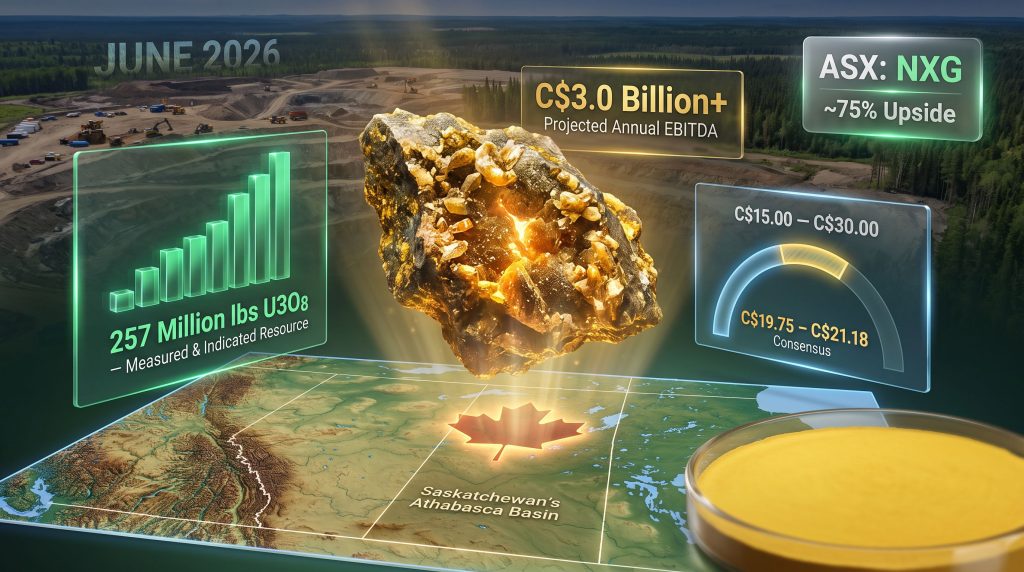
Analyst price targets for ASX:NXG range from approximately C$15.00 on the conservative end to C$30.00 at the most optimistic. Consensus averages cluster between C$19.75 and C$21.18 in Canadian dollar terms. In Australian dollars, Shaw and Partners has set a target of A$24.80, implying approximately 75% upside from mid-2026 levels.
What is the Rook I uranium project and why does it matter?
Rook I is NexGen's flagship development in the Athabasca Basin, Saskatchewan. It holds a Measured and Indicated Resource of 257 million pounds of U3O8 at an average grade of 3.1%, with the highest-grade zones reaching approximately 17% U3O8. At full production, it is projected to generate annual EBITDA exceeding C$3.0 billion.
Has NexGen received construction approval for Rook I?
Yes. NexGen received federal approval to begin on-site construction, with physical work commencing in June 2026. This removed a significant regulatory overhang and is considered a major de-risking milestone by analysts.
What are the main risks to NexGen Energy's upside case?
Key risks include uranium price volatility, construction execution risk, potential equity dilution to fund the remaining capex gap, and the possibility that shares have already partially priced in near-term positive catalysts. The wide analyst target range (C$15 to C$30) reflects genuine uncertainty about timing and magnitude.
What exploration catalysts could drive additional upside?
The Patterson Corridor East (PCE) target is the primary exploration wildcard. A high-grade zone expansion was announced in April 2026, and an inaugural drill programme at the SW3 property commenced in July 2026. Confirmation of a second major Arrow-scale discovery would represent a transformational upside catalyst beyond current analyst targets.
Is the 75% NexGen Energy Stock Upside Case Credible?
The investment thesis for NexGen Energy (ASX:NXG) rests on three converging forces that are difficult to replicate elsewhere in the uranium development sector: an asset of genuinely exceptional geological quality, a uranium market characterised by a structural supply deficit that cannot be resolved quickly, and a construction timeline that is now actively compressing the development discount applied to the company's projected cash flows.
The 75% upside target from Shaw and Partners sits at the upper end of a wide but consistently positive analyst consensus. The base case scenario, anchored by consensus targets of C$19.75 to C$21.18, implies 42% to 52% upside even without a uranium price breakout above US$100/lb.
What differentiates NexGen from the typical development-stage mining investment is the scale of the projected economics relative to the residual risk. An asset projected to generate C$3.0 billion in annual EBITDA at full production, in a politically stable jurisdiction, with construction now underway, is not speculative in the conventional sense. The speculative element lies in the execution timeline, the uranium price path, and the financing structure, not in the asset's fundamental quality.
This article contains general financial information only and does not constitute personal financial advice. Investments in mining and resource companies involve material risks, including commodity price volatility, execution risk, and potential capital loss. Past performance is not indicative of future returns. Readers should seek independent financial advice tailored to their personal circumstances before making investment decisions. Analyst price targets referenced in this article represent third-party views and are not guaranteed outcomes.
For broader analysis of ASX uranium developers and sector dynamics, Motley Fool Australia at fool.com.au publishes regular broker research summaries and energy sector commentary relevant to uranium equity investors.
Want to Catch the Next Major Uranium Discovery Before the Market Does?
Discovery Alert's proprietary Discovery IQ model scans ASX announcements in real time, delivering instant alerts on significant mineral discoveries — including uranium — so subscribers can identify actionable opportunities ahead of the broader market. Explore Discovery Alert's dedicated discoveries page to understand how historic ASX discoveries have generated substantial returns, and begin your 14-day free trial today to position yourself at the forefront of the next major find.