August 6, 2026
When Portfolio Surgery Becomes a Catalyst: Reading South32's Aluminium Exit
Large-scale portfolio restructuring in the mining sector rarely happens in isolation. When a major diversified miner elects to shed an entire commodity vertical, it typically signals something deeper than simple capital recycling. It reflects a fundamental thesis about where value will be created over the next decade, which commodities will attract premium institutional multiples, and which assets are consuming capital without delivering proportionate strategic optionality. South32 shares rise after aluminium sale to Alcoa is, on its surface, a price movement story. But beneath that surface sits a more consequential narrative about how ASX resource companies are repositioning themselves for an electrification-driven commodity supercycle.
Understanding why the market responded so decisively to South32's announcement requires looking at the structural logic of the deal itself, the commodities the company is pivoting toward, and the specific project milestones that will determine whether the thesis ultimately delivers.
When big ASX news breaks, our subscribers know first
Anatomy of the Alcoa Transaction: What South32 Is Actually Exchanging
The transaction between South32 (ASX: S32) and Alcoa Corporation represents one of the more architecturally complex deals to cross the ASX resources sector in recent years. Rather than a straightforward cash acquisition, the consideration is layered across multiple components that carry different risk profiles for South32 shareholders. This Alcoa strategic partnership demonstrates the increasing complexity of modern mining sector consolidation.
| Deal Component | Value |
|---|---|
| Upfront cash consideration | US$3.1 billion |
| Alcoa equity (stock component) | ~US$1.0 billion |
| Assumed rehabilitation liabilities | ~US$1.2 billion |
| Aluminium price-linked contingent payments | Variable |
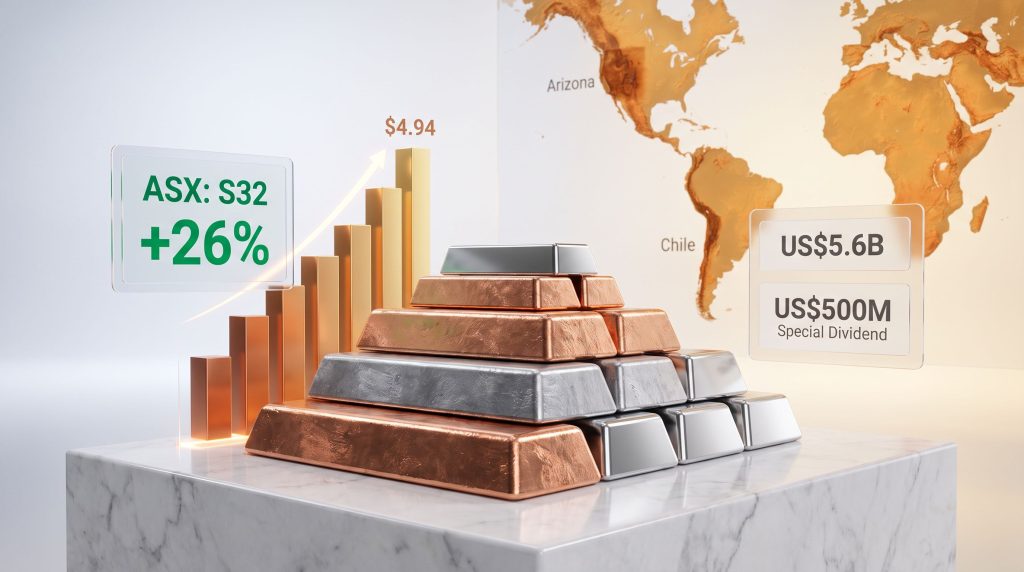
| Implied enterprise value (total) | Up to US$5.6 billion |
Several elements of this structure deserve closer examination:
- The rehabilitation liability assumption of approximately US$1.2 billion is a frequently overlooked component. Aluminium smelting operations carry significant long-term environmental remediation obligations, and Alcoa absorbing these liabilities meaningfully simplifies South32's future balance sheet obligations.
- The equity component means South32 will hold a stake in Alcoa post-transaction, creating a residual link to aluminium pricing that moderates the completeness of the exit.
- The contingent payments tied to future aluminium prices introduce a scenario where total proceeds could exceed the headline figure if the commodity performs strongly over the agreement's reference period.
- The Mozal smelter in Mozambique is explicitly excluded from the transaction scope, meaning South32 retains one aluminium asset while divesting the broader value chain.
The transaction requires South32 shareholder approval and is targeted for completion in the second half of FY27. Until then, the deal remains subject to execution risk that investors should factor into any valuation assessment.
Why Alcoa Wanted This Asset Package
From Alcoa's perspective, the acquisition delivers upstream integration across bauxite mining and alumina refining that complements its existing smelting capacity. The global aluminium industry is entering a structural phase where vertically integrated producers hold meaningful cost advantages over those dependent on spot alumina or third-party bauxite supply. As aluminium demand accelerates through electric vehicle manufacturing, grid infrastructure, and lightweight construction applications, controlling the full production chain from ore to metal becomes strategically valuable. Alcoa's willingness to absorb rehabilitation liabilities suggests a high degree of conviction in the long-term earnings potential of these assets.
South32 Shares Rise: Unpacking the Price Momentum
The immediate market reaction to the announcement was unambiguous. South32 shares rise after aluminium sale to Alcoa was evident in the stock surging significantly on the day of the announcement, and the momentum extended across the following weeks rather than fading as a typical event-driven spike might.
Key price metrics as of early August 2026:
- Four-year high reached: $4.94
- Three-week gain: approximately 26%
- Month of August gain: approximately 8%
- Year-to-date performance: +39%
- Trailing 12-month performance: +66%
- 2026 trading range: $3.55 (January low) to $4.94 (August high)
The sustained nature of the rally is more analytically significant than its magnitude. Single-day spikes on deal announcements are common and often partially reversed. A multi-week continuation suggests the market is not merely reacting to the announcement but is actively recalibrating its view of what South32's long-term earnings profile looks like under the new portfolio configuration.
The FY26 operating results, released ahead of the Alcoa announcement, added further positive momentum. South32 exceeded several production guidance targets across key operations during the period, providing an operational foundation that complemented the strategic news flow. The compounding effect of both catalysts arriving within a short window accelerated the price discovery process.
The Post-Sale Portfolio: A Base Metals Pure-Play in Construction
The most consequential aspect of this transaction is not the cash it generates but the portfolio it leaves behind. South32's pro-forma earnings composition after the Alcoa deal closes represents a genuinely transformed business.
| Portfolio Metric | Pre-Sale | Post-Sale (Pro-Forma) |
|---|---|---|
| Base and precious metals share of earnings | ~50-55% (estimated) | ~85% |
| Aluminium value chain exposure | Material | Minimal (Mozal only) |
| Primary growth commodities | Diversified | Copper, zinc, silver, manganese |
| Approved project production growth target | Modest | ~55% |
This concentration shift matters for several interconnected reasons:
- Valuation multiple expansion potential: Mining companies with cleaner commodity exposure profiles typically trade at higher earnings multiples than diversified producers. Removing the aluminium complex, which carries different demand drivers and margin characteristics to base metals, could attract investors who previously avoided S32 due to its commodity mix complexity.
- Index weighting and fund flow implications: A simplified portfolio concentrated in electrification-linked metals may qualify S32 for inclusion in thematic ETFs and ESG-adjacent funds that weight toward battery and transition metals. This creates incremental institutional demand that did not previously exist.
- Capital allocation clarity: Management can now focus investment decisions on a narrower set of commodities where the company has demonstrated operational expertise and project pipeline depth.
Sierra Gorda and Hermosa: The Engines of Future Growth
Two projects sit at the centre of South32's growth thesis following the divestment:
Sierra Gorda (Chile) is a copper operation where South32 has been expanding production capacity. Furthermore, the ongoing copper supply crunch in global markets underpins the long-term demand case for this asset. South32 holds a 45% interest in the Sierra Gorda joint venture, with the operation capable of producing copper, molybdenum, and gold as co-products. The polymetallic nature of the deposit provides some natural revenue diversification within the copper exposure.
Hermosa Project (Arizona, USA) is currently under active construction and represents perhaps the most strategically distinctive asset in South32's portfolio. The project targets zinc, manganese, and silver production from two deposits: the Taylor zinc-silver deposit and the Clark manganese deposit. Battery-grade manganese is a component of certain lithium-ion battery chemistries, and the battery raw materials market is increasingly driving domestic US supply considerations as automakers seek to reduce dependence on imported critical minerals.
Hermosa's manganese credentials deserve particular attention from technically oriented investors. The Clark deposit targets manganese sulphate monohydrate, a processed form suitable for battery precursor manufacturing. If the project successfully produces battery-grade material at commercial scale, it positions South32 at a point in the critical minerals value chain that most ASX mining companies have not yet reached.
Broker Positioning and the Valuation Compression Challenge
Following the three-week rally, the relationship between South32's trading price and analyst price targets has compressed significantly, creating a more nuanced picture for investors considering entry at current levels.
| Broker | Rating | 12-Month Price Target |
|---|---|---|
| Morgans | Accumulate | $4.70 |
| Morgan Stanley | Buy | $4.75 |
| Market Index consensus | Majority Buy | ~$4.94 |
| TradingView consensus average | Mixed | ~$4.84 |
| Most bullish analyst target | Buy/Strong Buy | $5.95 |
Of 14 analysts tracked on TradingView, 8 maintain buy or strong buy ratings, 5 are on hold, and sell coverage is minimal. The average consensus target of approximately $4.84 implies a slight downside from the $4.94 trading price, while the most optimistic target of $5.95 suggests approximately 21% upside for those prepared to hold through the deal completion timeline.
The distinction between Morgans' accumulate rating and Morgan Stanley's outright buy is worth examining:
- An accumulate rating in Australian broker conventions typically signals that the analyst considers the stock reasonably valued at current prices but expects gradual appreciation over the target horizon. It implies building a position progressively rather than deploying capital in a single transaction.
- A buy rating with a target below the current price may reflect a valuation model anchored to near-term earnings rather than the full strategic value of the deal, or it may incorporate a risk-adjusted discount for deal execution uncertainty.
Risk Framework: Where the South32 Thesis Can Break Down
Bull Case Conditions
- Alcoa deal completes on schedule in H2 FY27, unlocking the US$500 million special dividend
- Copper prices remain elevated through the Hermosa construction phase, validating Sierra Gorda's earnings contribution
- Portfolio simplification triggers a re-rating from institutional investors previously underweight on S32 due to commodity mix concerns
- Battery-grade manganese demand accelerates as North American EV manufacturers seek domestic supply chain security
Bear Case Conditions
- Shareholder approval or regulatory clearance introduces delays to the Alcoa transaction timeline
- A weaker aluminium price environment reduces the contingent payment component of deal proceeds
- Copper price volatility compresses Sierra Gorda margins during a period when management attention is divided between deal execution and project construction
- Hermosa construction encounters cost escalation or timeline slippage, a risk that is particularly relevant for greenfield projects in the current inflationary environment for mining capital expenditure
Investor caution point: Purchasing S32 at current levels is effectively a simultaneous bet on deal completion, copper price stability, and project execution success. Any single variable moving adversely could justify a price correction from levels where considerable good news is already priced in.
The next major ASX story will hit our subscribers first
How South32's Strategic Logic Compares to ASX Peers
| Company | Strategic Direction | Primary Commodity Exposure | Recent Capital Action |
|---|---|---|---|
| South32 (S32) | Exiting aluminium; concentrating base metals | Copper, zinc, silver, manganese | US$5.6B asset sale; $500M special dividend |
| BHP Group (BHP) | Copper-led growth; potash expansion | Copper, iron ore, potash | Ongoing Jansen potash development |
| Rio Tinto (RIO) | Lithium entry; aluminium retention | Iron ore, aluminium, lithium | Arcadium Lithium acquisition |
The contrast between South32 and Rio Tinto is particularly instructive. Both companies have maintained significant aluminium exposure historically, but they are now moving in opposite strategic directions. Rio Tinto has retained and expanded its aluminium operations while pursuing lithium through its Arcadium acquisition, betting on a diversified transition metals portfolio. South32, however, is making a more concentrated wager, exiting aluminium almost entirely to deepen its base metals conviction.
Neither approach is inherently superior. The outcome will be determined largely by relative commodity price trajectories over the next five to seven years and by each company's ability to execute its capital projects on schedule and within budget. What South32's decision does confirm is that management has made a deliberate assessment that the risk-adjusted returns from copper, zinc, and manganese are more compelling than continuing to allocate capital to aluminium value chain maintenance and expansion. Indeed, broader critical minerals demand trends support this strategic pivot toward electrification-linked metals.
Frequently Asked Questions: South32 and the Alcoa Deal
What is South32 selling to Alcoa?
South32 is divesting its integrated aluminium value chain, which encompasses bauxite mining, alumina refining, and primary aluminium smelting assets. The Mozal smelter in Mozambique is excluded from the transaction. The implied enterprise value reaches up to US$5.6 billion across cash, equity, assumed rehabilitation liabilities, and contingent payments.
When is the deal expected to close?
Completion is targeted for the second half of FY27, contingent on South32 shareholder approval and relevant regulatory clearances. Until those conditions are satisfied, the transaction timeline carries execution uncertainty.
What special dividend has South32 announced?
South32 has indicated plans to return approximately US$500 million to shareholders through a special dividend following successful completion of the Alcoa transaction.
What commodities will drive South32's earnings after the sale?
Post-transaction, approximately 85% of South32's pro-forma earnings are expected to come from base and precious metals, with copper production at Sierra Gorda and zinc, silver, and manganese production at the Hermosa project in Arizona serving as the primary growth drivers. The company is targeting approximately 55% production growth from its approved project pipeline. Investors exploring copper investment strategies will find South32's repositioning particularly relevant to their thesis.
What is the current broker consensus on South32 shares?
As of early August 2026, the majority of analysts maintain buy or accumulate ratings. Price targets range from $4.70 at Morgans to a bullish outlier of $5.95, with consensus averages clustered near the current trading price of $4.94. The compressed gap between targets and current price suggests analysts view the stock as fairly valued near term, with upside contingent on deal and project milestones being met. For additional context, Market Index's analysis offers a comprehensive overview of the post-deal valuation debate.
Key Considerations for ASX Resource Investors
South32's transformation through the Alcoa divestment offers several lessons that extend beyond a single stock analysis:
- Portfolio engineering as a valuation lever: The market's reaction to South32's announcement reinforces that how a mining company's earnings are composed can be as important as the absolute level of those earnings. Investors frequently pay premium multiples for commodity purity and strategic clarity.
- The rehabilitation liability factor: When assessing resource M&A, the assumption of rehabilitation obligations by an acquirer materially affects the real economics of the transaction. South32 transferring approximately US$1.2 billion in future remediation liabilities is a form of value extraction that headline enterprise value figures can obscure.
- Special dividends as deal catalysts: The US$500 million capital return announcement is functioning as a commitment device, signalling management confidence in deal completion and providing income-seeking investors with a concrete near-term catalyst to anchor their investment thesis.
- Execution risk compounds at the margin: With consensus targets clustered near or slightly below the current price, the asymmetry of risk has shifted. Investors entering now are exposed to meaningful downside if either the Alcoa transaction or the Hermosa project timeline disappoints, while the upside from consensus targets is limited.
This article contains general information only and does not constitute financial advice. Past performance is not indicative of future returns. Investors should consider their own circumstances and seek independent professional advice before making investment decisions. Share prices and analyst targets referenced reflect publicly available data as of early August 2026 and are subject to change.
Want to Catch the Next Major ASX Mineral Discovery Before the Market Does?
Discovery Alert's proprietary Discovery IQ model delivers real-time alerts on significant ASX mineral discoveries, instantly translating complex mineral data into actionable insights for both short-term traders and long-term investors — explore historic discoveries and their extraordinary returns to understand the scale of opportunity, then begin your 14-day free trial to position yourself ahead of the broader market.