August 25, 2026
The Policy Architecture Behind Greenfields Discovery: Understanding WA's Co-Funded Drilling Framework
Mineral exploration is, at its core, a probabilistic enterprise. Before a single metre of drill core is recovered, explorers must commit capital to test geological hypotheses that may never yield economic results. This asymmetry between cost certainty and outcome uncertainty creates a structural market failure: the private sector systematically underinvests in genuinely novel, first-pass exploration, preferring instead to cluster activity around known mineralisation where the risk-return calculus is more predictable. It is precisely this dynamic that the WA Exploration Incentive Scheme co-funded drilling program was designed to disrupt.
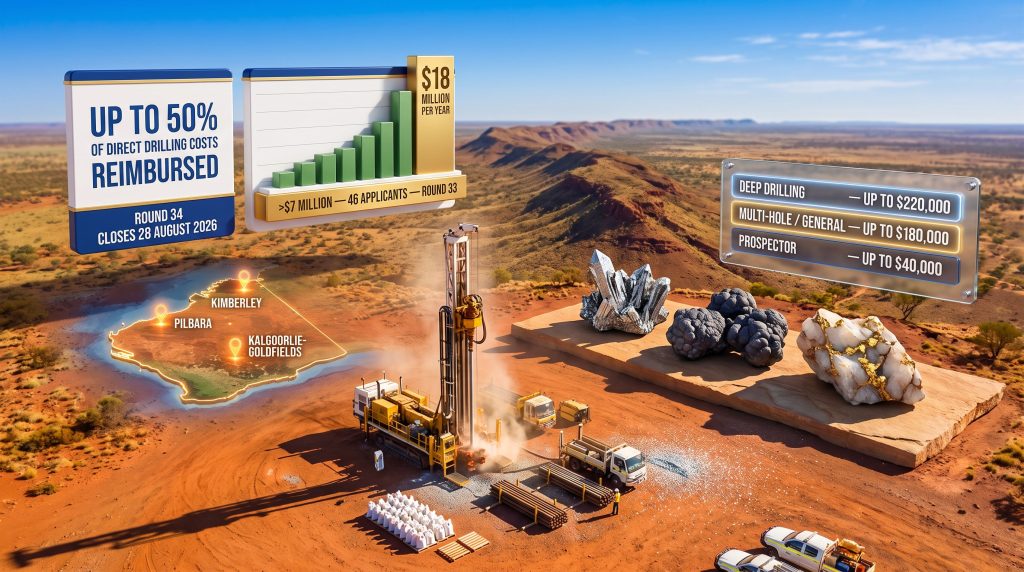
By redistributing financial risk between the state and private operators, the program creates a discovery pipeline that would otherwise remain largely untested. Round 34 is now open, with applications closing 28 August 2026, making it a critical window for explorers positioned on underexplored ground across Western Australia. Furthermore, understanding the importance of mineral exploration at a national level helps contextualise why state-level programs like this one carry such strategic weight.
When big ASX news breaks, our subscribers know first
What Is the WA Exploration Incentive Scheme Co-Funded Drilling Program?
Defining the Policy Instrument and How the Cost-Sharing Model Works
The WA Exploration Incentive Scheme (EIS) Co-funded Exploration Drilling Program is a Western Australian Government grant mechanism that reimburses eligible applicants up to 50% of direct drilling costs for innovative, first-pass exploration across the state's underexplored geological terranes.
The distinction between what qualifies and what does not is fundamental to understanding the program's design intent. Eligible activities are strictly limited to greenfields-style exploration drilling. The following activities are explicitly excluded:
- Resource definition drilling
- Appraisal and stimulation drilling
- Development drilling
- Uranium mine development
This exclusion architecture matters because it ensures public funds are directed toward geological risk-taking rather than commercial confirmation. The state is not subsidising certainty; it is subsidising curiosity.
From a policy design perspective, the cost-sharing model functions as a risk redistribution mechanism. WA's geology is among the most minerally endowed on Earth, spanning Archean cratons, Proterozoic fold belts, and sedimentary basins that collectively host gold, iron ore, lithium, nickel, rare earths, manganese, and a growing suite of critical minerals. Yet vast portions of this geology remain effectively untested at depth or under cover. The EIS co-funded drilling program uses public investment to unlock this latent geological potential by lowering the financial threshold that separates a viable drilling program from one that never proceeds.
How Does the Co-Funded Drilling Program Compare to Other Funding Instruments?
The broader EIS suite includes multiple components beyond co-funded drilling, including geoscience data acquisition programs, airborne surveys, and geological mapping initiatives. The drilling-specific co-funding component is treated separately because drilling carries the highest per-program cost and produces the most direct discovery evidence. In addition, exploration drilling programs of this nature represent some of the most capital-intensive decisions an explorer will make.
| Program Feature | EIS Co-Funded Drilling | Typical Commercial Financing |
|---|---|---|
| Government cost contribution | Up to 50% of direct drilling costs | None |
| Financial risk for explorer | Shared with the state | Fully borne by the operator |
| Target exploration stage | First-pass / greenfields only | Variable |
| Uranium mine development | Explicitly excluded | Potentially eligible |
| Application cadence | Twice annually | Continuous / deal-by-deal |
The program's position within WA's broader resources development pipeline is that of a discovery catalyst rather than a project developer. Its outputs feed the earliest stages of the resource project lifecycle, creating optionality that eventually translates into royalties, employment, and infrastructure investment decades later.
Who Can Apply and What Funding Tiers Apply?
Eligibility Framework: Core Requirements
The program maintains a deliberately accessible eligibility framework to ensure junior explorers and prospectors are not structurally excluded by administrative complexity. Mandatory requirements include:
- An active Australian Business Number (ABN)
- Tenement holder status or documented access to a qualifying tenement
- Drilling activity must be classified as genuine exploration, not resource definition
- The project must target underexplored or geologically novel ground
The requirement that ground be genuinely underexplored is arguably the most nuanced criterion. Assessment officers evaluate drill hole density in the surrounding area, prior exploration history, and the geological novelty of the target model being tested. This criterion actively discourages what practitioners sometimes call the follow-the-herd dynamic, where explorers crowd around already-tested trends rather than genuinely testing new geological ideas.
What Funding Caps Apply Across Different Applicant Categories?
Important: The EIS Co-funded Drilling Program uses a tiered funding structure, with different grant ceilings applying based on drilling type and applicant category.
| Application Category | Maximum Funding Available |
|---|---|
| Multi-hole / General Applications | Up to $180,000 |
| Deep Drilling Projects | Up to $220,000 |
| Prospector Applications | Up to $40,000 |
The higher ceiling for deep drilling reflects a geologically informed design choice. Drilling below approximately 500 metres requires significantly more expensive equipment, longer mobilisation times, and greater consumable costs per metre. Deep targets in WA's goldfields and base metal provinces are often systematically underexplored precisely because the cost escalation at depth deters private capital. The $220,000 ceiling for deep drilling attempts to partially bridge this funding gap.
The prospector tier serves a different function: it democratises access. Individual operators and small-scale explorers who lack the balance sheet of an ASX-listed junior can still access co-funded drilling to test tenement-scale targets, ensuring that discovery potential is not exclusively the domain of well-capitalised companies. This is particularly relevant given the broader landscape of junior explorers funding across Australia, where access to capital remains a persistent structural challenge.
Round 34 Application Window: Critical Dates and Timing Considerations
When Does Round 34 Open and Close?
- Applications opened: Monday, 3 August 2026 (consistent with the program's standard first-Monday-of-August opening)
- Applications close: 28 August 2026
- Total application window: 26 days
Time-Sensitive Notice: Round 34 of the WA Exploration Incentive Scheme co-funded drilling program closes on 28 August 2026. Applicants must ensure tenement documentation, ABN verification, cost schedules, and geological justification materials are fully prepared before the window closes. Late submissions are not accepted.
The program runs on a biannual cadence, opening on the first Monday of February and the first Monday of August each year. This structure is not arbitrary. It aligns with WA's seasonal drilling calendar, with the August round corresponding to the lead-in to the summer drilling season across the southern goldfields and the onset of the dry season across the Pilbara and Kimberley.
The February round, by contrast, targets the post-summer planning cycle when explorers are designing programs for the cooler months. The 26-day application window functions as a design feature rather than a constraint. A compressed window creates a forcing function that requires applicants to have their geological targets, tenement positions, and cost structures clearly defined before applying, which arguably improves application quality and reduces speculative submissions.
For explorers running multi-year programs, the biannual cadence creates strategic optionality: first-pass results from one round can inform target refinement for the next application cycle, enabling a compounding approach to greenfields discovery without requiring a single large capital commitment.
EIS-Funded Discoveries: Evidence From Recent Rounds
What the Track Record Reveals About Program Performance
The most compelling argument for any exploration incentive program is not its budget size or application volume; it is the quality of discoveries it enables. Recent rounds of the WA Exploration Incentive Scheme co-funded drilling program have produced outcomes across a notably diverse commodity spectrum.
Antimony and polymetallic mineralisation in the Pilbara: Black Cat Syndicate's drilling at its Mt Clement Antimony Project intersected antimony, lead, and silver mineralisation in ground that had not previously been tested by drilling. This was a textbook greenfields result on a target that had been identified through surface geochemistry and structural geology interpretation but had never been drill-tested due to capital constraints. The EIS co-funding removed that constraint.
High-grade manganese at the North Manganese Corridor: Black Canyon Resources used shallow reverse circulation (RC) drilling at its Wandanya Project to unlock a fresh manganese and iron discovery. RC drilling at relatively shallow depths (typically less than 200 metres) is often the most cost-effective way to test laterite-hosted or near-surface sedimentary manganese targets, and the EIS co-funding structure is particularly well-suited to these program types.
Gold lode extension near Kalgoorlie: Ora Banda Mining's drilling at the Little Gem prospect within the Davyhurst Gold Project, supported through Round 29 funding, identified new lode systems that subsequently enabled follow-up work leading to the Sapphire Trend discovery. This sequence illustrates a critical but underappreciated dynamic in greenfields exploration: EIS-funded first-pass drilling rarely produces a mine on its own. Its value lies in de-risking the geological hypothesis sufficiently to attract follow-on private capital for more intensive programs. Consequently, interpreting drill results accurately is an essential skill for any investor or operator seeking to assess the commercial significance of these outcomes.
Policy Insight: These outcomes illustrate a fundamental design principle. The EIS does not fund certainty; it funds geological hypotheses that the private sector would not test without shared risk. The program's return on public investment is best measured not by the drilling results themselves, but by the discovery pipelines those results enable.
Commodity Diversification as a Program Strength
One underappreciated feature of the WA Exploration Incentive Scheme co-funded drilling program is its commodity-agnostic structure. Unlike some targeted grant programs that prioritise specific minerals, the EIS is open to exploration across gold, base metals, critical minerals, rare earths, manganese, antimony, and battery materials simultaneously. This breadth has two strategic advantages:
- It allows the program to capture discovery value across commodity cycles, ensuring that a period of low gold prices does not depress program outcomes if critical minerals activity is elevated.
- It enables diversified portfolio effects across funded applicants, reducing the risk that any single commodity downturn renders the program's results commercially irrelevant.
How Has WA's Investment in the EIS Evolved?
Budget Trajectory and the $18 Million Annual Commitment
The program's fiscal trajectory reflects growing political confidence in its return on investment. In Round 33 (May 2026), the program distributed more than $7 million across 46 applicants spanning multiple commodity categories.
The Cook Labor Government committed during the 2025 state election to increase the annual EIS budget to $18 million per year, representing a significant uplift from prior funding levels. This commitment reflects an understanding of the royalty multiplier effect: early-stage discovery funding that ultimately results in producing mines generates royalty revenues that far exceed the initial grant expenditure.
| Metric | Round 33 Data Point |
|---|---|
| Total government disbursement | More than $7 million |
| Number of funded applicants | 46 |
| Committed annual budget (from 2025 election pledge) | $18 million per year |
WA Mines, Petroleum and Exploration Minister Daniel Pastorelli has described the scheme as among the state's most important tools for encouraging responsible exploration investment, supporting regional employment, and strengthening WA's pipeline of future resource projects.
Beyond the royalty argument, the EIS functions as a counter-cyclical policy instrument. During periods when private sector exploration budgets contract in response to commodity price weakness or capital market tightening, the program maintains a baseline of drilling activity across underexplored ground that would otherwise go completely untested. This counter-cyclical function preserves geological optionality that might otherwise be lost for a full market cycle.
The next major ASX story will hit our subscribers first
How to Apply: A Step-by-Step Guide for Round 34
Application Process Breakdown
- Confirm eligibility — Verify ABN status and confirm tenement holder status or documented access to a qualifying tenement.
- Define the drilling scope — Ensure the planned program is clearly classifiable as first-pass greenfields exploration, not resource definition or development drilling.
- Select the applicable funding tier — Determine whether the program qualifies as a general multi-hole application (up to $180,000), a deep drilling project (up to $220,000), or a prospector-category application (up to $40,000).
- Prepare cost documentation — Compile detailed direct drilling cost estimates aligned with the eligible expenditure categories defined by DMIRS. Mobilisation, supervision, and analytical costs may or may not be eligible depending on classification.
- Submit via the DMIRS portal — Lodgement must occur within the 26-day open window. Applications received outside this window are not assessed.
- Await merit assessment — Applications are evaluated on geological innovation, target novelty, and the degree to which the proposed ground is genuinely underexplored relative to regional drilling density.
- Receive funding determination and drill — Successful applicants receive reimbursement of up to 50% of eligible costs following drilling completion and submission of required reporting documentation.
Common Application Pitfalls That Disqualify or Weaken Submissions
- Proposing drilling programs that functionally constitute resource definition rather than genuine exploration
- Failing to demonstrate that the target represents underexplored ground relative to regional drill hole databases
- Incomplete or incorrectly executed tenement documentation at time of submission
- Misclassifying drilling methodology or inflating cost estimates across ineligible expenditure categories
- Submitting without a clear geological rationale that distinguishes the hypothesis being tested from prior exploration work in the area
Geographic and Commodity Scope: What Ground Qualifies?
The Program's Coverage Across WA's Geological Provinces
The EIS co-funded drilling program applies across all of Western Australia, from the ancient Pilbara Craton and Kimberley Basin in the north to the Goldfields and Eastern Goldfields in the interior, through to the South West and the Eucla Basin margin. No geographic exclusion zones apply beyond the general requirement that ground be underexplored.
Historically funded discoveries span a remarkable geological range:
- Gold in the Eastern Goldfields and Kalgoorlie region, hosted in Archean greenstone belts
- Manganese in shallow Pilbara corridor targets, typically laterite-hosted or sedimentary in origin
- Antimony in structurally controlled Pilbara vein systems, often associated with lead and silver
- Lithium-adjacent targets in pegmatite-rich terranes across the Goldfields and Murchison
The definition of underexplored in the WA regulatory context is assessed against the WAMEX drillhole database, which contains records of historical drilling across the state. Ground with low drill hole density relative to its geological prospectivity rating typically satisfies the underexplored criterion, while areas with dense historical drilling programs are less likely to qualify regardless of commodity target.
Frequently Asked Questions: WA EIS Co-Funded Drilling Program
How often does the program open?
Twice per year: on the first Monday of February and the first Monday of August, with each round remaining open for 26 days.
What is the maximum grant available?
Up to $220,000 for deep drilling, up to $180,000 for general multi-hole applications, and up to $40,000 for prospector-category submissions.
Can the EIS fund resource definition drilling?
No. Resource definition, appraisal, stimulation, and development drilling are all explicitly excluded. Only first-pass exploration drilling qualifies.
Is a tenement required to apply?
Yes. Applicants must hold or have documented access to a qualifying tenement at the time of application.
When does Round 34 close?
Applications close 28 August 2026.
What percentage of costs does the EIS reimburse?
Up to 50% of eligible direct drilling costs, subject to the applicable funding cap.
The Strategic Outlook: From Individual Grants to a Systemic Discovery Engine
What 34 Rounds of Co-Funded Drilling Has Built
The cumulative effect of 34 rounds of co-funded drilling is difficult to capture in a single metric, but its strategic significance is substantial. Each round adds a new layer of geological knowledge across WA's underexplored terranes, progressively reducing the information asymmetry that prevents private capital from committing to genuinely novel targets.
The program also functions as a proving ground for junior explorers. Many ASX-listed juniors and private operators have used EIS co-funding to generate the initial drill results that subsequently attracted institutional investor interest, enabling capital raisings that funded far larger follow-up programs. In this sense, the EIS functions as a discovery seed fund for the broader WA exploration sector. This dynamic is further supported by the junior exploration incentive framework at the federal level, which complements state-based programs by encouraging early-stage geological risk-taking.
The $18 million annual budget commitment positions WA as a globally competitive jurisdiction for early-stage mineral exploration investment. For context, first-pass RC drilling programs in WA typically cost between $150,000 and $600,000 depending on depth, hole count, and remoteness. At a 50% co-funding rate, the EIS effectively doubles the drilling capacity that any given exploration budget can achieve.
EIS Co-Funded Drilling and Australia's Critical Minerals Agenda
The commodity diversity of EIS-funded discoveries intersects meaningfully with Australia's national critical minerals strategy, which identifies antimony, manganese, and a range of battery and technology metals as strategically significant. Antimony, for example, has emerged as a critical input in next-generation battery technologies and flame retardants, while manganese is essential to both steel production and lithium-manganese-oxide battery chemistries.
By funding the earliest-stage discovery work across these commodity categories, the WA Exploration Incentive Scheme co-funded drilling program contributes indirectly to sovereign supply chain resilience objectives, even though the program itself operates as a state-level grant mechanism rather than a federal strategic program. This intersection of state exploration incentives and national energy transition policy creates a layered policy environment in which early-stage drilling in WA carries implications well beyond any individual tenement.
Disclaimer: This article contains references to government funding programs, exploration outcomes, and budget commitments. Information regarding grant amounts, application deadlines, and program parameters is based on publicly available sources and should be verified directly with the Western Australian Department of Mines, Industry Regulation and Safety (DMIRS) before making any exploration investment or application decisions. Nothing in this article constitutes financial advice.
Further Reading: For additional context on Western Australia's mineral exploration regulatory environment and the EIS program structure, readers can consult the official DMIRS resources or industry coverage available through Australian Mining at australianmining.com.au.
Want to Know the Moment a Major ASX Mineral Discovery Is Announced?
Discovery Alert's proprietary Discovery IQ model scans ASX announcements in real time, delivering instant alerts on significant mineral discoveries — including those emerging from greenfields programs just like the WA Exploration Incentive Scheme — so subscribers can act ahead of the broader market. Explore historic discoveries and the substantial returns they generated, then begin your 14-day free trial to position yourself at the forefront of Australia's next major find.