August 25, 2026
The Midstream Problem Nobody Is Talking About
When analysts assess America's vulnerability in critical mineral supply chains, the conversation almost always gravitates toward mining. How many deposits exist? How quickly can they be permitted? Who controls the ore in the ground? These are legitimate questions, but they miss the deeper structural problem hiding one step further down the value chain. The BN Strategic Metals US tungsten supply chain challenge is, fundamentally, a processing problem.
The real chokepoint is not the mine. It is the refinery. Specifically, the near-complete absence of domestic capacity to convert tungsten concentrate into ammonium paratungstate — the chemical intermediate that serves as the gateway to virtually every downstream tungsten product used in defence, aerospace, semiconductors, and industrial manufacturing. Without APT refining, a functioning US mine simply produces concentrate that must be shipped offshore for processing, recreating the dependency the industry is trying to escape.
This is the structural problem that BN Strategic Metals and its Atolia Tungsten Project are attempting to solve. Furthermore, understanding why it matters requires stepping back into the history of how the US arrived at this vulnerability in the first place.
When big ASX news breaks, our subscribers know first
How America Lost Its Tungsten Processing Capability
The United States was once a meaningful producer of tungsten. The Rand Mining District in California's San Bernardino County was, at its peak, the fourth-largest tungsten-producing district in the entire country, characterised by ore grades and concentrate grades that ranked among the highest ever recorded in US tungsten mining history. During the Cold War, domestic production served as a strategic industrial asset.
The unravelling began in the 1990s. As Chinese production scaled rapidly and export prices collapsed, the economic logic of domestic tungsten mining evaporated. Processing capacity followed, as refineries dependent on US concentrate feedstock could not compete with Chinese APT arriving at substantially lower cost.
Over roughly two decades, the institutional knowledge, infrastructure, and technical workforce associated with domestic tungsten processing quietly atrophied. What remained was a country that still consumed significant quantities of tungsten across defence manufacturing, industrial tooling, electronics, and aerospace, but sourced almost all of it — in processed form — from China. The strategic importance of tungsten only became apparent when that concentrated supply within a single geopolitical actor created a structural fragility, invisible during stable trade conditions and immediately dangerous when those conditions changed.
What China's Export Controls Actually Did to Global Tungsten Markets
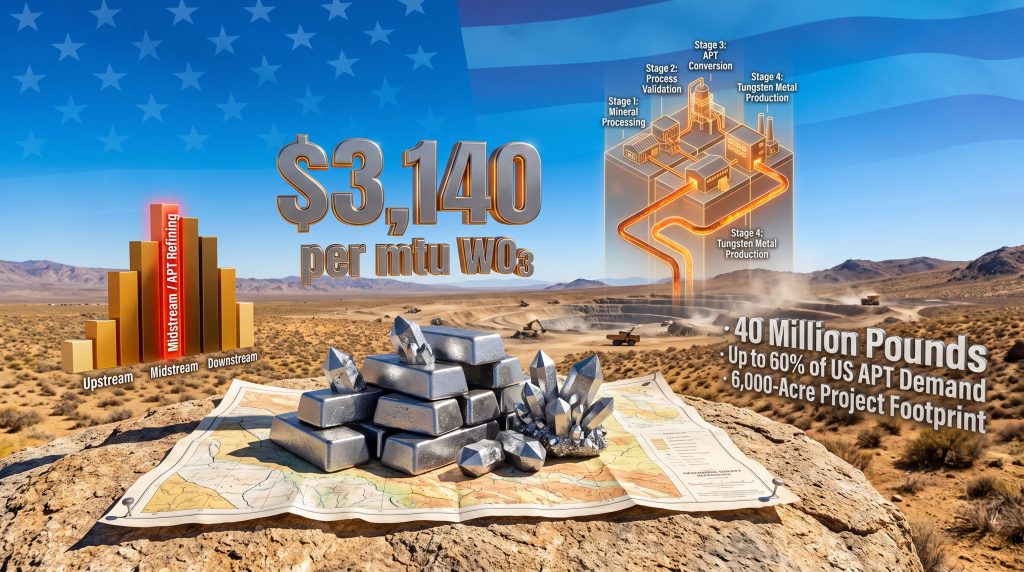
The implementation of Chinese export controls on tungsten products, including APT, triggered a market dislocation that went well beyond cyclical price volatility. According to Fastmarkets pricing data, the weekly assessment for tungsten APT at 88.5% WO3 minimum, CIF Rotterdam and Baltimore duty-free, reached an all-time high of $3,140 per metric tonne unit (mtu) WO3 — a level first recorded in May 2025 and sustained through extreme volatility in subsequent months.
What makes this price environment structurally different from previous tungsten price cycles is the simultaneous emergence of a two-tiered global market:
| Market Segment | Price Direction | Underlying Driver |
|---|---|---|
| Seaborne APT (ex-China) | All-time highs, sustained volatility | Export control constraints, supply scarcity |
| Domestic Chinese APT | Lower, declining | Higher domestic availability, lower production costs |
| Tungsten concentrate (seaborne) | Record highs | Derived demand from APT refinery feedstock shortage |
This divergence is not a temporary arbitrage gap that traders will close. It reflects a deliberate bifurcation of the global tungsten market into two distinct ecosystems: one centred on China and one operating outside it. Consequently, Western defence contractors and industrial manufacturers are now operating in a structurally higher-cost environment with no near-term resolution unless ex-China processing capacity is built.
"The growing separation between Chinese domestic APT prices and seaborne prices signals something more significant than a trade policy dispute. It marks the formal splitting of what was once a unified global tungsten market into two parallel systems, with very different pricing dynamics and supply security profiles."
The Policy Architecture Responding to the Crisis
The US government has moved on multiple fronts to address tungsten supply vulnerability. The surging critical minerals demand across defence and industrial sectors has accelerated this policy response considerably. Key policy actions include:
- The $12 billion Project Vault initiative to establish a civilian strategic stockpile of critical minerals, representing one of the largest peacetime investments in mineral supply security in US history
- Temporary restrictions on the export of tungsten waste, scrap, and black mass, implemented as part of broader efforts to secure materials deemed essential to national defence
- Executive-level mandates targeting domestic acquisition of critical materials for defence supply chains
- US Army Research Laboratory funding of multi-stage tungsten processing research, signalling direct defence establishment involvement in rebuilding industrial processing capability
A critical shift in policy discourse has also occurred. The conversation has moved from focusing exclusively on mine supply toward equal emphasis on processing capacity. Defence Production Act support has further reinforced this shift, as policymakers have recognised that concentrate production without refining capability does not achieve supply independence. This recognition is reshaping how domestic tungsten projects are evaluated and prioritised.
The US has also adopted a parallel friend-shoring strategy, seeking structured supply agreements with allied nations while pursuing domestic development simultaneously. In addition, the use of wartime powers for minerals has become part of the broader conversation about accelerating domestic capacity. The table below illustrates the tradeoffs between these approaches:
| Strategic Approach | Key Advantage | Primary Limitation |
|---|---|---|
| Full domestic onshoring | Maximum security, job creation, technology retention | High capital intensity, long permitting timelines |
| Friend-shoring | Faster diversification, lower upfront capital | Geopolitical dependency, logistics complexity |
| Hybrid model | Risk distribution, balances speed and security | Requires complex bilateral coordination |
BN Strategic Metals and the Atolia Project: Building the Missing Link
Against this policy and market backdrop, the Atolia Tungsten Project being developed by BN Strategic Metals in California's Rand Mining District represents an attempt to address the midstream processing gap directly — not simply as a mine, but as an integrated mine-to-APT platform.
The project's resource base, disclosed under the SEC's S-K 1300 technical report standard, confirms 40 million pounds of tungsten in the ground. The S-K 1300 framework requires independent qualified persons to assess and classify resources under internationally recognised standards, lending the estimate meaningful regulatory credibility. It is important to note, however, that a resource estimate under S-K 1300 is not a reserve. Conversion to a bankable reserve requires a completed feasibility study, which the company is working toward.
The Rand Mining District's historical production profile provides geological context that reinforces confidence in the resource estimate. The district's scheelite-bearing ore historically yielded some of the highest ore grades and concentrate grades of any tungsten-producing area in the United States — a legacy characteristic that makes modern resource development economically compelling under current elevated price conditions.
The project sits within a 6,000-acre footprint, providing meaningful scope for resource expansion through additional drilling and exploration campaigns beyond the current 40 million pound estimate.
The 60% APT Coverage Claim: What It Means and What It Doesn't
BN Strategic Metals has indicated its Atolia project could supply up to 60% of total US APT demand once fully operational. Understanding the precise context of this figure is essential for accurate interpretation:
- The 60% coverage projection applies specifically to a roughly two-year production window at full operational capacity, not an indefinite ongoing supply commitment
- It represents a ceiling under current resource estimates, not a guaranteed minimum
- Achieving this level of supply coverage depends on successful completion of feasibility studies, permitting processes, financing, and construction of both the mine and the APT processing facility
- The figure is derived from the company's assessment of US annual APT consumption relative to the projected output of its planned dual processing plant configuration
Even interpreted conservatively, the scale of potential contribution is strategically significant given the near-absence of other advanced-stage domestic tungsten projects operating at comparable scale.
Development Timeline and Key Milestones
| Milestone | Target Date |
|---|---|
| Sample extraction and feasibility preparation | Ongoing through Q3 2026 |
| Final feasibility study completion | ~November 2026 |
| Initial tungsten production (first ore to market) | Q4 2027 |
| Full processing capacity from both plants | Q1 2028 |
| Public market listing (IPO/public offering) | Q2 2027 (targeted) |
The company has engaged law firm DLA Piper as legal advisor for the public offering process — a signal of institutional-grade capital market preparation. Multiple investment banking firms are reportedly engaged, and significant institutional investor interest has been identified. Off-take agreement discussions are also underway, with demand described as substantial from companies seeking secure tungsten supply.
The Four-Stage Processing Program: Technical Architecture
The technical processing approach being developed in partnership with Montana Technological University, funded by the US Army Research Laboratory, follows a structured four-stage program:
- Mineral Processing Development — Establishing beneficiation and physical separation protocols for scheelite-bearing ore extracted from the Atolia deposit
- Process Validation and Bulk Concentrate Production — Scaling laboratory-proven separation methods to produce commercial-grade tungsten concentrate at commercially meaningful volumes
- APT Conversion — Applying hydrometallurgical refining techniques to convert tungsten concentrate into ammonium paratungstate meeting commercial purity specifications
- Tungsten Metal Production — Downstream conversion of APT into metallic tungsten products suitable for defence and industrial end-use applications
This architecture covers the full midstream-to-downstream value chain, positioning a successfully completed operation to supply customers at multiple points in the tungsten product hierarchy, from concentrate through to finished metal. The involvement of the US Army Research Laboratory in funding this processing program reflects the defence establishment's direct interest in seeing the technical pathway validated at scale.
"A processing model that addresses all four stages from beneficiation through metal production represents a fundamentally different proposition from a simple mine development. It is the difference between adding another concentrate supplier to a market and actually rebuilding a piece of the industrial infrastructure that the US lost over several decades."
Zero-Waste Processing: Environmental Design and Commercial Implications
A distinctive design objective of the Atolia processing program is the elimination of waste material from the processing operation. The intended approach involves processing all mined material on-site, leaving no tailings and minimising environmental liability. This zero-waste design philosophy carries several practical implications:
- It may provide permitting advantages in California's rigorous environmental review environment by eliminating tailings storage facility requirements
- It creates the potential for a toll-processing revenue stream, whereby the same processing technology is applied to ore or concentrate supplied by third-party operators in the surrounding western US region
- The technology could theoretically be applied to legacy tailings from historical mining operations in the Rand Mining District and surrounding areas, creating a supplementary feedstock source that would otherwise require disposal management
The next major ASX story will hit our subscribers first
Risk Factors Every Stakeholder Should Understand
The strategic logic of domestic tungsten processing is compelling, but the distance between current project stage and production reality involves material risks that demand clear-eyed assessment. Furthermore, the broader context of critical military metals dependency underscores just how consequential these risks are at a national level:
- Feasibility risk: The gap between resource estimation and a bankable feasibility study is substantial. Engineering, metallurgical, and economic parameters must all be proven before capital commitment is appropriate
- Permitting risk: California's environmental review processes introduce timeline uncertainty that is difficult to quantify and has historically extended project timelines beyond initial projections
- Financing risk: Integrated mine-plus-refinery infrastructure is capital-intensive, and access to public markets or institutional debt on acceptable terms is not guaranteed
- Technology risk: The four-stage processing program has not been demonstrated at commercial scale. Laboratory and pilot-scale results do not automatically translate to industrial performance
- Market timing risk: If APT prices moderate significantly before the project reaches production, projected margins will compress, potentially affecting the project's economic viability
- Resource sufficiency risk: There is a broader concern that US domestic tungsten resources, even fully developed, may not be sufficient to meet total national consumption at current levels
This final point is perhaps the most underappreciated strategic risk. Even a successfully built domestic project covering up to 60% of APT demand for a two-year window addresses only a portion of a structural problem that will require resource expansion, recycling programmes, and allied-nation supply partnerships to resolve comprehensively.
The Economic Case Beyond National Security
The rationale for rebuilding domestic tungsten processing capacity extends well beyond supply chain security arguments. The projected creation of at least 150 high-paying jobs at the Atolia project site represents a direct economic development contribution to a region that lost its industrial base when the Rand Mining District went dormant.
More broadly, integrated mine-to-APT operations generate economic value across a wider range of skill categories than extraction-only operations, including process chemistry, hydrometallurgy, engineering, logistics, and technical workforce development. The retention of this industrial knowledge within the domestic economy has long-term value that extends beyond any single project.
Defence and aerospace manufacturers also have a direct financial interest in supporting domestic tungsten processing capacity. According to Fastmarkets analysis on the US tungsten supply chain, procurement teams currently managing supply chain risk associated with single-source import dependency effectively pay an insurance premium through supply disruption risk, premium pricing for secure supply, and contract contingency planning costs. Domestic APT supply, even at a price premium to pre-export-control Chinese pricing, offers supply security advantages that reduce these embedded costs.
Scenario Outlook: What Could US Tungsten Supply Look Like by 2030?
| Scenario | Description | Probability Driver |
|---|---|---|
| Optimistic | Multiple domestic projects producing, domestic APT refining established, allied-nation agreements providing buffer stock | Permitting reform, capital market access, sustained high APT prices |
| Base Case | One or two domestic producers at early-stage output, APT refining limited, friend-shoring filling majority of gap | Current project timelines hold, moderate financing environment |
| Constrained | Permitting delays and financing gaps slow development, structural import dependency continues through 2030 | Regulatory friction, price moderation reducing investor appetite |
The most realistic near-term outcome is the base case, where projects like Atolia contribute meaningfully but the US remains partially dependent on allied-nation imports to cover the majority of APT requirements. Full supply independence is unlikely by 2030 given resource constraints and capital deployment timelines.
What domestic projects fundamentally provide, in this context, is not complete independence but supply chain anchors: points of domestic control that reduce the severity of any future import disruption and provide a platform for gradual capacity expansion over time.
Frequently Asked Questions
What Is APT and Why Is It the Critical Bottleneck?
Ammonium paratungstate is the primary chemical intermediate produced from tungsten ore concentrate through hydrometallurgical processing. It serves as feedstock for essentially all downstream tungsten products, including tungsten carbide cutting tools, tungsten wire, and high-density tungsten metal used in defence and aerospace applications. The US currently has virtually no domestic APT refining capacity, meaning domestically mined tungsten concentrate must still be processed offshore without integrated domestic refining, recreating the supply chain dependency that export controls have made strategically dangerous.
What Is the S-K 1300 Standard and Why Does It Matter?
The SEC's S-K 1300 regulation governs mineral resource and reserve disclosure for US-listed companies. It requires independent technical reports prepared by qualified persons under internationally recognised classification frameworks. A resource estimate disclosed under S-K 1300 carries regulatory credibility, but remains a resource, not a reserve, until supported by a completed bankable feasibility study demonstrating economic viability under defined operating assumptions.
What Is Project Vault?
Project Vault is a US initiative targeting the establishment of a $12 billion civilian strategic stockpile of critical minerals, including tungsten. It represents a significant policy signal about long-term strategic planning horizons for mineral supply security and the depth of concern within the US government about dependence on geopolitically sensitive supply sources.
Can the US Achieve Tungsten Supply Independence?
Full independence from imported tungsten is not achievable in the near to medium term given the scale of US consumption relative to known domestic resources. A realistic supply security strategy combines domestic mine and refinery development, scrap recycling and recovery programmes, and structured agreements with allied-nation suppliers. The goal is meaningful risk reduction and supply diversification rather than complete self-sufficiency, with domestic processing capacity serving as the strategic anchor of any credible supply security architecture.
Disclaimer: This article contains forward-looking statements and projections based on publicly available information and company disclosures. Development-stage mining and processing projects involve material risks including permitting delays, financing uncertainty, technical performance gaps, and market price volatility. Nothing in this article constitutes financial or investment advice. Readers should conduct independent due diligence before making any investment decisions.
Want To Stay Ahead of the Next Major Critical Mineral Discovery?
Discovery Alert's proprietary Discovery IQ model scans ASX announcements in real time, instantly identifying significant mineral discoveries across tungsten, rare earths, and more than 30 other commodities — turning complex data into clear, actionable opportunities. Explore how historic discoveries have generated extraordinary returns on Discovery Alert's dedicated discoveries page, and start your 14-day free trial today to position yourself ahead of the broader market.