August 25, 2026
The Metals That Empires Are Built On: Why Western Nations Are Racing to Secure Tungsten
Throughout history, the nations that controlled the materials underpinning military and industrial power shaped the geopolitical order around them. Iron, steel, aluminium, and uranium each defined an era. Today, a quieter but equally consequential contest is unfolding around a dense, silvery-grey metal that most people have never considered: tungsten. The Tungsten West Hemerdon mine restart investment sits at the centre of this strategic shift, with the metal's unmatched properties — including the highest melting point of any element at 3,422 degrees Celsius — making it genuinely irreplaceable across defence, aerospace, and industrial applications.
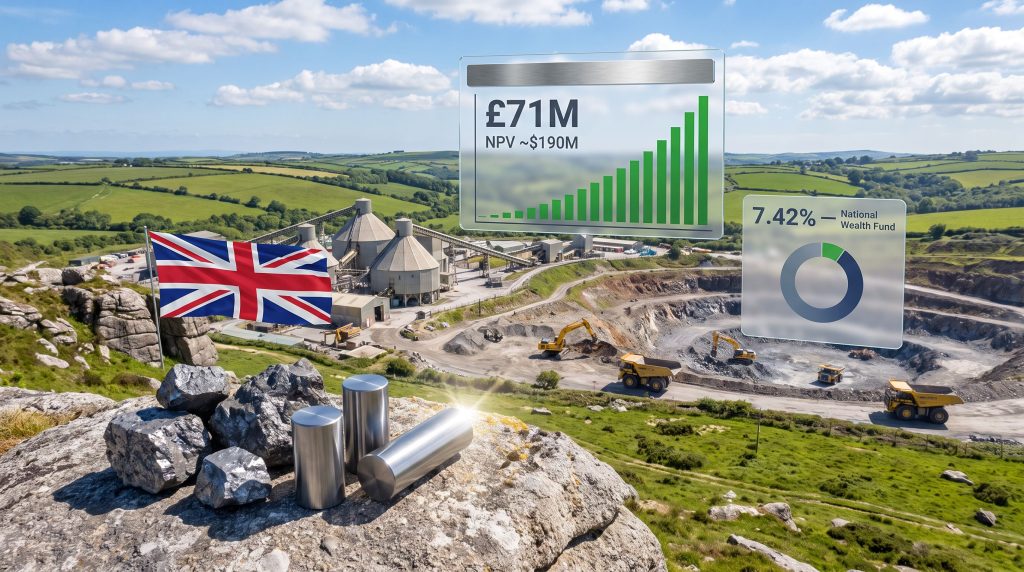
Against this backdrop, the UK government's decision to deploy £71 million through the National Wealth Fund into Tungsten West's Hemerdon mine restart is not simply an infrastructure investment. It is a statement about the structural vulnerabilities that Western industrial economies have allowed to accumulate over decades of offshored production and concentrated supply chains.
When big ASX news breaks, our subscribers know first
Understanding What Makes Tungsten Genuinely Irreplaceable
Unlike many metals described as critical, tungsten's strategic status is not primarily driven by the energy transition narrative that dominates critical minerals demand surge discourse. Its importance predates the electric vehicle boom by decades and persists regardless of energy policy direction.
Tungsten's physical properties make substitution technically impractical across its most important applications:
-
Extreme hardness: Tungsten carbide, the compound formed when tungsten is combined with carbon, registers between 9 and 9.5 on the Mohs hardness scale, approaching diamond. This makes it the material of choice for cutting tools, drill bits, and wear-resistant industrial components.
-
Thermal stability: Its unmatched melting point makes tungsten the only viable material for certain high-temperature aerospace and energy applications, including rocket nozzle throats and high-temperature furnace components.
-
Density advantage: At 19.3 grams per cubic centimetre, tungsten's density is comparable to gold and nearly twice that of lead, making it the preferred material for kinetic energy penetrators in armour-piercing munitions.
-
Emerging fusion energy role: Tungsten is the leading candidate material for plasma-facing components in nuclear fusion reactors, a demand vector that could expand significantly over the coming decades as fusion programmes advance.
The combination of these properties means that no other element can replace tungsten across its critical applications simultaneously. This is a genuinely non-substitutable metal in the sectors that matter most to national security.
Furthermore, tungsten's strategic importance extends well beyond its physical properties, encompassing geopolitical leverage that few other industrial metals can rival.
The Supply Chain Concentration Risk That Hemerdon Is Designed to Address
China currently accounts for an estimated 80% or more of global refined tungsten supply, a concentration that has no equivalent among major industrial metals except perhaps for some rare earth processing stages. This is not simply a matter of mining production; China dominates the entire value chain from ore extraction through to advanced tungsten carbide product manufacturing.
For Western defence procurement agencies, aerospace manufacturers, and precision engineering firms, this concentration creates a structural dependency that becomes increasingly untenable as geopolitical tensions intensify. Several factors compound this risk:
-
There is no significant Western tungsten recycling infrastructure capable of replacing primary supply at scale, though secondary recovery from scrap does occur at modest volumes.
-
Outside of China, meaningful primary production is limited to a small number of operations in Portugal, Vietnam, and a handful of other jurisdictions, none of which offers the scale or jurisdiction stability of Hemerdon.
-
Allied-nation defence procurement is accelerating simultaneously across multiple countries, increasing aggregate Western tungsten demand at precisely the moment when supply chain diversification is most urgently needed.
Consequently, defence metal supply risks have moved from theoretical concern to urgent policy priority across NATO-aligned nations. The Hemerdon mine's revival directly targets this vulnerability. Located in Devon, South West England, it sits atop one of the world's largest identified tungsten resources, with a dual-commodity profile that also yields tin concentrate, providing additional revenue resilience.
Hemerdon's Geological and Economic Profile: A Closer Look
What distinguishes Hemerdon from most critical minerals development projects in Western jurisdictions is the combination of resource scale, prior capital investment, and the relatively modest restart capital requirement relative to that historical investment.
| Attribute | Hemerdon Detail |
|---|---|
| Resource classification | Among largest tungsten deposits outside China |
| Primary commodities | Tungsten (scheelite/wolframite) and Tin |
| Prior capital invested | ~$300 million in historical development |
| Post-tax NPV | ~$190 million at base-case commodity prices |
| Project IRR | ~29% at base case; materially higher at spot prices |
| Restart capital requirement | ~$93 million total |
| Jurisdiction | Devon, South West England |
| Sovereign risk classification | Low (stable developed nation) |
The $300 million in sunk infrastructure from prior development phases is a critical but underappreciated element of the investment thesis. A project of this scale, built from greenfield in the current inflationary construction environment, would require multiples of the current restart capital. Tungsten West effectively inherits processing infrastructure, site development, permitting history, and community relationships that would take a decade and enormous capital to replicate.
Why Mineralogy Matters
A further technical point that tends to be overlooked in mainstream coverage: tungsten occurs in two primary mineralogical forms, scheelite (calcium tungstate) and wolframite (an iron-manganese tungstate). Each requires different processing approaches, and the mineralogical character of a deposit significantly influences metallurgical recovery rates and concentrate quality. Hemerdon's mineralogy and the processing circuit being commissioned are calibrated to the specific characteristics of its ore body, which has been extensively characterised through prior development programmes.
How the £71 Million Investment Structure Works
The National Wealth Fund's capital deployment reflects a deliberate architecture designed to achieve multiple objectives simultaneously: de-risking the project for co-investors, establishing governance oversight, and embedding sovereign procurement rights into the agreement structure.
The three components of the investment:
-
Equity subscription of £36 million structured as 100 million new ordinary shares at £0.36 per share, resulting in the National Wealth Fund holding approximately 7.42% of Tungsten West's issued share capital. This establishes direct equity alignment between the government and project outcomes.
-
Senior debt facility of £25 million providing direct lending to support operational restart capital requirements, complementing the broader project debt facilities in advanced stages of completion.
-
Non-committed accordion facility of £10 million preserving contingency capital optionality for phased commissioning requirements without creating unconditional government exposure.
In addition to financial participation, the National Wealth Fund secured the right to nominate one non-executive director to the Tungsten West board, embedding governance oversight into the arrangement. This is standard practice for development finance institutions and transforms the relationship from passive investor to active strategic partner.
Perhaps the most strategically significant element of the agreement is the government's right to negotiate and procure up to 50% of Hemerdon's 2025 feasibility study tungsten production. This is not a passive financial investment; it is an active supply chain sovereignty measure that positions the UK government as a potential anchor offtaker for domestically produced critical minerals.
The Full Capital Stack: How Hemerdon's Restart Is Being Financed
The government's commitment sits within a broader, multi-source financing structure that Tungsten West has assembled to fund the complete restart programme:
| Financing Component | Value | Type | Status |
|---|---|---|---|
| National Wealth Fund equity | £36 million | Equity | Committed |
| National Wealth Fund senior debt | £25 million | Senior debt | Committed |
| NWF accordion facility | £10 million | Contingent debt | Non-committed |
| Bridge loan (Coffey entity) | $25 million | Unsecured bridge | Binding, secured |
| Main project debt package | Up to $85 million | Project debt | Advanced due diligence |
| Equipment finance (McHale Komatsu) | £22.3 million | Asset finance | Secured |
| Total restart capital target | ~$93 million | Full stack | In execution |
Note: Figures reflect multiple tranches and currencies across different financing rounds. Currency conversions are approximate.
The combination of government equity, sovereign debt, equipment finance, and project lending represents a financing architecture that substantially reduces the risk profile for each individual participant. No single lender or investor carries the full weight of the restart, and the government's anchor position provides a credibility signal that facilitates private capital participation.
The next major ASX story will hit our subscribers first
Production Pathway: Timeline from Commissioning to Full Output
Tungsten West has already produced trial quantities of tungsten and tin concentrate at Hemerdon as part of its pre-restart testing programme, with final completion testing underway. The phased commissioning strategy is designed to generate early cash flow while the full processing circuit is brought to nameplate capacity:
| Phase | Target Timing | Key Milestone |
|---|---|---|
| Phase 1: Fines gravity processing | Q3 2026 | Initial concentrate production commences |
| Full plant commissioning | Q1 2027 | Complete processing circuit operational |
| Nameplate production rate | H2 2027 | Full design throughput achieved |
Why Phase 1 Sequencing Makes Sense
The decision to prioritise fines gravity processing in Phase 1 reflects a technically sound approach to early revenue generation. Gravity separation of fine-grained ore fractions is a relatively lower-capital process step that can operate independently of the full flotation and magnetic separation circuits required for complete ore processing. This sequencing allows Tungsten West to begin generating concentrate revenue and operational experience while completing the more capital-intensive aspects of full commissioning.
Offtake negotiations with a major downstream tungsten refiner were described as well advanced at the time of the investment announcement, indicating that the commercial architecture for concentrate sales is progressing in parallel with the operational restart programme. For further detail on Tungsten West's phased approach, Mining Weekly's analysis offers a thorough overview of the restart plan.
Regional Economic Significance: Devon as a Critical Minerals Anchor
The economic geography of the Hemerdon restart carries weight that extends beyond the mine gate. South West England has historically faced structural challenges in sustaining high-quality industrial employment following the decline of traditional industries, making the project's employment profile particularly significant:
-
350 direct jobs created at the mine site, spanning mining operations, metallurgical processing, engineering, environmental management, and administration
-
Approximately 2,400 additional positions supported across the wider regional supply chain, encompassing equipment suppliers, maintenance contractors, transport logistics, and professional services
-
Skills development in disciplines including mining engineering, hydrometallurgy, and environmental compliance, creating transferable expertise with value across the UK's broader critical minerals ambitions
UK Exchequer Chancellor John Healey characterised the investment in terms of its dual mandate: providing access to strategically critical minerals while delivering economic benefits and employment to communities in the South West of England. UK Business and Trade Secretary Jonathan Reynolds described the investment as a concrete expression of the UK's critical minerals strategy, framing it as a measure designed to strengthen economic resilience, diversify supply chains, and support skilled employment across Devon and beyond.
The Policy Architecture Behind the Investment
The Hemerdon investment is not an isolated transaction driven by a single political decision. It reflects the operational deployment of a layered policy framework that has been building across multiple UK government initiatives.
Three pillars of UK critical minerals policy as demonstrated by Hemerdon:
-
Domestic resource prioritisation: Rather than relying solely on trade agreements or import diversification, the UK is now actively deploying balance-sheet capital into known large-scale domestic deposits.
-
Sovereign procurement embedding: The government's offtake rights for up to 50% of feasibility study tungsten production represent a structural integration of supply chain sovereignty into the investment agreement itself, not a separate policy aspiration.
-
Reindustrialisation alignment: The project's employment profile and supply chain activation in Devon align with the broader industrial geography objectives that the UK government has articulated as central to its economic growth strategy.
Tungsten West CEO Jeff Court characterised Hemerdon as a world-class, low-cost, and long-life tungsten and tin resource, emphasising the company's intent to prioritise meeting UK domestic requirements for the metal, including strategic demand from tungsten for defence and aerospace sectors.
What the Hemerdon Model Tells Investors About UK Critical Minerals Opportunity
For investors and project developers assessing the UK critical minerals landscape, the Tungsten West Hemerdon mine restart investment establishes several precedents worth understanding carefully.
Investment Thesis Clarification: The National Wealth Fund's participation does not eliminate project risk. Commissioning complexity, commodity price exposure, and operational execution remain genuine variables. The government's involvement de-risks the capital structure but does not transform the project into a guaranteed outcome.
However, what the transaction does establish is a replicable template for how the UK government intends to engage with strategically important domestic resource projects. The combination of equity participation, debt provision, governance rights, and offtake optionality creates a multi-instrument engagement model that:
-
Reduces the cost of capital for qualifying projects by providing an anchor investor signal to private co-investors
-
Embeds long-term strategic procurement alignment between project economics and national supply chain objectives
-
Creates a governance pathway through board representation that enables ongoing oversight without operational control
Comparing Hemerdon to analogous international sovereign investment models:
| Dimension | Hemerdon (UK) | International Comparisons |
|---|---|---|
| State equity stake | ~7.42% via NWF | Canada's equity positions in lithium projects via federal programmes |
| Offtake rights | Up to 50% of feasibility production | US Department of Defense offtake agreements with domestic rare earth producers |
| Governance rights | NWF board nominee | Standard for development finance institutions globally |
| Debt and equity hybrid structure | Yes (£61 million committed) | Consistent with Australian Critical Minerals Facility structures |
The broader implication for investors is that the UK government has transitioned from publishing critical minerals strategy documents to actively deploying sovereign capital in support of domestic projects that meet strategic threshold criteria. For developers with qualifying assets, this signals a materially different policy environment than existed five years ago.
Disclaimer: This article is intended for informational purposes only and does not constitute financial advice or a recommendation to invest. All financial projections, NPV estimates, IRR figures, and production timelines referenced are forward-looking in nature and subject to material risks, uncertainties, and assumptions that may cause actual outcomes to differ significantly. Readers should conduct their own independent due diligence and consult qualified financial advisers before making any investment decisions.
Want to Stay Ahead of the Next Major Strategic Mineral Discovery?
Discovery Alert's proprietary Discovery IQ model delivers real-time alerts on significant ASX mineral discoveries — instantly turning complex mineral data into actionable investment insights across tungsten, tin, and more than 30 other commodities. Explore historic discoveries and their market-defining returns, then begin your 14-day free trial to position yourself ahead of the broader market.