August 25, 2026
The Long Game: Why Patient Investors Keep Coming Back to Rio Tinto
Mining cycles have a habit of humbling even the most disciplined investors. Commodities boom, prices collapse, dividends get trimmed, and headlines turn grim. Yet through each of these cycles, a select group of diversified, Tier-1 mining companies not only survive but quietly build out asset bases that emerge stronger on the other side. Understanding this pattern is the starting point for evaluating whether Rio Tinto shares buy and hold represents a genuine opportunity for long-term ASX investors.
The question is not simply whether Rio Tinto is cheap or expensive today. The more instructive lens is whether the company is deploying capital into assets capable of generating meaningful cash flows for decades to come, and whether the current valuation offers a reasonable entry point for that longer-duration story.
When big ASX news breaks, our subscribers know first
What "Buy and Hold" Actually Requires From a Cyclical Miner
The buy-and-hold framework was largely built around compounding businesses. Think consumer staples, software platforms, and financial networks where earnings grow incrementally year after year and reinvestment compounds shareholder value. A diversified mining company like Rio Tinto operates on an entirely different logic.
In commodity-exposed businesses, earnings do not compound in a straight line. They oscillate with iron ore prices, copper demand, aluminium premiums, and macroeconomic cycles, particularly in China, which remains the dominant consumer of the raw materials Rio Tinto produces. A buy-and-hold approach in this context requires a different kind of patience: the willingness to look through earnings volatility, accept dividend variability in weaker cycles, and focus on the quality and longevity of the underlying asset base.
Rio Tinto is not a compounder in the traditional sense. It is better understood as a long-duration income and commodity growth holding, where the return profile is shaped by asset quality, production growth, and commodity price cycles rather than earnings momentum alone.
| Criteria | Classic Compounder | Rio Tinto (ASX: RIO) |
|---|---|---|
| Earnings Pattern | Consistent annual growth | Cyclical, commodity-driven |
| Dividend Profile | Growing, predictable | Fully franked, variable with cycle |
| Key Growth Driver | Reinvestment compounding | Major project ramp-ups |
| Valuation Reference | P/E expansion over time | ~15x forecast earnings |
| Commodity Exposure | Minimal | High across iron ore, copper, aluminium, lithium |
| Long-Term Pipeline | Internal reinvestment | Oyu Tolgoi, Simandou, Winu, Resolution |
Breaking Down the Valuation: What 15x Earnings Signals for Rio Tinto
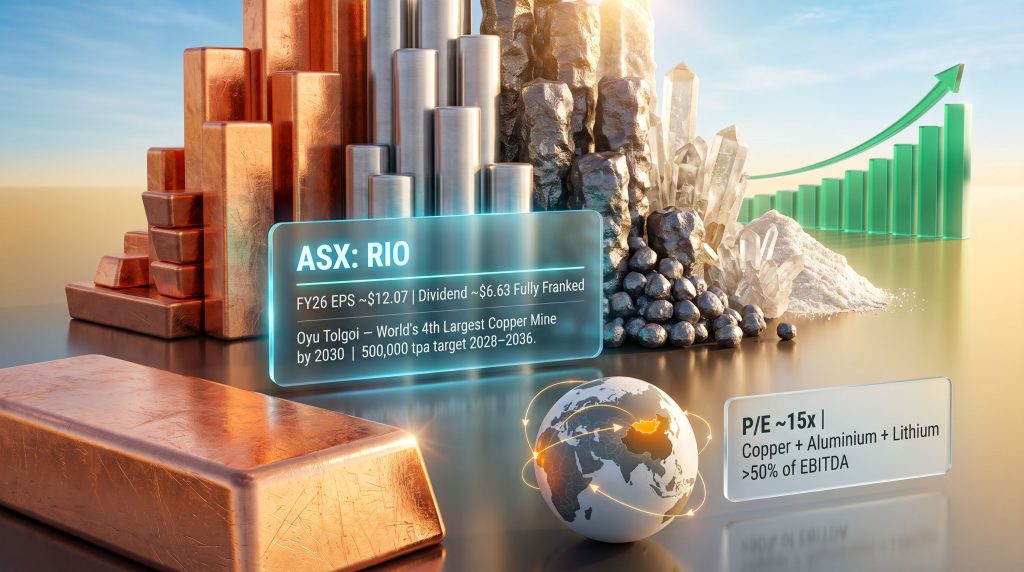
At a share price of approximately $180.44, Rio Tinto trades at roughly 15 times forecast earnings in both FY26 and FY27, based on consensus EPS estimates of approximately $12.07 and $12.04 respectively. To a growth investor, flat earnings over two years might appear uninspiring. For a long-term commodity investor, however, the picture is more nuanced.
Why Flat Near-Term Earnings Are Not the Real Story
Large-scale mining operations involve substantial upfront capital expenditure during construction and ramp-up phases before production volumes translate into earnings. Rio Tinto is currently mid-cycle in terms of several of its most significant growth projects. Furthermore, the Oyu Tolgoi ramp-up in Mongolia is still progressing, while Simandou in Guinea is moving toward production. These assets are absorbing capital today but are not yet contributing their full earnings potential to the income statement.
In this context, FY26 and FY27 consensus forecasts are arguably a floor estimate rather than a ceiling, particularly when Oyu Tolgoi's full production contribution begins flowing through from 2028 onward.
The Income Dimension: Franked Dividends as a Return While You Wait
Consensus estimates point to fully franked dividends of approximately $6.63 per share in FY26 and $6.62 per share in FY27. For eligible Australian resident investors, franking credits significantly enhance the after-tax return. At a share price of $180.44, the gross dividend yield (including franking credit value at the 30% corporate tax rate) is materially higher than the headline cash yield.
Fully franked dividends deliver a tax offset to eligible Australian shareholders equivalent to the corporate tax already paid on those earnings. For a self-managed super fund in pension phase paying zero tax, the franking credit represents a direct cash refund, making the effective yield considerably higher than what the headline figure implies.
The stability of that dividend across FY26 and FY27, despite flat earnings forecasts, is itself a signal. It suggests management is comfortable maintaining distributions through the capital expenditure phase, rather than cutting income to fund growth projects entirely from retained earnings.
Copper: The Structural Growth Engine Hiding Inside Rio Tinto's Numbers
For many investors, Rio Tinto has historically been synonymous with iron ore. The Pilbara operations in Western Australia have dominated the earnings narrative for years. However, a significant shift is underway in the underlying earnings composition of the business, and the Rio Tinto copper expansion is central to that transformation.
In the first half of 2026, copper, aluminium, and lithium combined contributed more than half of Rio Tinto's underlying EBITDA. That is a landmark milestone. It means the company's earnings base has already diversified beyond what the traditional iron ore narrative would suggest.
Oyu Tolgoi: A Tier-1 Asset at a Pivotal Moment
The Oyu Tolgoi copper and gold mine in Mongolia represents one of the most consequential assets in global mining. Located in the South Gobi Desert, it encompasses both open pit and underground operations. The underground component, carved into some of the richest copper-gold ore in the world, took years of complex engineering and significant capital to develop.
In the first half of 2026, copper production from Oyu Tolgoi increased 31% compared to the same period in 2025, with Rio Tinto confirming the ramp-up trajectory remains on schedule. The target is substantial: approximately 500,000 tonnes of copper annually on average between 2028 and 2036, which would position it as the world's fourth-largest copper mine by 2030.
To put that number in context, 500,000 tonnes of copper per year represents roughly 2% of current global annual copper production from a single asset. At current copper prices, that production volume would generate significant incremental revenue well beyond what FY26 or FY27 consensus models currently capture.
The Underground Mining Complexity That Makes Oyu Tolgoi Unique
Block cave mining, the technique employed in Oyu Tolgoi's underground operations, is one of the most technically demanding methods in the mining industry. It involves inducing controlled collapse of ore columns deep underground, allowing enormous volumes of mineralised material to flow toward collection points below.
The method can unlock ore bodies that would be uneconomic to access through conventional drilling and blasting approaches, but it requires precise geological modelling, significant upfront infrastructure, and years of careful caving initiation. The successful progression of Oyu Tolgoi's underground block cave is therefore not just a production milestone — it is a technical validation of one of the most complex engineering undertakings in contemporary mining, underpinning confidence in Rio Tinto's projected production trajectory through to 2036.
Other Copper Projects Building the Pipeline
| Project | Location | Development Stage |
|---|---|---|
| Oyu Tolgoi | Mongolia | Active ramp-up, on schedule |
| Resolution | United States | Advanced permitting and evaluation |
| Winu | Western Australia | Development-stage assessment |
Each of these assets adds optionality to Rio Tinto's copper exposure. Resolution, located in Arizona, targets a large porphyry copper deposit. Winu in the Paterson Province of Western Australia is exploring a copper-gold system in one of Australia's most prospective yet underexplored geological terrains.
Why Copper Demand Looks Structurally Supported
The demand case for copper is well understood in broad terms but often underappreciated in its specifics. Electricity grid upgrades required to support renewable energy integration are exceptionally copper-intensive. A single offshore wind turbine requires several tonnes of copper wiring, and electric vehicle powertrains use approximately three to four times more copper than internal combustion engine equivalents.
Grid-scale battery storage installations, electric charging infrastructure, and high-voltage transmission lines all compound this demand picture. According to analysis from Wood Mackenzie, global copper demand could increase by more than 50% between 2023 and 2050 under energy transition scenarios, while supply additions have consistently disappointed against forecasts over the past decade due to declining ore grades, permitting delays, and geopolitical complications in major producing regions.
Simandou and Lithium: The Other Pillars of Portfolio Transformation
Simandou: Redefining Rio Tinto's Iron Ore Story
The Simandou iron ore deposit in Guinea is one of the largest undeveloped high-grade iron ore resources in the world. The ore grade at Simandou is meaningfully higher than the average grade of material currently shipped from the Pilbara, which has implications for the premium pricing Rio Tinto can command in Asian steel markets. Consequently, the China steel demand outlook becomes particularly relevant when assessing Simandou's long-term earnings contribution.
High-grade iron ore commands a premium over lower-grade material because it improves blast furnace efficiency and reduces coking coal consumption per tonne of steel produced. As steel producers face pressure to reduce emissions intensity, demand for high-grade feedstock is expected to grow. Simandou positions Rio Tinto to benefit directly from this quality premium dynamic, and its zero-carbon steel strategy aligns with the broader decarbonisation agenda reshaping global steel markets.
The infrastructure challenge involved in Simandou, including a trans-Guinea railway and purpose-built port facilities, has historically made development timelines uncertain. However, with the project advancing, it has the potential to add a geographically diversified iron ore supply source to Rio Tinto's production base over the medium term.
Lithium: Emerging Exposure to Battery Materials
Rio Tinto's expansion into lithium has accelerated as the company recognises that energy transition demand creates a multi-decade structural story across several commodities simultaneously. Lithium's contribution to group EBITDA is growing and represents a relatively new but increasingly material diversification layer within the portfolio.
Portfolio Composition at a Glance
| Commodity | Role | Key Asset / Geography |
|---|---|---|
| Iron Ore | Core earnings engine | Pilbara, Western Australia |
| Copper | Primary growth driver | Oyu Tolgoi (Mongolia), Resolution (US), Winu (WA) |
| Aluminium | Significant EBITDA contributor | Global smelting and bauxite operations |
| Lithium | Emerging growth exposure | Expanding globally |
| High-Grade Iron Ore | Premium supply diversification | Simandou, Guinea |
What Analyst Consensus Actually Tells Long-Term Investors
Rating Breakdown Across Global Exchanges
Rio Tinto trades on multiple exchanges, and analyst coverage reflects a range of perspectives:
- NYSE ADR (RIO): MarketBeat consensus of Hold from 16 analysts, comprising 3 sell ratings, 6 hold, 5 buy, and 2 strong buy recommendations. The average price target sits at approximately $101.63 against a current ADR price near $104 to $105, implying limited near-term upside on consensus estimates.
- London Stock Exchange: Consensus Hold from 7 analysts, with Hold ratings outnumbering Buy recommendations.
- Investing.com aggregate (21 analysts): Overall Neutral consensus rating.
A Hold rating in the mining sector does not imply a business with limited merit. It typically means analysts view the stock as fairly valued at current prices relative to near-term earnings forecasts. For investors with a multi-year horizon, analyst 12-month price targets are often the least relevant input in the decision-making process.
Bull and Bear Case Comparison
| Dimension | Bull Case | Bear Case |
|---|---|---|
| Copper Growth | Oyu Tolgoi reaches 500,000 tpa from 2028, delivering material earnings uplift | Production delays or cost overruns compress returns on invested capital |
| Iron Ore | Simandou adds high-grade supply and quality premium pricing power | Iron ore price softness weighs on the core Pilbara earnings engine |
| Valuation | 15x earnings is undemanding for a diversified Tier-1 global miner | Flat EPS growth limits near-term re-rating potential |
| Dividends | Fully franked yield provides meaningful income during the growth investment phase | Commodity downturns have historically triggered significant dividend reductions |
| Diversification | Copper, aluminium, and lithium now exceed 50% of underlying EBITDA | New project execution risk if multiple assets underperform simultaneously |
The next major ASX story will hit our subscribers first
Time Horizon Matters: How the Investment Case Evolves
Short-Term View (0 to 12 Months)
Near-zero earnings growth is implied by FY26 and FY27 consensus forecasts. Analyst price targets are clustered close to current trading levels, suggesting limited near-term re-rating potential. In addition, monitoring iron ore price trends remains critical, as commodity price volatility — particularly given China's steel sector dynamics — is the dominant short-term risk variable.
Medium-Term View (1 to 3 Years)
- Oyu Tolgoi production volumes continue building toward the 2028 target window.
- Simandou iron ore volumes come online, with potential to reshape high-grade iron ore market dynamics in Asian steel markets.
- Lithium portfolio contribution grows as battery supply chain demand accelerates.
- Winu and Resolution advance through permitting and development evaluation phases.
Long-Term View (3 to 10 Years)
- Oyu Tolgoi's 500,000 tpa copper average across 2028 to 2036 represents a material earnings inflection point not yet captured in consensus estimates.
- Rio Tinto's commodity mix becomes increasingly aligned with electrification and decarbonisation megatrends.
- Fully franked dividends compound the total return case for patient investors holding through the project maturation cycle.
Key Risks Every Investor Should Assess Before Buying Rio Tinto Shares
Commodity Price Sensitivity
Iron ore, copper, aluminium, and lithium prices are all subject to global demand cycles and supply-side shocks. China's steel production trajectory is particularly important given its dominance in iron ore consumption. A sustained Chinese economic slowdown would pressure the core earnings base in ways that cannot be fully offset by copper and lithium diversification in the near term.
Project Execution Risk
Large-scale mining developments carry inherent execution uncertainty:
- Oyu Tolgoi involves sovereign risk in Mongolia, where government relations and royalty negotiations have historically been complex.
- Simandou in Guinea carries infrastructure risk, political risk, and multi-party coordination complexity involving the Guinean government and other joint venture partners.
- Resolution in the United States faces a lengthy and uncertain permitting process given its location near environmentally sensitive areas.
Currency and Geopolitical Exposure
Rio Tinto's operations span Mongolia, Guinea, Australia, the United States, Canada, and multiple other jurisdictions. USD-denominated commodity pricing creates currency translation effects for ASX-listed shareholders, and geopolitical developments in any operating jurisdiction can affect asset values and cash flow projections.
Dividend Sustainability Through the Cycle
Fully franked dividends are one of Rio Tinto's most attractive features for Australian investors, but they are not guaranteed. Historical analysis of Rio Tinto's dividend history shows material reductions during commodity price troughs, including a significant cut during the 2015 to 2016 commodity downturn. Investors should, therefore, stress-test their income expectations against prior cycle drawdowns rather than assuming current dividend levels are permanent.
This article is general in nature and does not constitute personal financial advice. Past performance is not indicative of future results. Investors should consider their own circumstances and consult a licensed financial adviser before making investment decisions.
Frequently Asked Questions: Rio Tinto Shares as a Buy and Hold Investment
Is Rio Tinto a good long-term investment on the ASX?
Rio Tinto offers a combination of commodity diversification, a significant copper growth pipeline centred on Oyu Tolgoi, and fully franked dividends that can appeal to long-term investors. Its earnings are inherently tied to commodity cycles, meaning investors should expect volatility rather than linear annual growth. The investment case strengthens materially from 2028 onward as major projects move from capital expenditure into full production.
What is Rio Tinto's forecast dividend for FY26 and FY27?
Analyst consensus estimates a fully franked dividend of approximately $6.63 per share in FY26 and $6.62 per share in FY27. Franking credits attached to these dividends enhance after-tax returns for eligible Australian investors, particularly self-managed super funds and lower-rate taxpayers.
What is Rio Tinto's current P/E ratio?
At approximately $180.44 per share, Rio Tinto trades at around 15 times forecast earnings for both FY26 and FY27, based on consensus EPS estimates of approximately $12.07 and $12.04 respectively.
What is Oyu Tolgoi and why does it matter?
Oyu Tolgoi is a large-scale copper and gold mining operation in Mongolia's South Gobi Desert, employing block cave underground mining technology. Rio Tinto expects it to produce approximately 500,000 tonnes of copper annually on average between 2028 and 2036, potentially ranking as the world's fourth-largest copper mine by 2030. This represents one of the most significant long-term earnings growth drivers within Rio Tinto's portfolio.
What do analysts recommend for Rio Tinto shares?
Analyst consensus across major platforms is broadly Hold/Neutral, with average price targets close to current trading levels. A meaningful proportion of analysts hold Buy or Strong Buy ratings, reflecting divergent views on the long-term commodity and project pipeline outlook. Near-term consensus neutrality does not negate the longer-duration investment case for Rio Tinto shares buy and hold strategies.
How diversified is Rio Tinto's earnings base today?
In the first half of 2026, copper, aluminium, and lithium together accounted for more than half of Rio Tinto's underlying EBITDA. This marks a significant structural evolution from the predominantly iron ore-driven earnings profile that defined Rio Tinto's identity for much of the past two decades.
The Strategic Verdict: Who Should Consider Rio Tinto Shares for the Long Term
Investors Well-Suited to Rio Tinto
- Those seeking diversified commodity sector exposure within a broader ASX portfolio.
- Income-focused investors who value fully franked dividends and can accept cyclical variability in the payout.
- Long-term holders with a five to ten year time horizon who can look through near-term earnings flatness toward the Oyu Tolgoi production ramp and Simandou supply contribution.
- Self-managed super funds seeking grossed-up yield from franking credits alongside commodity exposure.
Investors Who Should Approach With Caution
- Those requiring consistent, predictable earnings growth year on year without cyclical interruption.
- Investors with a short to medium time horizon where commodity price swings could dominate total returns.
- Those uncomfortable with geopolitical exposure across Mongolia, Guinea, and other developing-market jurisdictions.
Rio Tinto at approximately 15 times forecast earnings, with a substantial copper growth pipeline maturing from 2028, a multi-commodity EBITDA base already exceeding 50% outside iron ore, and fully franked dividends providing income through the investment cycle, presents a considered long-term holding for patient investors. The near-term earnings outlook is flat and analyst consensus is broadly neutral, but neither factor materially undermines the longer-duration investment thesis built around Oyu Tolgoi, Simandou, and the company's expanding lithium exposure.
For investors willing to look beyond the next two financial years and accept the inherent volatility of commodity markets, Rio Tinto shares buy and hold offers a combination of current income, multi-commodity diversification, and meaningful long-term production growth that is difficult to replicate elsewhere on the ASX at comparable scale. Readers seeking additional analysis on Rio Tinto and ASX resource sector investing can explore related commentary at Motley Fool Australia, which regularly publishes research on major ASX-listed miners and long-term investing strategies.
Want to Catch the Next Major ASX Mineral Discovery Before the Market Does?
While Rio Tinto represents a compelling long-term holding for patient investors, the most significant wealth-creation moments in resources often emerge from ground-floor discoveries — and Discovery Alert's proprietary Discovery IQ model delivers real-time alerts the moment significant mineral discoveries hit the ASX, transforming complex data across 30-plus commodities into clear, actionable opportunities for both traders and long-term investors. Explore historic discoveries and the returns they generated, then begin your 14-day free trial to ensure you're positioned ahead of the market when the next major find is announced.