August 25, 2026
The Cyclical Trap: Why Earnings Trajectory Matters More Than Yield in Resource Stocks
Investors drawn to high-yield mining stocks often focus on the wrong variable. The headline dividend percentage captures attention, but experienced resource investors know that the direction of earnings momentum is far more predictive of future returns than any single year's payout ratio. In cyclical industries like iron ore mining, a stock offering an apparently generous yield while its earnings base is contracting can quietly destroy capital even as it distributes income. Understanding this dynamic is essential before answering the question that many ASX investors are currently asking: should I invest in Fortescue shares?
When big ASX news breaks, our subscribers know first
What Fortescue Actually Is as a Business
Fortescue Ltd (ASX: FMG) is one of the world's largest pure-play iron ore producers, built from the ground up across its Pilbara operations in Western Australia. What makes Fortescue structurally distinctive is not just its scale but its near-total revenue dependence on a single commodity. Unlike BHP or Rio Tinto, which spread earnings across copper, coal, potash, aluminium, and lithium, Fortescue's financial performance rises and falls almost entirely with the iron ore price trends.
This concentration has historically been both the source of Fortescue's extraordinary wealth creation during iron ore bull markets and its vulnerability during downturns. The company has developed genuinely world-class infrastructure, including its own private railway network and export port facilities capable of handling hundreds of millions of tonnes annually. These assets represent a replacement-cost moat that would require decades and extraordinary capital to replicate.
Where Fortescue Sits in the ASX Ecosystem
As a major constituent of the ASX Top 200, Fortescue carries meaningful weighting in Australian equity indices. This means a large proportion of superannuation members and index ETF investors already carry indirect exposure to FMG without necessarily realising it. For those considering a deliberate, active position, the question is not whether Fortescue is a quality operator but whether the current price reflects an attractive entry point given the forward earnings picture.
The stock occupies an unusual dual identity: part high-yield income play, part cyclical commodity bet. That duality creates opportunity when the iron ore cycle is turning upward, and meaningful risk when it is not.
Decoding the Earnings Forecast Curve
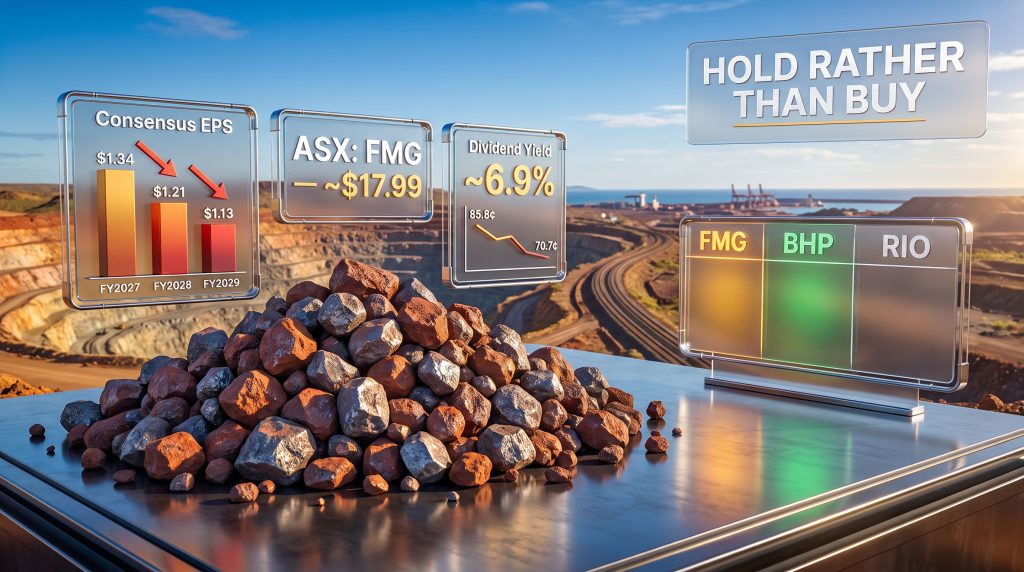
The most compelling reason for caution around Fortescue at current prices has little to do with operational quality and everything to do with what the numbers are pointing toward. Consensus earnings per share forecasts, sourced via CommSec, currently project the following trajectory:
| Metric | FY2027 | FY2028 | FY2029 |
|---|---|---|---|
| Consensus EPS | $1.34 | $1.21 | $1.13 |
| Share Price (Reference) | ~$17.99 | ~$17.99 | ~$17.99 |
| Implied Forward P/E | ~13.4x | ~14.9x | ~15.9x |
| EPS Change (Year-on-Year) | Baseline | -9.7% | -6.6% |
This table reveals something counterintuitive that many retail investors miss: when a stock's price remains flat while earnings decline, the price-to-earnings multiple expands upward. By FY2029, Fortescue would be trading at nearly 16x earnings, not because the market has re-rated the stock higher, but simply because profits are expected to shrink. That is precisely the wrong type of P/E expansion.
Why This Valuation Dynamic Matters for Cyclical Miners
Among experienced resource sector investors, a well-established principle holds that the ideal entry point into a cyclical mining stock is when the P/E multiple looks expensive in absolute terms but earnings are at a cyclical trough and about to recover. Conversely, a cyclical miner trading at a seemingly modest 13x earnings can still represent poor value if those earnings are heading lower.
At approximately 13.4x FY2027 consensus earnings, Fortescue does not offer the kind of compressed-multiple, improving-trajectory setup that has historically signalled compelling value in iron ore stocks. Furthermore, the forecast curve runs in the opposite direction. For context, Morningstar's analysis of ASX mining valuations highlights similar concerns about premium pricing in the sector.
A rising P/E multiple driven by shrinking profits, rather than rising prices, is one of the more deceptive traps in cyclical stock analysis. It creates the illusion of stability while the underlying earnings foundation is eroding.
An approximate 16% contraction in earnings between FY2027 and FY2029 represents a meaningful deterioration, particularly for a business where the earnings base is already sensitive to commodity price assumptions that carry substantial uncertainty.
The Dividend Outlook: Direction Over Absolute Yield
Fortescue's appeal to income investors has long rested on its willingness to distribute large portions of earnings as dividends. Historically, the company has maintained payout ratios that translate iron ore profitability into meaningful cash returns for shareholders. However, forward dividend forecasts tell a more sobering story for those considering Fortescue as an income vehicle today.
| Year | DPS Forecast | Yield (at $17.99) | Change vs Prior Year |
|---|---|---|---|
| FY2027 | 85.8 cents | ~4.8% | Baseline |
| FY2028 | 77.6 cents | ~4.3% | -9.6% |
| FY2029 | 70.7 cents | ~3.9% | -8.9% |
The current trailing yield sits at approximately 6.9%, which appears attractive in isolation. However, the forward trajectory is one of consistent compression. By FY2029, the projected yield on current prices has declined to roughly 3.9%, with further downside if iron ore pricing disappoints consensus assumptions.
The Income Investor's Dilemma
For income-focused portfolios, dividend sustainability is inseparable from earnings resilience. Fortescue's payout structure is directly linked to iron ore profitability, meaning any deterioration in realised ore prices flows quickly through to distribution capacity. A simultaneously declining earnings and dividend profile over a three-year horizon fundamentally changes the risk-reward calculation for yield-seeking investors.
It is worth noting that a ~3.9% forward yield by FY2029, against a backdrop of declining trend, compares unfavourably to what diversified miners like BHP can offer with materially lower commodity concentration risk. BHP's recent FY2026 profit result of $13.7 billion underscores the earnings resilience that commodity diversification provides during periods of iron ore price decline.
Iron Ore Market Dynamics: The Variables Driving the Forecast Risk
Understanding why Fortescue's earnings are under pressure requires a brief examination of the iron ore market itself. Iron ore is priced in US dollars and primarily consumed by Chinese steelmakers. Fortescue ships a high-volume, lower-grade product relative to some competitors, which means its realised price per tonne is typically at a discount to the benchmark 62% Fe index.
This grade differential is an important but underappreciated aspect of the Fortescue investment thesis. When iron ore prices fall, lower-grade producers tend to experience amplified margin compression because:
- Steel mills prioritise higher-grade feed to maintain efficiency when margins are tight
- The price discount between 58% Fe and 62% Fe ore widens during weak markets
- Chinese mills operating under environmental compliance pressures preferentially blend higher-grade ore to reduce emissions per unit of output
Fortescue has made significant investments in blending and processing technology to improve its ore presentation, but the grade discount dynamic remains a structural feature of its pricing versus benchmark.
The China Demand Equation
Chinese steel production is the single most important demand variable for iron ore globally. The China steel and iron ore market faces several structural forces currently weighing on the outlook:
- China's property sector, which historically accounted for a substantial share of steel consumption, remains under significant financial stress following the deleveraging of major developers since 2021.
- Infrastructure-led stimulus has partially offset property weakness but has not fully compensated for the demand gap.
- Chinese crude steel output has shown signs of plateau as the economy transitions toward consumption and services from heavy industry.
- Green steel technology adoption, including electric arc furnaces, reduces dependence on blast furnace iron ore over longer timeframes, though this transition remains gradual.
These are the demand-side forces embedded in consensus iron ore price assumptions. Any deterioration beyond current forecasts would compress Fortescue's realised earnings further than the already-declining EPS trajectory suggests.
Currency Risk: The AUD/USD Squeeze
A factor that receives less retail investor attention is the currency exposure inherent in Fortescue's economics. Iron ore is sold in US dollars while the majority of Fortescue's cost base, including labour, equipment maintenance, and logistics, is denominated in Australian dollars. When the AUD strengthens against the USD, realised margins compress even if the iron ore price holds steady.
This AUD/USD dynamic has been flagged as a headwind to near-term profitability, adding another layer of uncertainty to earnings forecasts that are already pointing lower.
Key Risk Factors at a Glance
For investors evaluating whether to initiate or expand a position in Fortescue shares, the following risk matrix summarises the primary concerns:
| Risk Factor | Nature | Severity |
|---|---|---|
| Iron ore price decline below consensus | Market/macro | High |
| AUD strengthening vs USD | Currency | Medium-High |
| Grade discount widening in weak markets | Commodity/structural | Medium |
| Green energy venture execution risk | Strategic | Medium |
| Declining earnings and dividend trajectory | Financial | High |
| Valuation providing limited margin of safety | Valuation | Medium-High |
The next major ASX story will hit our subscribers first
Fortescue vs. BHP vs. Rio Tinto: A Structural Comparison
For investors contemplating ASX resources exposure, the decision is rarely binary. Fortescue sits alongside BHP and Rio Tinto as large-cap alternatives, but the structural differences between them are significant.
| Factor | Fortescue (FMG) | BHP | Rio Tinto |
|---|---|---|---|
| Commodity Diversification | Low (iron ore dominant) | High (iron ore, copper, coal, potash) | Medium-High (iron ore, copper, aluminium, lithium) |
| Near-Term Earnings Direction | Declining | Expanding | Mixed |
| Dividend Sustainability | Under pressure | Supported by diversification | Relatively stable |
| Green Transition Exposure | High (hydrogen/green energy) | Moderate | Moderate |
| Grade/Quality Risk | Higher (lower-grade ore) | Lower (diversified) | Lower (diversified) |
| Valuation Risk at Current Prices | Higher | Lower | Moderate |
BHP's commodity diversification gives it earnings buffers that Fortescue simply does not possess in the current cycle. Rio Tinto's multi-commodity growth pipeline, including major copper and lithium development projects, provides forward optionality that extends well beyond iron ore market conditions. In addition, Australia's iron ore industry context is worth understanding when weighing these peer comparisons.
What Triggers Could Change the Investment Case?
The current outlook is not static. Several catalysts could materially shift the risk-reward balance for Fortescue investors in either direction.
| Trigger | Potential Implication |
|---|---|
| Iron ore price recovery above consensus | Upward EPS revisions, potential re-rating |
| Share price pullback to ~$14-$15 range | Improved margin of safety, more attractive entry |
| AUD weakening against USD | Margin expansion, earnings beats |
| Chinese steel demand recovery | Positive for iron ore pricing |
| Green energy/hydrogen revenue becoming material | Reduces commodity concentration risk |
| Further iron ore price deterioration | Earnings below already-declining consensus |
Analyst price target ranges for Fortescue currently cluster between approximately $17.10 and $20.44, implying limited near-term upside at current prices relative to the embedded downside risk from commodity price volatility.
Who Should Actually Consider Fortescue Shares Right Now?
Fortescue may suit investors who:
- Already hold the stock and are weighing whether to maintain or exit their position
- Have genuine conviction on an iron ore price recovery not currently reflected in consensus forecasts
- Are comfortable with dividend income that fluctuates materially with commodity market conditions
- Want small, tactical exposure to Australian iron ore as part of a broader, diversified resources allocation
Fortescue is likely less appropriate for investors who:
- Require stable or growing dividend income with manageable commodity price risk
- Are deploying fresh capital and need a strong margin of safety at the point of entry
- Prefer improving earnings momentum as a prerequisite for initiating new positions
- Want diversified commodity exposure rather than concentrated iron ore risk
The Hold vs. Buy Distinction
There is an important conceptual distinction that often gets lost in retail investor discussions: the decision to continue holding a stock is fundamentally different from the decision to deploy fresh capital into it today. These two decisions carry different risk profiles and require different justifications.
For existing Fortescue shareholders, the calculus includes factors like capital gains tax implications, portfolio concentration, and the cost of rotating capital into alternatives. The company's Pilbara infrastructure, operational efficiency, and long-term commodity leverage remain genuine attributes. Commodity markets are inherently cyclical, and an unexpected recovery in iron ore pricing could rapidly reverse the current earnings trajectory.
For investors considering a new position, the burden of proof is higher. At approximately $17.99 per share with a declining EPS forecast curve, the entry point does not offer the margin of safety that disciplined investors in cyclical businesses typically require. A price in the $14-$15 range, or evidence of upward earnings revisions driven by iron ore price recovery, would substantially improve the risk-reward equation. The broader question of whether should I invest in Fortescue shares ultimately depends on this interplay between entry price and commodity cycle timing. Consequently, understanding the tariff impact on iron ore adds further important context to this assessment.
The structural quality of Fortescue's iron ore operations is not the question. The question is whether the current price adequately compensates investors for three years of forecast earnings and dividend deterioration in a commodity-sensitive business.
Frequently Asked Questions About Investing in Fortescue Shares
What is Fortescue's forward P/E ratio?
Based on FY2027 consensus EPS of $1.34 and a reference share price of approximately $17.99, the forward P/E ratio is roughly 13.4x. This rises to approximately 15.9x by FY2029 as earnings are forecast to contract, making the valuation progressively less attractive on a forward basis as profits decline.
What dividend yield does Fortescue currently offer?
The current trailing yield sits at approximately 6.9%. However, forward dividend per share forecasts project payments declining from 85.8 cents in FY2027 to 70.7 cents by FY2029, compressing the prospective yield to approximately 3.9% at current prices by the end of that period.
How does Fortescue's ore grade affect its investment case?
Fortescue ships predominantly lower-grade iron ore relative to the benchmark 62% Fe index product. During weak market conditions, the price discount applied to lower-grade ore tends to widen as steel mills prioritise feed efficiency and emissions compliance. This structural dynamic means Fortescue's realised revenue per tonne can decline faster than headline iron ore price indices suggest during market downturns.
Is Fortescue's green energy strategy a meaningful investment catalyst yet?
At this stage, Fortescue's green hydrogen and clean energy ventures contribute minimally to group earnings. While the long-term strategic rationale for diversifying away from iron ore dependency is sound, execution risk is significant and the timeline for these ventures to generate material, recurring cash flows remains uncertain. Those asking should I invest in Fortescue shares should note that the investment case today remains almost entirely driven by iron ore market conditions. For additional independent perspective, Rask Media's analysis of FMG alternatives offers a worthwhile counterpoint to consider.
What price would make Fortescue more attractive as a buy?
A share price in the vicinity of $14-$15, or alternatively, upward revisions to earnings forecasts driven by stronger-than-expected iron ore pricing, would materially improve the risk-reward profile for new investors. At current prices, the margin of safety against a cyclical commodity business with a declining earnings trajectory is insufficient for most risk-conscious investors.
This article contains general information only and does not constitute personal financial advice. Investors should consider their own financial circumstances and, where appropriate, seek advice from a qualified financial professional before making investment decisions. Past performance is not indicative of future results. All earnings forecasts and valuation metrics referenced are based on consensus estimates and are subject to revision.
Want to Spot the Next Major ASX Mineral Discovery Before the Broader Market Does?
While analysing established miners like Fortescue offers valuable cyclical insights, the most significant wealth-creation opportunities in ASX resources have historically come from being positioned early in transformative mineral discoveries — exactly what Discovery Alert's proprietary Discovery IQ model is designed to identify, delivering real-time alerts on significant ASX discoveries and turning complex mineral data into actionable opportunities. Explore Discovery Alert's dedicated discoveries page to understand how historic finds have generated exceptional returns, and begin your 14-day free trial today to gain a market-leading edge.