August 25, 2026
The Hidden Cost of Queensland's Coal Royalty Structure
Resource royalty frameworks rarely attract public attention until the economic consequences of their design become impossible to ignore. Across Queensland's coal-producing heartland, that moment has arrived. The Regions before Royalties campaign Queensland coal royalties debate, led by the Resource Industry Network (RIN), has placed the mechanics of Queensland's coal royalty system under a spotlight that policymakers can no longer afford to dim.
Understanding why this campaign has gained traction requires looking beyond the headline royalty figures and examining how fiscal settings ripple through an entire regional economy, from major coal producers down to the family-owned mechanical workshops and catering businesses that keep those operations running day to day.
When big ASX news breaks, our subscribers know first
Queensland's Coal Royalty Structure: How It Works and Why It Matters
The Progressive Royalty Model Explained
Queensland does not apply a flat royalty rate to coal production. Instead, the state operates a tiered, price-linked system where royalty obligations escalate in proportion to the global coal price at the time of sale. This structure was designed to allow the state to capture a larger share of revenue during commodity price booms while theoretically reducing the burden on producers during price downturns.
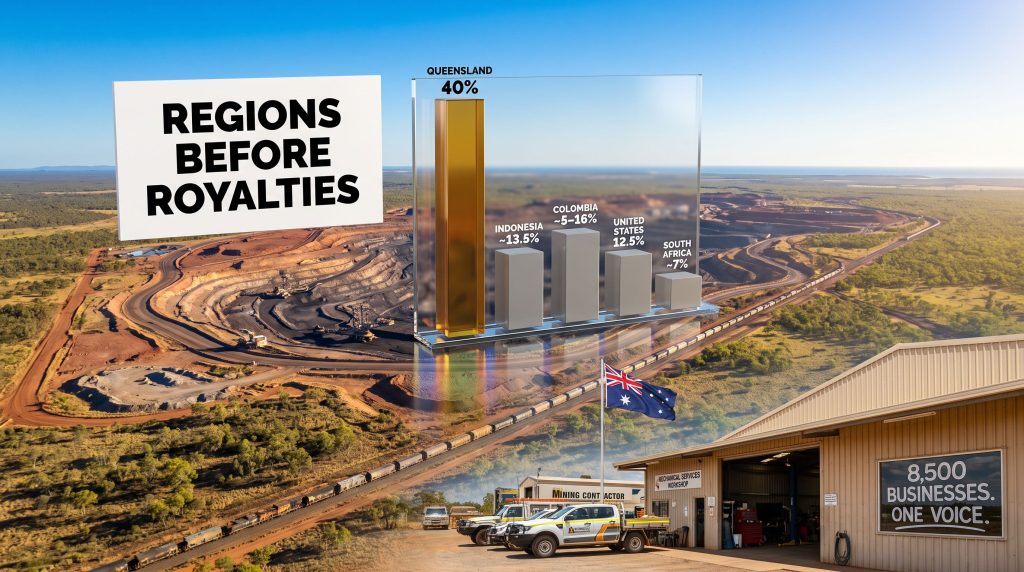
The critical threshold introduced from 1 July 2022 set the highest tier at 40% on coal sold above $300 per tonne. This was a significant departure from the pre-reform structure, where the top tier sat at a materially lower level. The change was framed by the state government as a mechanism to capture windfall profits during a period of historically elevated global coal prices driven by European energy market disruptions following Russia's invasion of Ukraine.
What the headline rate obscures is the volatility this structure introduces into operational planning. Because royalty obligations are directly linked to spot price movements denominated in US dollars, Queensland producers face a royalty bill that can swing dramatically from one quarter to the next, creating genuine difficulty in forward contract pricing and capital allocation decisions. Furthermore, these coal supply challenges compound the structural pressure already facing regional operators.
Global Comparison: How Queensland Stacks Up
When placed alongside competing coal-exporting jurisdictions, Queensland's royalty settings represent an outlier position at the upper extreme of global resource taxation.
| Jurisdiction | Maximum Royalty Rate | Rate Type |
|---|---|---|
| Queensland, Australia | Up to 40% | Progressive / price-linked |
| Indonesia | ~13.5% | Tiered |
| Colombia | ~5–16% | Variable |
| United States (federal) | 12.5% | Flat |
| South Africa | ~7% | Formula-based |
Key Insight: Queensland's top royalty tier is applied to coal prices denominated in Australian dollars but competes in export markets priced in US dollars. Currency fluctuations therefore compound the effective cost differential, meaning the real competitive disadvantage is more pronounced during periods of Australian dollar strength than the nominal rate comparison suggests.
This is a dimension of the royalty debate that rarely surfaces in public commentary. The AUD/USD exchange rate effectively acts as an amplifier on Queensland's competitiveness gap relative to producers in Indonesia or Colombia, whose domestic currencies typically depreciate against the US dollar during commodity downturns, providing a natural cost cushion that Queensland operators do not enjoy. Consequently, the resource export challenges facing Queensland are more acute than simple royalty rate comparisons suggest.
The 2022 Reforms and the Industry Response
The absence of meaningful consultation with regional supply chain businesses before the 2022 royalty changes were implemented became the foundational grievance that later crystallised into organised advocacy. Major producers had the scale and sophistication to mount immediate financial modelling of the impact. SMEs in regional communities did not, and often only understood the full implications when their contract renewal conversations changed in tone.
The Regions before Royalties campaign Queensland coal royalties movement is, in part, a delayed but structured response to that consultation gap. In addition, the broader commodity price pressures affecting mining company performance have made the timing of this campaign especially significant.
Who Is Behind the Regions Before Royalties Campaign?
The Resource Industry Network's Mandate
The Resource Industry Network operates as a not-for-profit peak body whose membership deliberately targets the economic middle layer of Queensland's resources sector. Rather than representing major coal producers, RIN's constituency spans the approximately 8,500 businesses that form the supply chain surrounding those producers, including engineering firms, equipment suppliers, maintenance contractors, technology service providers, and community-facing enterprises.
This positioning is strategically significant. Major producers have well-resourced government affairs teams and direct access to ministerial offices. The businesses RIN represents typically do not. The Regions Before Royalties campaign is therefore functioning as an access mechanism, giving SMEs a structured vehicle for political engagement that individual businesses could not sustain independently.
What the Campaign Is Actually Demanding
The Regions before Royalties campaign Queensland coal royalties debate is frequently mischaracterised as an argument for lower taxes or a return to pre-2022 royalty rates. Its actual demands are more measured and more technically defensible:
- A formal, evidence-based government review of Queensland's current coal royalty settings.
- Policy recalibration that weighs regional economic sustainability alongside state revenue maximisation objectives.
- Greater recognition within Queensland's political framework of the economic contribution made by supply chain SMEs, not just headline coal producers.
- Assurance that royalty revenue generated in regional Queensland translates into proportionate reinvestment in the communities that produced it.
The campaign's advocacy mechanics are built around a community petition designed to aggregate grassroots support across regional Queensland, supported by a digital toolkit enabling member businesses to communicate directly with their elected representatives. This model reflects a sophisticated understanding of how policy change occurs at the state level in Australia, where electoral pressure in regional seats carries disproportionate influence relative to the size of the population involved.
Campaign Core Argument: The royalty revenue flowing from regional Queensland funds hospitals, roads, and schools across the entire state. Yet the communities generating that revenue are experiencing investment withdrawal, contract reductions, and employment uncertainty as a direct consequence of the royalty structure's design.
The Real Economic Geography of Queensland's Coal Industry
Infrastructure as a Constraint and a Vulnerability
The Bowen, Surat, and Galilee Basins represent the geographic heart of Queensland's coal production, but the economic logic of the industry only functions because of the infrastructure chains connecting inland operations to coastal export terminals. The Port of Hay Point near Mackay handles a significant volume of metallurgical coal from the Bowen Basin, while Gladstone serves as the primary export gateway for thermal coal from the Surat Basin.
The rail corridors connecting these basins to their respective port terminals are not just logistical infrastructure. They are the economic arteries sustaining entire communities along their routes. Towns positioned as service hubs, including Mackay, Rockhampton, and Emerald, function because the operational health of surrounding coal mines creates consistent demand for services, accommodation, professional support, and retail activity.
The Supply Chain Multiplier That Policy Ignores
One of the most underappreciated dimensions of the royalty debate is the supply chain multiplier effect. Every dollar of direct mining expenditure generates downstream economic activity through multiple rounds of spending as contractors, their employees, and their suppliers cycle money through regional economies. Standard economic modelling typically estimates mining sector multipliers in the range of 1.5 to 2.5 times direct expenditure, though the specific figure varies by region and project type.
What this means in practice is that when a major producer reduces its discretionary supply chain expenditure by 15 to 20 percent in response to elevated royalty obligations, the actual reduction in regional economic activity is considerably larger than that percentage implies. Moreover, the mining consolidation pressures currently reshaping the sector amplify this effect further.
How Royalty Pressure Cascades: A Realistic Scenario
Scenario: A mid-tier Bowen Basin coal producer faces a substantially higher royalty bill following the introduction of the 40% tier during a period of elevated coal prices. In response, the operator initiates a procurement review and reduces discretionary maintenance contracts. A regional mechanical services firm loses multiple contracts worth several million dollars in annual revenue, triggering workforce reductions. Those workers reduce household expenditure in Mackay, affecting local retail, hospitality, and services businesses, none of whom appear in any royalty impact analysis conducted at the state level. The fiscal modelling that justified the royalty increase captured none of this downstream contraction.
This cascade dynamic is why RIN's campaign argues that royalty policy cannot be evaluated purely as a revenue instrument. It functions simultaneously as an investment climate signal, a supply chain cost-push mechanism, and an indirect determinant of regional employment levels.
Investment Climate Risks and the Sovereign Risk Question
What Investors Actually Assess
Capital allocation decisions in the coal sector are never made in isolation from jurisdictional comparisons. When a mining company's board evaluates whether to approve a new Bowen Basin project or expand an existing operation, Queensland's royalty settings are weighed alongside competing jurisdictions offering more predictable or lower fiscal terms.
The introduction of the 40% tier without adequate industry consultation introduced a sovereign risk dimension that did not previously characterise Queensland's resources policy environment. Sovereign risk in this context refers not to political instability but to the risk of retrospective or unexpectedly aggressive changes to the fiscal terms under which long-life capital investments were originally sanctioned.
Long-life mining assets, which typically require capital commitments spanning decades, are particularly sensitive to this form of risk because the investment thesis is built on assumptions about future royalty obligations that can be invalidated by legislative change.
The SME Balance Sheet Problem
For small and medium-sized businesses, the investment climate concern manifests differently. They are not evaluating greenfield capital deployment. They are assessing whether to renew equipment leases, take on additional staff, or bid for contracts that require committing working capital several months in advance.
When the operational signals from major producers suggest procurement contraction, SMEs rationally reduce their own forward commitments. The result is a synchronised pullback across the regional supply chain that is difficult to reverse quickly even if royalty settings are subsequently adjusted.
Speculative but Defensible View: If Queensland's royalty structure remains unchanged through the next major upcycle in metallurgical coal prices, the 40% tier will apply across a broader swath of production than the government's original modelling anticipated. The structural investment hesitancy this creates among both producers and their supply chains may suppress the economic benefit to regional communities during the very period when coal prices are generating maximum state revenue.
Coal as a Bridge, Not an End-State
The Diversification Argument Within the Campaign
One of the more strategically sophisticated aspects of the Regions before Royalties campaign Queensland coal royalties platform is its explicit acknowledgment that Queensland's resources sector is evolving. The campaign does not position coal as a permanent economic foundation. Instead, it frames coal's continuing profitability as a financial bridge, the income stream that allows regional businesses to remain viable long enough to pivot into new sectors as they develop.
Furthermore, Australia's critical minerals push represents exactly the kind of economic diversification that regional businesses need access to during this transition period. This framing is important because it repositions the royalty debate from a backward-looking defence of fossil fuel economics into a forward-looking argument about regional economic transition capacity.
Businesses that are forced into contraction or closure by sustained royalty-driven cost pressure cannot later retool to serve an emerging lithium or hydrogen economy. The regional human capital, technical skills, and business relationships that accumulated over decades of coal industry service are lost if the enterprises carrying them do not survive the transition period.
Metallurgical Coal's Structural Demand Position
It is worth distinguishing between thermal coal and metallurgical coal in this context, because their demand trajectories are meaningfully different. Thermal coal faces genuine long-term pressure from renewable energy displacement in power generation. Metallurgical coal, which is the dominant product of Queensland's Bowen Basin operations, occupies a structurally different position.
High-quality hard coking coal from the Bowen Basin is essential to the basic oxygen furnace steelmaking process that produces the majority of the world's steel. No commercially deployed steelmaking technology yet exists at scale that can replace coking coal entirely. Infrastructure development across Southeast Asia, India, and other emerging economies continues to drive steel demand in volumes that sustain metallurgical coal markets well beyond the timelines often cited in energy transition commentary.
The next major ASX story will hit our subscribers first
Key Takeaways for Understanding the Regions Before Royalties Debate
- Royalty design is not a neutral fiscal exercise. The structure, thresholds, and escalation mechanisms of coal royalties have direct consequences for regional investment climates and supply chain viability that extend well beyond the major producers who pay them directly.
- SMEs bear disproportionate adjustment costs when major operators respond to elevated royalty obligations by reducing discretionary supply chain expenditure. The businesses least able to absorb this pressure are the first to feel it.
- Regional communities generating royalty revenue do not automatically receive proportionate economic benefit from the fiscal centralisation of that revenue into state consolidated accounts.
- Metallurgical coal's demand position is structurally different from thermal coal, and the communities most affected by Queensland's royalty settings are primarily those serving hard coking coal operations whose global demand profile remains substantially intact.
- The sovereign risk dimension of the 2022 royalty reforms, introduced without adequate industry consultation, represents a qualitative shift in how Queensland is perceived by long-life capital allocators evaluating competing jurisdictions.
- Grassroots advocacy campaigns combining petitions with digital mobilisation represent an increasingly effective model for translating regional economic grievance into structured policy engagement at the state level, particularly in Queensland where regional electorates hold meaningful influence over government formation.
This article is intended for informational purposes only and does not constitute financial, investment, or legal advice. Forecasts, projections, and scenario analyses presented herein are based on publicly available information and represent analytical perspectives rather than verified outcomes. Readers should conduct independent research before making decisions based on any information contained in this article.
Further reporting and analysis on Queensland's coal royalty policy and regional economic impacts is available through Australian Mining at australianmining.com.au.
Want to Stay Ahead of Major Mineral Discoveries on the ASX?
While Queensland's royalty debate reshapes the investment landscape for coal and resource companies, Discovery Alert's proprietary Discovery IQ model delivers real-time alerts on significant ASX mineral discoveries — instantly translating complex mineral data into actionable opportunities for traders and investors alike. Explore historic examples of major discoveries and their market returns, then begin your 14-day free trial to position yourself ahead of the broader market.