August 25, 2026
The Geology Was Never the Problem
For decades, the global upstream oil industry operated on a simple premise: find the barrels, and the capital will follow. That logic shaped how producing nations marketed themselves to international oil companies, and for a long time, it worked. But the mechanics of capital allocation have shifted fundamentally. Today, the world's most generously endowed petroleum provinces are learning a hard lesson — geological wealth creates opportunity, but institutional quality determines who actually gets funded.
Nowhere is this tension more visible than in the Nigeria oil investment competition, where 37 billion barrels of proven oil and condensate reserves and 215.19 trillion cubic feet of natural gas sit alongside a decade-long collapse in upstream spending. Understanding why requires looking not at what is beneath the ground, but at everything above it.
When big ASX news breaks, our subscribers know first
From $26 Billion to $2 Billion: The Story Behind the Numbers
What Caused Nigeria's Investment Freefall?
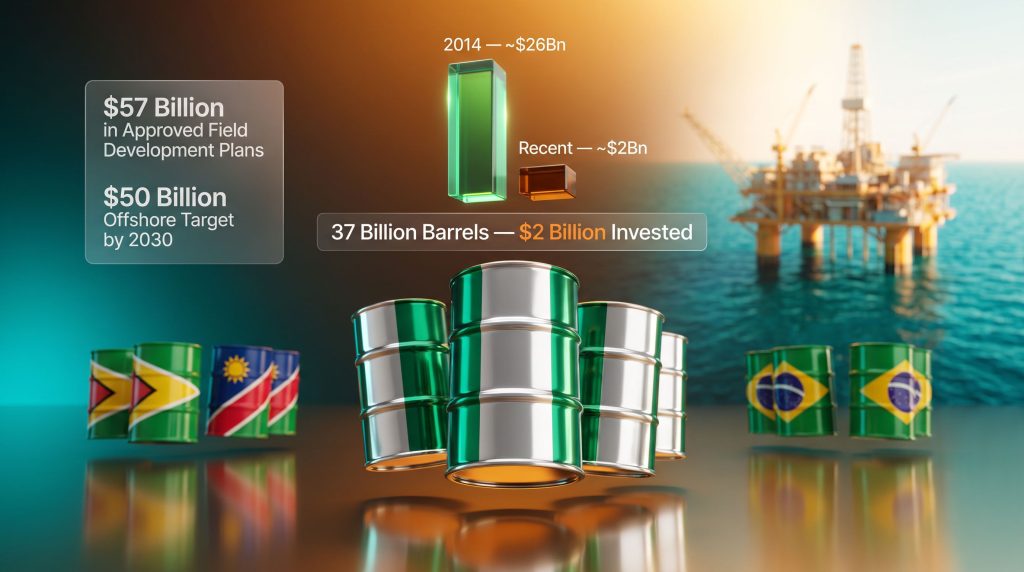
The scale of Nigeria's upstream investment contraction is difficult to overstate. Annual capital flows into the sector fell from approximately $26 billion in 2014 to roughly $2 billion in recent years — a decline of more than 90% in real terms. This did not happen because Nigeria ran out of oil. It happened because the risk-adjusted return profile of Nigerian upstream projects deteriorated sharply relative to alternatives available elsewhere in the world.
Several structural forces drove this divergence:
- Crude theft and pipeline vandalism in the Niger Delta imposed direct production losses and created persistent operating cost premiums
- Regulatory unpredictability made long-cycle project planning difficult for companies operating on 20 to 30 year investment horizons
- Administrative delays in permitting, environmental approvals, and field development plan endorsements extended pre-production timelines
- Community conflict and insecurity added an insurance and logistics cost layer that competing jurisdictions did not face
- The rise of technically accessible, low-above-ground-risk provinces in Guyana, Namibia, and Brazil offered IOCs a compelling alternative allocation for discretionary capital
The Petroleum and Natural Gas Senior Staff Association of Nigeria (PENGASSAN), following its fifth Energy and Labour Summit held in Abuja from August 19 to 21, issued a formal assessment reflecting this reality. Furthermore, the union's position was unambiguous: reserve size alone can no longer anchor Nigeria's value proposition to international investors.
How Nigeria Stacks Up Against the New Frontier Rivals
Benchmarking the Competition
The Nigeria oil investment competition is increasingly fought on dimensions where geology is only one input among many. When IOCs run capital allocation models across global upstream portfolios, they score jurisdictions across a multi-variable matrix that includes fiscal terms, regulatory architecture, security risk, permitting speed, and infrastructure readiness. These global trade war impacts have, in addition, reshaped how capital flows between competing resource jurisdictions.
| Dimension | Nigeria | Namibia | Guyana | Brazil |
|---|---|---|---|---|
| Proven Reserves | 37 Bn bbl + 215 Tcf gas | Frontier (Orange Basin) | ~11 Bn bbl | ~15 Bn bbl |
| Regulatory Framework | Reforming (PIA 2021) | Developing | Stable (PSA model) | Mature (ANP-led) |
| Security Risk | Elevated (Niger Delta) | Low | Low | Moderate |
| Fiscal Predictability | Improving | Emerging | High | High |
| Investment Trend | Recovering | Accelerating | Accelerating | Stable |
| Deepwater Activity | Resuming | Early-stage | Active | Dominant |
What makes Guyana particularly instructive is the combination of factors rather than any single advantage. The Exxon-led Stabroek block has delivered a series of first-oil milestones on schedule, underpinned by a stable production-sharing agreement framework that investors can model with confidence. Production costs are low, above-ground risk is minimal, and there is no legacy of contested infrastructure ownership.
Namibia's Orange Basin represents an even more recent case study. TotalEnergies and Shell attracted rapid exploration capital to a jurisdiction with no prior deepwater production history, largely because the licensing framework was transparent, the process was efficient, and there were no pre-existing community or regulatory disputes to navigate. For capital that can choose between a mature but complicated Nigeria and a frontier but uncomplicated Namibia, the calculus is not always straightforward.
Nigeria's competitive gap is not geological. It is structural and institutional. The reserves have always been there. What has been missing is the operating environment that converts resource potential into bankable project economics.
What Nigeria's Reform Program Has Actually Delivered
The Petroleum Industry Act and Its Real-World Impact
The Petroleum Industry Act (PIA), passed in 2021, was the most sweeping overhaul of Nigeria's upstream governance framework in a generation. Since 2023, implementation has accelerated under President Tinubu's administration, with streamlined administrative procedures, shortened approval timelines, and new offshore incentive structures introduced alongside more aggressive enforcement against crude theft networks.
The results are beginning to register in measurable terms:
- Crude oil and condensate production has recovered to 1.56 million barrels per day, the highest output level recorded since April 2020
- The upstream regulator, NUPRC, has approved more than $57 billion in field development plans since 2024
- ExxonMobil has returned to active drilling after nearly a decade of reduced engagement in Nigerian waters
ExxonMobil's reactivation carries particular significance as a sentiment indicator. The company and its partners announced in July a $1 billion commitment to the Usan Infill project, expected to contribute up to 40,000 barrels per day of additional production. Critically, the project builds on an existing producing field with established subsea infrastructure already in place, which compresses development timelines and reduces the capital intensity relative to a greenfield deepwater development.
The New Deepwater Fiscal Framework: Why Rules Matter More Than Rates
On August 11, Nigeria approved a new fiscal and regulatory framework for deepwater oil and gas development. The structural significance of this framework extends beyond its specific incentive provisions. Consequently, what investors in long-cycle capital-intensive projects value most is not the headline fiscal rate, but the degree to which that rate is established in advance and insulated from renegotiation.
The previous approach of negotiating commercial terms project by project created an implicit uncertainty premium that investors embedded in their hurdle rate calculations. Every bilateral negotiation introduced the possibility of shifting terms, which is particularly damaging for projects that require financial commitment a decade or more before they generate revenue.
The new framework replaces that negotiation model with pre-established, rules-based parameters. The target: attract up to $50 billion in offshore investment by 2030. NUPRC estimates that 22 projects could mobilise between $30 billion and $50 billion over that period. These developments also align with broader resource export challenges that have prompted similar fiscal rethinking across major producing nations.
Rules-based fiscal frameworks reduce the negotiation premium that investors price into project economics. For capital with a 25-year time horizon, a predictable 40% fiscal take is worth more than an unpredictable 30% rate.
Licensing Round Modernisation and the Signature Bonus Reduction
Nigeria has also restructured the entry economics of its licensing rounds. Signature bonuses for the most recent round were reduced to approximately $3 million to $7 million, down from $10 million in 2024 and substantially below historical levels. The intent is to widen the pool of potential bidders beyond the largest IOCs to include mid-tier operators and independents who bring technical capability but cannot absorb the capital drag of high upfront bonuses on speculative acreage.
Annual licensing rounds have been signalled as a standing commitment rather than ad hoc exercises, which creates a more predictable exploration pipeline for companies planning multi-year programmes. Nearly 300 firms competed for the latest round of oil blocks, signalling rising investor confidence in Nigeria's reformed upstream environment.
The 2025 licensing round results offer a nuanced picture of where investor appetite actually sits:
| Metric | Figure |
|---|---|
| Companies expressing initial interest | ~300 |
| Companies advancing to commercial bidding | 196 |
| Total blocks offered | 50 |
| Blocks receiving no bids | 13 |
| Implied bid coverage rate | ~74% |
The 26% of blocks receiving no bids is the figure that demands attention. It reveals that even within Nigeria's own portfolio, investor selectivity is acute. Blocks with elevated security exposure, infrastructure deficits, unclear title histories, or marginal geology are being passed over regardless of how attractive the headline incentive structure appears. This is the market telling Nigeria that reform at the framework level must translate into reality at the asset level.
The Bonga South West Aparo Test: A Decade of Waiting
Why This Project Matters to the Broader Investment Narrative
The Bonga South West Aparo project encapsulates the challenge Nigeria faces in converting reform intent into sanctioned capital. The Shell-led development, estimated at approximately $20 billion, has remained in suspension for more than ten years. During that period, competing deepwater projects in other jurisdictions moved from discovery through FID to first oil.
A final investment decision is now targeted for 2027. If that timeline is achieved and the project proceeds, Bonga South West Aparo would represent one of the largest deepwater FIDs in African upstream history. It would also serve as a powerful signal that Nigeria's institutional reforms have reached the threshold required to unlock stalled mega-projects.
Why Fiscal Incentives Are Necessary But Insufficient
The Stability Premium That No Tax Rate Can Replace
PENGASSAN's core argument, articulated after the Abuja summit, is that incentives can improve project economics at the margin but cannot substitute for the institutional durability that long-cycle capital fundamentally requires. A project sanctioned today on the basis of current fiscal terms must remain commercially viable through multiple electoral cycles, potential regulatory overhauls, and shifts in government priorities.
This is why the union is calling for recent presidential executive orders to be embedded into the PIA through National Assembly amendment. Executive orders can be reversed by the next executive. Statutory provisions within primary legislation, however, require a parliamentary majority to undo. For investors pricing sovereign and regulatory risk, this distinction has material value in their project models.
The security dimension operates similarly. Improved enforcement against crude theft has contributed to the production recovery to 1.56 million barrels per day. But enforcement campaigns are inherently cyclical. Structural solutions involving community benefit frameworks, pipeline surveillance technology, and stakeholder engagement programmes are required to eliminate the security discount from Nigerian upstream asset valuations on a durable basis. Notably, the geopolitical investment landscape across global resource markets has made such structural certainty even more critical to attracting long-cycle capital.
The next major ASX story will hit our subscribers first
Gas Monetisation: Nigeria's Parallel and Underutilised Frontier
The 215 Tcf Resource That Has Yet to Deliver Its Full Potential
Nigeria's 215.19 Tcf of proven gas reserves represent an enormous asset that has historically been poorly converted into industrial and economic value. The barriers are well understood within the sector: insufficient processing and pipeline infrastructure, a shortage of creditworthy offtakers, weak domestic market pricing signals, and a legacy of gas flaring that has seen associated gas treated as a byproduct rather than a primary revenue stream.
PENGASSAN frames gas infrastructure investment as an upstream enabler rather than a downstream afterthought. Without bankable gas offtake markets and reliable processing infrastructure, associated gas from oil production cannot be monetised. The union is calling for expanded investment across the full gas value chain:
- Gas processing capacity and pipeline network expansion
- Storage infrastructure and distribution systems for LNG, LPG, and CNG
- Gas-to-power connectivity to support industrial offtake growth
- Fertiliser and petrochemical feedstock markets to create domestic demand anchors
- Creditworthy offtake frameworks that allow gas-linked projects to achieve financial close
The broader LNG market implications of Nigeria's gas infrastructure push are significant, as global demand for flexible LNG supply continues to grow across Asian and European markets.
The Dangote Refinery as a Domestic Value Chain Anchor
The Dangote refinery, Africa's largest processing facility, represents a strategic inflection point for Nigeria's downstream integration. Industry stakeholders, including PENGASSAN, have emphasised the need for stronger policy protection of domestic refinery investments and accelerated development of petrochemical value chains connected to existing production.
Domestic refining capacity performs a dual function in the investment equation. It reduces Nigeria's structural exposure to refined product import costs, which have historically created foreign exchange pressure. Furthermore, it creates a domestic demand pathway for crude production that strengthens the overall economics of upstream development by diversifying the buyer base for Nigerian barrels.
What Durable Competitiveness Actually Requires
A Five-Pillar Framework for Sustained Investment Attraction
The trajectory of Nigeria's reform programme is positive, but the distance remaining to close the competitiveness gap with leading frontier jurisdictions is significant. Based on PENGASSAN's assessment and the structural analysis of what long-cycle capital actually requires, five interconnected pillars define the path forward:
- Legislative entrenchment of reforms — Converting executive orders and administrative directives into statutory PIA provisions to eliminate policy reversal risk across electoral cycles
- Regulatory efficiency and permitting speed — Reducing approval timelines for exploration permits, environmental assessments, and field development plans to match or exceed competing jurisdictions; broader mining permit reforms in other major economies offer instructive benchmarks for what streamlined frameworks can achieve
- Security architecture improvement — Moving from reactive enforcement toward structural community engagement and technology-enabled pipeline monitoring to eliminate the security discount permanently
- Infrastructure development as an investment prerequisite — Prioritising gas processing, pipeline expansion, and LNG/LPG infrastructure as upstream enablers rather than downstream luxuries
- Institutionalised stakeholder consultation — Establishing pre-consultation mechanisms before significant regulatory or fiscal changes to reduce the policy surprise risk that disproportionately affects long-cycle capital decisions
Frequently Asked Questions
How much oil does Nigeria have in proven reserves?
Nigeria holds approximately 37 billion barrels of proven oil and condensate reserves alongside 215.19 Tcf of natural gas, making it one of the most resource-endowed producing nations on the African continent.
Why has upstream investment in Nigeria fallen so sharply?
Annual upstream investment contracted from approximately $26 billion in 2014 to roughly $2 billion in recent years. The decline reflects a combination of crude theft, regulatory uncertainty, administrative delays, elevated operating costs, and intensifying competition for capital from jurisdictions including Guyana, Namibia, and Brazil.
What is Nigeria's new deepwater fiscal framework?
Approved on August 11, the framework replaces the previous model of project-by-project commercial negotiations with pre-established, rules-based fiscal parameters for offshore oil and gas development. It is designed to improve investor certainty and is targeted at attracting up to $50 billion in deepwater investment by 2030 across an estimated 22 projects.
What happened in Nigeria's 2025 licensing round?
Approximately 300 companies expressed initial interest, with 196 advancing to commercial bidding across 50 blocks. However, 13 blocks received no bids at all, reflecting that investor selectivity within Nigeria's own acreage portfolio remains high even under improved incentive structures.
When is a final investment decision expected on Bonga South West Aparo?
A final investment decision on the approximately $20 billion Bonga South West Aparo project, which has been on hold for more than a decade, is currently targeted for 2027. Its outcome will serve as a critical test of whether Nigeria's reformed fiscal framework can unlock large-scale stalled deepwater investments.
The Race That Cannot Be Won on Geology Alone
The recovery of Nigerian crude and condensate output to 1.56 million barrels per day, the approval of more than $57 billion in field development plans, and ExxonMobil's return to active drilling collectively indicate that the reform direction being pursued since 2023 is producing real results. These are not trivial achievements given the depth of the underinvestment cycle Nigeria has navigated.
But the Nigeria oil investment competition is ultimately a race that runs on two separate tracks simultaneously. On one track, Nigeria is improving. On the other track, Namibia is accelerating Orange Basin development, Guyana continues delivering first-oil milestones with expanding production capacity, and Brazil's pre-salt operations maintain their status as the global benchmark for deepwater execution excellence.
The critical variable is not whether Nigeria is moving in the right direction, but whether the pace of institutional reform is fast enough to prevent competing jurisdictions from locking in capital commitments that might otherwise have flowed to Nigerian projects. Reserves that have been waiting underground for decades can wait longer. Investment capital, however, cannot.
The geology was always sufficient. The question Nigeria must now answer is whether the governance architecture surrounding it can become sufficient too, and whether it can do so before the window of opportunity narrows further.
Readers seeking additional context on Nigeria's energy sector reform trajectory and African upstream investment dynamics can explore related reporting and analysis published by Ecofin Agency at ecofinagency.com.
Want to Track the Next Major Mineral Discovery Before the Market Does?
Discovery Alert's proprietary Discovery IQ model delivers real-time alerts the moment significant ASX mineral discoveries are announced, translating complex resource data into actionable investment insights for both short-term traders and long-term investors — begin your 14-day free trial today, or explore how historic discoveries have generated substantial returns to understand the scale of opportunity that early positioning can unlock.