August 25, 2026
The Great Dyke Awakens: Understanding the Strategic Weight of Zimbabwe's PGM Frontier
For most of the past century, the global platinum group metals supply chain has operated with an uncomfortable dependency at its core. South Africa accounts for roughly 70% of annual global PGM production, a concentration that creates systemic fragility for every downstream industry reliant on these metals. Automotive manufacturers, chemical processors, electronics producers, and now hydrogen technology developers all sit downstream of a supply corridor that has faced mounting structural challenges including labour unrest, ageing infrastructure, load-shedding impacts, and declining ore grades.
Against this backdrop, Zimbabwe's Great Dyke has attracted growing attention as one of the few geological formations on Earth capable of eventually challenging South Africa's dominance. The Tharisa Zimbabwe platinum mining lease, formalised through a 25-year special mining lease agreement with the Zimbabwean government for the Karo PGM project, represents one of the most consequential tenure agreements in Zimbabwe's recent mining history. Understanding what this agreement actually unlocks requires stepping back from the headline and examining the geology, the legal framework, the commodity cycle, and the sovereign dynamics all at once.
When big ASX news breaks, our subscribers know first
Why the Great Dyke Deserves More Attention Than It Gets
The Great Dyke is a narrow, linear geological intrusion stretching approximately 550 kilometres through the heart of Zimbabwe. It formed roughly 2.5 billion years ago through the same magmatic processes that produced South Africa's Bushveld Complex, the world's largest PGM-bearing geological structure. While the Bushveld has been heavily exploited for decades, the Great Dyke remains comparatively underdeveloped, partly due to historical political and economic instability that deterred foreign capital.
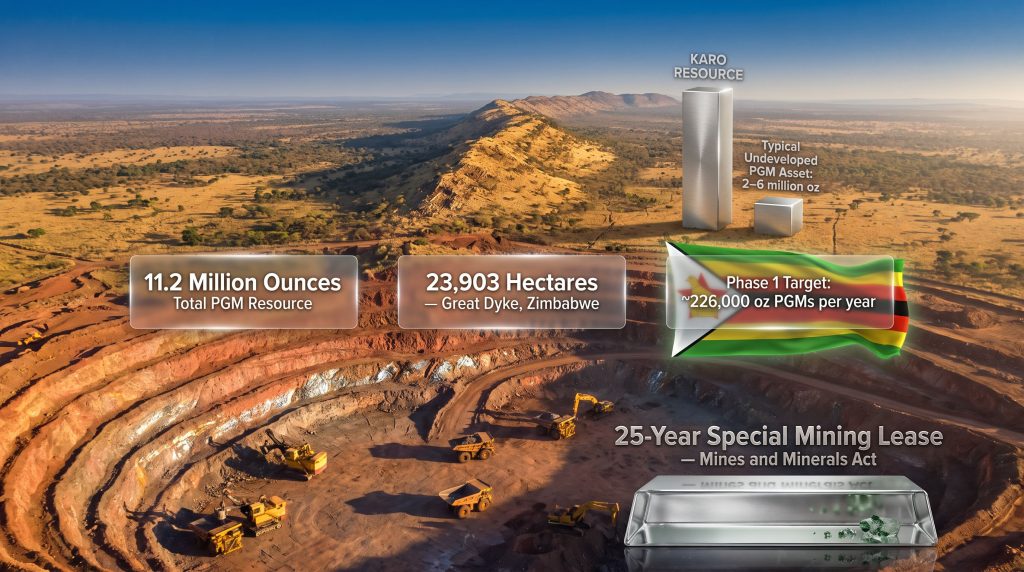
The Karo PGM project sits within this underexplored corridor and carries a resource footprint that distinguishes it from most undeveloped PGM assets globally. With a total PGM resource of 11.2 million ounces and open-pit reserves of 2.1 million ounces, Karo is not a marginal exploration-stage asset. It is a project of genuine scale, and critically, its geometry allows for open-pit mining methodology rather than the deep shaft-based extraction that characterises most South African PGM operations.
This distinction carries significant economic weight. Open-pit mining typically delivers:
- Lower per-ounce operating costs due to reduced underground infrastructure requirements
- Faster ramp-up timelines compared to shaft sinking and underground development
- Simpler occupational safety management and lower ventilation costs
- Greater operational flexibility in adjusting mining rates to market conditions
The project's Phase 1 annual production target of approximately 226,000 ounces of PGMs at full ramp-up would make Karo a meaningful contributor to global supply diversification, not simply a niche addition to the market.
How Karo Compares to Other Undeveloped PGM Assets
| Metric | Karo (Zimbabwe) | Typical Undeveloped PGM Asset |
|---|---|---|
| Total PGM Resource | 11.2 million oz | 2 to 6 million oz |
| Open-Pit Reserves | 2.1 million oz | Often underground |
| Phase 1 Annual Target | ~226,000 oz PGMs | Varies widely |
| Mining Method | Open-pit (lower cost) | Predominantly underground |
| Lease Term Secured | 25 years | Project-dependent |
| Concession Area | 23,903 hectares | Variable |
What a Special Mining Lease Actually Does Under Zimbabwean Law
The legal instrument at the centre of this development is not a standard mining licence. Zimbabwe's Mines and Minerals Act distinguishes between ordinary mining licences, which offer limited tenure and narrower fiscal certainty, and special mining leases, which are negotiated directly with the state and carry substantially greater legal weight. Furthermore, understanding PGM supply constraints helps contextualise why securing such agreements has become increasingly critical for developers operating in frontier jurisdictions.
A special mining lease typically provides:
- Long-term tenure security over a defined concession area for a fixed contractual period
- Fiscal stabilisation provisions that limit the state's ability to retrospectively alter royalty rates or tax obligations
- Defined repatriation rights enabling the mining company to move capital and profits across borders under agreed terms
- Operational clarity over environmental obligations, community development commitments, and labour requirements
For a project like Karo, covering 23,903 hectares on the Great Dyke, a 25-year lease is not merely a legal formality. It is the foundational instrument that makes the project bankable in the technical financing sense. Project finance lenders, who typically provide the senior debt that funds major mining construction, require conditions precedent to be satisfied before drawdown. Secure tenure over the project's full operational life is almost universally among those conditions.
A 25-year special mining lease does not merely grant extraction rights. It establishes the fiscal and regulatory certainty that transforms a geological asset into a bankable project capable of attracting institutional debt and equity capital at the scale required for construction.
The ownership architecture embedded in the Tharisa agreement also reflects Zimbabwe's broader approach to strategic mineral development. The Zimbabwean government holds a 15% equity stake in the Karo project. This model, increasingly common across sub-Saharan African mining jurisdictions, serves a dual function. It ensures the sovereign captures direct economic participation in project success, and it aligns government interests with project performance rather than against it.
The PGM Price Cycle That Reshaped Karo's Development Timeline
The path to this lease signing was far from linear. Between 2023 and 2024, PGM prices experienced one of their sharpest corrections in recent memory. The primary driver was not a demand collapse in existing applications, but rather a shift in forward-looking market expectations driven by battery electric vehicle adoption forecasts.
PGMs serve a critical industrial function in autocatalysts, the emission control systems fitted to internal combustion engine vehicles. Platinum, palladium, and rhodium work together within catalytic converters to neutralise harmful exhaust gases. Battery electric vehicles do not use catalytic converters at all, meaning aggressive BEV adoption forecasts implied a structurally shrinking demand pool for PGMs' largest end-use application. Consequently, the platinum and palladium market dynamics of this period created considerable uncertainty across the entire development pipeline.
Markets priced in this scenario ahead of the physical reality, producing a period of significant price weakness that directly impacted capital allocation decisions across the global PGM development pipeline. For Karo specifically, the consequence was a revised first production target of 2027, representing a three-year delay from the project's original schedule.
The 2025 price recovery that followed was driven by two converging forces:
- South African supply continued to contract as major producers faced persistent cost pressures, infrastructure challenges, and declining grades, reducing available global supply
- EV adoption rates proved materially slower than consensus forecasts, extending the operational life and demand contribution of the global internal combustion engine vehicle fleet
PGM Market Scenario Framework
| Scenario | EV Adoption Pace | South African Supply | Karo Project Impact |
|---|---|---|---|
| Base Case | Moderate growth | Continued decline | Improved project economics by 2027 |
| Bull Case | Slower than expected | Accelerated supply decline | Strong returns, potential early ramp-up |
| Bear Case | Rapid acceleration | Supply stabilisation | Margin compression, timeline risk |
Beyond Catalytic Converters: The Structural Demand Pillars Most Investors Miss
One of the more nuanced aspects of the PGM investment thesis involves the metal's demand profile outside automotive applications. The popular narrative frames PGM demand as primarily an automotive story, making these metals appear structurally vulnerable to electrification. However, this framing significantly underweights several growing demand vectors, including the rising critical minerals demand driven by the global energy transition.
Hydrogen fuel cell technology represents perhaps the most compelling long-term demand driver for platinum specifically. Hydrogen fuel cells use platinum as a catalyst to generate electricity through an electrochemical reaction between hydrogen and oxygen. As governments and industrial planners invest in hydrogen infrastructure for heavy transport, industrial decarbonisation, and grid storage applications, platinum demand from this sector is expected to grow substantially over the coming decade.
Additional industrial demand sources include:
- Chemical processing where platinum and palladium serve as industrial catalysts in nitric acid and other chemical production
- Electronics manufacturing where PGMs are used in hard disk drives, sensors, and advanced components
- Glass manufacturing where platinum crucibles and bushings are used in high-temperature production processes
- Investment demand through exchange-traded funds and physically-backed instruments
Karo's production timeline, targeting first output in 2027, positions the project to benefit from both the near-term recovery in autocatalyst demand and the medium-term ramp-up in hydrogen economy-related platinum consumption.
Assessing Zimbabwe as a Mining Jurisdiction in 2025 and Beyond
Any rigorous analysis of the Karo project must engage honestly with Zimbabwe's sovereign risk profile. The country carries a legacy of resource nationalism episodes, hyperinflationary monetary history, and policy unpredictability that created a multi-decade deterrent to foreign mining capital.
The current policy environment reflects deliberate reform efforts aimed at repositioning Zimbabwe as a competitive destination for mining investment. These include amendments to indigenisation legislation, the growing role of mining special economic zones, and the formalisation of bilateral investment protections. The Tharisa Zimbabwe platinum mining lease itself functions as a form of sovereign signalling, demonstrating to the international investment community that the government is prepared to offer long-term, contractually secure frameworks for major projects.
In addition, the adoption of renewable energy in mining operations is increasingly influencing how developers assess Zimbabwe's infrastructure gaps, with solar and hybrid power solutions offering viable alternatives to grid dependency in remote project locations.
Zimbabwe Mining Jurisdiction Risk Assessment
| Risk Category | Current Assessment | Direction |
|---|---|---|
| Regulatory Stability | Improving | Positive trend |
| Fiscal Transparency | Moderate | Stable |
| Infrastructure Adequacy | Developing | Improving |
| Currency and Repatriation Risk | Elevated | Requires monitoring |
| Political Risk Premium | Moderate to High | Gradual reduction |
The government's 15% equity stake model warrants particular attention as a risk mitigation mechanism. When a sovereign holds a meaningful equity interest in a project, its incentive structure shifts fundamentally. Policy actions that damage project economics directly damage the sovereign's own financial position. This alignment does not eliminate political risk, but it reduces the probability of retrospective interference that has historically characterised less sophisticated resource nationalism approaches.
The next major ASX story will hit our subscribers first
The Financing Pathway From Lease to Construction
With the special mining lease secured, the critical next phase for the Karo project involves assembling the financing structure required to fund construction. This typically involves a combination of senior project finance debt from development finance institutions or commercial lenders, equity contributions from project sponsors, and potentially offtake-backed financing where committed purchase agreements from refined metal buyers are used to de-risk the lending package.
Phase 1 of the Tharisa Zimbabwe platinum mining lease project is expected to employ more than 1,000 people, representing a substantial socioeconomic contribution to the surrounding region. Infrastructure development requirements including power supply, water access, processing plant construction, and logistics corridor establishment represent significant capital deployment ahead of first production.
Key milestones between the lease signing and the 2027 production target include:
- Project financing close and satisfaction of lender conditions precedent
- Environmental impact assessment completion and regulatory approvals
- Engineering, procurement, and construction contractor appointment
- Infrastructure development including power and water supply establishment
- Processing facility construction and commissioning
- Workforce recruitment, skills development, and community engagement programmes
- Operational ramp-up toward full Phase 1 production capacity
Frequently Asked Questions: Tharisa Zimbabwe Platinum Mining Lease
What is the Tharisa Zimbabwe platinum mining lease?
Tharisa has secured a 25-year special mining lease with the Zimbabwean government for its Karo PGM project, covering 23,903 hectares on the Great Dyke. This agreement provides the long-term tenure and fiscal certainty required to advance the project toward construction and first production.
When is the Karo project expected to begin production?
First production from Karo is currently targeted for 2027, following a three-year delay from the original schedule, primarily caused by the sharp decline in PGM prices experienced between 2023 and 2024.
How large is the Karo PGM resource?
Karo holds a total PGM resource of 11.2 million ounces, with open-pit reserves of 2.1 million ounces. Phase 1 is designed to produce approximately 226,000 ounces of PGMs annually at full ramp-up.
What stake does the Zimbabwean government hold in Karo?
The Zimbabwean government holds a 15% equity stake in the Karo project as part of the agreed ownership structure under the special mining lease framework.
What does a special mining lease mean under Zimbabwean law?
Under Zimbabwe's Mines and Minerals Act, a special mining lease is a long-term, legally binding agreement between a mining company and the state defining extraction rights, fiscal terms, and operational parameters. It provides substantially greater security than a standard mining licence and is the instrument typically required to satisfy project finance lender conditions.
Why did PGM prices fall so sharply between 2023 and 2024?
Market expectations around the pace of electric vehicle adoption shifted demand forecasts for catalytic converters, the primary industrial application for platinum, palladium, and rhodium. This expectation-driven repricing preceded the physical demand impact, compressing margins across the PGM development pipeline before the mid-2025 recovery took hold.
This article is intended for informational purposes only and does not constitute financial or investment advice. All forecasts, production timelines, and price scenario analyses involve inherent uncertainty. Readers should conduct independent research and consult qualified financial advisers before making investment decisions. Past commodity price recovery cycles do not guarantee future performance.
Want to Stay Ahead of the Next Major Mineral Discovery on the ASX?
Discovery Alert's proprietary Discovery IQ model delivers real-time alerts on significant ASX mineral discoveries across more than 30 commodities — including PGMs — turning complex geological data into actionable investment insights for both traders and long-term investors. Explore historic discoveries and their exceptional market returns, then begin your 14-day free trial at Discovery Alert to position yourself ahead of the broader market.