August 25, 2026
When Record Prices Tell Only Half the Story
Commodity markets move in long, grinding cycles that can last decades. The history of major mining stocks is littered with examples of investors who bought at what appeared to be peak prices, only to watch those levels become the floor of the next upcycle years later. Equally common are the cautionary tales of those who ignored valuation signals at the top and paid a steep price in portfolio drawdowns. Understanding which scenario is playing out requires more than tracking a share price headline.
BHP Group Ltd (ASX: BHP) reaching a fresh all-time high on the ASX in August 2026 is the kind of milestone that generates equal measures of excitement and anxiety among investors. The excitement is straightforward: a 56% gain over 12 months is exceptional performance from one of the world's largest diversified miners. The anxiety stems from a simple but persistent question in markets: when everyone already knows the good news, has all of it already been priced in?
Answering that question requires peeling back the layers of this rally, examining what actually drove BHP shares all-time high territory, and stress-testing whether the business fundamentals can support the current valuation.
When big ASX news breaks, our subscribers know first
Decoding the Record: Not All All-Time Highs Are Equal
Before drawing conclusions from BHP's record price, it is worth understanding that the specific figure you encounter depends heavily on where and how you are looking at the data. BHP operates as a dual-listed company, meaning its shares trade simultaneously on the ASX in Australian dollars and on the London Stock Exchange in British pounds. The two listings do not always move in perfect lockstep, and currency fluctuations introduce additional complexity.
The table below illustrates how different data sources and measurement conventions produce different record figures:
| Data Source | BHP Price Milestone | Date |
|---|---|---|
| ASX Intraday High | A$67.88 | August 25, 2026 |
| ASX Intraday High (prior session) | A$67.72 | August 24, 2026 |
| Macrotrends All-Time Closing High | A$93.15 | June 2, 2026 |
| CNBC 52-Week High | A$93.83 | June 16, 2026 |
| Yahoo Finance Closing Price | A$86.78 | August 14, 2026 |
The variation between A$67.88 and A$93.83 is not a data error. It reflects a combination of factors including which listing venue is being referenced, whether an intraday or closing price is being recorded, and how currency conversion is applied. Investors comparing performance figures across sources should always confirm which price series is being used before drawing conclusions. For further context, BHP's historical price data provides a useful long-term reference when assessing the significance of recent record levels.
Why Dual Listings Create Price Complexity
BHP's dual-listed structure means that arbitrage forces tend to keep the two listings broadly aligned in economic terms, but short-term divergences can and do occur. The LSE-listed shares, converted to AUD at prevailing exchange rates, have historically traded at slightly different implied prices to the ASX equivalent depending on the AUD/GBP rate and relative liquidity conditions in each market. This is not a flaw in the system; it is simply the nature of dual-listing mechanics that sophisticated investors factor into any cross-market comparison.
The FY26 Earnings Catalyst: Why This Rally Has Substance
Share price records can be driven by sentiment alone, or they can reflect genuine shifts in business fundamentals. In BHP's case, the August 2026 record appears anchored in real earnings performance rather than speculative enthusiasm.
Approximately one week before the August 25 all-time high on the ASX, BHP released its FY26 full-year results. The numbers were compelling across multiple dimensions:
- Underlying EBITDA rose by 27% year-on-year, a standout result at any point in the commodity cycle
- Net profit reached approximately A$13.7 billion, placing BHP back into peak earnings territory
- Strong operational output was delivered across copper, iron ore, and the emerging potash division
- The balance sheet remained in a position that supports continued dividend payments at or above the company's minimum 50% payout ratio
The market's response was immediate and sustained. A stock that was already up meaningfully for the year accelerated further, reflecting investor confidence that the FY26 result was not a one-off but rather a validation of the BHP strategic pivot toward commodities linked to the energy transition and industrial growth.
Contextualising BHP's Outperformance Against the Broader Market
The scale of BHP's outperformance relative to the ASX 200 in 2026 is difficult to overstate. The following comparison illustrates the gap clearly:
| Timeframe | BHP Share Price Return | ASX 200 (XJO) Return |
|---|---|---|
| Past 1 month | ~+13% | ~+3% |
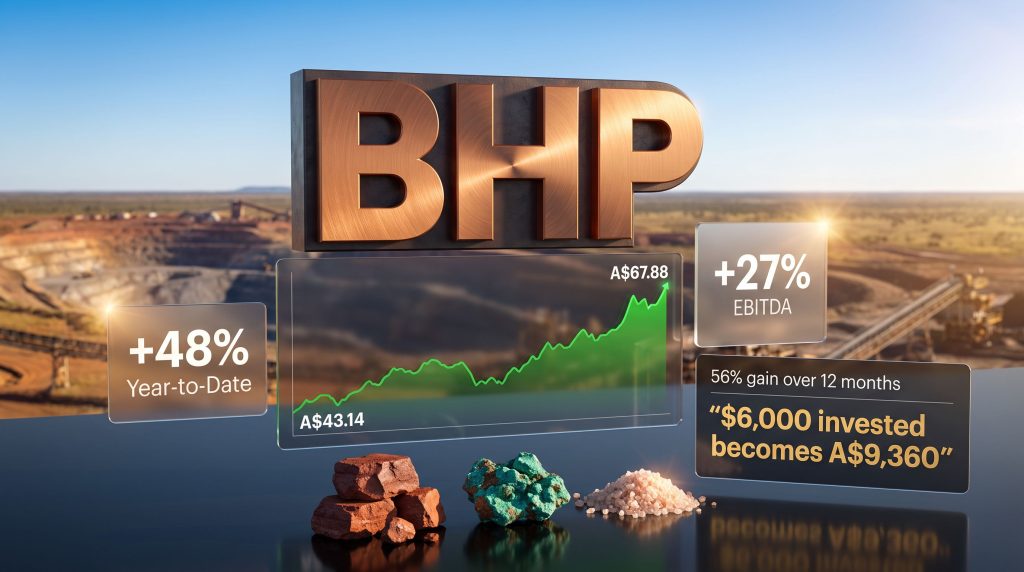
| Year-to-date (2026) | ~+48% | ~+5% |
| Past 12 months | ~+56% | Significantly lower |
A 48% year-to-date advance against a 5% index gain is the kind of outperformance that attracts both institutional and retail attention. It also raises legitimate questions about whether company-specific momentum has begun to run ahead of what underlying commodity prices alone can justify. The ASX 200 benchmark provides important context for measuring just how significant this gap in performance truly is.
Turning the 12-Month Return Into Real Numbers
Performance percentages become more meaningful when translated into tangible portfolio outcomes. BHP shares were trading at approximately A$43.14 twelve months prior to the August 25, 2026 record. The progression to A$67.88 represents a capital gain of approximately 56%.
For a hypothetical investor who allocated A$6,000 to BHP shares at that entry point:
- Initial investment: A$6,000 at approximately A$43.14 per share
- Portfolio value at August 25, 2026: approximately A$9,360
- Capital gain: approximately A$3,360 before fees and taxes
- Gain percentage: approximately 56%
Important disclaimer: This is a hypothetical scenario for illustrative purposes only. It excludes brokerage fees, capital gains tax, and dividend income. Past performance is not indicative of future returns. This does not constitute personal financial advice.
The Dividend Layer That Most Headlines Miss
The capital gain calculation above does not capture BHP's dividend contribution to total returns, which for income-focused investors can be material. BHP has maintained a minimum 50% payout ratio on underlying attributable profit as a stated policy, meaning that in a year where profits approached A$13.7 billion, dividends are likely to have been meaningful.
For long-term holders, total shareholder return (capital appreciation combined with dividends received) typically exceeds the headline price gain by a meaningful margin with BHP. This distinction matters particularly for SMSF investors or those building passive income portfolios, where the reinvestment of dividends through dividend reinvestment plans compounds returns over time in ways that pure price-watchers tend to underestimate.
What Brokers Are Saying: A Community Divided
One of the more revealing aspects of BHP's current position is the wide divergence of professional opinion about where the shares go from here. The consensus is not bullish.
Market Index aggregated broker data:
- Majority rating: Hold
- Average 12-month price target: A$61.78
- Implied move from A$67.88: approximately -9% downside
TradingView survey of 23 analysts:
- 13 analysts rated BHP as Hold
- 6 analysts assigned a Strong Buy
- 4 analysts issued a Sell or Strong Sell rating
- Average 12-month price target: A$62.68 (implying approximately -8% downside)
The individual broker positions tell a nuanced story:
| Broker | Rating | 12-Month Price Target | Implication |
|---|---|---|---|
| Morgan Stanley | Buy (renewed) | A$67.50 | Roughly in line with current price |
| Red Leaf Securities | Hold | Not specified | Wait for better entry |
| Morgans | Trim | A$55.30 | ~19% downside flagged |
What the Extreme Range of Price Targets Reveals
Perhaps the most instructive data point in the entire broker landscape is not the average target but the spread between the most bearish and most bullish forecasts:
| Scenario | Target Price | Implied Move from A$67.88 |
|---|---|---|
| Most Bearish | A$43.72 | -36% |
| Consensus Average | ~A$62.00 | -8% to -9% |
| Most Bullish | A$91.71 | +35% |
When analyst price targets span a range of more than 70%, it is rarely a signal of disagreement about operational quality. It is almost always a signal of deep uncertainty about the external commodity price environment that drives earnings. For BHP, that external variable is primarily iron ore and, increasingly, copper.
Morgan Stanley's renewed buy rating at a target of A$67.50 is worth examining carefully. The fact that their price target essentially matches the current trading price suggests the firm sees fair value at current levels rather than meaningful further upside, even under a constructive scenario. Furthermore, Morgans' Trim rating and A$55.30 target reflects a view that the share price has already absorbed the good news from the FY26 results, leaving little margin of safety for new buyers.
Commodity Fundamentals: The Engine Under the Hood
BHP's earnings power is inseparable from the prices of the commodities it produces. Understanding the underlying dynamics of each is essential for any investor considering whether the BHP shares all-time high represents a genuine opportunity or a warning sign.
Iron ore remains the single largest earnings contributor within BHP's portfolio. The iron ore demand outlook is primarily determined by Chinese steel production volumes, which in turn depend on construction activity, infrastructure spending, and manufacturing output across China. Monitoring the iron ore demand outlook is therefore central to any serious assessment of BHP's earnings trajectory. Any sustained deceleration in Chinese economic activity poses a direct risk to BHP's margins.
Copper is the commodity that many analysts believe will define BHP's next decade. The metal is central to electrification infrastructure, including power grids, electric vehicles, and renewable energy installations. However, the copper supply crunch has been constrained by a decade of underinvestment in new mines, grade decline at existing operations, and increasingly complex permitting environments globally. BHP's copper operations, primarily centred on the Escondida mine in Chile, position the company as a major beneficiary of these long-term electrification trends.
Potash represents BHP's most significant long-term growth bet through the Jansen project in Saskatchewan, Canada. While still in its development phase and requiring substantial capital expenditure in the near to medium term, Jansen targets a market tied to global food security and agricultural productivity. This gives BHP a commodity exposure with a fundamentally different demand driver to its existing portfolio.
The next major ASX story will hit our subscribers first
Buying at All-Time Highs: The Psychology and the Framework
There is a deeply embedded psychological resistance to buying assets at record prices. The intuition that something must be expensive because it has never been higher is understandable but not always analytically correct. Markets establish new all-time highs with regularity across long investment horizons; the question is whether the business has grown into its valuation or exceeded it.
For BHP specifically, three questions provide a useful decision framework:
-
Are earnings supporting the valuation or running ahead of it? With EBITDA up 27% and profits near A$13.7 billion, the FY26 result justifies a meaningful re-rating. The risk is that this earnings strength has already been fully capitalised in the share price, leaving future upside dependent on further commodity price appreciation.
-
What does your investment horizon allow? Short-term traders face a statistically unfavourable setup, with consensus targets implying 8-9% downside over 12 months. Long-term investors with a 5-10 year horizon are better positioned to absorb a near-term correction if commodity fundamentals remain broadly supportive through the cycle.
-
Can you tolerate the bear case? The most pessimistic analyst target of A$43.72 implies a 36% decline from current levels. Any investor unable to withstand that scenario without making reactive decisions should think carefully about position sizing.
Staged Entry as a Risk Management Tool
Investors who want exposure to BHP but are uncomfortable committing a full allocation at record prices have a practical alternative: deploying capital in tranches over a 3-6 month window. This dollar-cost averaging approach does not eliminate downside risk, but it reduces the impact of poor timing on overall portfolio returns. Given the wide dispersion in analyst targets and the genuine uncertainty about near-term commodity price direction, staged entry represents a disciplined way to participate in BHP's long-term story without taking excessive concentration risk at a single price point.
How BHP's 2026 Performance Compares to Peers
BHP's 48% year-to-date advance in 2026 materially exceeds the broader ASX 200 resources sector's performance, suggesting that the company's FY26 earnings outperformance, rather than sector-wide tailwinds alone, has been the dominant driver. Peer context with Rio Tinto (ASX: RIO) and South32 (ASX: S32) is instructive here, as both companies operate across overlapping commodity exposures and provide a baseline for assessing whether BHP's premium is justified.
Key comparative metrics worth examining include EBITDA margin differentials, dividend yield spreads, price-to-earnings ratios across the cycle, and relative copper versus iron ore exposure. BHP's growing copper weighting, particularly through Escondida, arguably warrants a modest valuation premium over peers with heavier iron ore concentration, given copper's stronger long-term demand outlook and supply constraints. For investors seeking the most current price data, BHP's live ASX listing offers an up-to-date view of trading activity and recent announcements.
Frequently Asked Questions: BHP Shares All-Time High
What is BHP's all-time high share price on the ASX?
As of August 25, 2026, BHP shares reached an intraday record of approximately A$67.88 on the ASX. Different data sources and listing venues may show different figures, with some sources citing closing highs above A$93 for the broader BHP price series depending on the exchange and currency measurement used.
Why did BHP shares hit an all-time high in August 2026?
The primary catalyst was BHP's FY26 full-year earnings results, which delivered a 27% increase in underlying EBITDA and profits approaching A$13.7 billion. The results triggered broad-based buying across institutional and retail investors who interpreted the outcome as confirmation of BHP's earnings recovery.
Is BHP a good buy at current prices?
Broker consensus leans toward Hold, with average targets implying 8-9% downside from the August 25 record price. Individual suitability depends on your risk tolerance, investment horizon, and existing portfolio exposure to commodity-linked assets. This article does not constitute personal financial advice.
What would a $6,000 investment 12 months ago be worth today?
A A$6,000 investment in BHP shares 12 months ago at approximately A$43.14 per share would have grown to approximately A$9,360 as of August 25, 2026, representing a capital gain of roughly 56% before fees, taxes, and dividends.
What is the biggest risk to BHP's share price from current levels?
Iron ore price weakness driven by a slowdown in Chinese steel production represents the most significant near-term earnings risk. A sustained decline in iron ore spot prices could materially compress BHP's margins given the commodity's continued dominance within the company's earnings mix.
Key Takeaways at a Glance
- BHP shares reached an ASX intraday all-time high of approximately A$67.88 on August 25, 2026
- The 12-month capital gain of approximately 56% dwarfs the broader ASX 200's performance over the same period
- The rally was anchored in genuine earnings strength, with FY26 EBITDA up 27% and profits approaching A$13.7 billion
- Broker consensus leans Hold, with average price targets implying 8-9% downside from the record price
- The bull-to-bear analyst target range spans more than 70%, reflecting commodity price uncertainty rather than disagreement about BHP's operational quality
- Long-term investors should weigh BHP's copper growth optionality, dividend track record, and asset quality against the risk of entry at a cyclically elevated valuation
- A staged entry strategy and clear understanding of the bear case are essential tools for anyone considering adding BHP at current levels
This article contains general information only and does not constitute personal financial advice. Always consider your individual circumstances and consult a licensed financial adviser before making investment decisions. Past performance is not indicative of future returns.
Want to Know Which ASX Mining Stocks Could Be the Next Major Discovery?
While BHP's record-breaking performance demonstrates the extraordinary returns that top-tier mining investments can generate, Discovery Alert's proprietary Discovery IQ model scans ASX announcements in real time to identify significant mineral discoveries the moment they are made public — giving subscribers an immediate edge on actionable opportunities before the broader market reacts. Explore historic discoveries and their remarkable returns, then begin your 14-day free trial at Discovery Alert to position yourself ahead of the next major find.