June 12, 2026
The Mineral That Energy Transition Forgot to Secure
For decades, the global energy transition conversation centred on lithium, cobalt, and rare earth elements. Billions of dollars flowed into securing supply chains for these well-publicised inputs, while a quieter but equally critical mineral slipped beneath the radar of most strategic planners. That mineral is antimony, and the fragility of its supply architecture is now forcing a fundamental rethink of how advanced economies source the building blocks of clean energy technology.
The story of Australia antimony production in Port Pirie is not simply a manufacturing story. It is a case study in what happens when geopolitical risk and industrial inertia collide, and what becomes possible when legacy infrastructure meets urgent strategic necessity.
When big ASX news breaks, our subscribers know first
Why Antimony Occupies a Unique Position in the Critical Minerals Hierarchy
The Technical Properties That Create Lock-In
Antimony sits at the intersection of several high-growth industrial sectors in a way that few other elements can match. As a metalloid, it exhibits properties of both metals and non-metals, giving it unusual versatility across chemically and thermally demanding applications. Its ability to form stable oxides, particularly antimony trioxide, makes it exceptionally effective as a flame retardant synergist in polymer materials, including the coatings and insulation systems used extensively in renewable energy infrastructure.
In the energy storage sector, antimony is gaining increasing attention for its role in next-generation grid-scale battery architectures. Molten metal battery systems and certain flow battery chemistries rely on antimony's electrochemical properties to deliver the thermal stability and cycling performance that large-scale energy storage demands. As grids become more dependent on intermittent solar and wind inputs, the pressure on energy storage technology is intensifying, and with it, the demand for the materials that enable it.
Beyond energy, antimony trioxide plays an essential role in military-grade flame retardants and ammunition components, while refined antimony metal is used in semiconductor manufacturing as a dopant material in compound semiconductors. Understanding antimony's critical role across these sectors reveals why its dual-use nature elevates its geopolitical sensitivity well beyond that of a standard industrial commodity.
The challenge with antimony is that substitution is not straightforward. Alternative flame retardant systems exist but typically involve performance trade-offs, cost penalties, or require redesign of existing product formulations. In battery chemistry, the electrochemical characteristics of antimony are difficult to replicate with materials that are currently commercially scalable. This technical stickiness is precisely what makes supply chain concentration so dangerous.
The 90% Concentration Problem
China, Russia, and Tajikistan collectively account for more than 90% of global antimony production, according to Energy Digital Magazine's May 2026 reporting. This level of geographic concentration means that a single policy decision by any one of these producers can send procurement teams across advanced economies scrambling for alternatives that, until recently, simply did not exist at meaningful scale.
This is not a theoretical risk. It is a risk that materialised. China's decision to restrict antimony exports to the United States created exactly the cascade of procurement disruptions and price volatility that supply chain analysts had long warned about. The downstream effects were felt across renewable energy technology manufacturing timelines, defence procurement schedules, and electronics supply chains simultaneously. Furthermore, the antimony shortage risks for defence and industry have become increasingly difficult to ignore at the policy level.
The concentration of over 90% of global antimony output among three countries, at least one of which has demonstrated willingness to weaponise export controls, represents a structural vulnerability that policy frameworks alone cannot resolve. Physical production capacity in allied nations is the only durable solution.
What makes antimony particularly difficult to hedge against is that it does not receive the same investor and policy attention as lithium or rare earths, meaning emergency diversification efforts must start from a lower base of existing allied production capacity. Port Pirie is changing that calculus.
China's Export Restrictions and the Supply Chain Inflection Point
When Policy Becomes Procurement Crisis
China's restrictions on antimony exports to the United States did not occur in isolation. They formed part of a broader pattern of critical mineral export controls that China has employed as a tool of economic statecraft, a pattern visible across gallium, germanium, graphite, and rare earth processing. Each restriction has served as a wake-up call for allied governments, but the antimony restriction carried particular urgency given antimony's role in both clean energy and defence applications.
The immediate market response was predictable in direction if not in magnitude: prices spiked, procurement teams faced allocation shortages, and companies that had relied on just-in-time sourcing from Chinese suppliers found themselves without adequate inventory buffers. For manufacturers of energy storage systems, flame retardant materials, and advanced electronics, this was not an abstract supply chain concern — it was a production constraint with direct revenue implications. In addition, bismuth export controls have compounded these pressures, highlighting how interconnected China's export restriction strategy has become across multiple critical minerals.
Allied nations began reassessing critical mineral dependencies in parallel. The United States, Australia, Japan, South Korea, Canada, and European Union member states all intensified efforts to identify alternative production sources and accelerate domestic or allied processing capacity. The US-Australia relationship emerged as a particularly productive axis for this response, given Australia's existing metallurgical infrastructure and the bilateral trust frameworks already in place.
The US-Australia Framework: Structure and Strategic Intent
The US-Australia Critical Minerals and Rare Earths Framework represents the formal policy architecture through which both nations have committed to reducing Western dependence on Chinese antimony supply. In August 2025, the South Australian and Australian federal governments jointly announced A$135 million in funding directed at Port Pirie's antimony production expansion, as reported by Energy Digital Magazine. Consequently, strategic antimony financing at the project level is increasingly underpinned by formal bilateral commitment rather than speculative interest.
| Policy Element | Detail |
|---|---|
| Funding Announced | August 2025 |
| Total Committed Funding | A$135 million (Federal + South Australian) |
| Bilateral Framework | US-Australia Critical Minerals and Rare Earths Framework |
| Primary Beneficiary Site | Port Pirie, South Australia |
| Operator | Nyrstar |
| Strategic Objective | Reduce Western dependence on Chinese antimony supply |
It is important to distinguish between a policy framework and project-specific government support. The A$135 million commitment reflects a concrete funding decision by both levels of Australian government, not merely a policy aspiration. The US-Australia framework provides the strategic and diplomatic architecture within which these decisions are made, but investors and analysts should assess each specific funding commitment independently rather than assuming the full framework automatically translates to project-level support across all participants.
Port Pirie: Why 130 Years of Industrial History Is a Strategic Asset
Infrastructure as Competitive Advantage
One of the most underappreciated aspects of Australia antimony production in Port Pirie is how heavily the economics of the project depend on existing infrastructure that took more than a century to accumulate. Port Pirie has operated as one of the world's largest lead smelting sites for over 130 years, according to Energy Digital Magazine. That history translates into a physical and operational platform that would cost hundreds of millions of dollars and many years to replicate from scratch.
The pyrometallurgical infrastructure already in place — covering high-temperature processing furnaces, refining equipment, materials handling systems, port access, and an experienced metallurgical workforce — provides the foundation upon which antimony processing has been grafted. Critically, antimony occurs naturally in association with lead mineralogy, meaning that lead smelter feed streams contain antimony as a co-product that can be selectively recovered and refined without requiring entirely new upstream mining operations.
This by-product recovery model is technically elegant and economically powerful. Rather than building a standalone antimony mine, concentrator, and smelter from the ground up, Nyrstar can extract antimony value from material streams that are already being processed for their lead content. The marginal capital cost of adding antimony recovery to an existing operation is substantially lower than the all-in cost of a greenfield antimony project.
Brownfield vs. Greenfield: The Speed Advantage
The comparison between brownfield expansion and greenfield development is not purely academic. When supply chain disruption is occurring in real time and governments are committing funding to accelerate allied production, the ability to bring new output to market within months rather than years is a decisive advantage.
A greenfield antimony mine and processing facility would typically require:
- Multi-year exploration and resource definition programs
- Environmental impact assessment and permitting processes spanning two to five years
- Design and engineering phases of 18 to 36 months
- Construction periods of two to four years
- Commissioning and ramp-up periods of six to 18 months
Total timeline from discovery to commercial production: commonly seven to fifteen years.
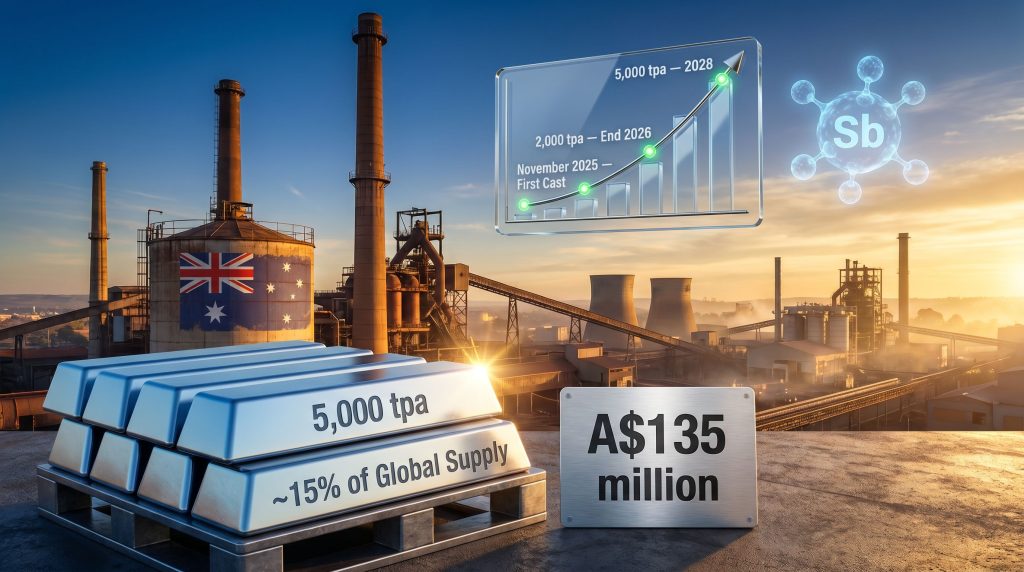
By contrast, Nyrstar cast its first antimony metal at Port Pirie in November 2025, representing a commercially meaningful proof of production capability reached in a fraction of that greenfield timeframe. This speed advantage is the brownfield model's most strategically relevant characteristic in the current geopolitical environment.
Brownfield repurposing of mature metallurgical facilities represents one of the fastest and most capital-efficient pathways to critical mineral production. Port Pirie's trajectory from pilot plant to commercial export in under two years demonstrates what is possible when industrial legacy meets strategic urgency.
A Technical Breakdown of Antimony Production at Port Pirie
From Lead Smelter By-Product to Commercial Antimony Metal
The process of recovering antimony at Port Pirie begins with the same lead-bearing feed materials that have flowed through the facility for generations. Within these materials, antimony is present as a natural impurity that historically may have been managed as a contaminant or discarded in process residues. The shift in perspective — from antimony as a nuisance element to antimony as a valuable product — reflects both the changed market dynamics and the engineering investment Nyrstar has made in refining its process flowsheet.
Pyrometallurgical processing uses controlled high-temperature conditions to separate metals based on their differing reduction potentials, melting points, and vapour pressures. In the lead smelting context, antimony can be selectively concentrated and then refined through a series of liquation, drossing, and refining steps to produce commercial-grade antimony metal. The specific technical details of Nyrstar's proprietary process are not publicly disclosed, but the general pyrometallurgical principles are well-established in metallurgical literature.
The November 2025 milestone of successfully casting the first antimony metal at Port Pirie marked the validation of this process at commercially meaningful scale. The subsequent dispatch of initial export batches in early 2026, as reported by Energy Digital Magazine, confirmed that the product met market quality specifications and that the logistics chain from Port Pirie to international customers was operational.
Production Targets and the Scale-Up Roadmap
The production trajectory outlined by Nyrstar and supported by government funding represents a significant addition to global antimony supply.
| Production Phase | Target Output | Timeline |
|---|---|---|
| Pilot Plant Validation | First commercial-grade metal cast | November 2025 |
| First Commercial Export | Initial batches dispatched | Early 2026 |
| Phase 1 Ramp-Up | 2,000 tonnes per annum | End of 2026 |
| Phase 2 Full Scale | 5,000 tonnes per annum | Target 2028 |
| Projected Global Share | ~15% of global antimony supply | 2028 projection |
| US Import Equivalence | ~100% of US 2023 annual imports | 2028 projection |
The significance of the 5,000 tpa target requires context. Global antimony production has historically ranged between 80,000 and 120,000 tonnes per annum across the production cycle, with China's dominance meaning that a single allied facility producing 5,000 tpa would represent a structurally meaningful rebalancing of accessible Western supply. The claim that Port Pirie at full capacity would represent approximately 15% of global antimony supply and coverage equivalent to 100% of US 2023 annual imports is a striking illustration of how significant even a single mid-scale facility can be when the starting point for allied production is effectively zero.
Disclaimer: Production targets and capacity projections are forward-looking estimates based on current plans. Actual outcomes may differ materially from these targets due to technical, operational, regulatory, financial, or market-related factors. This article does not constitute financial or investment advice.
Port Pirie as a Multi-Critical-Mineral Processing Hub
Beyond Antimony: The Co-Recovery Opportunity
One of the less widely understood aspects of Port Pirie's strategic potential lies not in antimony alone but in the broader suite of technology-critical metals that can potentially be recovered from the same processing streams. Nyrstar has identified a pipeline of additional minerals under investigation, specifically bismuth, tellurium, germanium, and indium, each of which carries its own strategic significance in clean energy and advanced electronics supply chains.
This is not coincidental. The geological association between lead, antimony, and these trace technology metals is well-established in metallurgical science. Lead sulphide ores (galena) commonly contain trace quantities of bismuth, which shares similar smelting chemistry. Tellurium, a critical input for cadmium telluride (CdTe) thin-film solar cells, is frequently recovered as a by-product of copper and lead refining. Germanium and indium are similarly recovered from complex polymetallic smelter streams in several global operations.
The strategic importance of these co-recovery minerals should not be understated:
- Bismuth: Used in pharmaceuticals, alloys, and as an environmentally acceptable replacement for lead in some applications. China accounts for the overwhelming majority of global bismuth production.
- Tellurium: Critical for CdTe solar panel manufacturing and thermoelectric devices. Global supply is extremely constrained, with production measured in hundreds rather than thousands of tonnes annually.
- Germanium: Used in fibre optic cables, infrared optics, and solar cells. China implemented export controls on germanium in 2023, creating immediate supply chain anxiety in the semiconductor and defence optics sectors.
- Indium: Essential for indium tin oxide (ITO) transparent conductors in flat panel displays, touchscreens, and thin-film solar cells. Supply is highly concentrated in China, South Korea, and Japan.
The Multi-Metals Model as a Structural Differentiator
A facility capable of recovering multiple technology-critical metals from a single integrated operation enjoys structural advantages that are difficult for single-product operations to match. Fixed infrastructure costs are spread across multiple revenue streams. Process knowledge developed for one metal often has direct applications in recovering adjacent metals. Furthermore, from a strategic supply chain perspective, a hub supplying bismuth, tellurium, germanium, and indium alongside antimony becomes genuinely irreplaceable for allied nations seeking to reduce dependency across multiple critical mineral categories simultaneously.
The multi-metals model also offers a degree of revenue diversification that insulates the operation from the price volatility inherent in any single commodity. If antimony prices decline while tellurium demand surges on the back of solar manufacturing growth, a multi-product facility can maintain financial performance in ways that a pure-play antimony producer cannot.
Note: The co-recovery of bismuth, tellurium, germanium, and indium at Port Pirie remains under investigation. These minerals have not yet been confirmed as commercial products from the facility. Readers should treat these as potential future opportunities rather than confirmed current outputs.
The next major ASX story will hit our subscribers first
Antimony's Role Across Clean Energy, Defence, and Semiconductors
Grid-Scale Storage and the Antimony Connection
The relationship between antimony and energy storage deserves more detailed examination than it typically receives in mainstream coverage. In molten metal battery technology, antimony serves as a cathode material, taking advantage of its relatively low melting point (630.6°C) and its ability to form stable alloys with other metals at elevated temperatures. These batteries are specifically designed for grid-scale stationary storage applications, where the priority is cycle life, safety, and cost per kilowatt-hour rather than energy density by weight.
As solar and wind generation capacity continues to expand globally, the intermittency problem becomes increasingly acute. Grid operators require storage systems capable of shifting generation from periods of surplus to periods of demand, often across multiple hours or even days. Molten metal and certain flow battery architectures are among the candidates for this long-duration storage role, and antimony's properties make it well-suited to the thermal environment these systems operate in. However, the broader challenge of critical minerals and energy security extends well beyond any single battery chemistry or application.
Dual-Use Dimensions: Defence and Semiconductor Applications
Antimony trioxide's function in military-grade flame retardants is not widely appreciated outside of defence procurement circles. In applications ranging from aircraft components and vehicle interiors to shipboard materials and military electronics enclosures, flame retardant performance to military specifications is non-negotiable. Antimony trioxide acts as a synergist with halogenated flame retardant systems, substantially improving their effectiveness at lower concentrations than could otherwise be achieved.
In ammunition, antimony is used in lead-antimony alloys for bullet and shot production, improving hardness and resistance to deformation under the extreme pressures of firing. While this is a legacy application, it remains relevant for defence procurement volumes.
In semiconductor manufacturing, antimony is used as an n-type dopant in compound semiconductor materials, influencing electrical conductivity characteristics in devices used across communications infrastructure, radar systems, and advanced sensors. The intersection of these applications with defence and national security priorities is one reason why antimony's supply chain has attracted the attention of government strategic planners rather than purely commercial procurement teams.
Australia's Broader Strategic Repositioning in Critical Minerals
From Raw Material Exporter to Processing Nation
Australia's historical role in global resources has been characterised by a persistent pattern: world-class mineral deposits are extracted, concentrated, and exported as raw or lightly processed material, with the higher-value refining, smelting, and manufacturing steps occurring overseas, frequently in China. This model has delivered export revenue but has left Australia largely absent from the mid-stream and downstream segments of the critical minerals value chain where margins and strategic leverage are concentrated.
Australia antimony production in Port Pirie represents a meaningful departure from this pattern. By processing antimony metal to commercial grade within Australia and exporting refined product rather than ore or concentrate, the Port Pirie operation captures a higher proportion of the value created by Australia's geological endowment. This shift matters not just economically but politically, as it positions Australia as a reliable supplier of processed critical materials rather than merely a resource province for others to refine.
Geopolitical Alignment and Supply Chain Architecture
Port Pirie's output directly addresses US procurement vulnerabilities created by China's export restrictions. The logic of the US-Australia framework is straightforward: the United States has demand, Australia has production capability and allied reliability, and the bilateral relationship provides the trust infrastructure necessary for long-term supply commitments.
Within the broader Five Eyes intelligence-sharing architecture and the AUKUS defence partnership, critical mineral supply chain security has become an increasingly prominent theme. A nation's ability to manufacture the weapons systems, energy infrastructure, and electronics that underpin modern military and economic capability depends on reliable access to the materials those systems require. Antimony sits within this strategic calculus in ways that extend well beyond its commodity price on any given trading day.
Economic Impact for South Australia and the Regional Economy
Port Pirie is a regional city whose economic identity has been closely tied to the lead smelting industry for generations. The expansion into antimony and potentially other critical minerals processing represents a reinvention of that industrial identity rather than an abandonment of it. Direct employment in metallurgical operations, supported by the technical and engineering skills base that has accumulated in the region over more than a century, provides a foundation for economic activity that extends into logistics, maintenance, professional services, and community infrastructure.
The South Australian government's participation in the A$135 million funding commitment reflects both the economic importance of Port Pirie to the state and the strategic significance of critical minerals processing as a pillar of South Australia's economic diversification agenda. Critical minerals processing, if developed at the scale being contemplated across multiple minerals and sites, has the potential to become a major economic driver for regions with the metallurgical heritage to support it.
Key Statistics at a Glance
| Metric | Data Point |
|---|---|
| Facility Operating History | 130+ years of continuous operation |
| First Antimony Metal Cast | November 2025 |
| First Commercial Export | Early 2026 |
| Phase 1 Production Target | 2,000 tpa by end-2026 |
| Phase 2 Production Target | 5,000 tpa by 2028 |
| Projected Global Market Share | ~15% at full capacity |
| US Import Coverage at Full Scale | ~100% of 2023 US annual imports |
| Government Funding Committed | A$135 million (Federal + South Australian) |
| Funding Announcement | August 2025 |
| Bilateral Framework | US-Australia Critical Minerals and Rare Earths Framework |
| Operator | Nyrstar |
| Additional Minerals Under Investigation | Bismuth, tellurium, germanium, indium |
| Primary Feed Material | Lead smelting by-product streams |
| Processing Method | Pyrometallurgy |
Frequently Asked Questions
What is antimony used for in clean energy technology?
Antimony plays a functional role in grid-scale energy storage systems, particularly in molten metal battery architectures where its electrochemical and thermal properties enable stable, long-duration energy storage. It is also used in flame retardant coatings applied to cables, insulation, and structural components within solar and wind energy installations, where fire resistance requirements are stringent. Additionally, antimony trioxide acts as a synergist in polymer flame retardant systems used throughout the electronics and infrastructure sectors that support clean energy deployment.
Why is Port Pirie significant for antimony production?
Port Pirie combines over 130 years of pyrometallurgical infrastructure with direct port access, an experienced metallurgical workforce, and established regulatory approvals, making it uniquely positioned to convert antimony from a lead smelting by-product into commercial-grade metal at speed and scale. Supported by A$135 million in Australian government funding and operating under the US-Australia Critical Minerals and Rare Earths Framework, the facility is targeting 2,000 tpa by end-2026 and 5,000 tpa by 2028, the latter representing approximately 15% of projected global supply.
How much antimony does Australia produce?
Australia was not a meaningful antimony producer prior to Nyrstar's Port Pirie expansion. Following the first metal cast in November 2025 and initial commercial exports in early 2026, production is targeting 2,000 tonnes per annum by end-2026 and 5,000 tonnes per annum by 2028. At full capacity, this would represent approximately 15% of global antimony supply and coverage equivalent to 100% of US 2023 annual import volumes.
What is the US-Australia Critical Minerals Framework?
The US-Australia Critical Minerals and Rare Earths Framework is a bilateral policy agreement designed to coordinate supply chain diversification across a range of technology-critical and strategic minerals. It provides the diplomatic and strategic context within which both governments have made commitments to support allied processing capacity. In August 2025, this framework was associated with the joint announcement of A$135 million in Australian federal and South Australian government funding directed at Port Pirie's antimony production expansion.
Who operates the Port Pirie antimony facility?
Nyrstar operates the Port Pirie multi-metals facility. Nyrstar is a global zinc and lead smelting company with operations across multiple countries, and Port Pirie has been one of its flagship sites for decades. The company's decision to invest in antimony recovery capability at Port Pirie reflects both the commercial opportunity created by supply chain disruptions and the strategic alignment with government-supported critical minerals initiatives.
Could Port Pirie produce other critical minerals beyond antimony?
Nyrstar has indicated it is exploring co-recovery opportunities for bismuth, tellurium, germanium, and indium from existing smelter feed streams at Port Pirie. Each of these minerals carries independent strategic importance across solar energy manufacturing, fibre optics, semiconductor production, and defence applications. While these remain under investigation rather than confirmed commercial outputs, the multi-metals recovery model represents a significant long-term opportunity to transform Port Pirie into a regional critical minerals hub capable of addressing multiple supply chain vulnerabilities simultaneously.
Milestones to Watch and the Road to 2028
Near-Term Indicators of Progress
For those tracking the development of Australia antimony production in Port Pirie, several milestones will serve as meaningful indicators of whether the project is progressing on schedule and at the planned cost and quality parameters:
- Achievement of 2,000 tpa run-rate production by end-2026 and confirmation of sustained throughput
- Announcement of Phase 2 investment decisions and engineering studies for the 5,000 tpa expansion
- First confirmed co-recovery announcements for bismuth, tellurium, germanium, or indium
- Long-term offtake agreement announcements with US or European defence or energy manufacturers
- Updates on the broader application of A$135 million funding across specific infrastructure and operational components
The Broader Lesson for Allied Critical Mineral Strategy
Port Pirie's trajectory offers a template that extends well beyond antimony. Australia possesses geological endowment and metallurgical heritage across a range of critical minerals that are currently processed predominantly in China. The brownfield repurposing model demonstrated at Port Pirie — leveraging existing infrastructure, workforce, logistics, and regulatory approvals to deliver allied processing capacity at speed — has potential applicability across nickel, cobalt, vanadium, and rare earth processing at other Australian sites with existing industrial infrastructure.
The deeper strategic lesson is that critical mineral supply chain sovereignty cannot be achieved through policy frameworks and diplomatic statements alone. It requires physical production capacity, built and operating in allied jurisdictions, that can deliver consistent volumes to market at competitive cost and quality. Port Pirie is, as of 2026, one of the clearest demonstrations of what that looks like in practice.
Disclaimer: This article is based on publicly available information including reporting by Energy Digital Magazine (May 2026). Production targets, market share projections, and capacity figures are forward-looking estimates and are subject to change. This article is intended for informational purposes only and does not constitute financial, investment, or professional advice. Readers should conduct their own due diligence and consult qualified advisors before making any investment decisions.
Want to Stay Ahead of the Next Major Critical Minerals Discovery?
Discovery Alert's proprietary Discovery IQ model delivers real-time alerts on significant ASX mineral discoveries — including opportunities across the critical minerals sector driving the global energy transition — ensuring subscribers can act on actionable insights before the broader market. Explore historic examples of transformative mineral discoveries and their returns, then begin your 14-day free trial at Discovery Alert to position yourself ahead of the next major find.