August 19, 2026
The Waste Stream Hiding in Plain Sight: Why Antimony Tailings Are Now Worth Fighting Over
For decades, the economics of critical mineral recovery from mine waste operated under a simple rule: if the commodity price is too low, leave it in the pile. Tailings facilities across North America accumulated vast quantities of processed rock carrying residual antimony concentrations that nobody bothered to measure twice, because recovering them made no financial sense. That logic has now inverted. US antimony recovery funding from tailings has emerged as a serious federal priority precisely because, when a mineral's price rises nearly 370% in four years, the entire calculus of what constitutes waste undergoes a fundamental transformation.
That is precisely what has happened with antimony. The same tailings deposits that represented environmental liabilities and closure bond obligations a few years ago are increasingly being evaluated as potential revenue-generating feedstocks. Federal capital is now flowing toward the technologies that could make that conversion commercially viable, and the scale of investment signals that this shift is structural rather than cyclical.
When big ASX news breaks, our subscribers know first
America's Antimony Problem Is Getting Worse Before It Gets Better
The Numbers Behind a Deepening Dependency
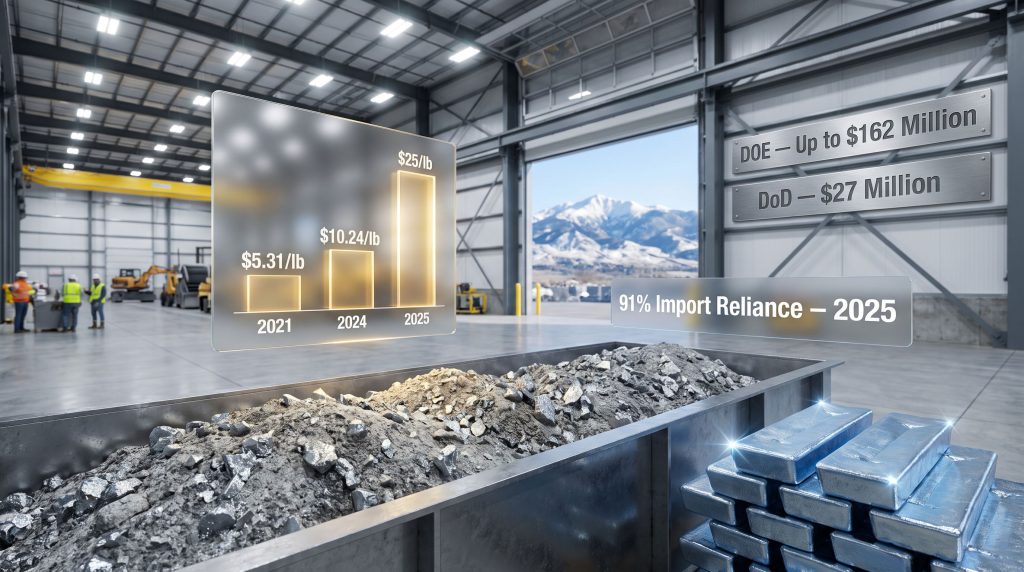
The United States Geological Survey tracks antimony import reliance annually, and the trajectory over the past three years tells an uncomfortable story. Net import reliance climbed from 81% of apparent consumption in 2023 to 86% in 2024, then reached 91% in 2025, according to USGS data. Simultaneously, apparent consumption surged from 28,600 tonnes to 45,000 tonnes across that period, meaning the absolute volume of imported material also expanded sharply, not just the percentage.
Against this consumption backdrop, domestic primary production contributed only 700 tonnes in 2025. The entire US primary antimony supply infrastructure consists of a single mining operation in Montana and one facility processing imported feedstock into primary metal and oxide. These two operations represent the complete extent of domestic primary supply, a structurally thin foundation for a mineral increasingly classified as critical to defence, energy, and industrial applications. Furthermore, the antimony shortage risks associated with this dependency are becoming increasingly difficult to ignore at a policy level.
What Antimony Is Actually Used For
Understanding why import dependency matters requires appreciating how antimony functions across multiple sectors simultaneously. Its antimony applications span a broad range of industries:
- Flame retardants in textiles, electronics, and construction materials, where it acts as a synergist with halogenated compounds
- Lead-acid battery hardening, where antimony strengthens lead alloys in conventional battery grids
- Military-grade ammunition and armour-piercing projectiles, where its density and hardness properties are operationally significant
- Semiconductor manufacturing, where antimony trioxide plays a role in specific doping applications
- Photovoltaic glass for solar panels, an application gaining strategic importance as clean energy deployment accelerates
This cross-sector demand profile means antimony supply disruptions create cascading effects rather than isolated shortages, which explains why both civilian and defence agencies are funding domestic supply solutions simultaneously. In addition, the defence uses of antimony continue to expand as military procurement requirements grow more technically demanding.
The Price Signal That Turned Waste Into Feedstock
A 370% Price Increase Changes What Is Economically Recoverable
The average US antimony metal price reached an estimated $25 per pound in 2025, up from $10.24 in 2024 and just $5.31 in 2021, according to USGS data. This is not a gradual price drift that incrementally adjusts project economics. It represents a step-change that fundamentally redefines which material grades are worth processing. The antimony price surge has consequently drawn both private capital and federal attention toward recovery infrastructure that would have been considered marginal just a few years prior.
| Year | Average US Antimony Price ($/lb) | Recovery Economics Assessment |
|---|---|---|
| 2021 | $5.31 | Most tailings uneconomical; disposal cost framing |
| 2024 | $10.24 | Selective recovery viable for characterised high-grade tailings |
| 2025 | $25.00 (estimated) | Broad recovery viable; low-grade waste becomes legitimate feedstock |
The practical implication of this price trajectory is that tailings deposits with antimony concentrations that were previously subeconomic now carry measurable revenue potential. Every dollar increase in antimony's market price expands the universe of recoverable grades and widens project margins at existing recovery operations. Federal funding programs that subsidise technology development costs further compress the effective breakeven point, making marginal projects viable that would otherwise remain uneconomical.
Price Sensitivity Note: A sustained price above $20 per pound maintains strong incentives for recovery investment. A decline toward $15 per pound would compress margins on lower-grade tailings and reduce the commercial pull for new processing projects. Investors should treat current price levels as supportive but not guaranteed over multi-year project development timelines.
Inside the $162 Million DOE Recovery Funding Program
Structure, Selection, and What the Awards Actually Mean
On August 18, 2026, the US Department of Energy's Office of Critical Minerals and Energy Innovation announced the selection of nine projects for up to $162 million in potential funding. The program targets recovery of antimony, scandium, copper, and rare earth elements from existing mines, tailings deposits, industrial facilities, and other above-ground feedstocks. Notably, US Antimony Corporation has been among the domestic operators drawing federal interest as this broader funding landscape takes shape.
A critical detail that investors and supply chain planners often overlook: selection for this program is not equivalent to a confirmed award. Projects were identified as candidates for potential funding, and actual disbursements depend on milestone achievement, award confirmation, and ongoing program requirements. This distinction separates near-term optimism from commercial reality.
The nine selected projects advance along two development pathways:
- Lab to Prototype (4 projects): Technologies still operating at bench scale that must demonstrate viability at pilot scale before advancing further
- Prototype to Pre-Commercial (5 projects): Technologies that have cleared initial validation and are targeting demonstration at scales approaching commercial operation
| Company | Development Stage | Primary Recovery Focus |
|---|---|---|
| Anactisis | Lab to Prototype | Critical mineral recovery |
| Still Bright | Lab to Prototype | Critical mineral recovery |
| Nusano | Lab to Prototype | Critical mineral recovery |
| SiTration | Lab to Prototype | Copper and critical minerals from mining waste |
| Thompson Creek Metals Company | Prototype to Pre-Commercial | Critical mineral recovery |
| Felix Gold | Prototype to Pre-Commercial | Critical mineral recovery |
| DISA Technologies | Prototype to Pre-Commercial | Critical mineral recovery |
| Alcoa Corporation | Prototype to Pre-Commercial | Critical mineral recovery |
| Trigg Minerals | Prototype to Pre-Commercial | Critical mineral recovery |
How This Program Fits Within a Broader Federal Recovery Strategy
This $162 million allocation is the third consecutive tranche of federal funding directed at above-ground material recovery rather than greenfield mine development. It follows $134 million committed to two rare earth demonstration projects using mine tailings and electronic waste, and $75 million directed toward five coal-based feedstock projects. The pattern across three sequential funding rounds reflects a deliberate policy orientation toward recovery infrastructure, which carries shorter development timelines and lower permitting complexity than new mine construction.
The DOE's approach, as articulated by the office leading these programs, centres on converting previously discarded material into recoverable feedstock, recognising that value already exists above ground in characterised tailings and industrial waste streams. This framing positions recovery not as an experimental niche but as a primary supply pathway. For further context on how this fits within the wider US critical minerals recovery landscape, nine critical minerals projects recently received $228 million in combined federal investment, underscoring how broad this policy commitment has become.
How Tailings Recovery Actually Works for Antimony
The Technical and Economic Logic of Processing Mine Waste
Mine tailings are the processed rock material that remains after target minerals have been extracted from ore during initial milling and concentration operations. Historically, the economics of full extraction were governed by commodity prices and processing costs at the time of original mining. When antimony was trading below $6 per pound, achieving complete extraction of trace concentrations carried a negative return, so residual grades were left in storage facilities.
What makes this material increasingly interesting at current price levels is its characterisation advantage. Unlike greenfield exploration, where grade distribution must be established through drilling campaigns, existing tailings facilities often have documented sampling data, historical assay records, and known volume measurements. This reduces the resource uncertainty that typically inflates early-stage exploration risk and allows recovery project economics to be modelled with greater confidence.
There are also indirect financial incentives embedded in tailings recovery that are not present in new mine development:
- Tailings storage facilities carry ongoing monitoring costs and closure bond obligations that represent fixed liabilities for their owners
- Recovery programmes can offset these costs by generating revenue from the same material
- Regulatory frameworks for reprocessing existing tailings typically involve lower environmental review complexity than disturbing undisturbed land
- Processing infrastructure from the original mining operation may be partially adaptable for recovery use
SiTration's approach illustrates one model for making this economics work. The company is developing technology specifically designed to recover copper and other critical materials from mining waste at active operating sites, integrating recovery into existing mine infrastructure rather than building standalone reprocessing facilities. This reduces capital requirements and allows recovery costs to be evaluated against already-depreciated infrastructure.
Secondary vs. Primary: The Output Gap That Defines US Supply
The domestic antimony supply picture is already dominated by secondary recovery rather than primary mining, a fact that receives insufficient attention in most supply security discussions.
| Supply Source | 2025 Output (Tonnes) | 2025 Production Value |
|---|---|---|
| Primary antimony mining | 700 | Not separately disclosed |
| Secondary smelter output | 3,500 | $190 million |
| Recycling share of consumption | ~5,400 (12% of 45,000t) | Included in secondary |
Secondary smelter output already exceeds primary mining output by a 5:1 ratio. Secondary production value reached $190 million in 2025, compared to just $49 million in 2023, representing a near-quadrupling in two years that reflects both higher prices and expanding recovery volumes. This data establishes above-ground recovery as the dominant domestic supply mechanism already in operation, well before the DOE's nine selected projects reach commercial scale.
The Department of Defense's Parallel Investment
Why Two Federal Agencies Are Funding Antimony Simultaneously
Separate from the DOE programme, the Department of Defense committed $27 million in February 2026 to US Antimony Corporation, targeting domestic extraction, processing, and refinement. The investment covers capacity expansion in Montana and advancement of excavation and extraction operations in Alaska. This commitment aligns closely with the broader logic of strategic antimony financing that has become a hallmark of the current federal approach to supply chain sovereignty.
The simultaneous involvement of DOE and DoD in antimony supply reflects genuinely different institutional mandates rather than programme duplication. DOE focuses on technology development and recovery infrastructure, working through grant mechanisms aimed at demonstrating commercial viability. DoD prioritises operational production capacity and supply chain sovereignty, working through direct contracts that target near-term output from existing facilities.
Together, these parallel tracks create a more complete federal response to import dependency. Technology development without production capacity leaves supply gaps, while production investments without technology innovation leave lower-grade resources stranded. The two programmes are complementary by design, even if they operate through different agencies with different timelines.
The next major ASX story will hit our subscribers first
Scenario Analysis: Can $162 Million Actually Move the Needle?
Three Pathways and What They Mean for Supply Security
Base Case: Pilot Progress Without Near-Term Commercial Impact
All nine projects advance through bench and pilot stages according to programme milestones. Technology transitions proceed but no commercial-scale antimony recovery volumes enter the domestic supply chain before 2028. US import reliance holds near 91% through 2027, keeping the market sensitive to foreign supply disruptions and supporting elevated price levels. This scenario represents the most probable near-term outcome given the technology readiness levels involved.
Optimistic Case: Pre-Commercial Scale-Up Succeeds
One or more of the five prototype-to-pre-commercial projects achieves operational scale ahead of schedule. Secondary antimony supply rises above the 12% of apparent consumption currently provided by recycling, and import reliance begins declining toward the 85% threshold. Price premium compression would follow as domestic availability improves, though this would require successful technology transitions that remain unproven at commercial scale.
Structural Risk: Conditional Awards and Technology Gaps
Federal selection does not guarantee federal funding. Bench-to-prototype transitions carry higher failure rates than prototype-to-commercial progressions, and projects at the earlier development stage face more significant technical uncertainty. Near-term supply additions from this programme should be treated as probability-weighted outcomes rather than confirmed volumes.
Risk Flag: Each project must independently clear three separate risk gates: award confirmation, technology milestone achievement, and successful commercial scale-up. Supply chain planners and investors should not factor these projects into base-case domestic supply models for 2027 delivery.
The Forward-Looking Indicators That Will Settle the Debate
What 2027 USGS Data Will Actually Tell the Market
The most reliable near-term validation of whether US antimony recovery funding from tailings is achieving its objectives will come from USGS annual commodity data releases for 2026 and 2027. Specific metrics worth tracking include:
- Import reliance below 85%: Would signal meaningful domestic supply growth and reduced scarcity-driven price pressure, requiring secondary production to have expanded significantly
- Import reliance near or above 91%: Confirms structural dependency persists and reinforces price sensitivity to external disruption
- Secondary production value above $250 million: Would indicate recovery economics are pulling additional private investment into above-ground processing independent of federal funding
- Primary output above 1,500 tonnes: Would suggest new domestic mining activity is beginning to complement recovery programmes at the primary level
The structural argument for prioritising recovery over new mine development becomes clearer when timelines are compared directly. New mine development in the US typically requires 7 to 15 years from discovery to production, factoring permitting, environmental review, feasibility studies, and infrastructure construction. Tailings recovery and secondary processing can reach operational scale in 2 to 5 years with proven technology and adequate capital. The DOE's three consecutive recovery-focused funding tranches reflect a policy judgement that recovery offers a materially faster path to domestic supply adequacy.
Key Metrics Summary: US Antimony Supply and Recovery Funding
| Metric | Value | Source / Year |
|---|---|---|
| US antimony import reliance | 91% of apparent consumption | USGS, 2025 |
| Apparent consumption | 45,000 tonnes | USGS, 2025 |
| Primary domestic output | 700 tonnes | USGS, 2025 |
| Secondary smelter output | 3,500 tonnes | USGS, 2025 |
| Secondary production value | $190 million | USGS, 2025 |
| Secondary production value (2023) | $49 million | USGS, 2023 |
| Recycling share of consumption | 12% | USGS, 2025 |
| Average antimony price (2025) | $25/lb (estimated) | USGS, 2025 |
| Average antimony price (2024) | $10.24/lb | USGS, 2024 |
| Average antimony price (2021) | $5.31/lb | USGS, 2021 |
| DOE recovery program funding | Up to $162 million | DOE, August 2026 |
| Projects selected | 9 | DOE, August 2026 |
| DoD antimony funding | $27 million | DoD, February 2026 |
Frequently Asked Questions: US Antimony Recovery Funding From Tailings
What is the $162 million DOE antimony recovery programme?
The US Department of Energy selected nine projects for up to $162 million in potential funding on August 18, 2026. The programme targets recovery of antimony, scandium, copper, and rare earth elements from existing mines, tailings, industrial facilities, and other above-ground feedstocks. Awards are conditional, and projects range from lab-to-prototype to prototype-to-pre-commercial development stages.
Why is the US so dependent on antimony imports?
US net import reliance reached 91% of apparent consumption in 2025, according to USGS data. Domestic primary mining output totalled only 700 tonnes in 2025 against apparent consumption of 45,000 tonnes. Limited primary production infrastructure and historically low prices that discouraged domestic investment have left the US structurally dependent on foreign supply, primarily from overseas sources including China.
Can antimony be recovered from mine tailings economically?
At current price levels of approximately $25 per pound, recovery from characterised tailings with documented antimony grades is increasingly viable. Secondary smelter output already reached 3,500 tonnes in 2025, five times primary mining output, demonstrating that above-ground recovery is already the dominant domestic supply mechanism. Federal funding further improves project economics by offsetting technology development costs.
When will the DOE-funded projects add antimony to US supply?
Under the base case scenario, the nine selected projects are unlikely to contribute commercial-scale antimony supply before 2028. Projects at bench and pilot stage require successful technology transitions before reaching production volumes. The most optimistic scenario involves one or more pre-commercial demonstration projects scaling up, which could begin lifting secondary supply above the current 12% recycling share of apparent consumption.
What other federal programmes support US antimony supply?
Beyond the DOE's $162 million recovery programme, the Department of Defense committed $27 million in February 2026 to support domestic antimony extraction, processing, and refinement, including operations in Montana and Alaska. Three consecutive DOE funding tranches have now targeted above-ground material recovery, establishing a consistent federal preference for this supply pathway over new mine development.
This article contains forward-looking analysis and scenario projections based on publicly available data from the USGS and DOE. Readers should treat scenario outcomes as probability-weighted possibilities rather than confirmed forecasts. Commodity prices and policy programme outcomes are subject to change. This content does not constitute financial or investment advice. For additional analysis on critical mineral markets and resource sector developments, visit Crux Investor.
Want to Track the Next Major Critical Mineral Discovery Before the Market Moves?
Discovery Alert's proprietary Discovery IQ model scans ASX announcements in real time, instantly identifying significant mineral discoveries across antimony and 30+ other commodities — turning complex data into actionable investment insights the moment they're announced. Explore why historic mineral discoveries have generated exceptional returns and begin your 14-day free trial today to position yourself ahead of the broader market.