August 14, 2026
The Hidden Fragility Behind the World's Alumina Backbone
Energy security rarely makes headlines until it fails. For the global aluminium industry, the vulnerability is not found in bauxite mines or smelting halls but in the invisible web of gas pipelines that feed the calcination kilns of the world's largest alumina refineries. When that web develops a fault, the consequences ripple outward with surprising speed, touching futures contracts in London, equity portfolios in Mumbai, and production schedules across Asia. The Norsk Hydro Alunorte restart after gas deal in Q3 2026 is a case study in precisely this kind of systemic fragility and how industrial giants navigate it under pressure.
When big ASX news breaks, our subscribers know first
Why Alunorte Carries Outsized Weight in Global Alumina Supply
Located in Barcarena, in Brazil's Pará state, the Alunorte refinery is one of the highest-capacity alumina processing facilities anywhere on earth. Its nameplate capacity positions it as a swing producer capable of influencing spot market pricing across multiple continents. Understanding why requires a brief look at the upstream dependency chain that underpins all primary aluminium production.
The refining process converts bauxite ore into alumina, which is then fed into smelters to produce primary aluminium metal. The critical ratio at play here is approximately 4 tonnes of alumina required for every tonne of primary aluminium produced. This multiplier effect means that a production disruption at the refinery stage creates a disproportionate shock at the smelter stage. A shortfall of 100,000 tonnes of alumina does not translate into a proportional reduction in metal output; it translates into smelter constraint, spot buying pressure, and margin compression across the buyer base.
Global Alumina Refinery Benchmarks for Comparison
| Refinery | Country | Approximate Capacity (Mtpa) | Primary Operator |
|---|---|---|---|
| Alunorte | Brazil | ~6.3 | Norsk Hydro |
| Worsley Alumina | Australia | ~4.6 | South32 |
| Pinjarra | Australia | ~4.2 | Alcoa |
| Qingdao Aluminum | China | ~3.0+ | Varied |
| Eurallumina | Italy | ~1.0 | Rusal (pre-sanctions) |
Alunorte's scale alone makes it a systemic node. Furthermore, when considering global bauxite production patterns, any prolonged interruption to Alunorte's output cannot be easily substituted from elsewhere without significant cost consequences.
What Actually Happened: The Gas Supply Breakdown in Q3 2026
The Role of CELBA and the Calcination Dependency
Alumina refining is an intensely energy-dependent process. The Bayer process, used at Alunorte, dissolves bauxite in caustic soda under high pressure and temperature, but it is the calcination step — where aluminium hydroxide is converted into alumina powder at temperatures exceeding 1,000 degrees Celsius — that consumes the most fuel. Natural gas is the preferred energy source for this process, offering more precise temperature control and lower carbon intensity compared to fuel oil alternatives.
When gas supplier CELBA notified Alunorte that natural gas availability would be reduced, the refinery faced an immediate operational dilemma. The disruption was not framed as a contractual disagreement but rather as an infrastructure access limitation, a distinction with important implications. Pipeline access constraints are far harder to resolve through commercial negotiation alone; they require regulatory intervention.
"A fuel supply limitation at calcination scale is not a procurement problem that can be solved with a phone call. It is an infrastructure problem that requires either alternative physical access to gas or a complete rethink of the fuel strategy."
The ANP Pathway: Becoming a Self-Importer
What distinguishes the resolution of this crisis from a simple renegotiation is Norsk Hydro's decision to pursue self-importer status through Brazil's Agência Nacional do Petróleo, Gás Natural e Biocombustíveis, known as the ANP. This regulatory body governs the importation, transportation, and commercialisation of natural gas across Brazil's complex energy infrastructure landscape.
By securing ANP approval to import natural gas directly, Alunorte fundamentally altered its energy dependency profile. Rather than relying on a single domestic supplier for pipeline access, the refinery gained the legal standing to source LNG directly through terminal infrastructure. This is not a minor administrative shift. It represents a structural upgrade in the refinery's energy sovereignty, reducing single-supplier concentration risk for all future operations.
The Financial Damage: Quantifying a Quarter of Disruption
Breaking Down the USD $75M to $100M Q3 2026 Impact
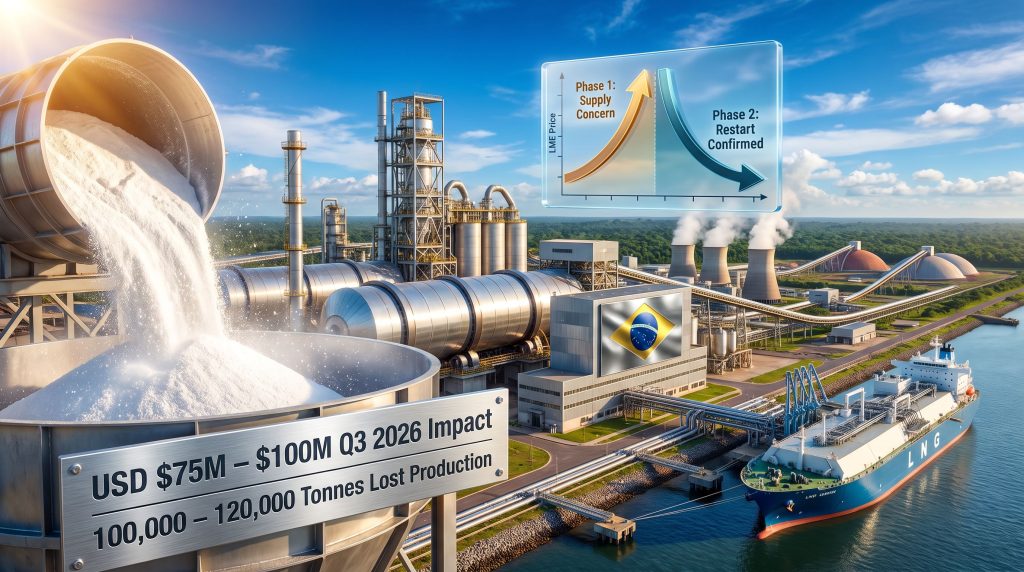
Norsk Hydro disclosed that the combined effect of production curtailment and above-contract gas procurement costs would produce a financial impact of between USD $75 million and USD $100 million on the Bauxite and Alumina segment during the third quarter of 2026. The two damage vectors are worth separating analytically.
| Impact Category | Estimated Magnitude |
|---|---|
| Lost alumina production volume | 100,000 to 120,000 tonnes |
| Above-contract spot gas procurement costs | Included in total impact |
| Total Q3 2026 financial impact (Bauxite & Alumina) | USD $75M to $100M |
| Affected business unit | Norsk Hydro Bauxite & Alumina |
The first vector is volume loss. At prevailing alumina spot prices, losing 100,000 to 120,000 tonnes of output represents a direct revenue gap. The second vector is cost inflation: procuring gas at spot rates above the contracted price compresses margins independently of volume, meaning the financial damage compounds rather than simply accumulates.
Whether this impact carries residual effects into Q4 2026 depends largely on the pace of the production ramp-back and whether the interim CELBA infrastructure agreement holds while longer-term supply arrangements are finalised.
Translating Lost Alumina Into Lost Metal Potential
Applying the standard alumina-to-aluminium conversion ratio, a production loss of 100,000 to 120,000 tonnes of alumina represents the feedstock equivalent of roughly 25,000 to 30,000 tonnes of primary aluminium. For context, that is meaningful volume in a global market where supply tightness can move benchmark London Metal Exchange prices by several percentage points within days.
Smelters most exposed to this shortfall are those reliant on Brazilian alumina spot supply, particularly in Asia and Europe, where Alunorte's output has historically served as a cost-competitive alternative to Australian and Chinese material. The degree to which global inventory buffers could absorb the shortfall without triggering a sustained price reaction became the central question during the disruption period. Indeed, the aluminum and alumina markets had already been navigating a complex pricing environment prior to this episode.
The Restart Mechanics and the Longer-Term Gas Strategy
Interim Access vs. Permanent Solution
The temporary agreement with CELBA provides Alunorte with access to gas infrastructure sufficient to ramp production back toward full capacity. Importantly, Norsk Hydro has been explicit that this is an interim arrangement. A longer-term supply solution remains under negotiation, meaning the refinery's energy security is not yet fully resolved despite the operational restart.
This distinction matters to investors and analysts monitoring the situation. An interim agreement reduces near-term risk but does not eliminate the structural vulnerability that caused the disruption in the first place.
The New Fortress Energy Framework: Contextualising the Directional Shift
Alunorte's energy transition ambitions predate the CELBA incident. A previously established 15-year LNG supply arrangement with New Fortress Energy represents the strategic direction Norsk Hydro has been pursuing, moving the refinery away from fuel oil dependency and toward natural gas as the primary energy source. Natural gas combustion in alumina calcination produces meaningfully lower carbon dioxide emissions per tonne of output compared to heavy fuel oil, a consideration that aligns with both regulatory trends and broader industrial decarbonisation trends across heavy industry.
The CELBA disruption, while operationally damaging, has arguably accelerated the regulatory groundwork for this transition by prompting ANP approval for direct LNG importation. In that sense, the crisis contained within it a strategic unlock that would likely have taken longer to achieve under normal circumstances.
Market Reaction: Two Phases of Price Discovery
Phase One: Supply Concern Lifts Aluminium Pricing
When news of the Alunorte production curtailment reached commodity markets, the initial reaction followed predictable supply-shock logic. Tighter alumina availability raises input costs for primary aluminium smelters, reducing their output economics and in some cases forcing curtailment. This supply-side concern provided upward support to aluminium prices and lifted aluminium-related equities in several Asian markets, particularly in India, where domestic smelters are significant consumers of internationally traded alumina.
Phase Two: Restart Confirmation Reverses the Narrative
The Norsk Hydro Alunorte restart after gas deal announcement reversed this dynamic almost immediately. As supply-tightness concerns eased, the price support that had built during the disruption period began to unwind. Indian aluminium stocks, which had benefited from the expectation of higher alumina input costs falling on competitors, weakened as the supply normalisation narrative took hold.
"The two-phase market reaction to Alunorte's disruption and restart illustrates a broader truth about commodity markets: the anticipation of scarcity is often more price-moving than the scarcity itself."
The 2018 Comparison: Why Duration Determines Severity
Analysts assessing the 2026 gas disruption frequently drew comparisons to the 2018 Alunorte environmental shutdown, when Brazilian federal prosecutors ordered production curtailment over concerns about a tailings dam following flooding. That event lasted significantly longer and was governed by regulatory uncertainty rather than a resolvable infrastructure agreement. The result was a prolonged spike in global alumina prices that persisted for the better part of a year and severely stressed margins for aluminium smelters worldwide.
The 2026 disruption, by contrast, was resolved within a single quarter. The lesson is clear: the regulatory nature and expected duration of a refinery disruption, not just its initial volume impact, determines how severely commodity markets reprice. These commodity supply shock impacts are consistently underestimated until they unfold.
The next major ASX story will hit our subscribers first
Scenario Modelling: The Road Not Taken
| Scenario | Probable Outcome |
|---|---|
| No interim agreement reached | Extended production curtailment beyond Q3 2026 |
| Spot gas procurement only, no infrastructure access | Higher sustained cost base, operationally unsustainable at scale |
| Full refinery shutdown | 200,000+ tonne alumina deficit risk; severe LME price spike |
| Successful long-term supply deal (current trajectory) | Full capacity restoration; normalised cost structure |
The scenario table above makes clear that the interim agreement, while imperfect, was the critical intervention that prevented an escalation from a manageable quarterly disruption into a structural market event.
Structural Vulnerabilities and What Investors Should Watch
Brazil's Gas Infrastructure Concentration Risk
Brazil's natural gas market is characterised by significant infrastructure concentration. Pipeline networks are geographically constrained, and the commercial frameworks governing access rights can create single-point-of-failure risks for large industrial consumers like Alunorte. The refinery's previous dependence on CELBA as a sole-source infrastructure provider is a textbook example of this concentration risk in action.
For energy-intensive industrial facilities in emerging markets more broadly, fuel diversification is increasingly viewed not as a cost optimisation strategy but as a core operational resilience requirement. The Alunorte experience reinforces this thinking.
What ANP Self-Importer Status Actually Changes
The practical implications of Norsk Hydro's ANP approval extend beyond the immediate crisis. As a direct self-importer of natural gas, the company can:
- Access international LNG markets directly, bypassing domestic intermediaries
- Negotiate supply terms with a broader set of counterparties
- Utilise LNG terminal infrastructure to supplement or replace pipeline-dependent supply
- Reduce regulatory exposure to domestic gas market dynamics
This model could serve as a template for other large alumina refiners operating in markets where domestic gas infrastructure is fragmented or subject to concentration risk. The willingness of regulators like the ANP to enable self-importation for large industrial consumers represents a meaningful policy pathway that has not been widely exploited across the sector. Indeed, among the top aluminium producers, energy sovereignty is rapidly becoming a defining competitive differentiator.
Near-Term Market Outlook and Q4 2026 Implications
Supply Rebalancing and the Restocking Dynamic
The 100,000 to 120,000 tonne production loss from Alunorte drew down available alumina inventory during the disruption period. As the refinery ramps back to full capacity, the market will need to assess whether the pace of restocking creates a temporary surplus in Q4 2026 or whether the drawdown was absorbed cleanly enough to maintain price stability.
Alumina spot prices had already incorporated a supply-tightness premium during the disruption. The normalisation of that premium as production recovers may create modest downward price pressure in the near term, particularly if other producing regions maintained or increased output during the same period.
Medium-Term Structural Implications for Trade Flows
Over the medium term, Alunorte's energy transition from fuel oil toward natural gas and eventually LNG-based supply has meaningful implications for its cost competitiveness. According to Engineering News, the production ramp-up following the gas deal signals a stabilisation that will reverberate through global trade flows in the coming quarters. Specifically, the transition is expected to deliver:
- Lower energy cost per tonne as natural gas prices normalise relative to fuel oil
- Reduced carbon intensity per tonne of alumina produced, supporting access to premium markets with stringent carbon disclosure requirements
- Greater supply reliability once permanent gas arrangements are secured, reducing the risk premium that counterparties currently price into Brazilian alumina supply contracts
For Asian smelters, particularly in India and China, the reliability of Alunorte's output matters enormously. Any future disruption at the refinery would once again transmit through the alumina price channel into smelter margin pressure and equity market volatility, as the Q3 2026 episode demonstrated with notable clarity.
Frequently Asked Questions
What triggered the Alunorte production reduction in 2026?
Gas supplier CELBA notified the refinery of reduced natural gas availability due to an infrastructure access limitation, forcing Alunorte to curtail alumina output while alternative arrangements were secured.
How much alumina production was lost during the disruption?
Norsk Hydro estimated the disruption resulted in a production loss of between 100,000 and 120,000 tonnes of alumina during Q3 2026.
What is the total financial impact of the gas disruption?
The combined effect of lost production volume and above-contract spot gas procurement costs is expected to produce a USD $75 million to USD $100 million financial impact on Norsk Hydro's Bauxite and Alumina segment in Q3 2026.
What role did Brazil's ANP play in resolving the crisis?
Brazil's petroleum and gas regulator approved Norsk Hydro's application to become a direct self-importer of natural gas, enabling access to alternative supply sources and facilitating the Norsk Hydro Alunorte restart after gas deal.
Is the gas supply issue fully resolved?
The interim CELBA agreement provides temporary infrastructure access while longer-term supply arrangements are negotiated. The refinery is ramping back to full capacity, but a permanent solution has not yet been confirmed.
How did the disruption affect aluminium prices and equities?
The production curtailment initially supported aluminium prices by raising supply-tightness concerns. The restart announcement subsequently eased those concerns, with Indian aluminium equities weakening as the supply normalisation narrative took hold. A detailed timeline of key events at Alunorte provides useful historical context for understanding how quickly these market dynamics can shift.
Disclaimer: This article contains forward-looking assessments and market analysis based on publicly available information as of August 2026. It does not constitute financial or investment advice. Readers should conduct independent research and consult qualified advisers before making investment decisions. Financial estimates referenced reflect Norsk Hydro's own disclosed projections and are subject to change.
Want to Stay Ahead of the Next Major Commodity Supply Shock?
Discovery Alert's proprietary Discovery IQ model scans ASX announcements in real time, instantly identifying significant mineral discoveries across aluminium, bauxite, and more than 30 other commodities — turning complex market signals into actionable investment opportunities before the broader market catches on. Start your 14-day free trial at Discovery Alert and position yourself ahead of the next major market-moving event.