August 14, 2026
The Execution Imperative: Why the Global Mining Industry's Most Consequential Gathering Is in Sydney
There is a particular tension building across the global resources sector right now. Billions of dollars in critical minerals projects have been identified, scoped, and even approved. Yet the gap between project approval and actual production continues to widen. Capital is hesitant. Permitting timelines stretch. Geopolitical pressures mount. The industry has spent several years building the case for why critical minerals matter. The question that dominates 2026 is far more demanding: how do you actually deliver them?
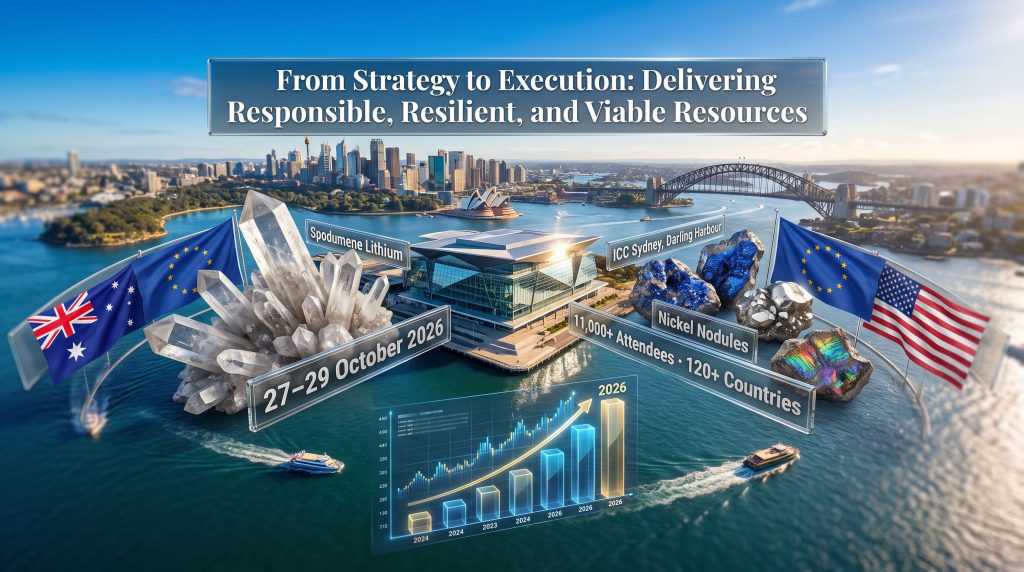
That question sits at the centre of the IMARC critical minerals conference in Sydney, scheduled for 27 to 29 October 2026 at ICC Sydney, Darling Harbour. Under its headline theme of From Strategy to Execution: Delivering Responsible, Resilient, and Viable Resources, IMARC 2026 is shaping up as the most consequential gathering the global mining calendar has seen in years.
When big ASX news breaks, our subscribers know first
What IMARC Is and Why It Occupies a Unique Position in Global Mining
The International Mining and Resources Conference and Expo has grown into something qualitatively different from a standard industry trade event. While other major mining conferences each serve distinct purposes, IMARC has carved out a role as a cross-disciplinary convening mechanism where capital, policy, technology, and operational expertise converge on the same floor at the same time.
To understand how it compares with other events across the global mining calendar:
| Conference | Location | Approx. Attendees | Primary Focus |
|---|---|---|---|
| IMARC | Sydney, Australia | 11,000+ | Critical minerals, investment, policy, technology |
| PDAC | Toronto, Canada | 25,000+ | Exploration, junior and early-stage mining |
| Mining Indaba | Cape Town, South Africa | 6,000+ | African mining investment and development |
| Mines and Money | London / Hong Kong | 2,000+ | Mining finance and capital markets |
IMARC's distinguishing characteristic is breadth. It connects mine-site operators with institutional investors, government trade envoys with technology vendors, and ESG compliance teams with capital market advisers. That breadth is precisely why organisations increasingly time major announcements to coincide with the event window rather than issuing them in isolation.
The 2025 edition attracted more than 11,000 registered attendees from over 120 countries, with representation spanning 125 nations across the broader engagement footprint. For 2026, organisers expect more than 500 speakers and 500 exhibitors across the ICC Sydney precinct.
The Four Macro Forces Converging on IMARC 2026
Understanding why this particular edition of IMARC carries such strategic weight requires examining the forces reshaping the mining industry simultaneously.
1. Geopolitical Supply Chain Realignment
The concentration of critical mineral processing capacity in a small number of jurisdictions has become a significant vulnerability for Western industrial economies. Nations that once treated resource security as a secondary consideration are now treating it as a core dimension of national strategy. This has accelerated bilateral engagement between resource-rich stable democracies and the industrial economies that depend on their output.
2. The Energy Transition Demand Surge
Lithium, cobalt, nickel, rare earth elements, and copper sit at the foundation of electric vehicle batteries, wind turbines, grid-scale storage systems, and advanced defence technologies. The critical minerals demand for these materials consistently outpaces current and planned production capacity, creating structural scarcity risk that cannot be resolved without new project delivery.
3. Artificial Intelligence Deployment Across Operations
AI in mining is no longer a speculative tool. It is being actively deployed across exploration targeting, autonomous haulage, predictive maintenance, real-time ore characterisation, and supply chain optimisation. The productivity dividend being realised at leading operations is measurable, and the cost-structure implications are substantial enough to reshape which projects become economically viable at various commodity price points.
4. The Capital Mobilisation Gap
Identified projects are failing to reach production at the rate the energy transition requires. The mismatch between project identification and project financing reflects a combination of jurisdiction risk concerns, permitting uncertainty, ESG compliance requirements, and the inherent difficulty of attracting patient capital to long-dated assets with lumpy return profiles.
The IMARC 2026 Speaker Lineup and What It Reveals
The confirmed speaker roster for IMARC 2026 is itself a signal about where the global resources conversation is heading. This is not a lineup assembled primarily around technical presentations. It reflects a deliberate effort to bridge investment strategy, energy security policy, and multilateral governance on a single platform.
Key confirmed speakers include:
-
Rick Rule, a veteran North American resource investor with decades of experience allocating capital across mining cycles, known for his contrarian approach to resource sector investment and his emphasis on geological quality over market momentum
-
Gracelin Baskaran, Director of the Critical Minerals Security Program at the Center for Strategic and International Studies (CSIS) in Washington, one of the most influential analytical voices on the intersection of mineral supply chains and national security
-
Abigail Hunter, Executive Director of Securing America's Future Energy (SAFE), whose policy work focuses on reducing US dependence on imported energy and mineral inputs with strategic defence implications
-
Maria van der Hoeven, former Executive Director of the International Energy Agency and nominee for Chair of the Extractive Industries Transparency Initiative (EITI) Board, bringing multilateral energy governance expertise to the program
The presence of figures from investment, policy, security, and international governance on a shared stage is not accidental. It reflects IMARC's evolution into what functions, in practice, as a parallel diplomacy mechanism for the resources sector.
IMARC has become a structured environment where bilateral resource priorities, investment mandates, and policy positions are formally advanced between sessions as much as during them.
Europe's Largest-Ever Delegation and What It Signals
One of the most significant developments shaping IMARC 2026 is the scale of European engagement. The European Union is expected to send its largest-ever delegation to an Australian mining event, with representation from Germany, France, Italy, and Finland, alongside senior figures from the European Commission and the European Investment Bank.
France's critical minerals envoy Benjamin Gallezot will participate, and Europe-Australia resource cooperation will feature in the opening plenary, giving it a prominence that reflects just how seriously European governments are treating Australian mineral supply.
The strategic logic behind each nation's presence is distinct:
| EU Nation | Key Critical Mineral Dependency | Strategic Interest in Australia |
|---|---|---|
| Germany | Lithium, Cobalt | Battery-grade supply for EV manufacturing transition |
| France | Rare earths, Nickel | Defence, aerospace, and industrial supply chain security |
| Italy | Copper, Aluminium | Core manufacturing and infrastructure inputs |
| Finland | Cobalt, Graphite | Battery technology and circular economy development |
The EU's Critical Raw Materials Act established domestic benchmarks for strategic mineral sourcing, however achieving those benchmarks requires reliable supply partnerships with producer nations that can meet both volume and ESG standards. Furthermore, European critical raw materials policy has placed Australia at the top of that shortlist for multiple European governments simultaneously, given its resource endowment, sovereign stability, and established regulatory frameworks.
US Engagement and the Indo-Pacific Critical Minerals Architecture
American participation at IMARC 2026 is expected to be substantial, extending beyond industry representatives to include government and policy voices focused on critical minerals security. The bilateral US-Australia critical minerals partnership, which gained significant momentum following major announcements at IMARC 2025, has matured into a framework that both sides are now working to operationalise.
SAFE's participation through Abigail Hunter reflects a US policy community that increasingly views Australian mineral supply as central to reducing strategic vulnerabilities in defence-related supply chains. The IRA and CHIPS Act have redirected significant capital toward domestic and allied-nation supply chain development, and Australian critical minerals projects are benefiting from that policy environment through increased investor interest from North American capital sources.
For junior and mid-tier Australian miners, US investor participation at IMARC represents a genuine opportunity. North American resource funds that historically focused on Canadian and Latin American assets are actively evaluating Australian projects, drawn by jurisdiction quality and the growing strategic premium attached to supply from allied nations. In addition, junior mining conferences like IMARC provide smaller operators with direct access to exactly these capital pools.
The next major ASX story will hit our subscribers first
The Capital Mobilisation Challenge: Why Finance Sessions Are Now as Important as Technical Ones
One of the less widely appreciated aspects of how IMARC functions is the degree to which significant financing conversations happen around the event rather than strictly within the formal program. Mining companies use the three-day window to advance discussions that would otherwise require months of separate travel and scheduling.
The financing landscape for mining projects in 2026 is more complex than it was five years ago, and IMARC's finance and capital markets program tracks reflect that complexity:
-
Blended finance structures combining development bank capital with private institutional investment are increasingly used to de-risk early-stage project financing
-
Export credit agencies from multiple nations are now active participants in critical minerals project financing, reflecting the government-backed strategic dimension of supply chain security
-
Royalty and streaming arrangements are gaining traction as alternative capital structures that allow producers to access non-dilutive funding while giving capital providers exposure to production upside
-
ESG compliance has shifted from a differentiating factor to a baseline requirement for accessing institutional capital, with non-compliant projects facing systematic exclusion from major fund mandates
Three Years of Escalating Strategic Importance
IMARC's trajectory across recent editions illustrates how rapidly the industry's centre of gravity has shifted:
| Year | Defining Theme | Key Development |
|---|---|---|
| 2024 | Fast-tracking critical minerals value chains | Plenary focus on supply chain acceleration and midstream development |
| 2025 | US-Australia critical minerals agreement | Landmark bilateral agreement reshaping Indo-Pacific supply strategy |
| 2026 | Strategy to Execution | Delivery, productivity, operational resilience, and financing |
Each successive edition has moved closer to the operational and financial mechanics of actually building mines and processing facilities, rather than arguing the strategic case for doing so. The 2026 theme reflects an industry that has largely won the policy argument and is now confronting the harder problem of delivery.
Program Coverage: The Full Mining Value Chain
IMARC 2026 is structured to serve participants across every stage of the resource development cycle, which is part of what makes it valuable to such a diverse range of attendees. Program tracks span:
-
Exploration and resource definition, from greenfields targeting through to feasibility
-
Mining operations and productivity, including efficiency frameworks suited to volatile input cost environments
-
Critical minerals processing and refining, addressing the persistent midstream gap in Western supply chains
-
Precious metals in the context of inflationary and high-uncertainty macro conditions
-
Sustainability, safety, and environmental governance at the project and corporate level
-
Finance, investment, and capital markets access for projects across the development spectrum
-
Technology, digitalisation, and AI integration across the mining value chain
Why Australia and Why Sydney
Australia's position as the host nation for the world's most strategically significant mining conference is not coincidental. The country holds significant reserves of lithium, cobalt, rare earth elements, nickel, and copper, making it one of the most important single jurisdictions in the global energy transition supply chain.
Beyond resource endowment, Australia offers a combination of attributes that resource-importing nations value highly: political stability, established rule of law, transparent regulatory frameworks, deep capital markets through the ASX, and operational expertise built across decades of resource development. The METS (Mining Equipment, Technology, and Services) sector, a significant contributor to Australian export income, also uses IMARC as its primary platform for international market entry and partnership development.
ICC Sydney's Darling Harbour location provides the physical infrastructure to host a gathering of this scale, but it is Australia's strategic positioning within the Indo-Pacific resource corridor that makes Sydney the logical centre of gravity for this conversation.
Frequently Asked Questions About IMARC 2026
When is IMARC 2026?
IMARC 2026 runs from 27 to 29 October 2026 at ICC Sydney, Darling Harbour, Sydney, Australia.
What is the theme of IMARC 2026?
The theme is From Strategy to Execution: Delivering Responsible, Resilient, and Viable Resources, reflecting the industry's transition from strategic planning to active project delivery.
How many people attend IMARC?
The 2025 edition drew more than 11,000 registered attendees from over 120 countries, with the 2026 edition expected to match or exceed that scale across speakers, exhibitors, and delegates.
Who should attend IMARC 2026?
The event is designed for mining executives, institutional and junior investors, government and trade representatives, technology providers, METS sector companies, and procurement professionals. Eligible personnel from major and mid-tier mining companies and contractors may qualify for complimentary access. For those comparing events, PDAC conference insights offer a useful point of reference for understanding how IMARC differs in scope and audience.
Is the IMARC critical minerals conference in Sydney focused only on critical minerals?
No. While critical minerals form a central pillar of the 2026 program, the IMARC critical minerals conference in Sydney covers the full mining value chain including precious metals, exploration, operations, sustainability, technology, and capital markets.
Disclaimer: This article contains forward-looking statements and references to anticipated participation, program content, and attendance figures. These are based on publicly available information and organisational announcements as of the time of writing and are subject to change. Nothing in this article constitutes financial or investment advice.
Want to Identify the Next Major ASX Mineral Discovery Before the Broader Market?
Discovery Alert's proprietary Discovery IQ model delivers real-time alerts on significant ASX mineral discoveries — instantly translating complex mineral data into actionable insights for traders and investors at every experience level. Explore historic discoveries and their exceptional returns, then begin your 14-day free trial at Discovery Alert to position yourself ahead of the market.