August 14, 2026
The Hidden Architecture of Global Industrial Supply Chains
The clean energy transition is frequently framed as a story about batteries, solar panels, and wind turbines. Yet beneath that narrative lies a more complex and less discussed reality: the materials that make modern industrial civilisation function are concentrated in ways that most policymakers, investors, and manufacturers have only recently begun to reckon with. Aluminium for aerospace and automotive components, sulfur for fertilisers and battery metal processing, helium for semiconductors and medical imaging — these are not niche inputs. They are foundational. And a significant portion of global supply for each originates from a single region that most analysts still associate primarily with oil. Understanding Middle East critical materials supply chains IEA analysis is essential to grasping the full scope of this structural challenge.
The International Energy Agency's Global Critical Minerals Outlook 2026 provides a data-rich lens through which to examine this reality. Its findings on Middle East critical materials supply chains challenge conventional assumptions and reveal structural vulnerabilities that extend well beyond the hydrocarbons sector.
When big ASX news breaks, our subscribers know first
Concentration Risk: The Core Vulnerability in Critical Materials Markets
Why Geographic Concentration Creates Systemic Fragility
Resource economists have long understood that supply chains become brittle when critical inputs are sourced from a narrow geographic base. The IEA's 2026 framework formalises this concern by evaluating materials on two dimensions simultaneously: how concentrated their production is geographically, and how irreplaceable they are in specific industrial applications.
What distinguishes critical materials from conventional commodities is precisely this irreplaceability. When crude oil supply tightens, demand can shift across fuel types, transportation modes, and energy sources over time. When sulfuric acid supply for lithium extraction tightens, there is no equivalent workaround. The processing chain simply slows or stops. Furthermore, the critical minerals demand pressures building across clean energy sectors only compound these existing vulnerabilities.
Key Framework: The IEA evaluates critical materials on supply concentration risk and demand criticality simultaneously. The Middle East scores highly on both axes for aluminium, sulfur, and helium — a combination that positions the region as a structural vulnerability in global industrial systems.
This distinction matters for investors and supply chain planners alike. A material can be abundant globally while still creating acute disruption risk if its production and export routes are geographically compressed. The Middle East's role in aluminium, sulfur, and helium supply chains exemplifies this dynamic with unusual clarity.
Aluminium: A Gulf Industry Whose Strategic Weight Exceeds Its Production Share
The Numbers Behind the Region's Smelting Capacity
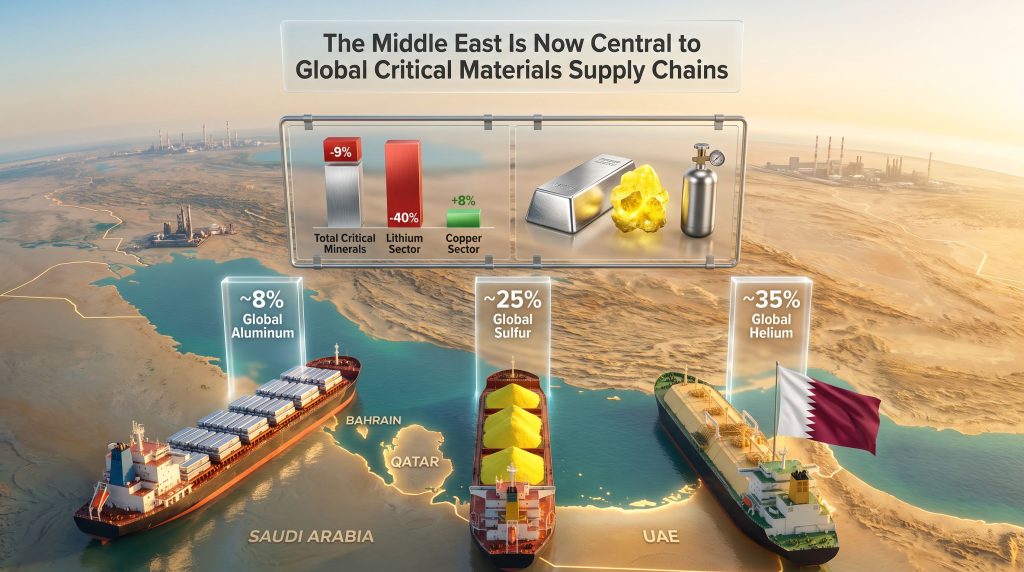
The Gulf Cooperation Council collectively accounts for approximately 8% of global primary aluminium output, generating around 6.5 million tonnes in 2025 according to the International Aluminium Institute. That production share, taken in isolation, might appear modest. The export dependency ratios, however, tell a more consequential story.
| Metric | Data Point |
|---|---|
| Middle East share of global aluminium production | ~8% |
| Gulf producer output (2025) | ~6.5 million tonnes |
| Share of global smelting capacity | ~9% |
| Share of EU aluminium imports | ~15% |
| Share of US aluminium imports | ~20% |
| Pre-disruption supply share (EU, Japan, Korea, Mexico) | >10% of total supply |
| Pre-disruption supply share (US) | ~20% of total supply |
Aluminium Bahrain, known as Alba, is identified by the IEA as the world's largest aluminium smelter outside China. That single facility's operational status carries meaningful weight in global aluminium pricing. When Alba curtailed output by shutting down three smelting lines, reducing production by 19%, the downstream effects were rapid and measurable: aluminium prices climbed to nearly $3,700 per tonne, and the Rotterdam premium surged by 60% between February and April of the disruption period.
Operational Reality: The IEA's 2026 outlook notes that restarting an idled aluminium smelter typically requires between six and twelve months. This extended restart timeline means that supply disruptions persist in markets long after the underlying geopolitical trigger has been resolved.
The UAE's High-Purity Advantage
Beyond raw tonnage, the UAE occupies a strategically differentiated position within the aluminium supply chain. Its producers specialise in high-purity aluminium variants that serve aerospace and defence manufacturing applications. These grades command price premiums and have a narrower supplier base globally, meaning that disruption to UAE output creates bottlenecks in sectors where specifications cannot simply be relaxed to accommodate lower-grade material.
The Gulf Cooperation Council has been identified alongside China as one of the two primary drivers of global aluminium smelting capacity growth. Crucially, Gulf facilities tend to be newer and more energy-efficient than older plants in other regions, giving them a structural cost advantage that supports long-term competitiveness independent of geopolitical considerations.
Sulfur: The Underanalysed Material Connecting Food Security to Battery Metals
A Feedstock That Touches Every Major Industrial System
If aluminium is the Middle East's most visible critical materials contribution, sulfur is its most systemically consequential and least discussed. The region supplies approximately one-quarter of global sulfur production, and around half of all global seaborne sulfur trade transits through the Strait of Hormuz. Consequently, the energy security risks associated with this chokepoint extend well beyond hydrocarbons into the heart of global food and battery systems.
Sulfur's industrial significance derives almost entirely from its role as the feedstock for sulfuric acid. That single compound sits at the intersection of multiple critical supply chains:
- Phosphate fertiliser production — the primary mechanism through which sulfur connects to global food security
- Copper refining — sulfuric acid is consumed in heap leach and solvent extraction operations
- Lithium processing — used in spodumene conversion and brine extraction processes
- Cobalt and nickel processing — essential for hydrometallurgical refining pathways
- Rare earth element separation — sulfuric acid is central to leaching and precipitation steps
The downstream web that sulfur anchors is not abstract. It is the processing infrastructure for the materials that build EV batteries, renewable energy systems, and advanced electronics. A sustained disruption to Middle Eastern sulfur exports would not merely affect fertiliser prices. It would progressively constrain the processing capacity for lithium, cobalt, nickel, and rare earths simultaneously. In addition, the battery raw materials market would face compounding pressure across multiple commodity streams at once.
Middle East Sulfur Production
        ↓
   Sulfuric Acid
   ↙              ↘
Fertilisers        Battery Metal Processing
(Food Security)   (Copper / Lithium / Cobalt / Nickel / Rare Earths)
                           ↓
               EV Batteries / Clean Energy Technology
The Byproduct Dynamic: Why Middle Eastern Sulfur Is Structurally Durable
A dimension of Middle Eastern sulfur supply that receives limited analytical attention is its origin as a byproduct of oil and gas processing. Gulf producers generate sulfur as an unavoidable output of hydrocarbon refining and liquefied natural gas production. This means that sulfur supply from the region is not primarily driven by sulfur market economics — it is a structural consequence of the region's core energy industry.
This byproduct characteristic creates both a cost advantage and a supply stability feature. Gulf sulfur producers do not need sulfur prices to justify production decisions. Output continues as long as hydrocarbons are processed. For importing industries, this is a double-edged dynamic: supply is reliable under normal conditions, but it is also concentrated in a geography where geopolitical disruption risk is elevated.
Helium: Qatar's Overlooked Strategic Monopoly
Why 35% Market Share in an Unsynthesisable Gas Matters
Qatar produces approximately 35% of global helium, placing it among the world's two or three dominant suppliers depending on annual output fluctuations from competing producers in the United States and Russia. What distinguishes helium from other critical materials is an absolute physical constraint: it cannot be synthesised. Helium is extracted exclusively as a byproduct of natural gas processing from specific geological formations where it has accumulated over geological timescales.
This means Qatar's helium position is not vulnerable to the same competitive dynamics that affect mined materials. New entrants cannot simply build a helium plant — they must find and develop gas fields with sufficient helium concentrations, a process that takes years and remains geologically constrained.
The industrial applications that depend on helium are non-substitutable in the near term:
- Semiconductor fabrication — helium provides inert atmosphere conditions and cooling at process nodes where contamination is measured in atoms
- Fibre-optic cable manufacturing — used in the drawing process to achieve optical clarity specifications
- Medical imaging — MRI machines require liquid helium for superconducting magnet cooling, with no current commercial alternative
- Aerospace and defence — pressurisation systems, leak detection, and cryogenic applications
For semiconductor manufacturing hubs concentrated in East Asia, Taiwan, South Korea, and increasingly Europe, Qatar represents a single-point helium supplier with no rapid substitution pathway. The geopolitical risk embedded in that dependency is underweighted in most supply chain resilience frameworks.
The Strait of Hormuz: Reframing a Geopolitical Flashpoint
More Than an Oil Corridor
Conventional geopolitical analysis of the Strait of Hormuz centres on oil transit volumes. The IEA's 2026 data reframes this focus. The strait functions equally as a critical materials trade corridor whose disruption would cascade across industrial supply chains far beyond energy markets.
- Approximately half of global seaborne sulfur shipments pass through the strait
- Gulf aluminium exports to Europe, North America, and Asia transit the same maritime corridor
- Helium shipments from Qatar's LNG infrastructure share the same route
Multi-Sector Risk Assessment: A sustained closure of the Strait of Hormuz would simultaneously restrict aluminium supply to Western manufacturers, sever sulfur flows to fertiliser producers and battery metal processors, and constrain helium availability to semiconductor and medical industries. The combination represents a multi-sector supply shock for which no rapid substitution mechanism exists across any of the three material categories.
The price transmission data from the IEA illustrates how quickly regional disruptions become global market events. Aluminium prices reached nearly $3,700 per tonne during the disruption period examined, while the Rotterdam premium — a key pricing benchmark for European aluminium buyers — increased by 60% in the February to April window. These are not marginal adjustments. They represent material cost increases that flow directly into manufacturing economics across the automotive, construction, and packaging sectors.
The next major ASX story will hit our subscribers first
Investment Contraction in 2025: A Structural Warning Signal
Where Capital Pulled Back and What It Means
The IEA's 2026 outlook documents a significant and broadly unexpected reversal in critical mineral investment flows during 2025. The aggregate decline and its distribution across material categories carry important implications for supply chain resilience and Middle Eastern industrial positioning.
| Material Category | 2025 Investment Change |
|---|---|
| Total critical minerals | -9% |
| Battery metals (aggregate) | -20%+ |
| Lithium sector | -40% |
| Copper sector | +8% |
Battery metals experienced the sharpest contraction, with capital expenditure falling more than 20% — the largest single-year decline in over a decade. Lithium companies reduced investment by approximately 40%, reflecting a combination of price volatility, demand uncertainty tied to EV adoption trajectories, and evolving battery chemistry trends that have introduced uncertainty around which lithium compound specifications will dominate future supply contracts.
Copper stood apart from this contraction, with investment rising 8%. The divergence reflects copper's broader demand base across traditional power infrastructure, construction, and industrial applications, which provides a buffer against the concentration of demand risk that makes lithium investors more cautious.
Investor Psychology: The lithium-copper investment divergence illustrates a bifurcation in market confidence that extends beyond near-term price signals. Copper's diversified demand base across both legacy infrastructure and clean energy applications creates a more stable investment thesis, while lithium's fortunes remain tightly coupled to EV penetration rates and battery technology evolution — a narrower and more uncertain demand profile.
The Strategic Window This Creates for Middle Eastern Producers
The pullback in global critical mineral investment creates a specific opportunity for producers and governments in the Middle East. At a moment when capital is retreating from mining development globally, countries with established port infrastructure, energy cost advantages, and existing industrial capacity are positioned to consolidate their roles in global supply chains.
The IEA estimates that maintaining emergency stockpiles of 11 high-risk critical materials outside the dominant producing nation would cost less than $900 million annually. This figure is modest relative to the economic disruption that supply shocks generate. For context, the aluminium price spike alone during a recent disruption period represented a cost increase measured in billions of dollars for global aluminium-consuming industries.
Strategic Implications: What Supply Chain Planners and Governments Must Address
The IEA's Resilience Framework
The IEA's 2026 outlook outlines four interconnected mechanisms for building critical materials supply chain resilience, each of which has direct relevance to both Middle Eastern industrial strategy and importing economy policy. The IEA's Global Critical Minerals Outlook 2025 provides additional context on how these frameworks have evolved over successive reporting periods.
- Strategic stockpiling — Maintaining emergency reserves of high-risk materials to absorb short-term supply disruptions without triggering cascading price increases across downstream industries
- Infrastructure investment — Expanding storage capacity, port throughput, and export logistics to reinforce supply reliability and reduce the vulnerability window following any disruption
- Processing capability development — Moving up the value chain from raw material or intermediate product export toward refined and high-specification output manufacturing
- International coordination — Establishing bilateral and multilateral supply continuity agreements that reduce the political risk premium embedded in single-source dependencies
The Underweighted Exposures in Importing Economies
For economies that have invested heavily in supply chain diversification strategies focused on battery metals and rare earths, the IEA's data reveals a systematic blind spot. Sulfur and helium concentration risk in the Middle East is structurally comparable to rare earth concentration risk in China, yet it receives a fraction of the policy attention. The broader challenge of green transition materials extends well beyond the minerals that typically dominate policy discussions.
- EU member states sourcing approximately 15% of aluminium imports from the Gulf carry meaningful disruption exposure that existing diversification frameworks may not adequately address
- The United States, drawing approximately 20% of aluminium imports from the region, has an elevated strategic interest in Gulf smelter stability that goes beyond trade economics
- Semiconductor manufacturing clusters in East Asia and Europe face helium supply risk concentrated in a single country, with no near-term substitution pathway available
Policy Gap: Resilience strategies focused narrowly on battery metals while underweighting sulfur and helium concentration risk in the Middle East are structurally incomplete. The IEA's 2026 findings suggest that a comprehensive critical materials strategy must treat this region as a tier-one supply risk geography across all three material categories.
Frequently Asked Questions
What critical materials does the Middle East supply to global markets?
The region is a significant supplier of three materials with broad industrial reach: aluminium, accounting for approximately 8 to 9 percent of global production; sulfur, representing roughly one-quarter of global supply; and helium, with Qatar alone contributing approximately 35 percent of world output. Each feeds into multiple downstream industrial sectors spanning food production, clean energy, advanced manufacturing, and medical technology.
Why does the Strait of Hormuz matter for critical materials beyond oil?
Approximately half of all global seaborne sulfur trade transits the Strait of Hormuz, alongside aluminium exports from Gulf producers and helium shipments from Qatar. A disruption to this maritime route would simultaneously affect fertiliser production, battery metal processing, semiconductor manufacturing, and aluminium supply to major importing economies across three continents.
How did critical mineral investment perform in 2025?
Global critical mineral investment declined by 9 percent in 2025, ending a multi-year growth trend. Battery metals experienced a contraction exceeding 20 percent, with lithium companies reducing capital expenditure by approximately 40 percent. Copper was the notable exception, with investment rising 8 percent, reflecting confidence in the metal's diversified long-term demand profile.
What would it cost to build emergency stockpiles of critical materials?
The IEA estimates that maintaining strategic reserves of 11 high-risk critical materials outside the dominant producing nation would cost less than $900 million annually. This compares favourably to the economic costs that supply disruptions generate, including the aluminium price spike to nearly $3,700 per tonne and the 60 percent increase in the Rotterdam premium observed during a recent disruption period.
How long does it take to restart an aluminium smelter after a shutdown?
According to the IEA's 2026 outlook, restarting an idled aluminium smelter typically requires between six and twelve months. This means that even after the event triggering a shutdown is resolved, the supply and pricing effects persist in global markets for a year or more.
Is Qatar's helium position strategically significant?
Qatar accounts for approximately 35 percent of global helium production, and because helium cannot be synthesised and is extracted only from specific natural gas formations, this position is structurally durable. Industries dependent on helium, including semiconductor fabrication, fibre-optic manufacturing, and medical imaging, have no viable near-term substitutes, making Qatar a critical single-point supplier across multiple high-technology sectors. The Middle East's critical mineral resources report from the Middle East Institute further details how this strategic positioning intersects with broader clean energy ambitions.
The Region's Critical Materials Identity Is Already Established
The IEA's Global Critical Minerals Outlook 2026 makes a structural argument that deserves broader recognition: the Middle East critical materials supply chains IEA data reveals are not an emerging trend waiting to be developed. They are already embedded in the operating economics of aluminium smelters across Europe and North America, in the sulfuric acid flows that enable battery metal processing, and in the helium supply chains that keep semiconductor fabs and MRI machines operational.
The region's advantages in each of these material categories derive from conditions that are difficult to replicate elsewhere: energy economics that support competitive aluminium smelting, natural gas processing infrastructure that generates sulfur and helium as structural byproducts, and geographic positioning at the intersection of shipping routes connecting Asia, Europe, and North America.
The 2025 contraction in global critical mineral investment, particularly the sharp retreat from battery metals, creates a window for Middle Eastern producers to consolidate and extend their supply chain roles at a moment when global competitors are retrenching rather than expanding. Whether that window is captured will depend on near-term decisions regarding processing capability, storage infrastructure, and export logistics.
For importing economies, the data serves as a structural reminder. Supply chain resilience strategies that address rare earth concentration while overlooking sulfur and helium dependencies represent an incomplete picture of Middle East critical materials supply chains IEA research has now brought into sharp focus. The region is not an oil economy with a minerals footnote. It is a critical materials supplier whose disruption would reverberate across the full breadth of the modern industrial economy, from the food system to the semiconductor foundry.
Want to Identify the Next Major Mineral Discovery Before the Market Does?
Discovery Alert's proprietary Discovery IQ model delivers real-time alerts on significant ASX mineral discoveries — instantly translating complex geological and commodity data into actionable investment insights across the critical materials sectors reshaping global supply chains. Explore how historic mineral discoveries have generated extraordinary returns and begin your 14-day free trial today to position yourself ahead of the broader market.