
August 14, 2026
The Hidden Bottleneck Inside America's Critical Minerals Revival
Every major industrial transformation in history has eventually run into the same constraint: not money, not technology, and not political will, but people. The capacity to train, deploy, and retain skilled human capital ultimately determines whether industrial ambitions translate into operational reality. This principle applies with particular force to the United States' accelerating push to rebuild domestic critical minerals supply chains, where billions of dollars in capital commitments are beginning to collide with a workforce crisis that took decades to create and cannot be solved overnight.
Understanding why critical minerals workforce development has become as strategically urgent as mine permitting or processing plant construction requires stepping back from the headlines and examining the structural mechanics of how industrial expertise is built and lost.
When big ASX news breaks, our subscribers know first
The Compounding Cost of Three Decades of Decline
Workforce attrition in specialised technical industries does not occur linearly. When mining activity contracts, universities lose students, then funding, then faculty. Experienced engineers retire or move to other sectors. Laboratory infrastructure ages without replacement. Curriculum modernisation stalls. The institutional memory embedded in senior technical staff gradually disappears, taking with it knowledge that cannot be recovered simply by reopening enrolment.
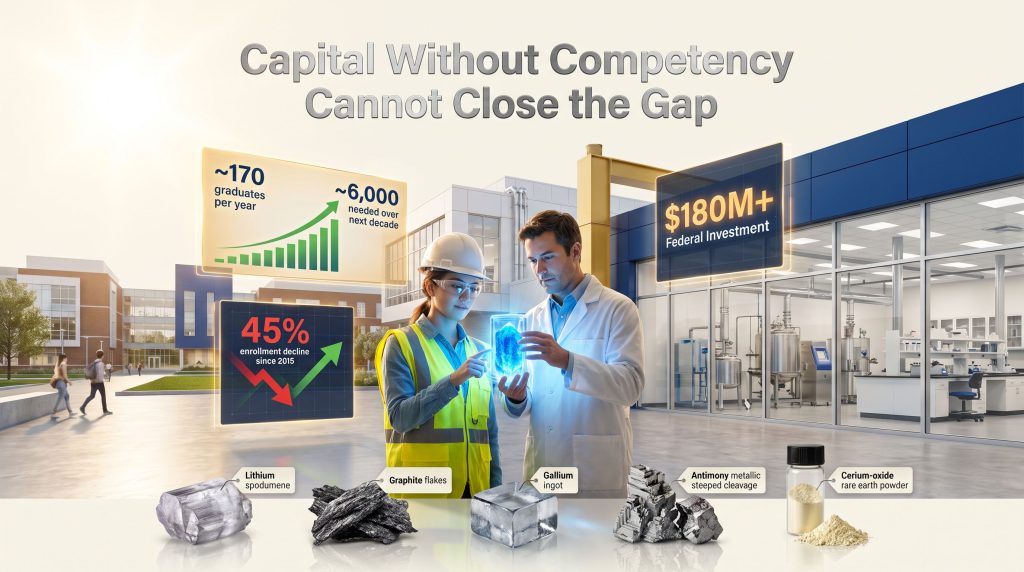
This is precisely the dynamic that has unfolded across U.S. mining education since the 1990s. The country's 14 accredited mining engineering programs now collectively produce approximately 170 graduates per year, a figure the U.S. Department of Energy estimates falls dramatically short of the roughly 6,000 new engineers the sector will require over the next decade. Enrolment in American mining programs has fallen roughly 45% since 2015 alone, compounding a longer-term erosion that stretches back further still.
The retirement dimension adds another layer of urgency. Industry data indicates that more than half of the current U.S. mine workforce is on a trajectory toward retirement within the next three years. That wave of departures will strip the sector of its most experienced operators, engineers, and technical leaders at precisely the moment when the country is attempting to expand domestic mineral production.
"The core problem is not simply a shortage of mines. It is a shortage of the people capable of designing, building, and running them at the speed and scale that supply chain sovereignty demands."
What Critical Minerals Workforce Development Actually Requires
The phrase mining workforce tends to conjure images of hard hats and haul trucks, but the actual skill set required to rebuild a sovereign critical minerals supply chain spans a far broader and more technically demanding range of disciplines. Reducing the challenge to mining engineering alone misrepresents both the scale and the nature of the problem.
A functioning domestic critical minerals value chain requires expertise across at least four distinct segments:
- Upstream: Geologists, exploration scientists, geophysicists, and drilling technicians capable of locating and characterising economically viable mineral deposits
- Midstream: Mining engineers, metallurgists, mineral processors, hydrometallurgists, and environmental specialists who can design extraction systems and convert ore into concentrates
- Downstream: Materials scientists, refining chemists, battery materials engineers, and semiconductor-grade processing specialists who can take concentrates and produce the specification-grade outputs that manufacturers actually need
- Circular economy: Recycling engineers, scrap metallurgists, and advanced manufacturing specialists who can recover and requalify materials from end-of-life products and industrial scrap
The downstream and circular economy segments represent the most severely depleted areas of U.S. technical capacity. Colorado School of Mines President Paul Johnson highlighted this during a critical minerals roundtable convened in Washington in August 2026, noting that U.S. mineral processing expertise in particular has atrophied considerably over time. This observation carries significant implications: even if domestic mines are developed on schedule, the country currently lacks sufficient personnel to convert raw ore into the battery-grade lithium, separated rare earth compounds, or semiconductor-grade gallium that downstream manufacturers require.
The Modern Mine Demands a New Kind of Engineer
Contemporary mineral operations have fundamentally changed in character. Autonomous haul trucks, AI-driven grade control systems, remote sensing technology, and real-time metallurgical monitoring have transformed what it means to operate a mine. The engineer or technician working in a modern processing facility is as likely to be managing a machine learning algorithm as calibrating a flotation circuit.
Furthermore, AI in mineral exploration is no longer an emerging concept but an operational standard at leading global producers. Traditional mining engineering curricula, designed around physical extraction methods and classical metallurgy, are increasingly insufficient preparation for this reality. The integration of automation, data science, and systems engineering into mineral operations means that U.S. workforce development programs failing to embed these capabilities risk producing graduates who are technically qualified but operationally underprepared.
Inside the $180 Million Federal Workforce Investment
The federal government's recognition of this challenge crystallised at a critical minerals roundtable held in Washington on August 7, 2026, where the Department of Energy and the Pentagon announced a combined investment of more than $180 million in mining education, workforce development, technology commercialisation, and materials training.
PROSPECT: DOE's $100 Million Pipeline Strategy
The largest component of this investment is the Department of Energy's Providing Opportunities for Specialized Education in Critical Technologies initiative, known by the fitting acronym PROSPECT. With a proposed budget of $100 million, PROSPECT is designed to reverse the enrolment collapse in U.S. mining programs and double the number of graduates in mining, minerals, and supply-chain-related disciplines within two years.
Critically, PROSPECT is not a traditional university grant program. Its scope encompasses universities, community colleges, trade schools, national laboratories, and industry partners, reflecting an understanding that the workforce gap spans academic levels and cannot be addressed through four-year engineering degrees alone.
The initiative's curriculum priorities include:
- Embedding AI, automation, and advanced manufacturing into mining and minerals education
- Expanding materials science, data science, and systems engineering content across programs
- Developing expertise across the full supply chain, from exploration through refining and recycling
- Upgrading university laboratory infrastructure that has degraded during years of enrolment decline
Mechanisms under consideration to connect education with industry include internships, apprenticeships, cooperative education placements, undergraduate research opportunities, and faculty development support. Assistant Secretary of Energy Audrey Robertson described the initiative as an unprecedented investment in the critical minerals workforce, one designed to channel domestically trained talent into high-demand careers across the mineral supply chain.
The University of Arizona School of Mining Engineering and Mineral Resources' executive director, Kray Luxbacher, captured the institutional readiness at the same roundtable, stating that American mining schools are prepared to contribute the technology and talent that achieving domestic mineral leadership will require.
Pentagon Investment One: The Critical Minerals Merit Scholars Consortium
The Department of Defense is proposing a $25 million investment to establish the Critical Minerals Merit Scholars Consortium, led by South Dakota School of Mines and supported by the University of Kentucky and Missouri University of Science and Technology. The consortium will fund four integrated workforce development programs across these three mineral-STEM institutions.
The broader objective extends beyond raw enrolment numbers. By connecting students directly to active mineral projects and industry partners, the consortium aims to address one of the sector's persistent challenges: competing for engineering talent against technology, aerospace, and energy industries that offer more visible career pathways and urban employment locations. Making mining's strategic importance and career potential tangible to students at the point of choosing their discipline is as important as any scholarship or enrolment incentive.
Pentagon Investment Two: Colorado School of Mines Commercialisation Hub
The Pentagon is also proposing a $32.7 million investment in Colorado School of Mines' Critical Minerals Innovation and Commercialisation Hub, a roughly 50,000-square-foot facility located in Golden, Colorado, approximately ten minutes from the main campus.
The hub addresses a different dimension of the workforce challenge: the gap between laboratory-proven technology and commercial-scale deployment. A mineral processing innovation that works at bench scale still faces enormous technical and economic uncertainty before it can operate reliably at production volumes. That transition, known in the industry as the pilot-scale or demonstration-scale phase, is where many promising technologies stall.
Paul Johnson, President of Colorado School of Mines, articulated the vision as creating a collaborative environment where startups, established companies, shared resources, and academic expertise converge to build the critical minerals supply chains U.S. industry needs more rapidly than traditional development pathways allow.
The hub will provide pilot-scale testing capacity for mineral processing, recovery, refining, recycling, and advanced materials technologies. Its co-location strategy — bringing together startups, established producers, academic researchers, and government agencies within a shared facility — is designed to generate the kind of cross-disciplinary problem-solving that isolated institutions struggle to produce. Students who work within the hub gain direct exposure to the commercialisation process, a skillset that is both rare and increasingly valued across the energy, defence, and advanced manufacturing sectors.
The hub is also being integrated with the National Laboratory of the Rockies and its planned 60,000-square-foot Energy Materials and Processing at Scale facility, also in Golden. Together, these two infrastructure investments could give U.S. researchers and students access to a continuous pilot-to-commercial development pathway that currently does not exist at this scale anywhere in the country.
Pentagon Investment Three: Johns Hopkins Recycling Innovation Hub
The third education-linked investment proposed by the Pentagon directs $23.6 million to Johns Hopkins University for a multi-material recycling innovation hub focused on defence applications. Working alongside advanced manufacturing technology developer AGILEWorks, the program targets the recovery and requalification of aluminium, high-performance alloys, and thermoplastic composites from structural scrap.
The work covers scrap sourcing, processing technology development, material qualification testing, and ultimately the integration of recovered materials back into defence systems. In addition, understanding the battery recycling process is increasingly central to this effort, as circular supply chains are now recognised as a strategic necessity rather than merely an environmental priority.
The Structural Barriers That Funding Alone Cannot Fix
Even with substantial federal investment, several structural barriers make critical minerals workforce development a longer and more complex process than headline numbers suggest.
The Education-to-Expertise Time Lag
Investing in university programs today does not produce experienced engineers for at least five to ten years. A student entering a mining engineering program in 2026 will not become a senior technical professional capable of leading complex mine or processing operations until the mid-2030s at the earliest. Meanwhile, the retiring workforce is leaving now, taking institutional knowledge and operational expertise that cannot be replicated in a classroom.
There is also a professor pipeline problem. Mining schools that lost enrolment during the past decade reduced faculty hiring. Rebuilding those programs requires qualified academics before qualified graduates can be produced, adding another lag cycle to an already constrained timeline.
Sector Perception and Career Visibility
Engineering graduates choosing between a career in software, aerospace, or mining face a perception gap that salary data alone may not resolve. Mining careers frequently require relocation to geographically remote regions, operate on different lifestyle rhythms than urban technology roles, and carry an outdated public image that undersells the technical sophistication of modern mineral operations.
Closing this perception gap is, consequently, as important a workforce development challenge as curriculum design. It requires sustained industry engagement with students at the undergraduate and even secondary school levels. Resources such as those provided by the Essential Minerals Association on workforce challenges highlight just how deeply rooted these perception barriers remain across the broader minerals industry.
The Downstream Expertise Erosion Problem
Perhaps the least-discussed but most consequential dimension of the workforce crisis is the loss of mineral processing and refining expertise. This knowledge does not reside only in textbooks; it is embedded in experienced practitioners who understand how specific ore types behave under different reagent regimes, how to manage impurities during hydrometallurgical processing, and how to qualify refined materials against exacting battery-grade or semiconductor-grade specifications.
Much of that tacit knowledge has left the U.S. workforce permanently, which means rebuilding it will require deliberate programs to transfer expertise from the small number of remaining specialists to a new generation of practitioners.
How a Complete Workforce Development System Functions
Translating investment into operational workforce capacity requires a systematic approach that connects each phase of human capital development:
- Skills forecasting to identify which disciplines face the most acute shortages based on project pipelines, retirement rates, and technology adoption timelines
- Curriculum modernisation to embed AI, automation, materials science, and supply chain management alongside traditional extraction and processing disciplines
- Enrolment pipeline creation through scholarship programs, merit consortia, and sector visibility campaigns targeting undergraduate and secondary school students
- Work-integrated learning connecting students to industry through internships, cooperative education, and apprenticeships before graduation
- Pilot-scale infrastructure providing shared facilities where researchers and students can test and iterate technologies at commercially relevant scales
- Direct industry linkage creating explicit pathways from graduation into employment through employer partnerships and sector-wide career frameworks
- Incumbent worker upskilling retraining existing employees in automation, data science, and emerging processing technologies to extend the productive life of the current workforce
- Retention strategies addressing geographic, compensation, and lifestyle factors that drive attrition from the sector before workers reach senior technical roles
The next major ASX story will hit our subscribers first
The Strategic Materials Driving the Urgency
The workforce investment is ultimately in service of rebuilding domestic supply chains for a specific set of materials where U.S. import dependence creates strategic vulnerability. The critical minerals demand surge across defence, clean energy, and advanced manufacturing sectors is accelerating this urgency considerably.
| Material | Primary Application | Processing Complexity |
|---|---|---|
| Lithium | EV and grid-scale battery manufacturing | High; battery-grade purity requires advanced hydrometallurgy |
| Rare Earth Elements | Defence systems, EV motors, wind turbines | Very high; separation requires specialised solvent extraction expertise |
| Graphite | Lithium-ion battery anodes | Moderate to high; synthetic graphite production is energy-intensive |
| Antimony | Military munitions, flame retardants, semiconductors | High; refining expertise largely offshore |
| Gallium | Semiconductors, LEDs, solar panels | Very high; semiconductor-grade production requires precision chemistry |
Each of these materials illustrates why processing and refining expertise is as strategically important as the mines themselves. A domestic lithium deposit that cannot be converted into battery-grade lithium carbonate or hydroxide does not reduce import dependency for battery manufacturers. Similarly, a rare earth mine whose concentrate must be sent offshore for separation provides only partial supply chain sovereignty.
Global Context: How Other Nations Are Approaching the Same Challenge
The U.S. is not alone in recognising that critical minerals workforce development requires deliberate national investment. However, the policy frameworks driving this recognition differ meaningfully across jurisdictions. The critical minerals executive order has sharpened the U.S. federal focus, while Canada's Critical Minerals Strategy workforce pillar emphasises skills forecasting, Indigenous workforce inclusion, equity-deserving group participation, and green skills development, coordinated across federal and provincial levels.
The ILO's framework on critical minerals workforce provides a further international reference point, with member nations establishing dedicated training institutions and large-scale skills transition programs aligned to global labour standards. Common threads across leading national programs include:
- Government-industry-academic partnerships as the foundational delivery model
- Work-integrated learning as the primary bridge between education and employment
- Incumbent worker upskilling alongside new entrant recruitment
- Diversity and inclusion mandates, particularly for communities located near resource regions
- Long-term skills forecasting to anticipate labour shortages before project pipelines mature
The U.S. approach, as articulated through PROSPECT and the Pentagon's consortium and hub investments, places relatively greater emphasis on commercialisation infrastructure and defence-linked training pipelines. Whether this configuration proves more or less effective than internationally coordinated models will depend heavily on how quickly industry partners translate the institutional investment into actual hiring and career development programs.
Furthermore, critical minerals energy security concerns are increasingly shaping how governments prioritise workforce investments, with nations treating skilled personnel as a direct component of national resilience planning.
Scenario Outlook: Three Trajectories for the U.S. Critical Minerals Workforce
| Scenario | Conditions | Likely Outcome by 2030 |
|---|---|---|
| Accelerated Pipeline | Full funding flows; enrolment doubles; industry co-investment scales; pilot infrastructure operational | Meaningful graduate growth by late 2020s; processing expertise gap partially closed |
| Moderate Progress | Programs funded but enrolment growth lags; industry linkage underperforms | Continued shortage in specialised roles; downstream processing remains a bottleneck |
| Structural Stagnation | Funding redirected; perception barriers persist; retirement wave outpaces new entrants | Physical supply chain investments underperform; reliance on foreign expertise persists |
This analysis involves forward-looking assessments based on current policy proposals and industry projections. Outcomes will depend on program implementation, industry participation, and sustained funding commitments. Readers should treat scenario projections as illustrative rather than predictive.
The $180 million announced in August 2026 represents a meaningful first step, but DOE's own target of doubling mineral-related graduates within two years is only the opening move in a much longer effort to rebuild an expertise base that eroded across three decades. The experienced workforce that America needs to operate tomorrow's mineral supply chains must begin training today, and even then, the structural lag between education and operational expertise means that the full benefit of current investment will not be felt for the better part of a decade.
The race to fill the pipeline before it runs empty has, by necessity, already begun.
For additional coverage of U.S. critical minerals policy, workforce initiatives, and mining technology developments, Metal Tech News provides ongoing reporting across North American supply chain topics.
Want to Know Which ASX Discoveries Could Benefit From the Critical Minerals Boom?
Discovery Alert's proprietary Discovery IQ model scans ASX announcements in real time, instantly identifying significant mineral discoveries across lithium, rare earths, and other critical commodities — turning complex data into actionable investment insights before the broader market reacts. Explore historic discoveries and their remarkable returns, then begin your 14-day free trial to position yourself at the forefront of the next major find.