
August 14, 2026
The Structural Vulnerability That Energy Markets Have Long Ignored
For decades, energy security analysts focused their attention on crude oil supply chains while treating refined product markets as a downstream afterthought. That analytical blind spot is now being exposed in real time. When crude flows are disrupted, the global system has months to respond through inventory drawdowns, alternative routing, and producer adjustments. When refined product supply collapses, the transmission to real-world economic pain is measured in days, not months.
The Russia diesel exports crash of 2026 is not merely a consequence of geopolitical conflict. It is the result of a pre-existing structural fragility in global distillate markets meeting a concentrated supply shock at the worst possible time. Understanding why that fragility exists, how it is being exploited, and what it means for the global economy requires stepping beyond the headlines and into the mechanics of how diesel actually moves around the world.
When big ASX news breaks, our subscribers know first
How Russia Built Its Position as a Middle Distillate Powerhouse
The Refining Expansion That Made Russia Indispensable
Russia's emergence as a top-tier diesel and gasoil exporter was not accidental. Following the Soviet collapse, Russian state energy companies invested heavily in refinery upgrading programmes throughout the 2000s and 2010s, modernising secondary processing units to increase the yield of higher-value middle distillates from each barrel of crude processed. This shift transformed Russia from a predominantly crude exporter into a major supplier of refined products, particularly diesel and gasoil, to European and Asian buyers.
At its peak, Russia was exporting approximately 1 million barrels per day (bpd) of diesel and gasoil combined. The key export corridors underpinning these flows included:
- Baltic Sea ports, particularly Primorsk, serving as the primary gateway to European customers
- Black Sea terminals at Novorossiysk, routing product toward Mediterranean and North African markets
- Overland pipeline infrastructure supplementing seaborne volumes across land-connected trading partners
This geography mattered enormously. Russia's proximity to European demand centres meant short voyage times, lower freight costs, and high supply reliability — factors that made Russian diesel structurally embedded in European energy infrastructure rather than simply a marginal supplier.
Why Diesel Markets Break Faster Than Crude Markets
A critical and underappreciated distinction separates crude oil markets from refined product markets. Crude can be stored at sea aboard very large crude carriers (VLCCs), rerouted to alternative refineries with different configurations, and blended to meet varying specifications. Middle distillates like diesel and gasoil are far less forgiving.
Refineries are engineered around specific crude slates and configured to maximise particular product yields. A hydrocracking-configured refinery optimised for middle distillate production cannot be rapidly converted to a different output mix. Equally, diesel product specifications vary between regulatory jurisdictions, meaning that a product meeting European low-sulphur requirements may not be immediately substitutable with product from a different origin without quality adjustment.
Key Insight: The inflexibility of refinery configurations and product specifications means that middle distillate supply shocks propagate through economies faster and with fewer natural buffers than equivalent crude oil disruptions. There is no floating storage solution for a diesel shortage, and no quick dial to turn up yield from an incompatibly configured refinery.
The IEA reported that global crude processing in July 2026 reached 80.9 million bpd, a figure sitting nearly 5 million bpd below year-ago levels. Even before the Russia diesel exports crash reached its most extreme levels, distillate markets were already tighter than crude markets. This was a legacy of underinvestment in new refining capacity and rising diesel demand from freight and agriculture sectors globally. Furthermore, the crude oil price trends leading into 2026 had already signalled mounting stress in global energy systems well before the conflict escalated.
Ukraine's Drone Campaign and the Dismantling of Russian Refining Capacity
A New Form of Energy Warfare
Ukraine's decision to systematically target Russian oil refining infrastructure beginning in spring 2026 represented a strategic calculation with significant precedent: disrupting an adversary's fuel production capacity creates simultaneous pressure on battlefield logistics, domestic civilian fuel availability, and export revenue streams. Unlike targeting crude production, which can sometimes be restored relatively quickly, refinery damage requires specialised equipment, technical expertise, and extended repair timelines.
Major Russian processing facilities were forced offline or severely degraded through repeated drone strikes. The compounding effect across multiple sites created a cascade of production losses that no individual refinery repair programme could offset fast enough during peak demand season. Falling Russian diesel exports have consequently tightened global distillate markets in ways that alternative suppliers are struggling to address.
Russia's Diesel Export Decline: March to August 2026
The decline in Russia's diesel and gasoil exports across this period followed a trajectory that accelerated with each successive wave of infrastructure damage:
| Period | Export Volume | Change | Primary Driver |
|---|---|---|---|
| March 2026 | ~3.06 million metric tons | -3% month-on-month | Port disruptions at Primorsk and Novorossiysk |
| June 2026 | ~1.8 million metric tons | -39% from May | Refinery strike damage accelerating across multiple sites |
| July 2026 | ~0.75 million metric tons | -60% month-on-month | Export ban introduced July 8 amid domestic fuel crisis |
| Early August 2026 | ~80,000 bpd | Multi-year low | Combined effect of ban and cumulative refinery capacity loss |
The Export Ban as Confirmation, Not Cause
Russia's temporary diesel export restriction, introduced on July 8, 2026, is frequently mischaracterised as the primary driver of the supply collapse. In reality, export volumes were already in freefall before the ban took effect. Moscow imposed the restriction as a reactive measure to protect domestic fuel availability during a period of acute shortage that had persisted for more than three months through Russia's peak demand season.
This distinction carries analytical weight. An export ban driven by domestic shortage rather than market strategy signals a far deeper supply-side problem — one rooted in destroyed refining infrastructure rather than policy preference. It also suggests the ban cannot be lifted simply by political decision; restored export capacity requires physical reconstruction of damaged facilities. The broader trade war economic impact on energy flows has, moreover, compounded these pressures by disrupting established trade financing and shipping arrangements simultaneously.
Quantifying the Collapse: What 80,000 bpd Actually Means
A Number Without Modern Peacetime Precedent
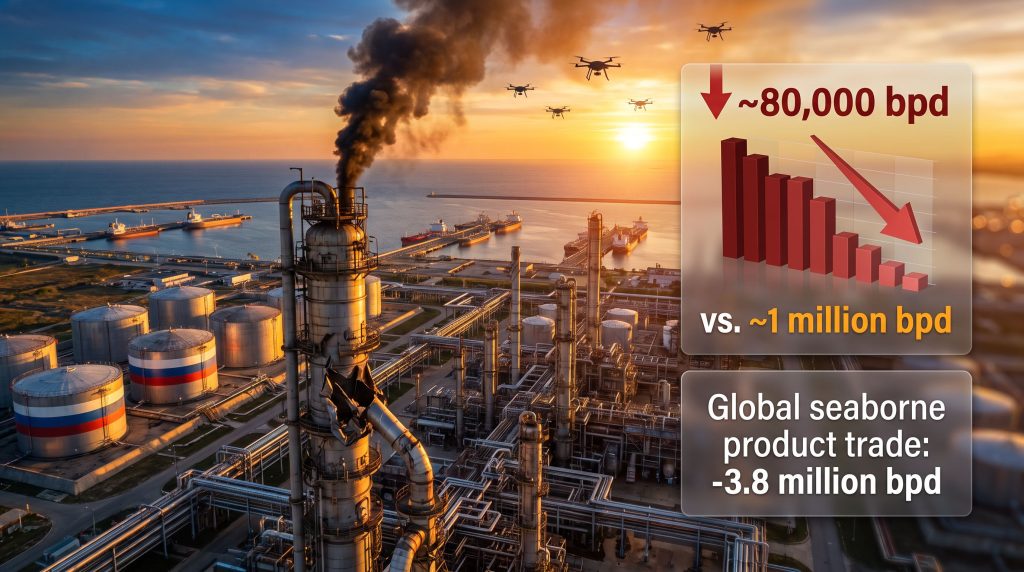
By the first week of August 2026, Bloomberg data tracking seaborne diesel flows confirmed Russian diesel and gasoil exports had fallen to approximately 80,000 bpd. Measured against the prior year's peak of roughly 1 million bpd, this represents a reduction of approximately 92% — a figure without comparable precedent in modern peacetime energy markets.
To contextualise the severity: global seaborne petroleum product trade typically runs in the hundreds of millions of barrels per month. A single supplier removing nearly 1 million bpd of product from that system within months creates a supply gap that no combination of incremental increases from alternative suppliers can rapidly fill.
The Compounding Effect: Two Disruptions Simultaneously
Russia's refinery crisis did not unfold in isolation. Simultaneous disruptions to Middle Eastern fuel exports, linked to the Strait of Hormuz standoff, compounded the distillate market stress significantly. The IEA assessed that global seaborne petroleum product trade fell by 3.8 million bpd, driven by the combination of collapsing Russian diesel and jet fuel flows alongside severely constrained Middle Eastern product exports.
U.S. fuel exporters moved quickly to capitalise on the opportunity, with American product exports rising by approximately 700,000 bpd year-on-year in July 2026. However, this increase offset less than a quarter of the combined shortfall. In addition, the WTI and Brent futures markets reflected this distress, with forward curves steepening as traders priced in prolonged supply tightness across distillate categories.
Scale Check: Even accounting for the U.S. export surge of 700,000 bpd, the net global seaborne product deficit remained approximately 3.1 million bpd. No single supplier bloc possesses the near-term infrastructure, refinery configuration, or logistics capacity to absorb a shock of this magnitude within a timeframe that matters for end-users.
How Markets Are Responding to the Distillate Crunch
Refining Margins Signal Acute Distress
The clearest market signal of middle distillate stress is visible in diesel crack spreads — the differential between the price of diesel and the cost of the crude oil input used to produce it. Wider crack spreads indicate that refiners are capturing outsized margins because product supply is insufficient to meet demand at prevailing prices.
The IEA confirmed that tighter light and middle distillate markets drove Atlantic Basin refining cracks and margins to record highs in the period following the Russia diesel exports crash reaching its nadir. Analysis from Jefferies highlighted diesel cracks as the most accurate indicator of where the true squeeze in global oil markets was occurring, distinguishing the distillate crisis sharply from broader crude market dynamics. Furthermore, the broader geopolitical risk landscape across multiple commodity markets has amplified investor uncertainty and risk premiums throughout this period.
Alternative Supplier Capacity at a Glance
| Supplier Region | Capacity to Scale Exports | Key Constraints |
|---|---|---|
| United States | Moderate (+700,000 bpd achieved July 2026) | Infrastructure bottlenecks, domestic demand commitments |
| Middle East | Severely limited (Hormuz disruption active) | Geopolitical risk, tanker availability restrictions |
| India | Incremental increases only | Refinery utilisation already near capacity |
| China | Limited export potential | Domestic export quota system restricts volumes |
Global Refinery Throughput Outlook
The IEA projects that global refinery crude throughputs will average 2.5 million bpd lower across the full year of 2026 compared to prior forecasts. A rebound of 3.5 million bpd is projected for 2027, though this recovery trajectory is explicitly contingent on geopolitical conditions stabilising sufficiently to allow refinery restoration work to proceed in Russia and for Middle Eastern transit routes to normalise.
The Broader Economic Consequences of a Diesel Squeeze
Why Diesel Price Shocks Transmit So Rapidly
Diesel is the foundational fuel of the physical economy in ways that petroleum market discussions rarely emphasise sufficiently. Nearly all long-haul road freight, agricultural machinery, maritime shipping, and heavy construction equipment depends on diesel or its closely related gasoil variants. Unlike petrol, which primarily serves passenger vehicles, diesel price movements directly affect the cost structure of producing and distributing virtually everything that moves through supply chains.
The sectors most acutely exposed to the current distillate crunch include:
- Road freight carriers, facing immediate margin compression as operating costs rise faster than contracted haulage rates
- Agricultural producers, particularly in the northern hemisphere harvest season when fuel demand peaks
- Maritime shipping operators, contending with both higher bunker fuel costs and product shortages affecting cargo availability
- Construction firms running diesel-dependent plant and equipment on fixed-price contracts
Macro Warning: Historical analysis of diesel price shocks indicates that transport and logistics cost increases typically transmit into consumer goods inflation with a lag of four to eight weeks. The severity of the 2026 distillate crunch, arriving simultaneously from both the Russian and Middle Eastern supply corridors, carries significant inflation transmission risk across both developed and emerging market economies.
Russia's Domestic Reversal: Importing What It Once Exported
One of the most geopolitically significant consequences of the refinery damage has been Russia's shift from diesel exporter to diesel importer. Reports confirmed that Russia began importing fuel products from India as domestic shortages deepened — a remarkable reversal for a country that generated substantial foreign currency income from refined product exports. The trade war oil markets dynamic has further complicated Russia's ability to source replacement volumes at competitive prices, given sanctions and shipping restrictions still constraining its trade relationships.
The next major ASX story will hit our subscribers first
Scenario Analysis: Three Possible Trajectories for Russian Diesel Exports
The path forward for global distillate markets hinges significantly on what happens to Russian refining capacity over the coming twelve to eighteen months. Three credible scenarios frame the range of outcomes:
Scenario 1: Partial Recovery (Base Case)
A reduction in drone strike intensity or a partial ceasefire arrangement allows restoration work to begin on damaged Russian refinery units. Export volumes recover toward the 400,000 to 500,000 bpd range within approximately six months. Diesel crack spreads ease from record levels but remain elevated relative to pre-2026 norms.
Scenario 2: Prolonged Disruption (Bear Case)
Ukraine's campaign intensifies or expands to target additional facilities. Russia's export ban is extended indefinitely as domestic shortages persist. Atlantic Basin diesel cracks remain at record highs, and demand destruction accelerates across import-dependent emerging market economies unable to absorb sustained high prices.
Scenario 3: Geopolitical Resolution (Bull Case)
Peace negotiations produce a durable ceasefire. Ukraine suspends infrastructure strikes as part of a broader settlement framework. However, given the extent of damage, a realistic timeline of twelve to eighteen months before meaningful export volumes return means the structural deficit in global distillate markets persists well into 2027 regardless. Diesel futures surged immediately following the export ban announcement, reflecting how swiftly markets priced in even the bull case as structurally problematic for near-term supply.
Frequently Asked Questions: Russia Diesel Exports Crash
What caused Russian diesel exports to collapse in 2026?
Ukraine's sustained drone campaign against Russian oil refining infrastructure throughout spring and summer 2026 was the primary driver. Multiple large processing facilities were forced offline, creating simultaneous domestic fuel shortages and export capacity losses. Moscow's export ban of July 8, 2026 compounded an already severe decline rather than initiating it.
How severe is the reduction in Russian diesel export volumes?
By early August 2026, Russian diesel and gasoil exports had fallen to approximately 80,000 bpd, compared to roughly 1 million bpd the prior year. This constitutes a reduction of approximately 92% and represents a multi-year low with no modern peacetime equivalent.
Can alternative suppliers replace lost Russian diesel volumes?
No single supplier or regional bloc can rapidly substitute for volumes of this magnitude. U.S. exports rose by 700,000 bpd year-on-year in July 2026, offsetting less than a quarter of the combined Russian and Middle Eastern shortfall. Indian and Chinese export capacity faces utilisation and quota constraints respectively.
What is the IEA's outlook for global refinery throughput?
The IEA projects global refinery throughput will average 2.5 million bpd lower across 2026 before a 3.5 million bpd rebound in 2027, subject to geopolitical conditions improving sufficiently to enable supply chain normalisation.
Why does a diesel shortage matter more than an equivalent crude shortage?
Diesel cannot be easily substituted, stored at sea in bulk, or rapidly redirected between incompatibly configured refineries. It powers freight, agriculture, shipping, and construction, meaning price increases transmit through the entire economy within weeks rather than months. A crude shortage gives markets time to adapt; a diesel shortage does not.
Key Takeaways
- Russian diesel and gasoil exports reached approximately 80,000 bpd in early August 2026, down from roughly 1 million bpd the prior year, representing a ~92% decline
- Ukraine's drone campaign targeting refinery infrastructure was the primary cause; Moscow's July 8 export ban was a secondary reinforcing factor driven by domestic shortage
- Global seaborne petroleum product trade fell by 3.8 million bpd, with distillate markets far more stressed than crude markets
- IEA data places global refinery throughput at 80.9 million bpd in July 2026, nearly 5 million bpd below year-ago levels
- Atlantic Basin diesel crack spreads and refining margins reached record highs following the combined Russian and Middle Eastern supply disruptions
- A U.S. export increase of 700,000 bpd year-on-year offset less than a quarter of the combined supply shortfall
- The IEA forecasts a 2.5 million bpd average throughput decline across 2026 before a 3.5 million bpd rebound in 2027
- Russia has begun importing Indian fuel products as a direct consequence of refinery capacity losses — a geopolitically significant reversal of its historical role as a net exporter
This article is for informational purposes only and does not constitute financial, investment, or trading advice. Forecasts, scenario projections, and market outlooks referenced herein involve inherent uncertainty and should not be relied upon as predictions of future outcomes. Readers should conduct their own independent research before making any investment or commercial decisions related to energy markets.
Want to Stay Ahead of the Commodity Shocks Reshaping Global Markets?
The distillate crisis unfolding across global energy markets is a reminder that structural supply shocks can move faster than most investors anticipate — and that early, informed positioning makes all the difference. Discovery Alert's proprietary Discovery IQ model delivers real-time alerts on significant ASX mineral discoveries, translating complex commodity data into actionable insights for both short-term traders and long-term investors; explore historic examples of major discovery returns or start your 14-day free trial today to ensure you are positioned ahead of the market when the next major opportunity emerges.