June 9, 2026
The Invisible Constraint Reshaping Copper's Future
Water, not ore grade, is increasingly the variable that determines whether a copper mine lives or dies in northern Chile. Across the Atacama Desert, where annual rainfall can measure in single-digit millimetres and aquifer recharge rates are geologically negligible, the industry is confronting a reckoning that has been building for decades. The question is no longer whether major operators will need to abandon continental freshwater sources, but how quickly they can engineer alternatives capable of sustaining production at scale.
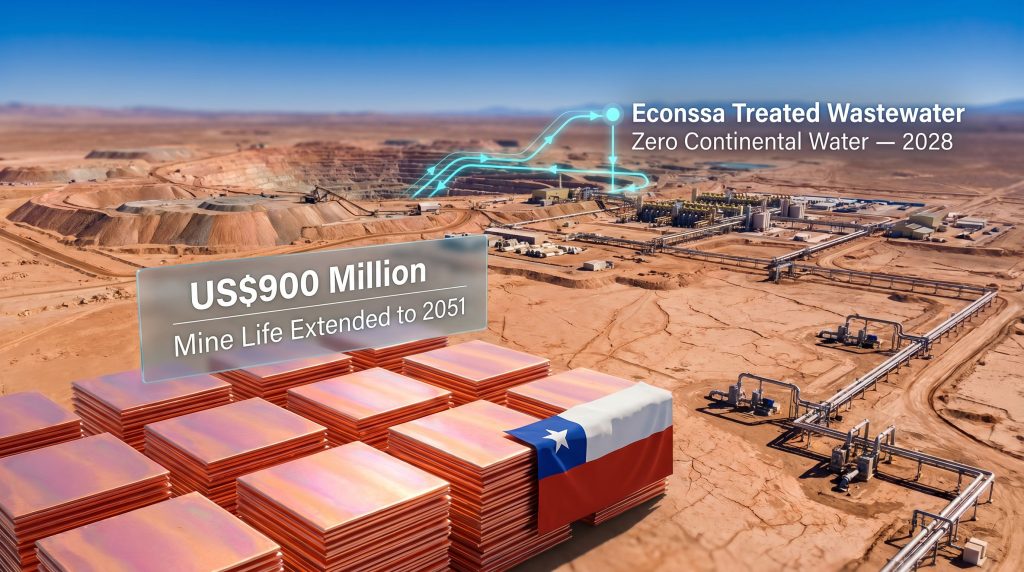
This infrastructure challenge sits at the centre of one of the most consequential capital decisions in Chilean copper mining today. The Antofagasta Minerals Zaldívar copper mine extension without continental water represents a US$900 million answer to that question, and its technical architecture offers a detailed blueprint for how the broader industry might navigate the same transition. Furthermore, understanding this project requires situating it within the copper supply gap that Chile is increasingly central to addressing.
When big ASX news breaks, our subscribers know first
Zaldívar's Place in the Chilean Copper Landscape
Located within the Atacama Desert in Chile's Antofagasta Region, the Zaldívar copper mine operates as a joint venture between Antofagasta Minerals, which holds the operator role, and Barrick Gold, which retains a significant joint venture stake. The operation produces copper cathodes through a heap leach and solvent extraction-electrowinning process, commonly known as SX-EW.
This production method is worth understanding in technical detail. Unlike conventional sulphide ore processing, heap leach SX-EW is specifically suited to oxide copper deposits. Crushed ore is stacked on lined pads, irrigated with an acidic solution that dissolves copper minerals, and the copper-rich solution is then processed electrochemically to produce refined cathode copper directly, without smelting. The process is energy-intensive but eliminates several downstream refining steps, and critically, it consumes significant volumes of water in both the leach and solution management circuits.
Chile produces roughly 27% of global copper supply, according to the US Geological Survey, yet its primary mining districts occupy one of the driest landscapes on Earth. That contradiction is now forcing billion-dollar infrastructure decisions at operations across the region.
Why Continental Water Is No Longer a Viable Foundation
Continental water, the term used in Chilean mining regulation to describe groundwater and surface freshwater drawn from inland aquifer systems, has historically been the default water source for Atacama operations. These aquifers formed over geological timescales under very different climatic conditions and do not replenish at rates compatible with industrial extraction. Some Atacama aquifer systems are effectively fossil water, meaning withdrawals are permanent depletions with no realistic recovery timeline.
Chile's water rights framework, governed largely by the Water Code of 1981 and significantly amended through reforms passed in 2022, has progressively tightened the conditions under which mining operations can maintain or renew continental water extraction rights. The 2022 reforms introduced a public function principle to water use, strengthened environmental protections over scarce water bodies, and created new mechanisms for authorities to review and revoke rights where ecological damage is demonstrated. For Atacama copper mines dependent on ageing water rights tied to finite aquifer systems, this regulatory shift directly threatens long-term operating licences.
Engineering the Transition: How the $900 Million Solves the Problem
The Antofagasta Minerals Zaldívar copper mine extension without continental water rests on a single central engineering commitment: replacing every litre of continental freshwater currently consumed at the site with treated municipal wastewater sourced from Econssa, Chile's state sanitation infrastructure operator. In addition, Antofagasta Minerals has committed to a construction timeline that makes this transition operational by 2028.
Econssa treats municipal wastewater from urban centres in the Antofagasta Region to a standard suitable for industrial reuse. The treated effluent is not potable water, but it meets the chemical and biological parameters required for mining process applications, including heap leach irrigation circuits and ancillary site uses. This distinction matters from a regulatory standpoint because treated wastewater is classified separately from continental water under Chilean environmental law, allowing its industrial use without triggering the same permitting constraints that govern freshwater extraction.
The infrastructure challenge is substantial. Conveying treated wastewater from coastal or urban treatment facilities to a high-altitude Atacama mine site requires purpose-built pumping systems engineered to maintain consistent flow rates across significant elevation gradients and extreme thermal ranges. Atacama temperatures can swing dramatically between day and night, and pipeline systems operating at altitude must account for differential thermal expansion, freeze-thaw cycling at elevation, and pressure dynamics across long conveyance distances.
Project Phasing and Construction Timeline
| Phase | Activity | Target Period |
|---|---|---|
| Phase 1 | Construction commencement | Second half of 2026 |
| Phase 2 | Peak construction activity, up to 5,000 jobs | 2026 to 2028 |
| Phase 3 | Water source transition from continental to treated wastewater | 2025 to 2028 |
| Phase 4 | Full operations under new water regime | 2028 onwards |
| Phase 5 | Extended mine life under revised environmental framework | Through 2051 |
The construction phase is expected to generate up to 5,000 employment positions at peak activity, creating a significant short-term economic stimulus for the Antofagasta Region before transitioning to the long-term operational workforce that will sustain the mine through to 2051.
Comparing Water Source Options for Atacama Operations
Zaldívar's approach occupies a strategic middle ground between two less viable alternatives. Full seawater desalination, which several other Atacama operations have pursued, carries extremely high capital costs and introduces its own environmental complexities around brine disposal and marine impact. Continued continental water use, by contrast, faces mounting regulatory resistance and finite supply. Treated municipal wastewater offers a third path, with moderate infrastructure costs and a regulatory profile that sidesteps the most contentious environmental objections.
| Water Source | Environmental Impact | Regulatory Risk | Infrastructure Cost | Long-Term Viability |
|---|---|---|---|---|
| Continental groundwater | High | Very High | Low | Declining |
| Seawater (desalinated) | Moderate | Low | Very High | High |
| Treated municipal wastewater | Low | Low | Moderate to High | High |
| Internal process water recycling | Very Low | Very Low | Moderate | Medium (supplementary) |
One factor that is not widely appreciated outside the industry is that treated wastewater supply is inherently linked to urban population growth. As Antofagasta's urban population expands, wastewater volumes available for industrial reuse increase proportionally, providing Zaldívar with a supply base that may actually grow over time rather than decline, which is the opposite dynamic to continental aquifer dependency.
Regulatory Logic and the Social Licence Equation
Chile's Environmental Impact Assessment System, known as SEIA, requires that major mine modifications or life extensions undergo formal environmental review. The complete elimination of continental water consumption directly addresses what has historically been the most contested element of Atacama mining permit renewals: the impact of freshwater extraction on hydrologically sensitive ecosystems, including high-altitude wetlands known as vegas and bofedales, which support endemic species and are protected under Chilean and international environmental frameworks.
By demonstrating zero continental water consumption as part of its SEIA submission, Antofagasta Minerals removes the primary basis for environmental objections that have derailed or delayed comparable projects at other operations. This is not merely a compliance exercise. It reflects a fundamental shift in how the social licence to operate is constructed in water-stressed mining jurisdictions. The definitive feasibility study process behind such decisions is increasingly shaped by these water governance considerations.
Local communities in Chile's arid north have historically positioned themselves in direct opposition to mining water use, drawing connections between industrial extraction and the progressive drying of rivers, wetlands, and community water supplies. The transition to treated wastewater severs that connection, enabling a different kind of stakeholder conversation, one centred on economic contribution and environmental stewardship rather than resource competition.
For institutional investors increasingly applying ESG screening criteria to mining exposures, water stewardship metrics have become a material due diligence factor. Operations that can demonstrate credible long-term water independence from sensitive freshwater systems are increasingly differentiated in capital allocation decisions.
What a 25-Year Extension Means for Copper Supply Chains
The economics of mine life extension versus greenfield development are rarely presented transparently to general audiences. Building a new copper mine from discovery to first production typically requires 15 to 20 years and capital expenditure that can exceed several billion dollars. Extending an existing operation with established infrastructure, trained workforce, and regulatory relationships at a cost of US$900 million across a 25-year production horizon represents a fundamentally different and often more capital-efficient proposition.
Copper's role in the global energy transition amplifies the strategic weight of this decision. Electric vehicles use roughly 2.5 to 4 times more copper than internal combustion engine vehicles. Grid-scale battery storage, offshore wind turbines, and solar photovoltaic installations all depend on copper at intensities that are expected to drive demand well beyond current supply trajectories. The critical minerals demand surge driven by energy transition investment makes securing cathode production at an established operation like Zaldívar a meaningful input into global supply chains through to 2051.
A Replicable Framework for the Industry
The technical and regulatory pathway Antofagasta Minerals is navigating at Zaldívar may serve as a reference model for other Atacama operators facing similar permit renewal challenges. The step-by-step logic of the transition follows a replicable structure:
-
Hydrological audit to quantify total continental water dependency and map reduction targets against permit renewal timelines.
-
Alternative source evaluation comparing treated wastewater availability, desalination feasibility, and internal process water recycling potential against site-specific constraints.
-
Infrastructure feasibility study assessing conveyance distance, elevation differential, required pumping capacity, and civil engineering scope.
-
Regulatory pre-engagement with Chilean environmental and water authorities to align transition schedules with SEIA submission requirements.
-
Community consultation structured around the environmental benefits of water source transition to build social licence ahead of formal approval processes.
-
SEIA submission incorporating the complete water transition plan as a core component of the environmental impact documentation.
-
Construction and phased commissioning with defined milestones tied to permit conditions.
-
Operational cutover from continental to alternative supply, supported by monitoring and reporting protocols that satisfy ongoing regulatory obligations.
The next major ASX story will hit our subscribers first
Key Project Metrics at a Glance
| Metric | Detail |
|---|---|
| Total investment | US$900 million |
| Mine life extension target | Through 2051 |
| Water transition completion | 2028 |
| Construction start | Second half of 2026 |
| Peak construction employment | Up to 5,000 jobs |
| Water source replacing continental | Treated wastewater via Econssa |
| Operator | Antofagasta Minerals |
| Location | Atacama Desert, Antofagasta Region, Chile |
| Primary product | Copper cathodes |
Consequently, the broader implications of this investment extend well beyond a single operation. The copper market trends emerging in 2025 suggest that water-constrained jurisdictions will increasingly reward operators who can demonstrate credible long-term water independence. Furthermore, the Chile copper price forecast for 2025 and beyond is closely tied to whether major operations like Zaldívar can successfully navigate these infrastructure and regulatory transitions.
Frequently Asked Questions
What is the Zaldívar copper mine water transition project?
The Antofagasta Minerals Zaldívar copper mine extension without continental water involves committing US$900 million to construct a water conveyance and pumping system that will supply the Zaldívar operation with treated municipal wastewater sourced from Econssa, replacing all continental freshwater currently used at the site and enabling production to continue through to 2051.
When will Zaldívar stop using continental water?
The water source transition is targeted for completion by 2028, after which the mine will operate without any continental freshwater consumption.
Why is treated wastewater preferred over seawater desalination?
Treated wastewater from urban sanitation systems carries a lower capital cost than full desalination infrastructure, faces fewer regulatory complications, and benefits from an increasing supply base tied to urban population growth. It also avoids the brine disposal challenges associated with coastal desalination plants.
How does the Zaldívar extension relate to copper's energy transition role?
Copper is a foundational material in electric vehicles, renewable energy infrastructure, and grid modernisation. Securing cathode production at an established operation through to 2051 directly supports global supply chains that are expected to face structural deficits as energy transition demand accelerates beyond currently sanctioned mine supply.
Disclaimer: This article is intended for informational purposes only and does not constitute financial or investment advice. Projections regarding mine life, production timelines, and market dynamics involve inherent uncertainty and are subject to change based on regulatory, operational, and market conditions.
Want to Stay Ahead of the Next Major Copper Discovery on the ASX?
Discovery Alert's proprietary Discovery IQ model delivers real-time alerts on significant ASX mineral discoveries — instantly translating complex data across more than 30 commodities into clear, actionable insights for both traders and long-term investors. Explore historic discoveries and their remarkable returns, then start your 14-day free trial at Discovery Alert to position yourself ahead of the broader market.