June 8, 2026
The Industrial Crossroads Facing Australia's Copper Heartland
For much of the twentieth century, the economic logic of processing copper close to where it was mined seemed unassailable. Ore was pulled from the earth, smelted nearby, refined downstream, and shipped to global markets as finished cathode. That vertically integrated model built entire cities, sustained generations of workers, and anchored regional economies across the world's great mining belts. Today, that logic is under siege, squeezed by aging capital infrastructure, the relentless arithmetic of energy costs, and the emergence of lower-cost processing competition in Asia. In North West Queensland, where copper has defined the regional identity for over a century, this pressure has reached a decisive point.
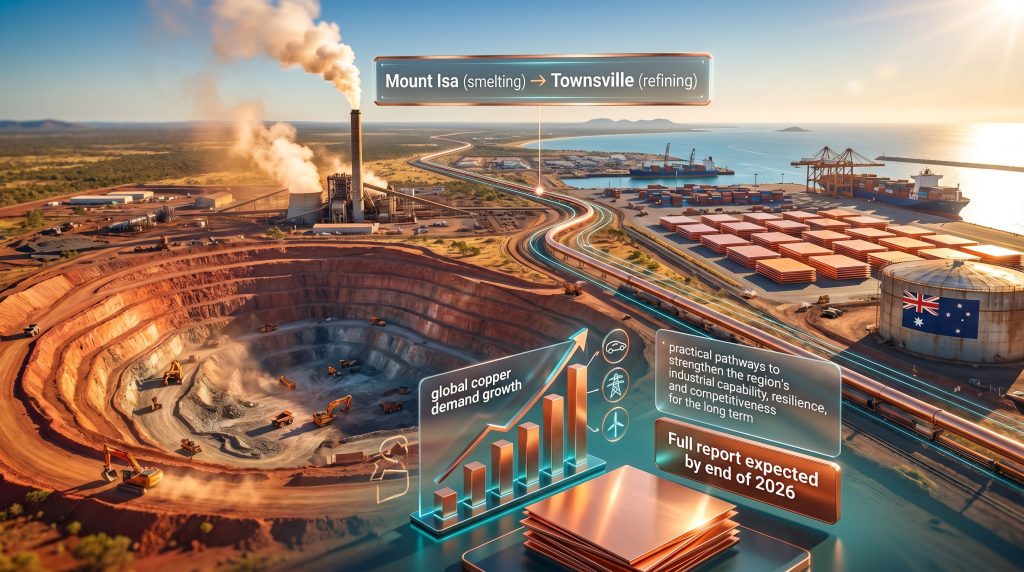
The Mount Isa transformation study, a formally commissioned joint initiative between the Queensland and Commonwealth governments, is the most structured policy response to this challenge that the region has seen. It is not a discussion paper or a ministerial review. It is a full-spectrum value chain assessment spanning every node of the copper production corridor, from the mines of the North West Minerals Province through to the smelter at Mount Isa and the refinery at Townsville. The outcome will shape investment decisions, regional employment trajectories, and Australia's positioning within the global critical minerals supply chain for the remainder of this decade.
When big ASX news breaks, our subscribers know first
Copper's Role in the Energy Transition and Why North West Queensland Is in the Frame
Copper is not incidental to the global energy transition. It is foundational. Every electric vehicle requires roughly 83 kilograms of copper, compared to approximately 23 kilograms in a conventional internal combustion engine vehicle. Offshore wind turbines require between 8 and 15 tonnes of copper per megawatt of installed capacity. A single utility-scale battery storage facility can consume hundreds of tonnes. The International Energy Agency projects that copper demand from clean energy technologies alone could double by 2040, placing extraordinary pressure on global supply chains that are already showing structural tightness.
Against this backdrop, Australia holds a strategically significant position. The country ranks among the world's top ten copper producers, and the North West Minerals Province represents one of its most concentrated zones of copper resource endowment. Furthermore, the critical minerals energy transition dynamic means the Mount Isa Copper Smelter and the Townsville Copper Refinery together form one of the few remaining integrated copper processing corridors in the Asia-Pacific region where ore is smelted and refined into export-ready cathode domestically rather than shipped overseas as concentrate.
Yet this corridor operates under mounting structural pressure. The smelting and refining infrastructure that underpins it was largely constructed in an era when energy was cheap, global competition for processing services was limited, and the regulatory environment was simpler. That era has passed. The Mount Isa transformation study is, at its core, an attempt to answer one fundamental question: does this corridor have a viable future, and if so, what does that future look like?
What the Mount Isa Transformation Study Actually Involves
The study is a joint Queensland and Commonwealth government initiative, announced by Australian Federal Minister for Industry and Innovation Senator Tim Ayres and Queensland Minister for Natural Resources and Mines Dale Last as part of a broader effort to secure the long-term future of the region's copper industry. At its centre is a mandate to evaluate the full copper value chain across the North West Minerals Province, with specific focus on the Mount Isa Copper Smelter and the Townsville Copper Refinery.
The scope is deliberately comprehensive. Rather than examining individual facilities in isolation, the study adopts an end-to-end analytical lens that connects upstream mining economics with midstream smelting operations and downstream refining output. This integrated approach reflects a growing recognition among policymakers and industry strategists that the viability of any single node in the processing chain cannot be assessed independently of the others.
Key Focus Areas of the Mount Isa Transformation Study:
| Study Component | What It Examines |
|---|---|
| End-to-end value chain assessment | Structural strengths and capability gaps across mining, smelting, and refining |
| Long-term industrial pathway modelling | Viable futures beyond the current government support period |
| Regional supply chain analysis | Emerging projects and their contribution to corridor economics |
| Workforce and community impact assessment | Social and economic transition risks for regional populations |
| Market intelligence and cost analytics | Global competitiveness benchmarking for each processing stage |
The study is being conducted throughout 2026, with the final report due for delivery to government by the end of the year. During this period, transitional financial support is being provided to stabilise existing processing operations, ensuring that infrastructure remains viable while the strategic assessment is completed.
CRU International and the Analytical Framework Behind the Study
The appointment of CRU International to lead the study carries significant weight. CRU is a globally recognised commodities research and consulting organisation with deep expertise spanning mining economics, processing operations, and downstream metal markets. Its selection to head a specialist consortium signals a deliberate choice to ground the study in independent, commercially rigorous analysis rather than politically framed consultation.
CRU's methodological approach integrates several layers of analytical rigour. Market intelligence capabilities allow the team to contextualise North West Queensland's processing operations within global copper supply and demand dynamics. Facility-level cost analytics provide granular insight into the economic performance of individual assets at Mount Isa and Townsville, benchmarking them against comparable operations internationally. Value chain modelling connects these individual data points into a coherent picture of systemic strengths and vulnerabilities.
Hugh Greene, Global Head of Consulting at CRU Group, articulated the purpose of the study by emphasising that the work is designed to identify practical pathways that would strengthen the region's industrial capability, resilience, and long-term competitiveness. This framing is deliberate: the study's value lies not in describing problems that are already broadly understood, but in identifying actionable solutions grounded in commercial and technical reality.
The consortium structure brings together complementary expertise across mining economics, refining operations, and downstream market dynamics, ensuring that the assessment captures the full complexity of a value chain that spans hundreds of kilometres and involves fundamentally different industrial processes at each stage.
Anatomy of the Copper Value Chain Under Assessment
Upstream: Mining Operations and Feed Supply
The North West Minerals Province encompasses a complex mosaic of active and emerging copper mining operations, each contributing to the concentrate feed supply that sustains downstream processing infrastructure. The economic health of the smelter and refinery is directly dependent on the volume, quality, and cost of ore feed flowing from upstream operations.
Ore grades across the province vary meaningfully, with copper head grades typically ranging from below one percent in bulk mining operations to several percent in higher-grade underground zones. This variation has direct implications for processing economics: higher-grade concentrate reduces energy and reagent consumption per unit of metal recovered, improving smelter economics. As existing orebodies mature and head grades naturally decline, maintaining processing efficiency requires either enhanced metallurgical capability or access to new high-grade feed sources.
The role of emerging projects in sustaining long-term feed supply is a critical variable. If the transformation study identifies a credible pipeline of new projects capable of supplying sufficient high-quality concentrate, the economic case for continued investment in processing infrastructure strengthens considerably. If, however, feed supply is projected to tighten, the calculus becomes more complex, potentially favouring a consolidation pathway over expansion.
Midstream: The Mount Isa Copper Smelter
The Mount Isa Copper Smelter is the industrial heart of the North West Queensland copper corridor. Operating since the mid-twentieth century, the smelter converts copper concentrate into blister copper, a high-purity intermediate product that is then transported to Townsville for final refining.
Smelting is one of the most energy-intensive steps in the copper production chain, typically consuming between three and five megawatt-hours of electricity per tonne of copper produced. In an environment of rising industrial power costs, this energy burden represents a significant operational challenge. The smelter's economics are further influenced by global treatment and refining charges — the fees paid by miners to smelters for processing their concentrate. When concentrate supply globally is abundant relative to smelting capacity, treatment charges rise, improving smelter margins. When supply tightens, charges compress, squeezing processing economics.
The infrastructure age of the Mount Isa smelter introduces capital expenditure uncertainty. Aging pyrometallurgical equipment requires ongoing maintenance investment to sustain operational reliability, and major refurbishment cycles can involve capital commitments that are difficult to justify without high confidence in long-term feed supply and market conditions.
Downstream: The Townsville Copper Refinery
Located approximately 900 kilometres east of Mount Isa, the Townsville Copper Refinery performs the final stage of the value chain transformation, converting blister copper into 99.99% pure electrolytic copper cathode. This product form commands premium pricing in global markets and is directly usable by wire rod manufacturers, tube producers, and electronics fabricators.
Townsville's strategic advantage extends beyond its refining capabilities. As a deep-water port city with established logistics infrastructure, it provides direct access to export shipping lanes serving Asian and Pacific markets. The refinery's coastal location also mitigates some of the inland freight cost disadvantages that constrain other elements of the North West Queensland supply chain.
The potential for value-added processing beyond standard cathode output represents one of the more intriguing dimensions of the study's mandate. Wire rod production, copper alloy fabrication, and specialty copper products for electronics and renewable energy applications each represent pathways toward capturing additional margin within the corridor.
Three Futures for the Region: Consolidation, Transformation, or Diversification
One of the study's most consequential analytical tasks involves modelling credible long-term industrial pathways for the region beyond the current period of government financial support. Three broad scenarios frame this analysis:
Consolidation assumes a rationalisation of processing capacity to match available feed supply and market conditions, accepting a smaller but more financially sustainable industrial footprint. This pathway prioritises near-term viability but may sacrifice the scale needed to justify major infrastructure investment.
Transformation envisions fundamental reinvestment in processing infrastructure, potentially incorporating new smelting technologies, renewable energy integration, and enhanced environmental performance to reposition the corridor as a globally competitive, low-emissions copper processor. This pathway is capital-intensive but offers the greatest long-term strategic value if commercial conditions support it.
Diversification expands the corridor's industrial base beyond copper, incorporating processing of other critical minerals, battery materials, or specialty metals that are compatible with existing infrastructure and regional capabilities. This pathway reduces single-commodity exposure but requires careful market analysis to identify products with genuine commercial demand.
A particularly compelling scenario involves the potential emergence of North West Queensland as a producer of verified low-carbon copper. As European and Asian markets increasingly impose carbon disclosure requirements and seek preferentially sourced, low-emissions metals, a premium price tier for green copper is developing. Queensland's renewable energy ambitions, including ambitious state-level targets for clean electricity generation, could provide the energy feedstock needed to fundamentally alter the emissions profile of copper smelting and refining operations. The mining decarbonisation benefits of such a transition could be substantial, and whether this premium is commercially viable at sufficient scale is precisely the kind of market intelligence question the Mount Isa transformation study is designed to answer.
The next major ASX story will hit our subscribers first
Structural Barriers That Regional Advocates Want Addressed
Industry bodies representing the Mount Isa to Townsville Economic Zone, commonly known as MITEZ, have been vocal in arguing that incremental financial support for existing operations is insufficient without addressing the systemic structural barriers that undermine the corridor's competitiveness. The case for structural reform rests on several interconnected deficits:
-
Energy costs: Industrial power prices in North West Queensland rank among the highest in Australia, adding a significant cost burden to energy-intensive smelting and refining operations that their global competitors do not face to the same degree.
-
Freight and logistics: The inland location of Mount Isa creates substantial transport cost disadvantages for concentrate haulage and for importing consumables needed in processing operations. Rail infrastructure along the Mount Isa line has faced long-standing capacity and reliability challenges.
-
Water security: Large-scale copper processing operations require substantial water resources in a region characterised by climatic variability and periodic drought conditions. Long-term water security solutions are essential for confident industrial planning.
-
Workforce and housing: Attracting and retaining skilled metallurgical and engineering workers in a remote industrial region requires competitive remuneration and quality-of-life infrastructure that can be difficult to deliver without active investment in community amenity.
-
Regulatory timelines: Approval processes for new mining projects and processing facility expansions in Queensland have historically involved significant lead times, creating uncertainty that deters long-cycle capital investment.
Regional advocates argue that the transformation study's recommendations must engage with each of these structural dimensions — not merely the economics of the processing facilities themselves — if they are to produce outcomes that genuinely reposition the corridor for long-term competitiveness.
The Mount Isa Future Ready Economy Roadmap: A Complementary Framework
The transformation study does not operate in isolation. It sits alongside the Mount Isa Future Ready Economy Roadmap, a complementary regional planning framework that addresses broader economic diversification beyond the copper industry. Where the transformation study is sector-specific and technically focused, the Roadmap takes a wider view, considering the full spectrum of economic activities that could sustain and diversify Mount Isa's community and workforce over the long term.
The two initiatives share significant thematic overlap. Decarbonisation, community resilience, workforce transition planning, and economic diversification are common threads running through both frameworks. The Roadmap identifies potential growth sectors including tourism, agriculture, clean energy generation, and advanced manufacturing as complements to the existing mining and processing base.
Critically, the two frameworks could together create a coordinated policy architecture that is greater than the sum of its parts. If the transformation study identifies a clear pathway for copper processing viability, the Roadmap can build a diversified economic ecosystem around that industrial anchor. If the study concludes that significant processing rationalisation is inevitable, the Roadmap provides the strategic scaffolding for managing that transition in a way that preserves community wellbeing and economic activity.
Why This Matters for Australia's Critical Minerals Agenda
Copper holds formal classification as a critical mineral under Australia's national critical minerals framework, reflecting its strategic importance for both domestic industrial activity and allied nation supply chain security. This classification carries policy significance that extends well beyond North West Queensland.
Allied nations — particularly in Europe, Japan, South Korea, and the United States — are actively seeking to diversify their critical mineral supply chains away from dominant processing hubs in China, which currently accounts for approximately 40% of global copper refining capacity. In addition, the broader copper supply crunch facing global markets means Australia's integrated copper processing corridor in North West Queensland represents one of the few viable alternative refined copper supply sources in the Asia-Pacific region, making its long-term viability a matter of geopolitical as well as industrial significance.
Australia's Copper Processing Corridor at a Glance:
| Metric | Detail |
|---|---|
| Processing corridor | Mount Isa (smelting) to Townsville (refining) |
| Study lead organisation | CRU International and specialist consortium |
| Study delivery timeline | Final report expected by end of 2026 |
| Primary deliverable | Long-term industrial pathway recommendations |
| Copper's policy status | Classified as a critical mineral under national strategy |
| Global context | Rising demand from electric vehicles, grids, and renewables |
The study's findings have the potential to influence federal infrastructure investment decisions, shape the structure of future critical minerals agreements with allied trading partners, and determine whether Australia captures value-add processing benefits from its copper resources or cedes that economic ground to offshore smelting and refining capacity.
Frequently Asked Questions: Mount Isa Transformation Study
What is the Mount Isa transformation study?
It is a joint Queensland and Commonwealth government initiative designed to comprehensively assess the copper value chain across North West Queensland, identify long-term industrial opportunities, and develop practical recommendations for the region's economic future beyond the current period of government financial support for processing operations.
Who is conducting the study?
CRU International is leading a specialist consortium appointed to deliver the study. CRU brings global expertise in commodities market intelligence, facility-level cost analytics, and value chain modelling across mining and refining sectors.
Which facilities does the study cover?
The study spans the full copper value chain across the North West Minerals Province, with specific focus on the Mount Isa Copper Smelter and the Townsville Copper Refinery, along with regional supply chains and upstream mining operations.
When will the study be completed?
Stakeholder engagement and analysis are being conducted throughout 2026, with the final report scheduled for delivery to government by the end of 2026.
What happens after the report is delivered?
The study's recommendations are expected to inform government policy decisions on infrastructure investment priorities, transition support mechanisms, and long-term economic development strategies for the Mount Isa to Townsville corridor.
Why is this study significant beyond the region itself?
Copper's classification as a critical mineral, combined with its central role in the global energy transition supply chain, means the study's outcomes have implications for Australia's national industrial strategy and its positioning as a reliable supplier of processed copper to allied trading partners.
What the Study Signals About Australia's Industrial Policy Direction
The commissioning of the Mount Isa transformation study represents a meaningful shift in the Australian government's approach to resource sector policy. Rather than managing decline through reactive financial support, the initiative signals a move toward proactive industrial strategy that seeks to determine — through rigorous analysis — whether a viable competitive future exists for domestic copper processing and what conditions are required to realise it.
This approach reflects a broader global trend in which resource-rich nations are reconsidering the strategic value of downstream processing capabilities. The era in which raw material exports were accepted as the primary vehicle for resource wealth is being reassessed in the context of supply chain vulnerabilities exposed by geopolitical disruptions, the strategic competition surrounding critical minerals, and the value-add economics of the energy transition. Furthermore, copper investment strategies that prioritise domestic processing are gaining policy traction across several resource-rich jurisdictions, reinforcing the significance of Australia's approach.
For North West Queensland, the stakes are particularly high. The region's economic identity has been built around copper for generations, and the industrial infrastructure that defines it represents decades of accumulated capital investment. Indeed, the future of copper mining in this region and its contribution to Australia's industrial base will depend heavily on the quality of analysis and the boldness of recommendations emerging from this process.
Whether that infrastructure can be repositioned for a competitive future in a world of high energy transition demand, tightening environmental standards, and intensifying global processing competition is precisely the question the Mount Isa transformation study is designed to answer. The quality and credibility of that answer, delivered by the end of 2026, will determine the policy and investment choices that shape this corridor's trajectory for the decades that follow.
This article contains forward-looking analysis and references to projected market trends that involve inherent uncertainty. Readers should conduct independent research and consult qualified advisers before making investment or business decisions based on information contained herein.
Want to Track the Next Major ASX Copper Discovery Before the Broader Market Reacts?
As North West Queensland's copper corridor navigates its most consequential strategic reassessment in decades, Discovery Alert's proprietary Discovery IQ model delivers real-time alerts the moment significant ASX copper and critical mineral discoveries are announced, transforming complex geological data into actionable investment insights. Explore how historic mineral discoveries have generated substantial returns and begin your 14-day free trial today to position yourself ahead of the market.